
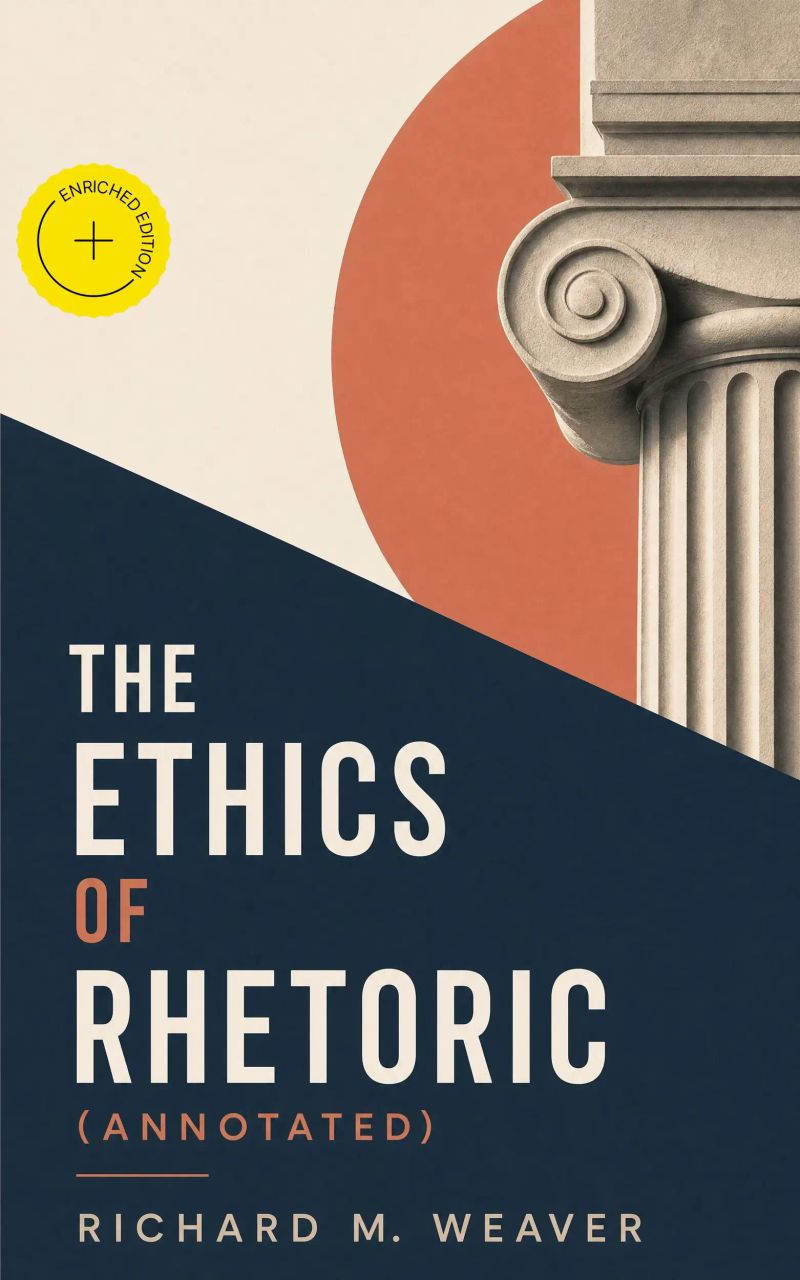
The ethics of rhetoric (Annotated)
Enriched Edition. Moral Persuasion, Classical Rhetoric, and the Ethics of Public LanguageBy Richard M. Weaver


Length9h 36m
About this audiobook
Richard M. Weaver's The Ethics of Rhetoric is a rigorous inquiry into persuasion as a moral art rather than a merely technical instrument. Moving from Plato's Phaedrus to modern public discourse, Weaver distinguishes rhetoric that leads the soul toward truth from rhetoric that manipulates appetite and circumstance. His style is aphoristic, classical, and polemically elegant, joining close textual analysis with cultural criticism. Especially influential are his discussions of "god terms" and "devil terms," and his hierarchy of arguments, where definition embodies the highest appeal to order. Weaver, an American literary critic and rhetorician associated with the University of Chicago, wrote from the standpoint of a humanist alarmed by modernity's erosion of metaphysical and linguistic standards. A Southern Agrarian and the author of Ideas Have Consequences, he believed that public language reveals a civilization's moral condition. His training in literature, philosophy, and classical rhetoric informs the book's insistence that style, argument, and ethical vision cannot be separated. This book is recommended for readers interested in rhetoric, political language, conservative thought, or the moral responsibilities of communication. It remains valuable not because it offers a neutral handbook, but because it asks what persuasion is for, and what kind of person or society it forms.
This enriched edition has been carefully crafted to add value to your reading experience.
- A succinct Introduction situates the work's timeless appeal and themes.
- The Synopsis outlines the central plot, highlighting key developments without spoiling critical twists.
- A detailed Historical Context immerses you in the era's events and influences that shaped the writing.
- A thorough Analysis dissects symbols, motifs, and character arcs to unearth underlying meanings.
- Reflection questions prompt you to engage personally with the work's messages, connecting them to modern life.
- Hand‐picked Memorable Quotes shine a spotlight on moments of literary brilliance.
- Interactive footnotes clarify unusual references, historical allusions, and archaic phrases for an effortless, more informed read.
Audiobook details
Rating★★★★ 4.3 (1.1K)
Includes Goodreads, Amazon, LibraryThing, StoryGraph
GenreOther
Length9 hrs 36 mins
Narrated byListen with 1,000+ voices
FormateBook with Audio
Publish dateDec 6, 2023
LanguageEnglish
Table of contents
1The ethics of rhetoric (Annotated)
2Introduction
3Synopsis
4Historical Context
5Chapter I THE PHAEDRUS AND THE NATURE OF RHETORIC
Show all chaptersShow less
6Chapter II DIALECTIC AND RHETORIC AT DAYTON, TENNESSEE
7Chapter III EDMUND BURKE AND THE ARGUMENT FROM CIRCUMSTANCE
8Chapter IV ABRAHAM LINCOLN AND THE ARGUMENT FROM DEFINITION
9Chapter V SOME RHETORICAL ASPECTS OF GRAMMATICAL CATEGORIES
10The Noun
11The Adjective
12The Adverb
13The Verb
14The Conjunction
15The Preposition
16The Phrase
17In Conclusion
18Chapter VI MILTON’S HEROIC PROSE
19Chapter VII THE SPACIOUSNESS OF OLD RHETORIC
20Chapter VIII THE RHETORIC OF SOCIAL SCIENCE
21I
22II
23III
24IV
25V
26VI
27Chapter IX ULTIMATE TERMS IN CONTEMPORARY RHETORIC
28Footnote
29Analysis
30Reflection
31Memorable Quotes
More from Richard M. Weaver


Mere ChristianityC. S. Lewis7h 7m4.4 (519.7K)$24 · $0.00

Her Daily BreadKate Wood12h 57m4.6 (153)$33 · $0.00
The Holy Bible - 1 SamuelKing James2h 13m4.8 (1.6K)$3 · $0.00
The American Standard Bible — The Gospel of MatthewMatthew3h 56m4.7 (3K)$2 · $0.00

Bad Fat Black GirlSesali Bowen6h 32m4.7 (2.8K)$24 · $0.00
The King James Audio Bible New Testament CompleteChristopher Glyn20h 2m4.7 (2.6K)$12 · $0.00
Faiths CheckbookCharles Spurgeon12h 44m4.7 (3.2K)$11 · $0.00

Ten Things I Wish You Knew About Your Child's Mental HealthDr. Billy Garvey4h 53m4.7 (2.4K)$20 · $0.00

Designing Terry Pratchett’s DiscworldPaul Kidby3h 52m4.7 (343)$20 · $0.00
The Chosen Book OneAmanda Jenkins, Kristen Hendricks, Dallas Jenkins3h 8m4.6 (4.9K)$10 · $0.00
The Lives of BrianBrian Johnson9h 45m4.6 (3.5K)$29 · $0.00
Expository Thoughts on the Gospel of LukeJ.C. Ryle27h 13m4.7 (536)$18 · $0.00

CrossroadsKaleb Dahlgren7h 56m4.6 (4.9K)$26 · $0.00

Across the RiverKent Babb11h 40m4.6 (927)$29 · $0.00

Brain Training for RidersAndrea Monsarrat Waldo5h 56m4.7 (550)$19 · $0.00

My Effin' LifeGeddy Lee17h 11m4.6 (13.1K)$40 · $0.00
Kings and PawnsHoward Bryant10h 9m4.6 (678)$29 · $0.00

The Elementia Chronicles #2: The New OrderSean Fay Wolfe11h 17m4.6 (841)$29 · $0.00
The ActsLuke2h 55m4.6 (19.7K)$12 · $0.00
New Testament - Easy NavigationWorld English Bible19h 35m4.6 (1.3K)$1.30 · $0.00
You may also like
The RepublicPlato13h 29m4.1 (283K)$4 · $0.00
CAPITAL (All 3 Books)Karl Marx92h 37m4.5 (16.5K)$2.99 · $0.00
Off with Her HeadEleanor Herman10h 58m4.0 (3.5K)$29 · $0.00
The Republican BrainChris Mooney10h 54m3.8 (1.8K)$23 · $0.00

A Room of One's Own & Three GuineasVirginia Woolf12h 51m4.3 (8.5K)$1 · $0.00

White GuiltShelby Steele5h 28m4.3 (3.6K)$24 · $0.00

Psychology of CrowdsGustave le Bon6h 21m3.9 (26.8K)$3.50 · $0.00

THREE GUINEASVirginia Woolf9h 29m4.0 (7.7K)$2.99 · $0.00
LeviathanThomas Hobbes22h 57m4.0 (64.7K)$1.20 · $0.00

The Ego and His OwnMax Stirner16h 36m4.2 (5.9K)$2 · $0.00

The Nature of the Judicial ProcessBenjamin N. Cardozo3h 39m4.1 (365)$20
America's Cultural RevolutionChristopher F. Rufo11h 24m4.5 (3.9K)$29 · $0.00
PropagandaJacques Ellul15h 36m4.3 (4.7K)$23 · $0.00
SpeechlessMichael Knowles8h 24m4.4 (6.3K)$20
The Psychic Soviet, and Other WorksIan F. Svenonius6h 8m4.3 (536)$17 · $0.00
EssaysGeorge Orwell1h 44m4.5 (14.5K)$2 · $0.00

Three GuineasVirginia Woolf6h 7m4.1 (9.2K)$1.20 · $0.00
A Mencken ChrestomathyH. L. Mencken26h 35m4.2 (1.6K)$30

Myths of GeographyPaul Richardson8h 10m3.5 (573)$26 · $0.00
A Miscellany of MenG. K. Chesterton5h 32m4.0 (495)$2.30