

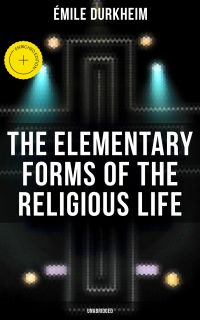
The Elementary Forms of the Religious Life (Annotated)
Enriched Edition. A Classic Study of Totemism, the Sacred and Profane, Ritual, and Collective Social LifeBy Émile Durkheim


Length25h 26m
About this audiobook
In The Elementary Forms of the Religious Life, Émile Durkheim offers a foundational sociological account of religion by examining Australian Aboriginal totemism, which he regarded as the simplest observable form of religious organization. Written in a lucid yet rigorously argumentative style, the work distinguishes the sacred from the profane and argues that religious symbols express, in transfigured form, the collective life of society itself. Situated within the emergence of modern social science, it is both an anthropological interpretation and a philosophical inquiry into knowledge, ritual, and social cohesion. Durkheim, one of the principal architects of sociology, wrote at a time when European intellectual life was grappling with secularization, individualism, and the authority of scientific explanation. His earlier studies of social facts, division of labor, and suicide prepared him to see religion not merely as belief, but as a system of practices through which communities generate moral order. His Jewish background, republican commitments, and academic mission to establish sociology as a discipline all inform the book's ambitions. This book is essential for readers interested in sociology, anthropology, religious studies, or social theory. Though some ethnographic assumptions are now contested, Durkheim's central insights into ritual, symbolism, and collective identity remain profoundly influential.
This enriched edition has been carefully crafted to add value to your reading experience.
- A succinct Introduction situates the work's timeless appeal and themes.
- The Synopsis outlines the central plot, highlighting key developments without spoiling critical twists.
- A detailed Historical Context immerses you in the era's events and influences that shaped the writing.
- An Author Biography reveals milestones in the author's life, illuminating the personal insights behind the text.
- A thorough Analysis dissects symbols, motifs, and character arcs to unearth underlying meanings.
- Reflection questions prompt you to engage personally with the work's messages, connecting them to modern life.
- Hand‐picked Memorable Quotes shine a spotlight on moments of literary brilliance.
- Interactive footnotes clarify unusual references, historical allusions, and archaic phrases for an effortless, more informed read.
Audiobook details
GenrePsychology
Length25 hrs 26 mins
Narrated byListen with 1,000+ voices
FormateBook with Audio
Publish dateNov 1, 2018
LanguageEnglish
Table of contents
1The Elementary Forms of the Religious Life (Annotated)
2Introduction
3Synopsis
4Historical Context
5Author Biography
Show all chaptersShow less
6INTRODUCTION SUBJECT OF OUR STUDY: RELIGIOUS SOCIOLOGY AND THE THEORY OF KNOWLEDGE
7BOOK I PRELIMINARY QUESTIONS
8CHAPTER I DEFINITION OF RELIGIOUS PHENOMENA AND OF RELIGION
9CHAPTER II LEADING CONCEPTIONS OF THE ELEMENTARY RELIGION
10CHAPTER III LEADING CONCEPTIONS OF THE ELEMENTARY RELIGION —continued
11CHAPTER IV TOTEMISM AS AN ELEMENTARY RELIGION
12BOOK II THE ELEMENTARY BELIEFS
13CHAPTER I TOTEMIC BELIEFS
14CHAPTER II TOTEMIC BELIEFS —continued
15CHAPTER III TOTEMIC BELIEFS —continued
16CHAPTER IV TOTEMIC BELIEFS —end
17CHAPTER V ORIGINS OF THESE BELIEFS
18CHAPTER VI ORIGINS OF THESE BELIEFS —continued
19CHAPTER VII ORIGINS OF THESE BELIEFS —end
20CHAPTER VIII THE IDEA OF THE SOUL
21CHAPTER IX THE IDEA OF SPIRITS AND GODS
22BOOK III THE PRINCIPAL RITUAL ATTITUDES
23CHAPTER I THE NEGATIVE CULT AND ITS FUNCTIONS THE ASCETIC RITES
24CHAPTER II THE POSITIVE CULT
25CHAPTER III THE POSITIVE CULT — continued
26CHAPTER IV THE POSITIVE CULT — continued
27CHAPTER V PIACULAR RITES AND THE AMBIGUITY OF THE NOTION OF SACREDNESS
28CONCLUSION
29Analysis
30Reflection
31Memorable Quotes
More from Émile Durkheim


What to Make of a LifeJim Collins13h 31m4.4 (794)$33 · $0.00

I Am The StormJanice Dean9h4.6 (1.5K)$8 · $0.00

On Democracies and Death CultsDouglas Murray10h 38m4.6 (6.5K)$29 · $0.00

TerraformPropaganda5h 39m4.7 (594)$24 · $0.00

Southern Horrors: Lynch Law in All Its Phases (Annotated)Ida B. Wells-Barnett2h 44m4.6 (1.3K)$2 · $0.00

Hour of the HeartIrvin D. Yalom, Benjamin Yalom8h 19m4.6 (2.3K)$26 · $0.00

Braving the TruthRachel Held Evans11h 31m4.7 (359)$29 · $0.00
Level UpRob Dial7h 42m4.6 (3.3K)$26 · $0.00

As a JewSarah Hurwitz8h 36m4.6 (1.2K)$26 · $0.00

Saint Joan (Annotated)George Bernard Shaw6h 20m4.6 (1.2K)$1.20 · $0.00

Burn the HaystackJennie Young, PhD9h 30m4.6 (543)$29 · $0.00

Woman and the New Race (Annotated)Margaret Sanger6h 30m4.6 (1K)$0.99 · $0.00

Good InsideBecky Kennedy9h 55m4.5 (59.3K)$29 · $0.00

The Mis-Education of the NegroCarter Godwin Woodson5h 4m4.5 (29.4K)$1.20 · $0.00

Du Bois: EssaysW.E.B. Du Bois6h 22m4.6 (1.5K)$1 · $0.00

The North American Indian (Illustrated Edition)Edward S. Curtis, Frederick Webb Hodge5h 59m4.6 (1.4K)$2 · $0.00

Valley of the BirdtailAndrew Stobo Sniderman, Douglas Sanderson10h 1m4.6 (2.4K)$29 · $0.00

Lies My Therapist Told MeGreg E. Gifford9h 3m4.6 (503)$29 · $0.00

Disturbed in Their NestsAlephonsion Deng, Judy A. Bernstein11h 22m4.6 (595)$23 · $0.00
No Name in the StreetJames Baldwin5h4.5 (8.5K)$20 · $0.00
You may also like
The Golden Verses of PythagorasAntoine Fabre d'Olivet8h 38m4.2 (269)$2.30
The Corpus HermeticumG. R. S. Mead3h 34m4.3 (1.7K)$4.10 · $0.00

The Kojiki, or Records of Ancient MattersAnonymous1h 20m4.0 (6.1K)$2 · $0.00
Myths and Legends of Ancient Greece and Rome E. M. Berens11h 1m3.9 (3.4K)Free

The Night Before Christmas (Illustrated Edition)Clement Clarke Moore1h 38m4.5 (155.7K)$1.99 · $0.00

The Younger EddaSnorri Sturluson4h 16m4.2 (21.6K)Free

Pinkalicious: Fairy HouseVictoria Kann6m4.2 (1.6K)$4 · $0.00
The Grand Grimoire with the Great Clavicle of SolomonUnknown Unknown1h 26m4.2 (628)$3.50 · $0.00

The Kabbalah - Collected BooksJ. Abelson, Nurho de Manhar, Bernhard Pick, S. L. MacGregor Mathers, W. W. Westcot36h 23m4.3 (271)$2 · $0.00
I CHING (The Book of Changes)Anonymous16h 33m4.4 (31.4K)$1.99 · $0.00

Bantu Beliefs and MagicC. W. Hobley10h 6m$2.30
A Letter from Santa ClausMark Twain5m3.1 (152)$2 · $0.00
Serpent-Worship, and Other Essays, with a Chapter on TotemismC. Staniland Wake7h 51m$1 · $0.00

The Eternal Belief in Immortality & Worship of the DeadJames George Frazer37h 7m4.1 (28)$1.99 · $0.00
Myth, Ritual and Religion (Summarized Edition)Andrew Lang5h 38m$2
Collectanea Hermetica (Volumes 1-10) (Annotated)William Wynn Westcott18h 29m4.5 (30)$2 · $0.00

Melodies of Praise: 6 Classic Hymn Books for Congregational PraiseIsaac Watts, Edmund S. Lorenz66h 9m$0.99 · $0.00

Haiti: Its dawn of progress after years in a night of revolutionJohn Dryden Kuser56m$2 · $0.00
The Occult Significance of BloodRudolf Steiner1h 4m4.1 (239)$4.70 · $0.00

There is no Religion Higher than the Truth (Annotated)Helena Blavatsky183h 24m4.6 (12)$1.99 · $0.00