
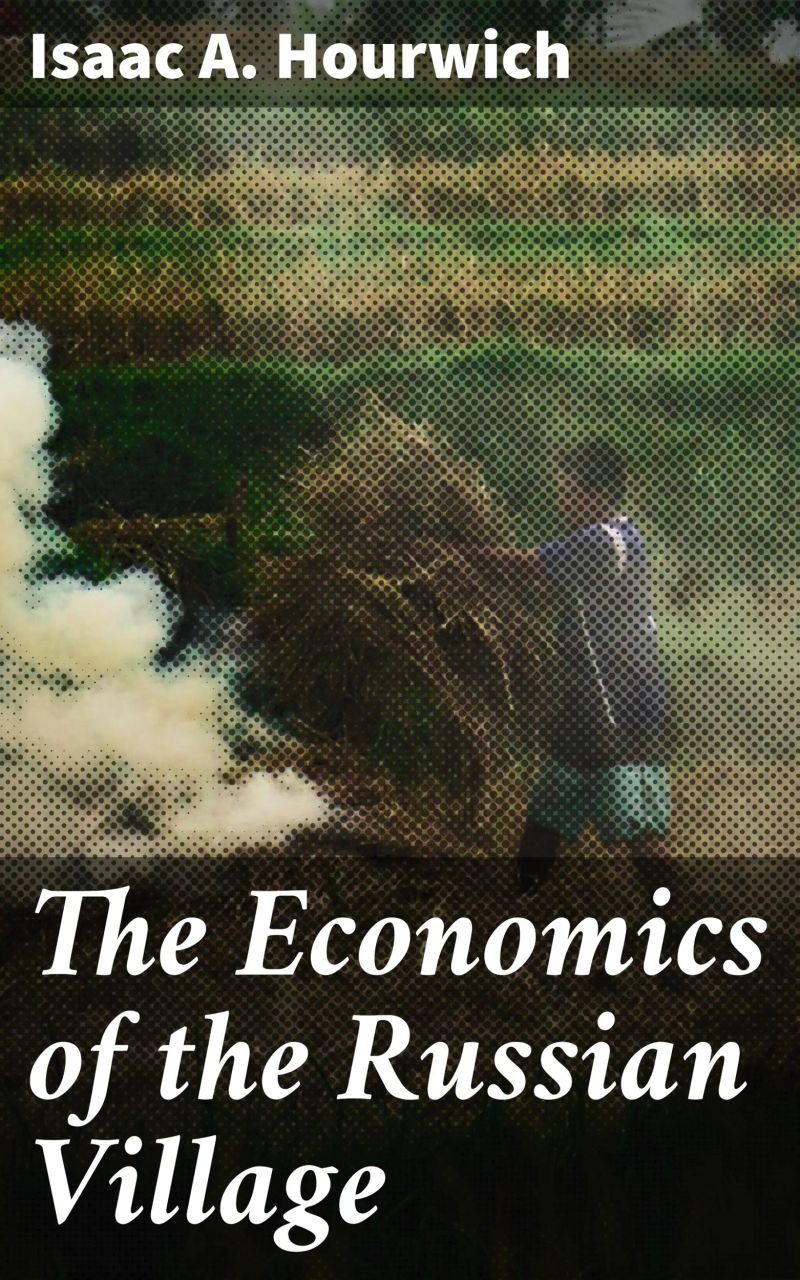
The Economics of the Russian Village
Unveiling the Rural Economies of Pre-Revolutionary RussiaBy Isaac A. Hourwich


Length5h 41m
About this audiobook
In 'The Economics of the Russian Village,' Isaac A. Hourwich delivers a comprehensive analysis of the socio-economic structures of rural Russia during the late 19th and early 20th centuries. Employing a meticulous blend of statistical evidence and ethnographic insight, Hourwich intricately examines the village economy, agrarian practices, and the intricate relationships among land, labor, and capital. His literary style is characterized by clarity and rigor, emphasizing a systematic approach that allows readers to grasp the complexities of agrarian life against the backdrop of emerging industrialization, making it a seminal work in agricultural economics and rural sociology. Hourwich, a scholar originally trained in the social sciences, was deeply influenced by the transformative historical context of his time, particularly the socio-economic upheavals in Russia. His background, reprising themes of migration and development, likely propelled him to explore the dynamics of Russian village life, seeking to understand both its economic systems and its place within broader societal changes. His expertise affords the book an authoritative voice, drawing from both empirical data and historical narrative. This meticulously researched work is essential for scholars of Russian history, economics, and sociology. Readers interested in the interplay of tradition and modernization in agrarian societies will find Hourwich'Äôs insights invaluable. 'The Economics of the Russian Village' not only informs but also challenges contemporary perspectives on rural economics, making it a critical addition to any academic library.
Audiobook details
GenreBusiness and Economics
Length5 hrs 41 mins
Narrated byListen with 1,000+ voices
FormateBook with Audio
Publish dateDec 19, 2019
LanguageEnglish
Table of contents
1INTRODUCTION. THE RISE OF “PEASANTISM.”
2CHAPTER I. GENERAL SKETCH OF THE DEVELOPMENT OF LANDHOLDING IN RUSSIA.
3CHAPTER II. COMMUNITY OF LAND.
4CHAPTER III. THE PRODUCTIVE FORCES OF THE PEASANTRY.
5CHAPTER IV. TAXATION OF THE PEASANT.
Show all chaptersShow less
6CHAPTER V. COMMUNAL TENURE AND SMALL HOLDINGS.
7CHAPTER VI. THE EVOLUTION OF THE FARMER INTO THE AGRICULTURAL LABORER.
8CHAPTER VII. THE WAGES IN THE RURAL DISTRICTS.
9CHAPTER VIII. THE RURAL SURPLUS POPULATION.
10CHAPTER IX. THE DISSOLUTION OF THE PATRIARCHAL FAMILY.
11CHAPTER X. THE MODERN AGRICULTURAL CLASSES.
12CHAPTER XI. INDIVIDUAL OWNERSHIP AND AGRARIAN COMMUNISM.
13CHAPTER XII. THE REDIVISION OF THE COMMUNAL LAND.: NOTE TO CHAPTER XII., THE “INALIENABILITY” SCHEME.
14CHAPTER XIII. AGRICULTURE ON A LARGE SCALE.
15CHAPTER XIV. CONCLUSION: THE CONSEQUENCES OF THE FAMINE.
16APPENDICES. STATISTICAL TABLES.
17TABLE I.—Distribution of Land Among the Several Sections of the Peasant Population.
18TABLE I, a.
19TABLE II.—Taxation of the Peasantry.
20TABLE III.—Arrears in Taxes.
21TABLE IV.—Distribution of Rented Land.
22TABLE V. BUDGETS OF TYPICAL PEASANT HOUSEHOLDS.
23I. Gabriel Michea’s (son) Trupoff, village Sukmanka, bailiwick (volost) Sukmanka.
24II. Kosma Abramoff, village Michaïlovka, bailiwick Nicholo-Kabañ yevskaya.
25III. Capiton Popoff, village Pavlovka, bailiwick Pavlodarovka.
26TABLE VI.—Wages of the Peasant in Industrial Employment.
27TABLE VII.—Average Yields of Wheat (District of Voronezh).
28BRITISH ECONOMIC ASSOCIATION.
29Council:
30Correspondents:
31AMERICAN ECONOMIC ASSOCIATION.
32PUBLICATIONS.
33CONTENTS OF VOLUMES.
34THE Economic Review.
35THE JOHNS HOPKINS PRESS.
36Systematic Political Science BY THE UNIVERSITY FACULTY OF POLITICAL SCIENCE OF COLUMBIA COLLEGE.

Never Split the DifferenceChris Voss, Tahl Raz8h 7m4.4 (277.7K)$26 · $0.00
The Intelligent Investor Rev Ed.Benjamin Graham17h 48m4.3 (191.5K)$40 · $0.00
The Hard Thing About Hard ThingsBen Horowitz7h 57m4.2 (134.3K)$26 · $0.00
Boundaries for LeadersHenry Cloud7h 36m4.3 (3.6K)$26 · $0.00

Eat It!Jordan Syatt, Michael Vacanti4h 40m4.6 (1.5K)$20 · $0.00

Progress and Poverty, Volumes I and II (Annotated)Henry George19h 21m4.6 (574)$0.99 · $0.00

Not Everything Counts but Everything Matters: The powerful and inspirational new book about leadership and achieving success from the visionary multi-premiership winning Panthers coachIvan Cleary6h 1m4.6 (680)$24 · $0.00
BuildTony Fadell11h 5m4.5 (14.3K)$8 · $0.00
The Joys Of CompoundingGautam Baid17h 34m4.5 (2.5K)$18 · $0.00
Basic EconomicsThomas Sowell18h 32m4.5 (29.3K)$28 · $0.00

Poor Charlie’s AlmanackGrover Gardener, Charles T. Munger13h 9m4.5 (24.7K)$18 · $0.00

The Ambuja StoryNarotam Sekhsaria13h 59m4.5 (830)$33 · $0.00

The Secret Door to SuccessFlorence Scovel Shinn2h 25m4.5 (2.1K)$1.20 · $0.00

This Is Going to HurtAdam Kay5h 47m4.4 (444.7K)$24 · $0.00

Big TrustShadé Zahrai, Fayçal Sekkouah8h 36m4.6 (406)$26 · $0.00
The Intelligent Investor Third EditionBenjamin Graham, Jason Zweig20h4.4 (156.6K)$46 · $0.00

Bottle of LiesKatherine Eban14h 25m4.4 (12K)$33 · $0.00

The Antiracist Business BookTrudi Lebrón6h 10m4.6 (275)$17 · $0.00

The FormulaJoshua Robinson, Jonathan Clegg10h 41m4.4 (6.9K)$29 · $0.00

Let Them LeadJohn U. Bacon7h 10m4.5 (1.4K)$24 · $0.00
You may also like

Germinal (Historical Novel)Émile Zola21h 14m4.3 (58.9K)$1.99 · $0.00

The Village (Annotated)Ivan Bunin9h 14m3.9 (2.3K)$0.99 · $0.00

Forty AutumnsNina Willner10h 5m4.4 (18.6K)$29 · $0.00
Weapons of the WeakJames C. Scott17h 11m4.3 (1K)$30

The Last HoursMinette Walters15h 29m4.0 (14.7K)$7 · $0.00

A History of the FutureJames Howard Kunstler11h 49m4.0 (2.3K)$20

The Souls Of Black FolkW. E. B. Du Bois7h 34m4.3 (50.1K)$2.30

In Defense of the Second AmendmentLarry Correia6h 50m4.6 (866)$17

Tethered to Other StarsElisa Stone Leahy8h 39m4.5 (508)$26 · $0.00

The MandiblesLionel Shriver13h 46m3.8 (13K)$33 · $0.00

The Complete Works of Elizabeth Gaskell (Illustrated)Elizabeth Gaskell211h 46m4.3 (2K)$1 · $0.00

Radio Free AfghanistanSaad Mohseni, Jenna Krajeski10h 27m4.4 (388)$29 · $0.00
How Green Was My ValleyRichard Llewellyn16h 23m4.3 (22.8K)$28

Kingdom of Olives and AshMichael Chabon, Ayelet Waldman16h 5m4.3 (760)$33 · $0.00

English Society in the Eighteenth CenturyRoy Porter16h3.9 (651)$28
Susanna WesleyKathy McReynolds3h 10m4.2 (222)$12

Life in a Railway FactoryAlfred Williams11h 15m4.1 (14)$1 · $0.00

The White Slaves of EnglandJohn C. Cobden17h 26m$0.99 · $0.00
BOUND IN CHAINSGrace Catherine Worthington4h 49m$9 · $0.00

Saving Main StreetGary Rivlin12h 45m4.1 (86)$33 · $0.00