
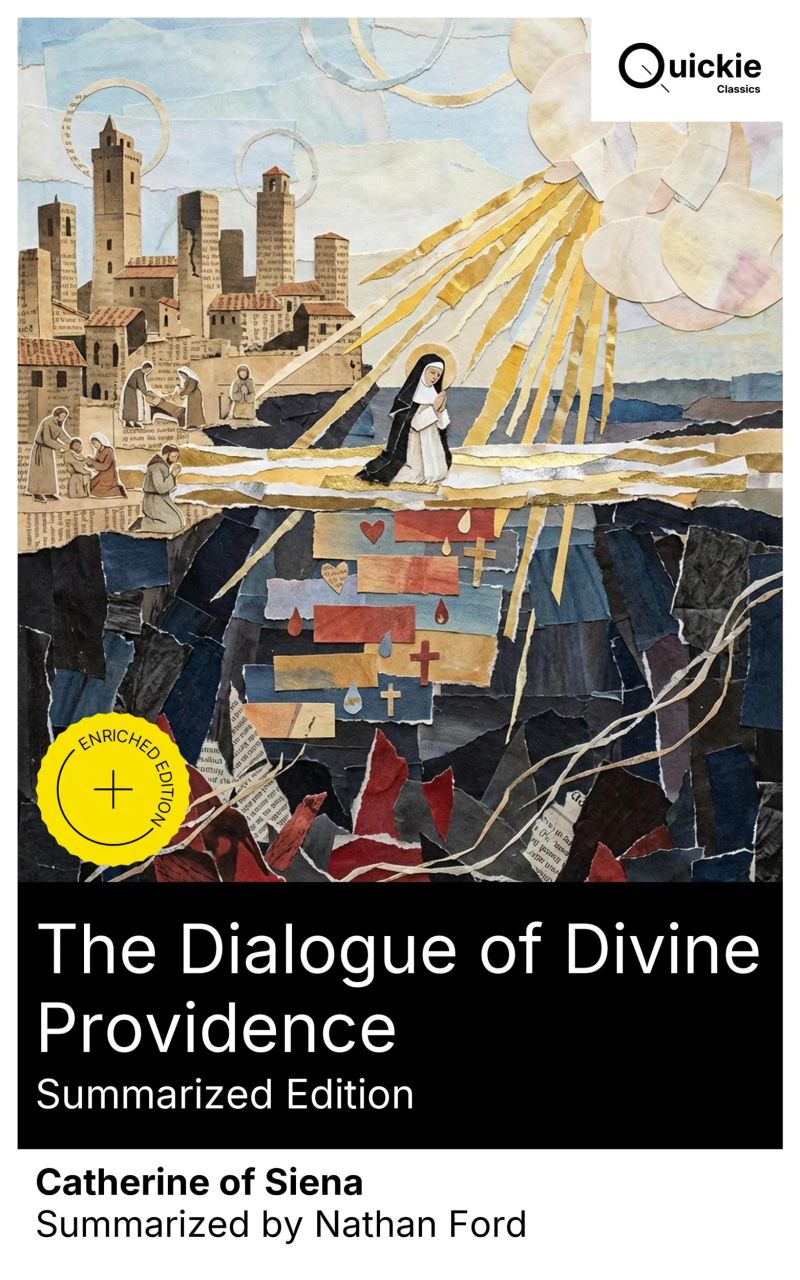
The Dialogue of Divine Providence (Summarized Edition)
Enriched edition. A Spiritual Treatise of Italian Mysticism: Godly Revelations, Divine Ecstasy, and the Path to Eternal SalvationBy Catherine of Siena


Length3h 44m
About this audiobook
The Dialogue of Divine Providence is Catherine of Siena's daring synthesis of mystical theology and pastoral counsel, staged as a conversation in which God the Father instructs a soul in grace, virtue, and the governance of the Church. In four treatises it unfolds the Bridge of Christ, the "cell" of self-knowledge, and the ladder of charity, treating sin, penance, freedom, and providence in vernacular Tuscan with Dominican, biblically saturated, catechetical intensity. Catherine (1347–1380), a Dominican tertiary from Siena, tended plague victims, exhorted princes, and urged Gregory XI to return from Avignon. Dictating the Dialogue in rapt prayer to secretaries under Raymond of Capua, she transposed her mystical marriage, hidden stigmata, and sorrow over clerical laxity into doctrine, wedding contemplative fire to urgent calls for ecclesial reform. Scholars of medieval spirituality, theologians, and serious seekers will find here a demanding yet consoling school of discernment. Read slowly, it marries luminous images to exacting moral counsel, making complex doctrine livable. As study text or guide for prayer, it remains a classic of sanctity under the sign of providence.
Quickie Classics summarizes timeless works with precision, preserving the author's voice and keeping the prose clear, fast, and readable—distilled, never diluted. Enriched Edition extras: Introduction · Synopsis · Historical Context · Author Biography · Brief Analysis · 4 Reflection Q&As · Editorial Footnotes.
Audiobook details
Rating★★★★★ 4.6 (129)
Includes Amazon, Goodreads
GenreSpirituality and Religion
Length3 hrs 44 mins
Narrated byListen with 1,000+ voices
FormateBook with Audio
Publish dateJan 10, 2026
LanguageEnglish
Table of contents
1Introduction
2Introduction
3Synopsis
4Historical Context
5Author Biography
Show all chaptersShow less
6The Dialogue of Divine Providence (pt. 1)
7The Dialogue of Divine Providence (pt. 2)
8Analysis
9Reflection
More from Catherine of Siena

The Holy Qur-an: Text, Translation and CommentaryAbdullah Yusuf Ali22h 16m4.7 (133K)$1 · $0.00

All of Grace (Annotated)Charles Spurgeon5h 1m4.7 (1.3K)$1.99 · $0.00

Steps to ChristEllen G. White3h 12m4.7 (13.8K)$2 · $0.00
The Doctrine and Selected CovenantsJoseph Smith13h 53m4.7 (10.4K)$1.99 · $0.00

Sinners in the Hands of an Angry God & Other Sermons (Annotated)Jonathan Edwards7h 51m4.7 (1.5K)$2 · $0.00

Swayam Ki AwaazPrem Rawat8h 34m4.7 (1.1K)$26 · $0.00

Behind the BadgeAdam Davis10h 18m4.7 (2.7K)$10 · $0.00
The New Human Revolution, vol. 1Daisaku Ikeda7h 46m4.7 (669)$12 · $0.00

You Are Worth ItKyle Carpenter, Don Yaeger8h 53m4.7 (4.8K)$29 · $0.00
Praying GraceDavid A. Holland3h 2m4.7 (658)$10 · $0.00

Evidence Not SeenDarlene Deibler Rose11h 11m4.6 (11.9K)$29 · $0.00
The Christ KeyChad Bird, Chad Bird7h 33m4.7 (592)$17.40 · $0.00

He and IGabrielle Bossis10h 12m4.7 (554)$17 · $0.00
Your Body Already KnowsNidhi Pandya Bhanshali9h 7m4.7 (360)$16 · $0.00

The Complete WorksFlorence Scovel Shinn7h 59m4.6 (6.6K)$2 · $0.00

Driven by EternityJohn Bevere3h 50m4.6 (3.2K)$10 · $0.00
Spiritual AnatomyDaaji Kamlesh D. Patel9h 47m4.7 (319)$29 · $0.00
The Mahabharata of Krishna-Dwaipayana Vyasa Translated into English ProseAnonymous8h 1m4.7 (1.9K)$2 · $0.00
The Chosen Book OneAmanda Jenkins, Kristen Hendricks, Dallas Jenkins3h 8m4.6 (4.9K)$10 · $0.00

The Grace MessageAndrew Farley8h 49m4.7 (433)$20 · $0.00
You may also like

DhammapadaAnonymous1h 35m4.4 (41K)$1.99 · $0.00

Songs of Kabir (Annotated)Kabir3h 7m4.2 (1.1K)$2 · $0.00

On Loving GodSaint Bernard Of Clairvaux1h 41m4.3 (2.1K)$10 · $0.00

Charity and Its Fruits (Annotated)Jonathan Edwards12h 39m4.6 (474)$2 · $0.00
The Root of the RighteousA. W. Tozer4h 21m4.6 (1.3K)$2 · $0.00

The Pursuit of GodA. W. Tozer3h 38m4.4 (96.8K)$2 · $0.00

Meister Eckhart’s Book of SecretsJon M. Sweeney, Mark S. Burrows2h 6m4.2 (530)$15

The Dialogue of Divine Providence (Annotated)Catherine of Siena10h 50m4.5 (1.4K)$2 · $0.00

The Pursuit of God (Religious Classic)A. W. Tozer3h 49m4.4 (130.7K)$1.99 · $0.00

Power Through PrayerEdward M. Bounds3h 1m4.5 (3.2K)$1 · $0.00

Pastoral Care (Annotated)Pope Gregory I8h 41m4.3 (1.9K)$2 · $0.00

The Deeper Christian Life (Annotated)Andrew Murray3h 20m4.4 (2.5K)$2 · $0.00

Thoughts From the Mount of Blessing (Annotated)Ellen G. White6h 16m4.7 (1.3K)$2 · $0.00

Prevailing Prayer: What Hinders It?Dwight Lyman Moody4h 34m4.6 (1.2K)$1 · $0.00

Union and Communion; or, Thoughts on the Song of SolomonJames Hudson Taylor2h 35m4.4 (377)$2 · $0.00
Meister Eckhart's SermonsMeister Eckhart1h 25m4.3 (435)$4 · $0.00

Sinners in the Hands of an Angry GodJonathan Edwards8h 34m3.9 (6.3K)$1 · $0.00
Humility: The Beauty of HolinessAndrew Murray2h 8m4.5 (14.3K)$2 · $0.00

Sermons of Meister Eckhart (Annotated)Meister Eckhart2h 3m4.5 (24)$2 · $0.00

The Pursuit of the Devine: A. W. Tozer CollectionA. W. Tozer17h 12m$1 · $0.00