
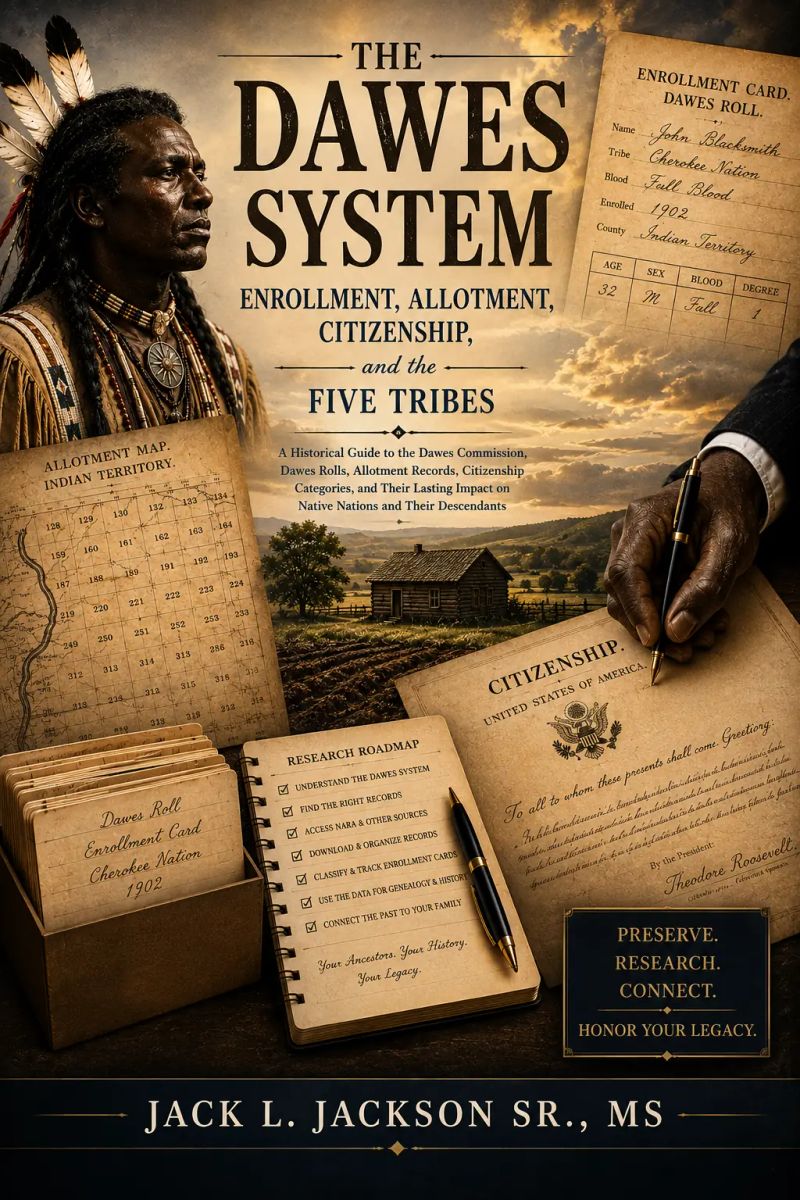
The Dawes System: Enrollment, Allotment, Citizenship, and the Five Tribes
A Historical Guide to the Dawes Commission, Tribal Enrollment, Freedmen Records, and the Allotment EraBy Jack L. Jackson Sr., MS


Length1h 25m
About this audiobook
A clear historical guide to the Dawes Commission, Dawes Rolls, enrollment cards, allotment, citizenship, Freedmen records, and the Five Tribes, with emphasis on how the system worked and how its records can be used for historical and genealogical research.
Audiobook details
Rating★★★★★ 5.0 (1)
GenreEducation and Learning
Length1 hr 25 mins
Narrated byListen with 1,000+ voices
FormateBook with Audio
Publish dateAug 8, 2026
LanguageEnglish
Table of contents
1The Dawes System
2Executive Summary: Five points to remember before using the records
3Plain-English Introduction: What Does “Dawes” Mean?
4Henry L. Dawes
5The Dawes Act of 1887
Show all chaptersShow less
6The Dawes Commission
7Chapter 1. Origins of Allotment and the Creation of the Commission
81.1 The late nineteenth-century allotment movement
91.2 Why the Five Tribes were initially different
101.3 Section 16 of the Act of March 3, 1893
111.4 From persuasion to federal compulsion
12Major legal steps, 1887-1914
13Chapter 2. The Five Tribes: Why Enrollment and Allotment Differed
14Cherokee
15Choctaw
16Chickasaw
17Muscogee (Creek)
18Seminole
19Comparison table
20Chapter 3. The Actual Enrollment Process, Step by Step
211. A person came forward - or was identified
222. The applicant was sworn and questioned
233. A family census/enrollment card was created
244. Earlier rolls and tribal law were checked
255. Tribal representatives could object or assist
266. Witnesses and documents were received
277. Commission staff investigated
288. The case received a status
299. Decisions moved upward
3010. Appeals or special litigation could occur
3111. Approved names entered final rolls
3212. The enrollee selected or received land
33Rejected does not mean “no Native ancestry”
34Doubtful cases
35Chapter 4. Record Types and How They Connect: The identifier crosswalk
36Chapter 5. Dawes Enrollment Categories: Historical Meaning
37Citizens by Blood (BB)
38Minor Citizens by Blood (M)
39Newborn Citizens by Blood (NB)
40Freedmen (F)
41Minor Freedmen (FM)
42Newborn Freedmen (FNB)
43Intermarried White / Citizen by Marriage (IW or IM)
44Mississippi Choctaw
45Adopted (A)
46Doubtful / Denied (D)
47Rejected (R)
48Freedmen Denied/Doubtful (FD) and Freedmen Rejected (FR)
49Blood degree: what it can and cannot tell you
50Chapter 6. Freedmen of the Five Tribes

A Brief History of IntelligenceMax S. Bennett12h 18m4.6 (6.6K)$29 · $0.00

HomeschooledStefan Merrill Block7h 10m3.6 (18.5K)$28 · $0.00

How We ThinkJohn Dewey7h 6m4.0 (1.1K)Free

Parents and Children (Annotated)Charlotte Mason9h 23m4.6 (988)$2 · $0.00

Children Under FireJohn Woodrow Cox10h 17m4.5 (1.6K)$29 · $0.00

The State Must ProvideAdam Harris7h 15m4.5 (775)$24 · $0.00

The Call of the Wild and FreeAinsley Arment9h 7m4.4 (21.2K)$29 · $0.00
The Freelance WayRobert Vlach19h 48m4.5 (528)$40 · $0.00
Race to the BottomLuke Rosiak9h 20m4.5 (600)$29 · $0.00

They Came for the SchoolsMike Hixenbaugh9h 5m4.5 (2.6K)$8 · $0.00
Find Me UnafraidKennedy Odede, Jessica Posner11h 11m4.5 (2.7K)$29 · $0.00

Asking for ItKate Harding8h 55m4.4 (5.3K)$20 · $0.00
Defining Moments in Black HistoryDick Gregory7h 37m4.4 (6K)$26 · $0.00
The Emerald Tablets of Thoth the AtlanteanMaurice Doreal3h 4m4.4 (8.8K)$6 · $0.00

Learning AmericaLuma Mufleh6h 37m4.4 (564)$24 · $0.00
Math-ishJo Boaler7h 21m4.4 (588)$24 · $0.00
It Worked For MeColin Powell7h 42m4.3 (9.8K)$26 · $0.00

Little SoldiersLenora Chu11h 30m4.3 (3.1K)$29 · $0.00

Financial FeministTori Dunlap8h 3m4.2 (22.2K)$8 · $0.00

Grammar-land; Or, Grammar in Fun for the Children of Schoolroom-shireM. L. Nesbitt2h 36m4.4 (487)$1 · $0.00
You may also like

Clotel, or The President's DaughterWilliam Wells Brown6h 2m3.7 (3.4K)$2.30

A Woman Like HerSanam Maher9h 22m3.8 (1.7K)$20
Policing the WombMichele Goodwin13h 15m4.5 (481)$23

Land Of Big NumbersTe-Ping Chen6h 35m4.0 (12.2K)$24 · $0.00
The Plot to Change AmericaMike Gonzalez9h 2m4.2 (283)$20
The Holy Bible - 3 JohnKing James2m4.5 (312)$3 · $0.00
Stalin's DaughterRosemary Sullivan19h 43m4.2 (7.2K)$40 · $0.00
GoliathMax Blumenthal22h 19m4.3 (1.6K)$30
Slouching towards GomorrahRobert H. Bork13h 8m3.9 (1.4K)$23 · $0.00

IntellectualsPaul Johnson18h 18m3.9 (9.1K)$28
The Life of St. Thomas Aquinas (Annotated)G. K. Chesterton7h 17m4.2 (13.6K)$2 · $0.00
Irish ImpressionsG. K. Chesterton4h 12m3.5 (74)$2.30
Frida Kahlo & Diego RiveraGerry Souter10h 43m4.1 (181)$19 · $0.00
Trial Of "Athens Three"John Warwick Montgomery59m$3 · $0.00
Bokwala, The Story of a Congo VictimH. Grattan Guinness2h 25m$2.30

"Imperialism" and "The Tracks of Our Forefathers"Charles Francis Adams1h 31m$2 · $0.00

Rebel City: Hong Kong's Year Of Water And FireSouth China Morning Post Team14h 51m3.8 (68)$15 · $0.00
Irish ImpressionsG.K. Chesterton4h 14m3.7 (105)$1 · $0.00

Alsace-Lorraine under German RuleCharles Downer Hazen6h 10m3.8 (10)$1 · $0.00
The Original Black EliteElizabeth Dowling Taylor16h 46m$40 · $0.00