
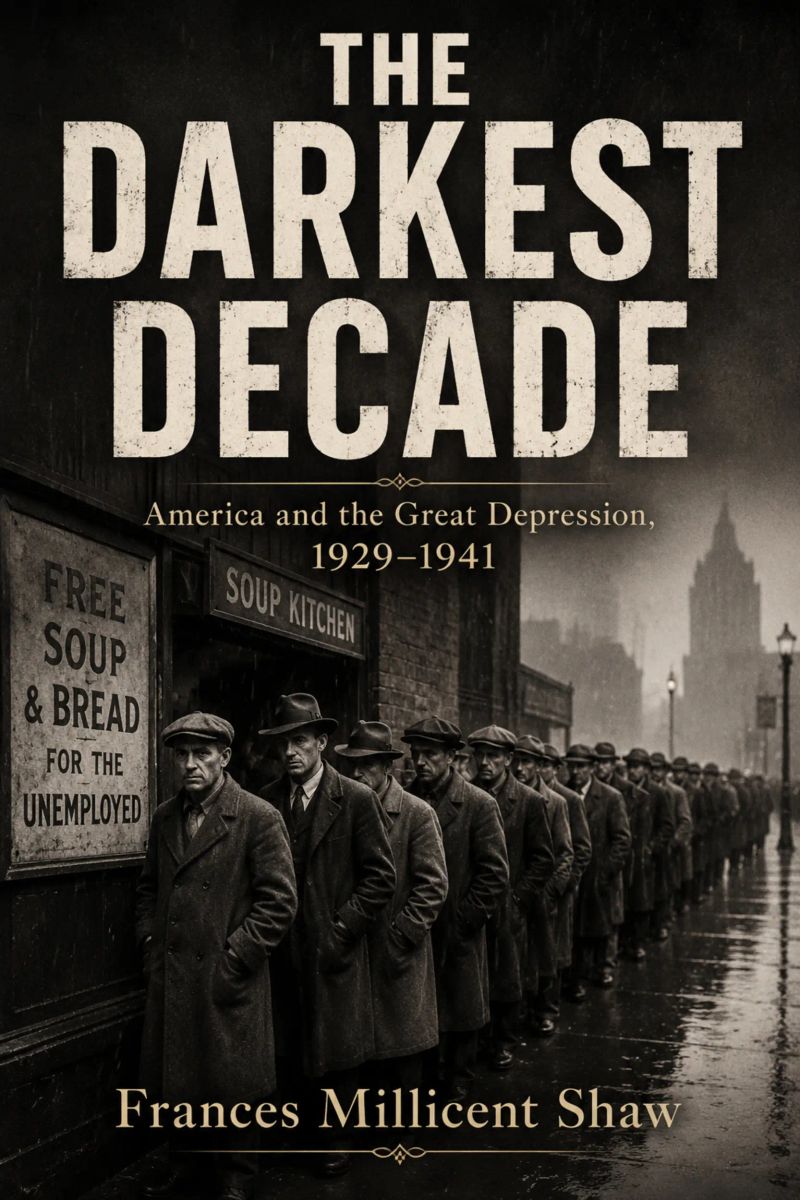
THE DARKEST DECADE
America and the Great Depression, 1929–1941By Frances Millicent Shaw


Length6h 16m
About this audiobook
On October 29, 1929, American markets collapsed in a single day, wiping out fortunes and triggering a decade of suffering. Frances Millicent Shaw traces the full arc of the Great Depression — from the structural causes of the crash through Hoover's failed response, FDR's Hundred Days, the alphabet agencies, and the human cost statistics cannot capture.
The book covers the banking crisis and the Fireside Chat that restored public confidence, Frances Perkins driving Social Security through Congress, the WPA's remarkable cultural output, and the racial inequalities baked into New Deal programmes that evicted 100,000 Black sharecroppers while excluding millions more. It also delivers an honest reckoning: court-packing, the 1937 Roosevelt Recession, and the uncomfortable conclusion that it was World War II — not the New Deal — that finally ended the Depression.
The institutions Roosevelt built — the FDIC, Social Security, the SEC — outlasted the decade. The question he left unresolved has not
Audiobook details
GenreHistorical Fiction, General Fiction, Fairy Tales and Folklore
Length6 hrs 16 mins
Narrated byListen with 1,000+ voices
FormateBook with Audio
LanguageEnglish
Table of contents
1Introduction
2Author’s Note
3Prologue: The Party Ends
4PART ONE: THE CRASH AND ITS CAUSES (1929)
5Chapter 1: Black Tuesday — The Stock Market Collapses
Show all chaptersShow less
6Chapter 2: The Structural Weaknesses — Why the Economy Failed
7Chapter 3: Hoover's Response — The Limits of Republican Orthodoxy
8Chapter 4: The Banking Crisis — When the Banks Failed
9PART TWO: THE DEPRESSION DEEPENS (1930–1932)
10Chapter 5: Unemployment and Breadlines — The Human Cost
11Chapter 6: The Dust Bowl — Drought, Displacement, and the Okies
12Chapter 7: Hoovervilles — Shanty Towns and Broken Dreams
13Chapter 8: The Bonus Army — Veterans March on Washington
14PART THREE: FRANKLIN ROOSEVELT AND THE NEW DEAL (1933–1935)
15Chapter 9: The Hundred Days — Roosevelt's Emergency Response
16Chapter 10: The First New Deal — Relief, Recovery, and Reform
17Chapter 11: The Second New Deal — Social Security and the Wagner Act
18Chapter 12: Opposition to the New Deal — Business, Courts, and the Left
19PART FOUR: NEW DEAL AMERICA (1933–1939)
20Chapter 13: The CCC and PWA — Putting America to Work
21Chapter 14: The TVA — Government Power and Regional Development
22Chapter 15: The New Deal and Race — Promises and Limits
23Chapter 16: Cultural Depression — Art, Literature, and the WPA
24PART FIVE: THE DEPRESSION'S HUMAN STORIES (1930–1940)
25Chapter 17: Women and the Depression — Gender, Work, and Survival
26Chapter 18: The Midwestern Exiles — From Oklahoma to California
27Chapter 19: Labor Rising — The CIO and the Sit-Down Strikes
28Chapter 20: Voices of the Depression — Photographers, Writers, and Radio
29PART SIX: END AND LEGACY
30Chapter 21: Court-Packing and the Conservative Turn — 1937
31Chapter 22: The Roosevelt Recession — The Limits of New Deal Economics
32Chapter 23: The Depression Ends — World War II and Economic Recovery
33Chapter 24: The New Deal Legacy — What It Changed and What It Didn't
34Epilogue: What the Depression Made
35Acknowledgments
36Selected Bibliography
37About the Author
More from Frances Millicent Shaw



Scaramouche (Annotated)Rafael Sabatini15h 24m4.6 (1.8K)$2 · $0.00

The Ghost by the Billabong (The Matilda Saga, #5)Jackie French14h 58m4.6 (773)$33 · $0.00

The Labyrinth of the SpiritsCarlos Ruiz Zafon27h 55m4.5 (77.2K)$53 · $0.00

ShivajiRanjit Desai25h 13m4.6 (3.1K)$24 · $0.00

The Things We Cannot SayKelly Rimmer13h 48m4.5 (359.1K)$33 · $0.00

Lieutenant Hornblower (Annotated)C. S. Forester11h 41m4.5 (2.9K)$2 · $0.00

A Christmas Carol (Illustrated Edition)Charles Dickens3h 23m4.5 (21.2K)$1.99 · $0.00

Rilla of InglesideLucy Maud Montgomery11h 44m4.5 (48.2K)$2 · $0.00

The Viennese DressmakerKathryn Gauci11h 46m4.5 (2.1K)$23 · $0.00

The Man in the Brown Suit & They Came to BaghdadAgatha Christie15h 43m4.6 (495)$33 · $0.00

Under the Light of the Italian MoonJennifer Anton12h 28m4.5 (5.3K)$23 · $0.00

Jubilee, 50th Anniversary EditionMargaret Walker15h 43m4.5 (9.5K)$25 · $0.00

Pride and PrejudiceJane Austen14h 44m4.4 (4.7M)$2 · $0.00

Flying Colours (Annotated)Cecil Louis Troughton Smith9h 26m4.4 (10.1K)$2 · $0.00

With Love from HarlemReShonda Tate13h 48m4.5 (2K)$6 · $0.00

Sweet Home Highland ChristmasMay McGoldrick, Jan Coffey2h 54m4.5 (1.4K)$7 · $0.00

Rilla of InglesideL. M. Montgomery12h 25m4.4 (67.5K)$2 · $0.00

Death Comes for the Archbishop (Annotated)Willa Cather9h 13m4.4 (4.7K)$2 · $0.00

The Alice NetworkKate Quinn15h 7m4.4 (887.1K)$33 · $0.00

The Goddess of WarsawLisa Barr13h 4m4.4 (36.4K)$33 · $0.00

WhistlerAnn Patchett10h 45m4.6 (4.6K)$29 · $0.00

Demon CopperheadBarbara Kingsolver21h 3m4.5 (949.4K)$46 · $0.00

To Kill a MockingbirdHarper Lee12h 18m4.5 (7.4M)$29 · $0.00

Remarkably Bright CreaturesShelby Van Pelt11h 17m4.4 (1.7M)$29 · $0.00

This Side of Paradise - The Original 1920 Edition (Annotated)F. Scott Fitzgerald11h 30m4.6 (1.6K)$2 · $0.00

War LordBernard Cornwell13h 21m4.6 (33.1K)$33 · $0.00
The Great Gatsby: Original 1925 Edition (An F. Scott Fitzgerald Classic NovelFrancis Scott Fitzgerald4h 45m4.6 (9.3K)$18 · $0.00
Something Like LoveBeverly Jenkins10h 21m4.6 (2.7K)$29 · $0.00
Black History CollectionFrederick Douglass, Harriet Ann Jacobs, Booker T. Washington, W.E.B. Du Bois27h 9m4.6 (2.6K)$18 · $0.00

The Old Man and the Sea (Annotated)Ernest Hemingway4h 27m4.6 (1.4K)$2 · $0.00

White HotIlona Andrews13h 18m4.5 (136.9K)$5 · $0.00
The Ghost by the Billabong (The Matilda Saga, #5)Jackie French14h 58m4.6 (773)$33 · $0.00

Cast in BloodMichelle Sagara16h 35m4.6 (607)$33 · $0.00

The Captain Blood Trilogy (Annotated)Rafael Sabatini29h 20m4.6 (1K)$3 · $0.00
Ship of the Line (Annotated)Cecil Louis Troughton Smith11h 13m4.6 (1K)$2 · $0.00

The George Orwell CollectionGeorge Orwell24h 46m4.5 (14.4K)$12 · $0.00
ShivajiRanjit Desai25h 13m4.6 (3.1K)$24 · $0.00
Time RegainedMarcel Proust15h 38m4.5 (9.2K)$2 · $0.00

Driving ForceElle James4h 58m4.6 (407)$20 · $0.00

When God Calls the HeartBrian Bird, Michelle Cox3h 24m4.6 (439)$10 · $0.00

Dark HarmonyLaura Thalassa14h 25m4.2 (101.3K)$23

The High PriestessMaya Daniels5h4.5 (49)Free

No Woman Left BehindJulie Moffett8h 49m4.5 (3K)$25 · $0.00

The Undead PoolKim Harrison16h 13m4.4 (34.6K)$33 · $0.00

The Sweetest FiendRaven Kennedy16h 35m4.4 (2.6K)$40 · $0.00

TILL WE HAVE FACES (Cupid & Psyche – The Story Behind the Myth)C. S. Lewis9h 51m4.3 (104.5K)$1 · $0.00
Grimms' Fairy TalesJacob Grimm, Wilhelm Grimm9h 46m4.3 (256.5K)$2 · $0.00

The Hymns of OrpheusThomas Taylor3h 13m4.4 (777)$21 · $0.00

The Olive Fairy BookAndrew Lang9h 46m4.4 (1.3K)$2.30 · $0.00

The Once and Future King (Annotated)T. H. White28h 26m4.3 (121.8K)$2 · $0.00
Further Tales of the CityArmistead Maupin8h 10m4.3 (20.4K)$26 · $0.00

A Christmas CarolCharles Dickens3h 11m4.3 (1.1M)$1.20 · $0.00
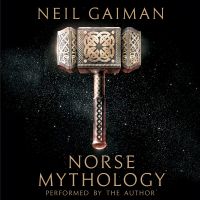
Norse MythologyNeil Gaiman6h 30m4.2 (453.7K)$24 · $0.00

The Grimm's Fairy Tales - Complete Edition: 200+ Stories in One VolumeBrothers Grimm29h 32m4.2 (168.7K)$1.99 · $0.00
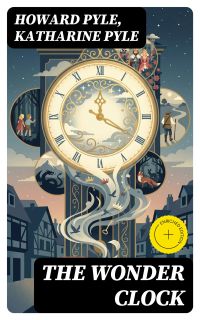
The Wonder ClockHoward Pyle, Katharine Pyle8h 16m4.3 (2.1K)$1 · $0.00

The Family InheritanceTricia Stringer12h 14m4.3 (2.6K)$29 · $0.00

The Good Wife of BathKaren Brooks19h 48m4.2 (9K)$40 · $0.00

Grimms' Fairy TalesJacob and Wilhelm Grimm10h 13m4.2 (291K)$1.20 · $0.00

Mary JaneJessica Anya Blau9h 45m4.2 (166.6K)$29 · $0.00
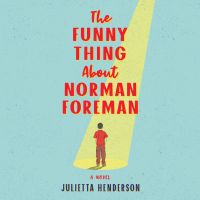
The Funny Thing About Norman ForemanJulietta Henderson9h 11m4.2 (16.4K)$29 · $0.00
You may also like

The Last Man (Dystopian Novel)Mary Shelley20h 38m3.7 (26K)$1.99 · $0.00
An Essay on the Principle of PopulationThomas Maltus5h 7m3.7 (3.9K)$15 · $0.00

After AmericaSteyn, Mark15h 10m4.2 (3.2K)Free

A Journal of the Plague YearDaniel Defoe9h 49m3.5 (16.1K)$2.30
Inconstant MoonLarry Niven59m4.3 (1.9K)$5

The Last Man (Annotated)Mary Shelley21h 5m3.6 (10.5K)$2 · $0.00

The Masque of the Red DeathEdgar Allan Poe18m4.2 (55.8K)$2.30 · $0.00

The Worst Hard TimeTimothy Egan12h 57m4.1 (63.4K)$33 · $0.00

Wastelands 2John Joseph Adams20h 11m3.9 (1.9K)$23

The Fragile EarthDavid Remnick, Henry Finder18h 39m4.2 (609)$40 · $0.00

A Brief Account of the Destruction of the IndiesBartolomé de las Casas3h 20m4.0 (12.9K)Free

The End of the World is Just the BeginningPeter Zeihan16h 45m4.2 (19.5K)$40 · $0.00

My Refuge and FortressMillie Copper12h 36m4.6 (266)$9.99 · $0.00
The Trackers Series Box SetNicholas Sansbury Smith34h4.4 (2.7K)$30
THE ATTENTION SPANAuthor name53m3.7 (2.5K) Only with Ultra

BlindnessJosé Saramago12h 32m4.2 (396.3K)$30

ASHFALL CHRONICLES - Episode 1M.L. Banner52m4.2 (2.7K) Only with Ultra

History of the Great Plague in LondonDaniel Defoe9h 21m3.9 (44.7K)$2.30

Riding the LightningAnthony Almojera8h 42m4.1 (1.1K)$26 · $0.00

Digital PandemicMichael Bociurkiw3h 35m3.7 (15)$15