
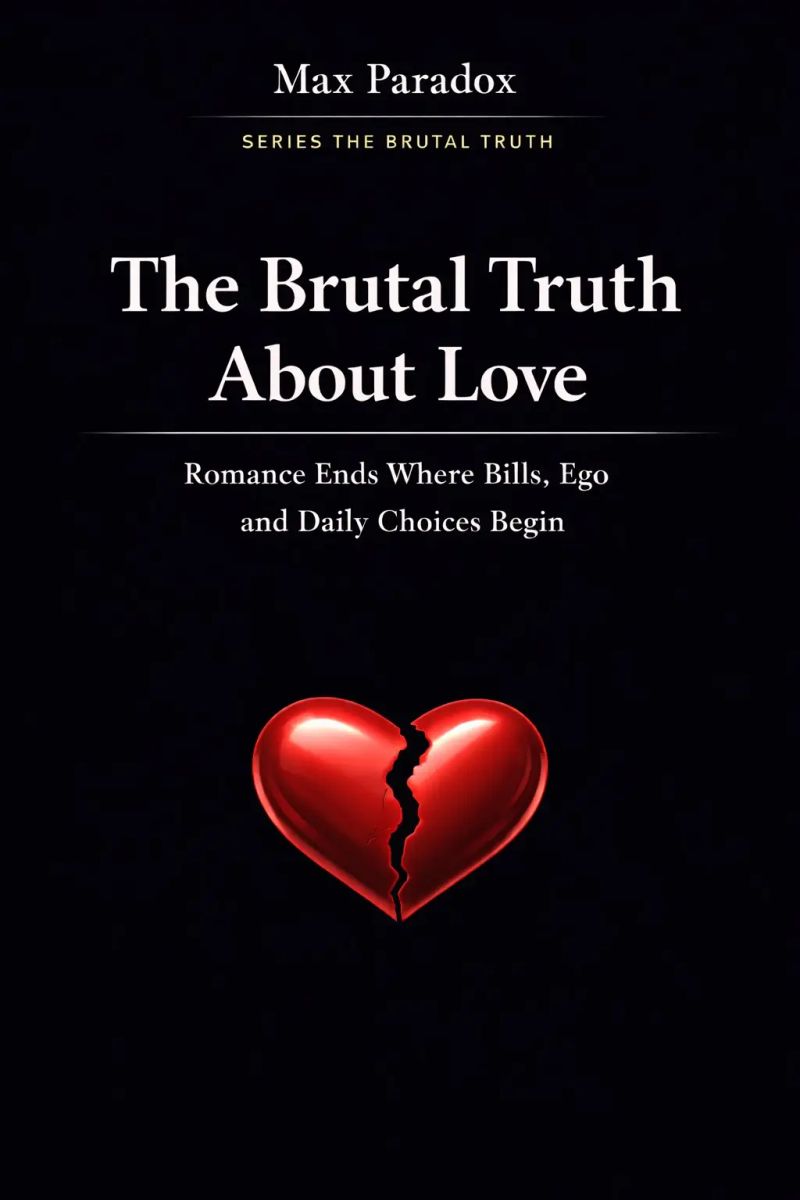
The Brutal Truth About Love - Romance Ends Where Bills, Ego and Daily Choices Begin
By Max Paradox


Length5h 59m
About this audiobook
Love is one of the most powerful myths human beings willingly participate in.
From childhood, people are surrounded by stories promising something extraordinary. Somewhere in the world there is a person who will understand them completely, who will feel familiar from the first conversation and who will transform ordinary life into something emotionally meaningful and stable. Films reinforce this belief. Songs repeat it endlessly. Friends describe their own relationships as proof that love, when it appears in the right form, solves the problem of loneliness and uncertainty.
The idea feels convincing because the beginning of love often looks exactly like that story.
Two people meet and something unusual happens. Conversations flow effortlessly. Small differences seem charming rather than threatening. Plans for the future appear naturally because both partners feel the same emotional momentum pulling them forward. In those early months the relationship feels natural, effortless and full of promise.
This is the stage where most romantic stories end.
Real relationships begin where that stage ends.
The brutal truth about love is not that it is fake. It is that love is human. And human emotions change, adapt and evolve in ways romantic mythology rarely acknowledges.
This book explores what happens after the beginning - after the excitement fades and daily life begins. When bills appear, responsibilities grow and two individuals must negotiate how to build a shared life without losing their own identity.
Love begins as an emotional experience.
A relationship becomes a system.
And systems must survive stress, routine, conflict, growth and time.
Most couples believe love itself will stabilize everything else. If the emotional connection is strong enough, communication should work, priorities should align and conflicts should resolve themselves.
Reality is more complicated.
People evolve. Careers change. Ambitions shift. Emotional needs become clearer. The individuals who once promised permanence slowly become different versions of themselves. Some relationships adapt to those changes. Others struggle to follow them.
This book examines the psychological mechanisms behind that process - why people reinterpret their past relationships to protect their identity, why emotional distance appears long before divorce, why the fantasy of life without compromise becomes seductive, and why promises about forever often become fragile over time.
It does not offer advice or formulas for saving relationships.
Instead it offers observation.
A brutally honest look at how love actually behaves once romantic stories meet everyday reality.
Divorce, in this perspective, becomes less a dramatic failure and more a gradual psychological process. Some marriages end through conflict. Others fade through silence. Many simply reach a point where the shared life no longer matches the people living inside it.
The brutal truth about love is therefore not cynical.
It is simply honest.
Love is powerful and meaningful, but it exists inside lives that continue evolving long after the first declaration of affection. Relationships survive when they adapt to that evolution. When they cannot, the ending does not necessarily mean the love was an illusion.
It may simply mean that the connection belonged to a particular chapter of two people's lives.
Understanding this does not make love less meaningful.
It makes it more real.
Oto 7 zoptymalizowanych keyword phrases:
modern relationship psychology
why relationships fail psychology
psychology of love and divorce
brutal truth about relationships
emotional detachment in relationships
why marriages fall apart psychology
relationship patterns and human behavior
---------------
This publication was prepared using tools that support the creative process, including solutions based on artificial intelligence. The final concept, structure, and editing are the work of the author.
Audiobook details
GenreSelf-Help
Length5 hrs 59 mins
Narrated byListen with 1,000+ voices
FormateBook with Audio
Publish dateAug 25, 2026
LanguageEnglish
Table of contents
1INTRO
2Chapter 1 - The Quiet Ledger
3Chapter 2 - Narrative Self-Defense
4Chapter 3 - Identity Protection
5Chapter 4 - Reputation Management
Show all chaptersShow less
6Chapter 5 - Conflict Avoidance
7Chapter 6 - Passive Aggression
8Chapter 7 - Emotional Outsourcing
9Chapter 8 - Nostalgia Bias
10Chapter 9 - Social Comparison
11Chapter 10 - Moral Camouflage
12Chapter 11 - Emotional Accounting
13Chapter 12 - Loyalty Theater
14Chapter 13 - Control
15Chapter 14 - Passive Resistance
16Chapter 15 - Blame Shifting
17Chapter 16 - Victim Identity
18Chapter 17 - Rewriting the Relationship
19Chapter 18 - The Fantasy of a Life Without Compromise
20Chapter 19 - The Prison Narrative
21Chapter 20 - Emotional Detachment
22Chapter 21 - Quiet Acceptance
23Chapter 22 - The Search for Meaning
24Chapter 23 - The Hope of Doing It Right Next Time
25Chapter 24 - The Illusion of Emotional Control
26Chapter 25 - Expectation Inflation
27Chapter 26 - Living Inside a Story That Already Ended
28Chapter 27 - The Myth of Permanent Love
29Chapter 28 - The Promise Paradox
30Chapter 29 - The Forever Illusion
31Chapter 30 - Why We Choose Love Anyway
32Chapter 31 - The Relationship That Never Fully Ends
33Chapter 32 - What Divorce Reveals About Love
34Chapter 33 - What We Really Mean When We Say "I Love You"
35Chapter 34 - The Truth People Rarely Admit
36Chapter 35 - The Strange Relief of the Ending
How to Stop Avoiding Difficult ConversationsMax Paradox6h 51m$7.70 · $0.00

I Have to Call. I’d Rather Send a Pigeon - How to Stop Putting Off Phone Calls, Prepare for Difficult Conversations, and Get Things Done Without Staring at the Call Button for an HourMax Paradox7h 8m$7.70 · $0.00

Nie umiem przyjmować komplementów - Jak powiedzieć „dziękuję” zamiast natychmiast udowadniać, że wcale nie jesteś taki fajnyMax Paradox4h 51m$7.70 · $0.00

Nie chcę nigdzie wychodzić, a potem żałuję, że zostałem w domu - Jak dogadać się z własną baterią społecznąMax Paradox4h 55m$7.70 · $0.00

Przeczytałem wszystkie wiadomości i teraz boję się wszystkiego - Jak przestać doomscrollować, nie wyprowadzając się do jaskiniMax Paradox5h 47m$7.70 · $0.00

I Can't Relax Without a Screen - How to Remember What People Did Before Everything Started ScrollingMax Paradox7h 22m$7.70 · $0.00

Próbuję zoptymalizować całe swoje życie - Jak przestać mierzyć sen, kroki, wodę, produktywność i własną wartośćMax Paradox5h 57m$7.70 · $0.00

I Lost My Job. Great, Just What I Needed - How to Handle the First Few Weeks, Money, Your CV, and the Job Search Without Treating Losing Your Job Like the End of the WorldMax Paradox7h 12m$7.70 · $0.00

The TV Is Always On - How Television Explains Nothing, Controls Everything, and Never Turns Itself OffMax Paradox2h 50m$7.70 · $0.00

Nie potrafię być w czymś początkujący - Jak robić coś źle wystarczająco długo, żeby w końcu robić to dobrzeMax Paradox5h 59m$7.70 · $0.00

Nie odpisuję, bo minęło już za dużo czasu - Jak wyjść z wiadomościowego długu bez zmiany numeru telefonuMax Paradox5h 51m$7.70 · $0.00

Moja praca składa się ze spotkań o kolejnych spotkaniach - Jak odzyskać dzień z kalendarza pełnego prostokątówMax Paradox5h 29m4.6 (30)$7.70 · $0.00

I Only Learned Today That Filters Need Cleaning Too - How to Handle Basic Home and Appliance Maintenance Before a Small Neglect Turns Into a Bill with an Extra ZeroMax Paradox6h 20m$7.70 · $0.00

Vacation with Friends Sounded Better in the Group Chat - How to Agree on the Budget, Pace, Accommodation, and Expectations Before a Trip So You Come Home Still FriendsMax Paradox5h 18m$7.70 · $0.00

Mam Pełną Szafę i Nic do Ubrania - Jak uporządkować ubrania, kupować mniej i wreszcie wiedzieć, co założyć bez porannego kryzysu przed lustremMax Paradox5h 5m$7.70 · $0.00

Zacząłem Nowy Nawyk. Skończyłem We Wtorek - Jak budować małe zmiany, które przetrwają gorszy dzień, brak motywacji i tydzień, w którym życie nie przeczytało twojego planuMax Paradox4h 52m$7.70 · $0.00

The Brutal Truth About Bolesław the Brave - Wars, Wives, Passions, and the Ruthless Road of Poland’s First King to the CrownMax Paradox6h$7.70 · $0.00

Brutalna prawda o licealistach - Oceny, presja, miłość, bunt i życie, którego dorośli prawie nigdy nie widząMax Paradox5h 46m$7.70 · $0.00
How to Beat Perfectionism and Start Finishing What You StartMax Paradox7h 36m$7.70 · $0.00
Learning to PrayJames Martin13h 24m4.5 (3.4K)$33 · $0.00

Swayam Ki AwaazPrem Rawat8h 34m4.7 (1.1K)$26 · $0.00

Forever BoyKate Swenson9h 27m4.7 (5K)$29 · $0.00

You Are Worth ItKyle Carpenter, Don Yaeger8h 53m4.7 (4.8K)$29 · $0.00

The Happiest Man on EarthEddie Jaku3h 48m4.6 (178K)$7 · $0.00

Finding MeViola Davis9h 15m4.6 (256.4K)$29 · $0.00

Spiritual AnatomyDaaji Kamlesh D. Patel9h 47m4.7 (319)$29 · $0.00

The Dangerous Truth about Today’s MarijuanaLaura Stack CSP, MBA9h 57m4.7 (385)$20 · $0.00

The Gospel according to Spiritualism (Translated)Allan Kardec14h 39m4.6 (3.9K)$5.70 · $0.00

Birdie & HarlowTaylor Wolfe7h 50m4.6 (6.5K)$26 · $0.00

CrossroadsKaleb Dahlgren7h 56m4.6 (4.9K)$26 · $0.00

Life on the BridgeKaelynn Partlow5h 40m4.6 (1.1K)$24 · $0.00

Keep Your Love OnDanny Silk9h 4m4.6 (8.1K)$10 · $0.00

The Tao of Joy Every DayDerek Lin10h 24m4.6 (762)$20 · $0.00

UndividedVicky Beeching9h 2m4.6 (1.3K)$29 · $0.00

HE CAN WHO THINKS HE CAN & OTHER BOOKS ON SUCCESSOrison Swett Marden5h 54m4.6 (1.2K)$1.99 · $0.00
Level UpRob Dial7h 42m4.6 (3.3K)$26 · $0.00

Burn the HaystackJennie Young, PhD9h 30m4.6 (543)$29 · $0.00

ACRES OF DIAMONDS: Our Every-day Opportunities (Wisdom & Empowerment Series) (Annotated)Russell Conwell2h 26m4.6 (1K)$2 · $0.00

Good InsideBecky Kennedy9h 55m4.5 (59.3K)$29 · $0.00
You may also like

The Love Song of J. Alfred PrufrockT.S. Eliot9m4.5 (112.2K)$1 · $0.00

Biographia LiterariaSamuel Taylor Coleridge13h 39m4.0 (1.1K)$2.30

The Collected Plays of Anton ChekhovAnton Chekhov16h 11m4.4 (291)$2 · $0.00

DearlyMargaret Atwood1h 47m4.0 (20K)$16 · $0.00

LamentsJan Kochanowski1h 12m4.2 (1.3K)$1 · $0.00

To the LighthouseVirginia Woolf8h 42m4.0 (260.1K)$2 · $0.00

Book of LongingLeonard Cohen3h 13m4.2 (17.5K)$18 · $0.00

On LoveStendhal13h3.6 (2.1K)$1 · $0.00
The Practice and Science of DrawingHarold Speed8h 7m4.3 (7.1K)$2.30 · $0.00

The Notebooks of Malte Laurids Brigge (Annotated)Rainer Maria Rilke8h 42m3.9 (10.3K)$2 · $0.00

Tragic Sense of LifeMiguel Unamuno12h 58m4.2 (4.1K)$2.30

The Dead (A Novella) (Annotated)James Joyce3h 30m4.2 (3.6K)$2 · $0.00
Reading Like a WriterFrancine Prose9h 2m3.8 (12.4K)$29 · $0.00

The Unknown Masterpiece (Annotated)Honoré de Balzac2h 53m3.7 (7.2K)$2 · $0.00

To the LighthouseVirginia Woolf7h 16m4.0 (270.4K)$21 · $0.00

Plays, Acting and Music: A Book Of TheoryArthur Symons4h 47m3.6 (10)$1 · $0.00

The Mathematical Works of Lewis CarrollLewis Carroll7h 30m4.3 (42)$1.99 · $0.00

Virginia Woolf: A Conversation with Walter Sickert, the Renowned English PainterVirginia Woolf31m3.7 (41)$1 · $0.00

I Keep Saving Things “for Later” - How to Stop Building a Digital Warehouse You'll Never RevisitMax Paradox6h 50m$7.70 · $0.00

Violets and Other Tales (Annotated)Alice Moore Dunbar-Nelson3h 35m3.8 (51)$2 · $0.00