
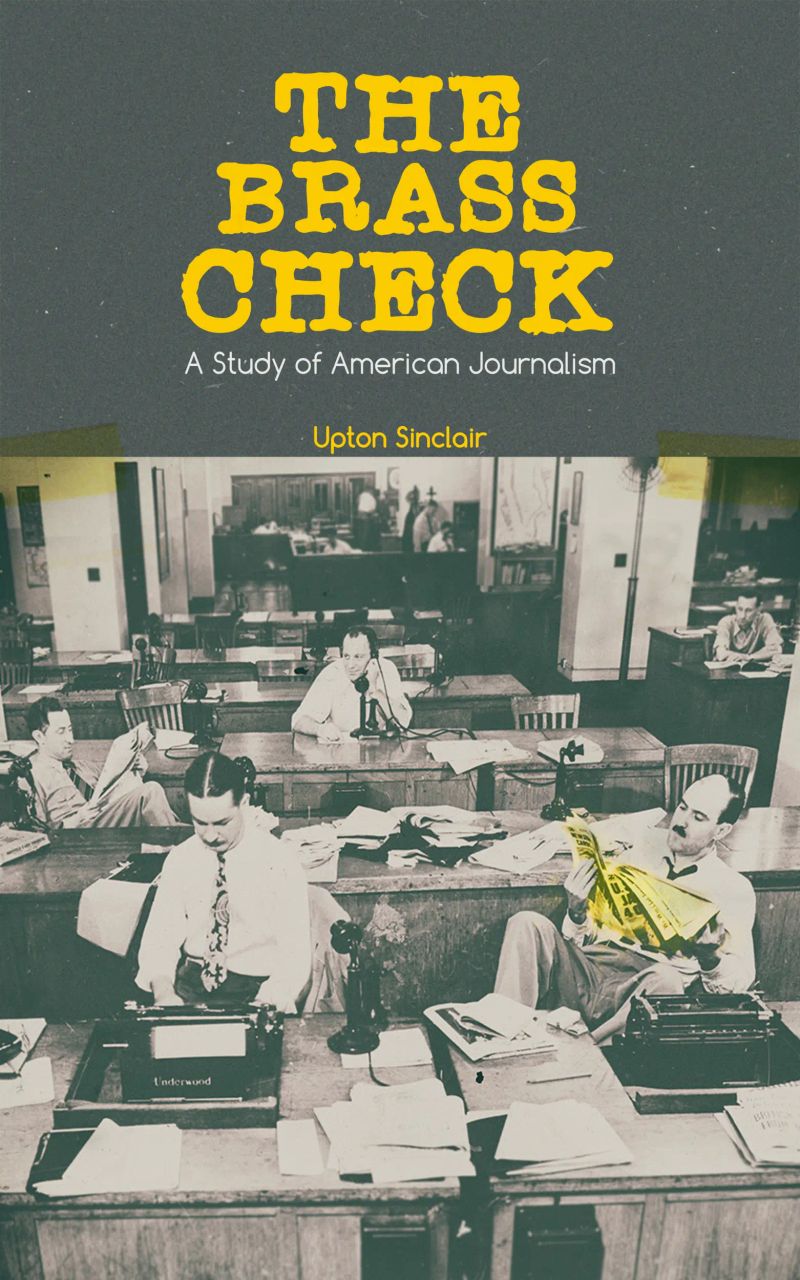
THE BRASS CHECK: A Study of American Journalism
The Biggest Exposé on Sensational Media Coverage and Unethical Journalism in USA (From the Renowned Author, Journalist and Pulitzer Prize Winner)By Upton Sinclair


Length20h 23m
About this audiobook
Yellow journalism, or the yellow press, is a type of journalism that presents little or no legitimate well-researched news and instead uses eye-catching headlines to sell more newspapers. Techniques may include exaggerations of news events, scandal-mongering or sensationalism. By extension, the term yellow journalism is used today as a pejorative to decry any journalism that treats news in an unprofessional or unethical fashion. In 1919, Upton Sinclair published "The Brass Check", a muckraking exposé of American journalism that publicized the issue of yellow journalism and the limitations of the "free press" in the United States. Four years after publication of The Brass Check, the first code of ethics for journalists was created.
Upton Sinclair (1878–1968) was an American author who wrote books in many genres, but in all of them advocating for the moral ethics, better life style for the working people and social justice. Writing during the Progressive Era, Sinclair describes the world of industrialized America from both the working man's point of view and the industrialist. He has also won the Pulitzer Prize for Fiction in 1943.
Audiobook details
GenrePsychology
Length20 hrs 23 mins
Narrated byListen with 1,000+ voices
FormateBook with Audio
Publish dateSep 10, 2017
LanguageEnglish
Table of contents
1THE BRASS CHECK: A Study of American Journalism
39Book 2: The Explanation
2A Letter for the Time
40XXXV. The Causes of Things
3Author’s Note
41XXXVI. The Empire of Business
4Book 1: The Evidence
42XXXVII. The Dregs of the Cup
5I. The Story of the Brass Check
43XXXVIII. Owning the Press
Show all chaptersShow less
6II. The Story of a Poet
44XXXIX. The War-Makers
7III. Open Sesame!
45XL. Owning the Owners
8IV. The Real Fight
46XLI. The Owner in Politics
9V. The Condemned Meat Industry
47XLII. Owning the Associated Press
10VI. An Adventure with Roosevelt
48XLIII. The Owner and His Advertisers
11VII. Jackals and a Carcase
49XLIV. The Advertising Boycott
12VIII. The Last Act
50XLV. The Advertising Ecstasy
13IX. Aiming at the Public's Heart
51XLVI. The Bribe Direct
14X. A Voice from Russia
52XLVII. The Bribe Wholesale
15XI. A Venture in Co-operation
53XLVIII. Poison Ivy
16XII. The Village Horse-Doctor
54XLIX. The Elbert Hubbard Worm
17XIII. In High Society
55L. The Press and Public Welfare
18XIV. The Great Panic
56LI. The Press and the Radicals
19XV. Shredded Wheat Biscuit
57LII. The Press and the Socialists
20XVI. An Interview on Marriage
58LIII. The Press and Sex
21XVII. 'Gaming' on the Sabbath
59LIV. The Press and Crime
22XVIII. An Essential Monogamist
60LV. The Press and Jack London
23XIX. In the Lion's Den
61LVI. The Press and Labor
24XX. The Story of a Lynching
62LVII. The Associated Press and Labor
25XXI. Journalism and Burglary
63LVIII. 'Poisoned at the Source'
26XXII. A Millionaire and an Author
64LIX. The Press and the War
27XXIII. The 'Heart-Wife'
65LX. The Case of Russia
28XXIV. The Mourning Pickets
66LXI. 'Bolshevism' in America
29XXV. The Case of the Associated Press
67Book 3: The Remedy
30XXVI. A Governor and His Lie
68LXII. Cutting the Tiger Claws
31XXVII. The Associated Press at the Bar
69LXIII. The Mental Munition-Factory
32XXVIII. The Associated Press and Its Newspapers
70LXIV. The Problem of the Reporter
33XXIX. The Scandal-Bureau
71LXV. The Press Set Free
34XXX. The Concrete Wall
72LXVI. A Frame-up That Fell Down ---
35XXXI. Making Bomb-Makers
73Conclusion
36XXXII. The Roof-Garden of the World
74A Practical Program
37XXXIII. A Fountain of Poison
75Bonus
38XXXIV. The Daily Cat-and-Dog Fight ---
76The Crimes of the "Times": A Test of Newspaper Decency"

A Deep Analytic Retelling of The JungleUpton Sinclair3h 44m$7 · $0.00

100%: The Story of a PatriotUpton Sinclair11h 36m$1 · $0.00

THE FASTING CUREUpton Sinclair3h 46m$1 · $0.00
A Prisoner of Morro; Or, In the Hands of the EnemyUpton Sinclair7h 10m$2 · $0.00

A Captain of IndustryUpton Sinclair2h 13m$2 · $0.00

The NaturewomanUpton Sinclair2h 9m$2 · $0.00

UPTON SINCLAIR: 29 Books in One VolumeUpton Sinclair222h 20m$1 · $0.00
King CoalUpton Sinclair13h 34m$2 · $0.00

Prince HagenUpton Sinclair2h 14m$2 · $0.00

The Profits of ReligionUpton Sinclair10h 52m$1 · $0.00
The Pot BoilerUpton Sinclair2h 49m$2 · $0.00
The Journal of Arthur Stirling : ("The Valley of the Shadow")Upton Sinclair5h 45m$2 · $0.00
The Autobiography of Upton SinclairUpton Sinclair12h 7m$2 · $0.00

Chikago: Nykyajan romaaniUpton Sinclair14h 28m$2 · $0.00

Love's PilgrimageUpton Sinclair18h 44m$2 · $0.00

Oil!Upton Sinclair23h 27m$2 · $0.00
Sadan prosentin patrioottiUpton Sinclair10h 46m$2 · $0.00

Bill PorterUpton Sinclair4h 15m$2 · $0.00

The MoneychangersUpton Sinclair7h 23m$2 · $0.00
Mental Radio (Summarized Edition)Upton Sinclair, Albert Einstein3h 20m$2

I Am The StormJanice Dean9h$8 · $0.00

On Democracies and Death CultsDouglas Murray10h 38m$29 · $0.00

TerraformPropaganda5h 39m$24 · $0.00
Hour of the HeartIrvin D. Yalom, Benjamin Yalom8h 19m5 (1)$26 · $0.00
The Thomas Sowell ReaderThomas Sowell14h 51m$25

So You Want to Talk about RaceIjeoma Oluo7h 41m$17

Braving the TruthRachel Held Evans11h 31m$29 · $0.00
Level UpRob Dial7h 42m$26 · $0.00

As a JewSarah Hurwitz8h 36m$26 · $0.00

The North American Indian (Illustrated Edition)Edward S. Curtis, Frederick Webb Hodge6h$2 · $0.00

Burn the HaystackJennie Young, PhD9h 30m$29 · $0.00

Good InsideBecky Kennedy9h 55m$29 · $0.00

Du Bois: EssaysW.E.B. Du Bois6h 23m$1 · $0.00

Valley of the BirdtailAndrew Stobo Sniderman, Douglas Sanderson10h 1m$29 · $0.00

Lies My Therapist Told MeGreg E. Gifford9h 3m$29 · $0.00

Disturbed in Their NestsAlephonsion Deng, Judy A. Bernstein11h 22m$23 · $0.00
Nobody Knows My NameJames Baldwin5h 49m$17

Start Here Start NowLiz Kleinrock4h 20m$20

The Collected Works of Sigmund FreudSigmund Freud112h 54m$2 · $0.00

Man's Search for MeaningViktor E. Frankl5h 44m$20
You may also like

Mayday 1971Lawrence Roberts15h 42m$33 · $0.00

The Real Anthony FauciKennedy Jr., Robert F27h 50mFree

Red Hot LiesChristopher C. Horner11h 47m$23 · $0.00
BailoutNeil Barofsky9h 26m$20 · $0.00
Letters to Judd, an American WorkingmanUpton Sinclair3h 33m$2.30

Unwanted AdvancesLaura Kipnis6h 57m$24 · $0.00

They Never Let a Crisis Go to WasteJason Chaffetz9h 28m$29 · $0.00

The Spider's WebReginald Wright Kauffman10h 9m$2.30

American ConspiraciesVentura, Jesse11h 42mFree

The Spider's WebReginald Wright Kauffman10h 11m$2 · $0.00

The Brass Check A Study of American JournalismUpton Sinclair18h 34m$2.30

AlmightyDan Zak10h 49m$20 · $0.00

KleptopiaTom Burgis10h 59m$29 · $0.00

An Ethical ProblemAlbert Leffingwell10h 15m$2 · $0.00

Benito Cereno & BartlebyHerman Melville6h 12m$2 · $0.00

Vaccination a Delusion: Its Penal Enforcement a CrimeAlfred Russel Wallace5h 7m$1 · $0.00

Suppression, Deception, Snobbery, and BiasAri Fleischer8h 40m$26 · $0.00

American InjusticeDavid S. Rudolf10h 46m$29 · $0.00

Madame RolandMathilde Blind8h 45m$1 · $0.00
The Power Of The Media During The 90sCélio Azevedo50m$6 · $0.00