
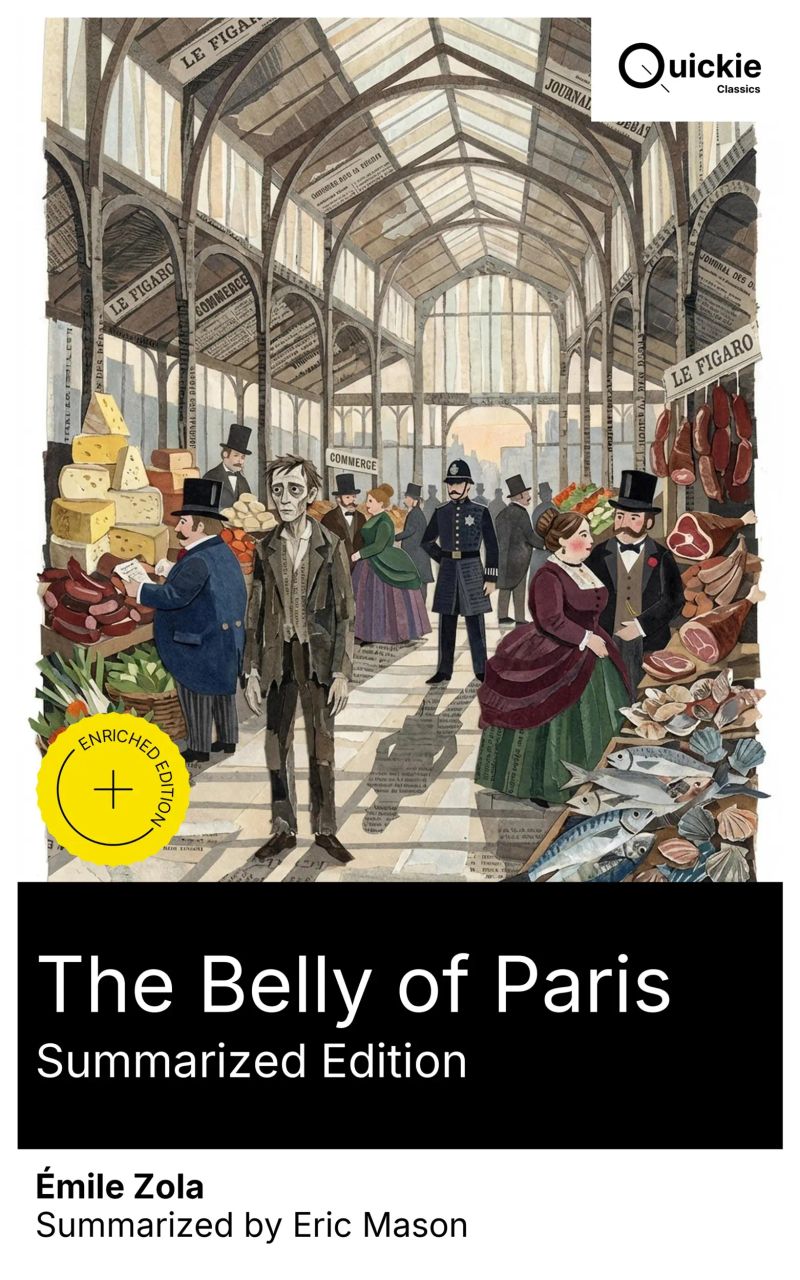
The Belly of Paris (Summarized Edition)
Enriched edition. A naturalistic chronicle of urban market life, class conflict, and capitalism's costs in 19th-century ParisBy Émile Zola


Length4h 32m
About this audiobook
Published in 1873 as the third Rougon-Macquart novel, The Belly of Paris immerses readers in Les Halles, the iron-and-glass market of the Second Empire. Following the returned exile Florent and the charcutiers Quenu and Lisa, Zola opposes the 'thin' and the 'fat' while staging politics amid pyramids of food. Naturalist catalogues—most famously the 'symphony of cheeses'—link sensory excess to surveillance and social control. Zola (1840–1902), architect of literary naturalism, conceived the Rougon-Macquart as a 'natural and social history' of a family under Napoleon III, governed by heredity and milieu. Informed by Tainean determinism and rigorous reporting, he haunted Les Halles with notebooks and sketches. Written after the Commune, the novel tests how abundance and civic order cloak repression and betrayals among neighbors. Readers of Balzac and Flaubert, as well as students of urban modernity and food culture, will find this anatomy of consumption indispensable. For its vivid prose and lucid sociology alike, The Belly of Paris remains a masterclass in seeing power in everyday plenty—rewarding in any reliable modern translation.
Quickie Classics summarizes timeless works with precision, preserving the author's voice and keeping the prose clear, fast, and readable—distilled, never diluted. Enriched Edition extras: Introduction · Synopsis · Historical Context · Author Biography · Brief Analysis · 4 Reflection Q&As · Editorial Footnotes.
Audiobook details
GenreLiterary Classics, Historical Fiction
Length4 hrs 32 mins
Narrated byListen with 1,000+ voices
FormateBook with Audio
Publish dateJan 10, 2026
LanguageEnglish
Table of contents
1Introduction
2Introduction
3Synopsis
4Historical Context
5Author Biography
Show all chaptersShow less
6The Belly of Paris (also known as: The Fat and The Thin) (pt. 1)
7The Belly of Paris (also known as: The Fat and The Thin) (pt. 2)
8Analysis
9Reflection

NanaÉmile Zola13h 59m4.0 (36.7K)$12 · $0.00

THE LADIES' PARADISEÉmile Zola19h 41m4.2 (27.7K)$1.99 · $0.00

The Complete Short Stories of Émile ZolaÉmile Zola23h 21m$1.99 · $0.00
Theresa Raquin (Musaicum Classics Series)Émile Zola9h 34m4.0 (18)$1.99 · $0.00

THE COMPLETE WORKS OF ÉMILE ZOLAÉmile Zola536h 54m$1.99 · $0.00

THE FLOODÉmile Zola2h 33m3.9 (849)$1.99 · $0.00

Germinal (Historical Novel)Émile Zola21h 14m4.3 (58.9K)$1.99 · $0.00

The Complete Rougon-Macquart Series (All 20 Books in One Edition)Émile Zola326h 41m4.6 (144)$1.99 · $0.00

Theresa Raquin (Annotated)Émile Zola9h 17m4.0 (118.8K)$1.99 · $0.00

La Collection Intégrale des ROUGON-MACQUART (20 titres)Émile Zola308h 26m4.5 (223)$0.99 · $0.00

GerminalÉmile Zola20h 36m4.3 (59.4K)$0.99 · $0.00

Les Oeuvres Complètes d'Emile ZolaÉmile Zola545h 42m4.3 (1.8K)$0.99 · $0.00

Germinal (Anotado)Émile Zola20h 33m4.3 (68.7K)$0.99 · $0.00

The Ladies' Paradise (Vizetelly Translation, Unabridged) (Annotated)Émile Zola19h 34m4.5 (1.2K)$2 · $0.00

The Belly of Paris (also known as: The Fat and The Thin) (Annotated)Émile Zola16h 29m4.1 (9.4K)$2 · $0.00

The Death of Olivier Becaille (Unabridged) (Annotated)Émile Zola2h 38m3.8 (378)$2 · $0.00

The Complete Short Stories (All Unabridged) (Annotated)Émile Zola23h 23m$2 · $0.00

Zijn Excellentie Eugène RougonÉmile Zola15h 50m3.9 (2.5K)$2 · $0.00

The Downfall (La Débâcle)Émile Zola25h 33m4.1 (2.6K)$1 · $0.00

Jacht naar FortuinÉmile Zola13h 23m3.9 (13.5K)$2 · $0.00

To Kill a MockingbirdHarper Lee12h 18m4.5 (7.4M)$29 · $0.00

These Precious DaysAnn Patchett11h 14m4.5 (45.2K)$29 · $0.00

The Complete Histories / History Plays of William Shakespeare (Annotated)William Shakespeare29h 42m4.6 (2.3K)$0.99 · $0.00

Braving the TruthRachel Held Evans11h 31m4.7 (359)$29 · $0.00

The Old Man and the Sea (Annotated)Ernest Hemingway4h 27m4.6 (1.4K)$2 · $0.00

Henry V (The Play, Historical Background and Analysis of the Character in the Play)William Shakespeare, William Hazlitt8h 50m4.6 (1.3K)$1.99 · $0.00

H. P. LOVECRAFT Ultimate Collection: Novellas, Short Stories, Poetry & Essays (Annotated)H. P. Lovecraft12h 28m4.6 (2.3K)$2 · $0.00
Time RegainedMarcel Proust16h 8m4.5 (10.6K)$1.99 · $0.00

The Mis-Education of the NegroCarter Goodwin Woodson4h 32m4.5 (28.4K)$10 · $0.00
Lessons in TruthH. Emilie3h 50m4.6 (1.4K)$4.70 · $0.00

TORAH - Bilingual Edition: English/Hebrew (Annotated)Max Margolis, JPS28h 26m4.6 (1K)$2 · $0.00

Betty Crocker picture cooky bookBetty Crocker, Inc. General Mills2h 13m4.5 (6.5K)$1 · $0.00

The Complete Tales of Beatrix PotterBeatrix Potter3h 36m4.5 (75K)$3 · $0.00

Anne of Green GablesL. M. Montgomery11h 1m4.5 (1.2M)$2.30 · $0.00

Crime and Punishment (The Unabridged Garnett Translation) (Annotated)Fyodor Dostoevsky24h 25m4.5 (15.4K)$0.99 · $0.00

The North American IndianEdward S. Curtis, Frederick Webb Hodge6h4.5 (1.2K)$2 · $0.00

The Picture of Dorian Gray: The Uncensored 13 Chapter Version + The Revised 20 Chapter Version (Annotated)Oscar Wilde16h 12m4.5 (2.8K)$0.99 · $0.00

Grimoire Of The Everyday WitchIsadora Lys / Virginia Santos5h 35m4.5 (3.9K)$9 · $0.00

Winnie-the-PoohAlan Alexander Milne2h 52m4.5 (401.1K)$3 · $0.00

Sitting PrettyRebekah Taussig7h 33m4.5 (18.9K)$26 · $0.00

Lieutenant Hornblower (Annotated)C. S. Forester11h 41m4.5 (2.9K)$2 · $0.00

A Christmas Carol (Illustrated Edition)Charles Dickens3h 23m4.5 (21.2K)$1.99 · $0.00

Rilla of InglesideLucy Maud Montgomery11h 44m4.5 (48.2K)$2 · $0.00

The Viennese DressmakerKathryn Gauci11h 46m4.5 (2.1K)$23 · $0.00

The Man in the Brown Suit & They Came to BaghdadAgatha Christie15h 43m4.6 (495)$33 · $0.00

Under the Light of the Italian MoonJennifer Anton12h 28m4.5 (5.3K)$23 · $0.00

Jubilee, 50th Anniversary EditionMargaret Walker15h 43m4.5 (9.5K)$25 · $0.00

Pride and PrejudiceJane Austen14h 44m4.4 (4.7M)$2 · $0.00

Flying Colours (Annotated)Cecil Louis Troughton Smith9h 26m4.4 (10.1K)$2 · $0.00
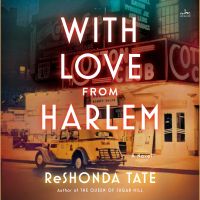
With Love from HarlemReShonda Tate13h 48m4.5 (2K)$6 · $0.00

Sweet Home Highland ChristmasMay McGoldrick, Jan Coffey2h 54m4.5 (1.4K)$7 · $0.00

Rilla of InglesideL. M. Montgomery12h 25m4.4 (67.5K)$2 · $0.00

Death Comes for the Archbishop (Annotated)Willa Cather9h 13m4.4 (4.7K)$2 · $0.00

The Alice NetworkKate Quinn15h 7m4.4 (887.1K)$33 · $0.00

The Goddess of WarsawLisa Barr13h 4m4.4 (36.4K)$33 · $0.00

The Ohio River Trilogy: Betty Zane, The Spirit of the Border & The Last TrailZane Grey29h 8m4.4 (1.8K)$1 · $0.00

The Attic ChildLola Jaye14h 46m4.4 (21K)$33 · $0.00

Martyr of the CatacombsJames De Mille3h 41m4.5 (744)$1 · $0.00

Quo VadisHenryk Sienkiewicz22h 52m4.4 (62K)$21 · $0.00

Bring Up The BodiesHilary Mantel14h 35m4.4 (150K)$33 · $0.00
You may also like

Republican GomorrahMax Blumenthal11h 34m4.0 (1.7K)$21 · $0.00

Words Will Break CementMasha Gessen7h 56m4.0 (1.8K)$20 · $0.00

Obama's AmericaD'Souza, Dinesh8h 17m4.2 (2.3K)Free

Trust the PlanWill Sommer8h 13m4.2 (5K)$7 · $0.00
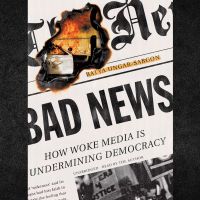
Bad NewsBatya Ungar-Sargon7h 50m4.1 (981)$20 · $0.00

Under Western EyesJoseph Conrad10h 53m4.0 (22.8K)$1 · $0.00
The Belly of Paris (also known as: The Fat and The Thin) (Annotated)Émile Zola16h 29m4.1 (9.4K)$2 · $0.00

HomewreckersAaron Glantz10h 10m4.3 (927)$29 · $0.00

Adios, AmericaCoulter, Ann12h 51m4.0 (4.6K)Free

The Breakdown of Higher EducationJohn M. Ellis7h 47m4.2 (296)$17 · $0.00

AlmightyDan Zak10h 49m4.1 (473)$20 · $0.00

The Storm Is upon UsMike Rothschild7h 58m4.1 (4K)$20 · $0.00

Under Western Eyes (Unabridged Deluxe Edition)Joseph Conrad35h 34m3.9 (5.9K)$2 · $0.00

White LiesA. J. Baime12h 58m4.4 (1.1K)$33 · $0.00

The Belly of ParisÉmile Zola13h 5m4.0 (17.7K)$30

Land Of Big NumbersTe-Ping Chen6h 35m4.0 (12.2K)$24 · $0.00
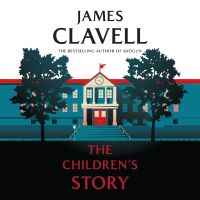
The Children’s StoryJames Clavell36m4.2 (4.2K)$4 · $0.00

It’s Even Worse Than It LooksThomas E. Mann, Norman J. Ornstein6h 43m4.0 (4.6K)$18 · $0.00

The Abolition of SexKara Dansky4h 8m4.5 (442)$15 · $0.00

Outrage, Inc.Derek Hunter7h 51m4.3 (1.3K)$26 · $0.00