
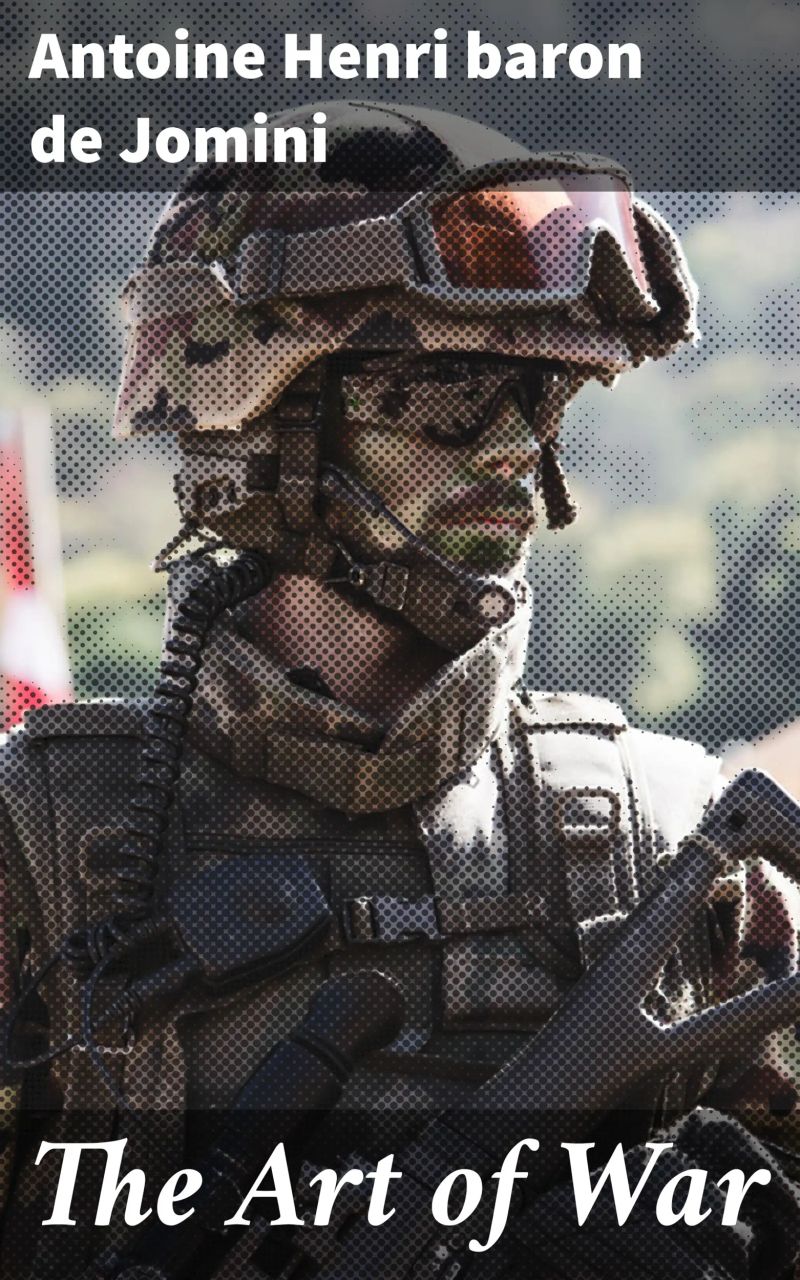
The Art of War
Mastering Warfare: Timeless Strategies for Military Leaders and EnthusiastsBy Antoine Henri baron de Jomini


Length13h 56m
About this audiobook
In 'The Art of War,' Antoine Henri baron de Jomini presents a comprehensive analysis of military strategy and the principles of warfare during a time of rapid transformation in European military thought. Jomini's writing is marked by clarity and precision, using a systematic approach to dissect the complexities of warfare. He emphasizes concepts such as decisive points, the importance of logistics, and the relationship between strategy and tactics, presenting his theories in the context of the Napoleonic Wars, thereby situating his work within the broader evolution of military literature that moved away from anecdotal narratives to a more scientific examination of war. Jomini, a Swiss officer who served under both Napoleon and the Russian army, was profoundly influenced by his experiences on the battlefield and his desire to develop a cohesive theory of military art. His unique perspective, grounded in pragmatic observations, reflects his ambition to formalize the chaotic nature of war into understandable principles. This integration of practice and theory represents a significant development in military thought, bridging the gap between classical and modern approaches to warfare. For scholars, military professionals, and history enthusiasts alike, 'The Art of War' is an indispensable text that not only outlines essential strategies but also invites readers to engage critically with the nature of conflict itself. This seminal work remains relevant as it offers timeless insights, making it a must-read for those seeking to understand the operational frameworks that continue to influence contemporary military strategy.
Audiobook details
Rating★★★★ 4.0 (1.3K)
Includes Goodreads, LibraryThing, Amazon, StoryGraph
GenreHistory
Length13 hrs 56 mins
Narrated byListen with 1,000+ voices
FormateBook with Audio
Publish dateJan 9, 2020
LanguageEnglish
Table of contents
1Introduction
2PREFACE
3SUMMARY: OF
4THE ART OF WAR.: DEFINITION OF THE ART OF WAR.
5CHAPTER I.: STATESMANSHIP IN ITS RELATION TO WAR.
Show all chaptersShow less
6ARTICLE I.: Offensive Wars to Reclaim Rights.
7ARTICLE II.: Of Wars Defensive Politically, and Offensive in a Military Point of View.
8ARTICLE III.: Wars of Expediency.
9ARTICLE IV.: Of Wars with or without Allies.
10ARTICLE V.: Wars of Intervention.
11ARTICLE VI.: Aggressive Wars for Conquest and other Reasons.
12ARTICLE VII.: Wars of Opinion.
13ARTICLE VIII.: National Wars.
14ARTICLE IX.: Civil Wars, and Wars of Religion.
15ARTICLE X.: Double Wars, and the Danger of Undertaking Two Wars at Once.
16CHAPTER II.: MILITARY POLICY.
17ARTICLE XI.: Military Statistics and Geography.
18ARTICLE XII.: Other Causes which exercise an Influence upon the Success of a War.
19ARTICLE XIII.: Military Institutions.
20ARTICLE XIV.: The Command of Armies, and the Chief Control over Operations.
21ARTICLE XV.: The Military Spirit of Nations, and the Morale of Armies.
22CHAPTER III.
23STRATEGY.
24DEFINITION OF STRATEGY AND THE FUNDAMENTAL PRINCIPLE OF WAR.
25THE FUNDAMENTAL PRINCIPLE OF WAR.
26OF STRATEGIC COMBINATIONS.
27ARTICLE XVI.: Of the System of Operations.
28ARTICLE XVII.: Of the Theater of Operations.
29ARTICLE XVIII.
30Bases of Operations.
31Fig. 1.
32Fig. 2.
33ARTICLE XIX.
34Strategic lines and Points, Decisive Points of the Theater of War, and Objective Points of Operations.
35OBJECTIVE POINTS.
36ARTICLE XX.
37Fronts of Operations, Strategic Fronts, Lines of Defense, and Strategic Positions.
38FRONTS OF OPERATIONS AND STRATEGIC FRONTS.
39LINES OF DEFENSE.
40STRATEGIC POSITIONS.
41ARTICLE XXI.
42Zones and Lines of Operations.
43OBSERVATIONS UPON THE LINES OF OPERATIONS IN THE WARS OF THE FRENCH REVOLUTION.
44Fig. 3.
45THE STRATIGIC FIELD OF 1806.: To illustrate Maxim 3 on the direction of Lines of Operations.
46MAXIMS ON LINES OF OPERATIONS.
47Fig. 4.
48OBSERVATIONS UPON INTERIOR LINES—WHAT HAS BEEN SAID AGAINST THEM.
49ARTICLE XXII.: Strategic Lines.
50ARTICLE XXIII.

A Brief History of IntelligenceMax S. Bennett12h 18m4.6 (6.6K)$29 · $0.00

The Gulag Archipelago Volume 3Aleksandr I. Solzhenitsyn21h 56m4.7 (8.9K)$46 · $0.00

Pearl of Great PriceJoseph Smith3h 8m4.7 (7.2K)$1.20 · $0.00

The Happiest Man on EarthEddie Jaku3h 48m4.6 (178K)$7 · $0.00

MotherlandJulia Ioffe17h 52m4.7 (2.5K)$40 · $0.00

Where Cowards Go to DieBenjamin Sledge8h 42m4.7 (351)$20 · $0.00

RevolutionariesSanjeev Sanyal11h 23m4.6 (2.6K)$29 · $0.00

Days of Love and Rage: A Story of RevolutionAnand Gopal22h 36m4.7 (584)$34 · $0.00

We Crossed a Bridge and It TrembledWendy Pearlman6h4.6 (5.2K)$24 · $0.00

Unbroken Bonds of BattleJohnny Joey Jones8h 31m4.6 (2.6K)$8 · $0.00

The Daughter of AuschwitzTova Friedman, Malcolm Brabant7h 54m4.6 (16.7K)$26 · $0.00

Lily's PromiseLily Ebert, Dov Forman8h 54m4.6 (16.1K)$29 · $0.00

On Democracies and Death CultsDouglas Murray10h 38m4.6 (6.5K)$29 · $0.00

Across the RiverKent Babb11h 40m4.6 (927)$29 · $0.00

Balcony Over Jerusalem: A Middle East Memoir - Israel, Palestine and BeyondJohn Lyons12h 37m4.6 (1.4K)$33 · $0.00

BeyondStephen Walker15h 39m4.6 (3.2K)$33 · $0.00

Kings and PawnsHoward Bryant10h 9m4.6 (678)$29 · $0.00

No EscapeNury Turkel9h 30m4.6 (809)$28 · $0.00

Jubal Stone: U.S. Marshal: Blood Trail To Hell: A Western Adventure NovelCasey Nash3h 42m4.6 (3.2K)$18 · $0.00

Fall and RiseMitchell Zuckoff17h 23m4.6 (9.8K)$40 · $0.00
You may also like

Small Wars ManualUnited States Marine Corps20h 27m4.2 (355)$2 · $0.00

Destruction and Reconstruction: / Personal Experiences of the Late WarRichard Taylor10h 51m4.1 (440)$2.30

The River War (History of the War in Sudan)Winston Churchill15h 2m4.1 (2.2K)$1.99 · $0.00

GettysburgStephen W. Sears20h 59m4.4 (8.1K)$46 · $0.00
HellenicaXenophon15h 2m4.2 (4.4K)$1 · $0.00

The History of the Peloponnesian WarThucydides22h 10m4.2 (54.2K)$2.30
Lincoln's LieutenantsStephen W. Sears31h 36m4.4 (1.1K)$53 · $0.00

Small Wars ManualUnited States Marine Corps18h 28m4.1 (510)$1 · $0.00

History of The Decline and Fall of The Roman Empire Vol IEdward Gibbon30h 34m4.4 (6.2K)$2.30

The Major Operations of the Navies in the War of American IndependenceA. T. Mahan7h 59m4.1 (20)$2 · $0.00

The War with Mexico (Vol.1&2)Justin Harvey Smith58h 19m3.7 (45)$2 · $0.00

Annals of the Turkish Empire (Annotated)Mustafa Naima21h 20m$2 · $0.00
Julius CaesarJ. F. C. Fuller14h 6m3.9 (677)$25 · $0.00

History of the War in the Peninsular and the South of France from the Year 1807 to the Year 1814 Vol. 2William Francis Patrick Napier17h 44m4.4 (17)$2.30

Vietnam War: The Complete History of America’s Longest Cold War Conflict and Its Lasting LegacyRobert Melton1h 48m4.2 (19)$3.40 · $0.00

The Life and Work of Jefferson Davis (Annotated)Jefferson Davis, Frank H. Alfriend105h 1m$0.99 · $0.00

BROTHER AGAINST BROTHERRobert Calhoun Stoddard5h 5m$10 · $0.00

BROTHER AGAINST BROTHERRobert Calhoun Stoddard5h 48m$7

The Complete History of the Civil War (Including Memoirs & Biographies of the Lead Commanders)John Esten Cooke, Abraham Lincoln, James Ford Rhodes, Ulysses S. Grant, William T. Sherman, Frank H. Alfriend154h 44m$2 · $0.00

The Jacobite Rebellions (1689-1746) (Bell's Scottish History Source Books.) (Annotated)J. Pringle Thomson6h 6m$3 · $0.00