
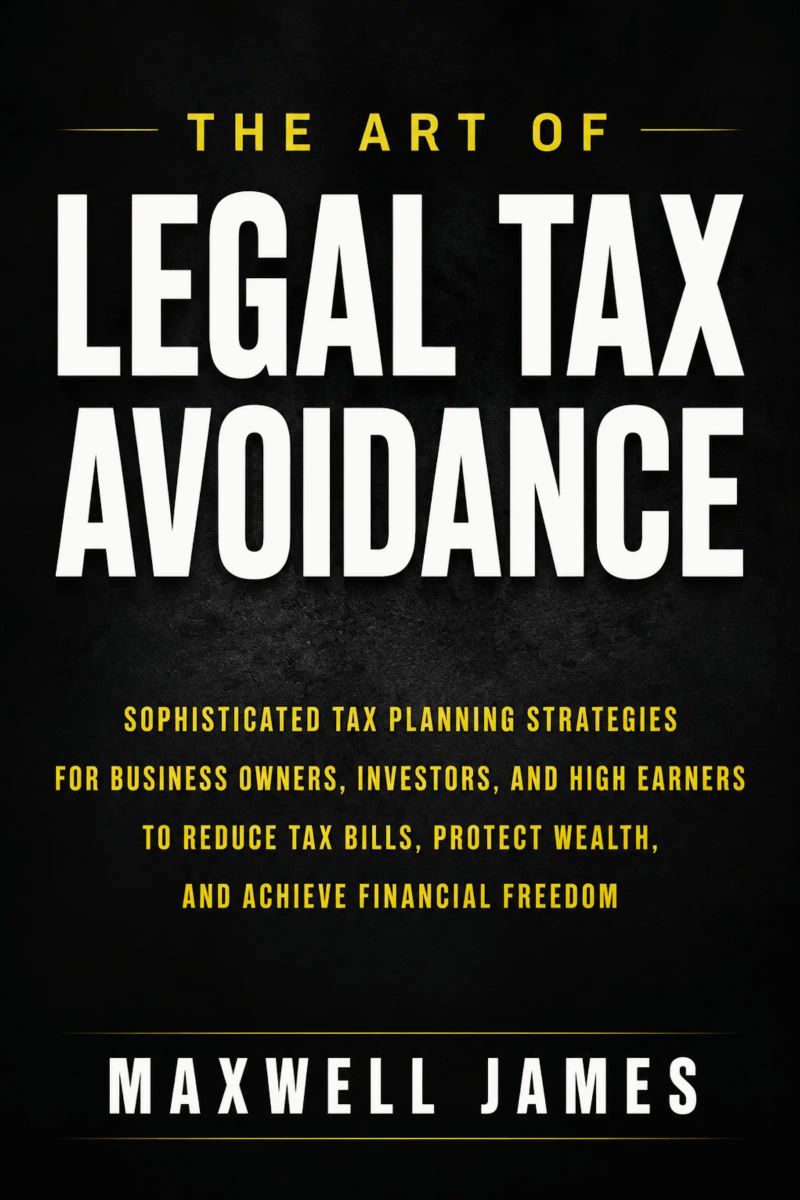
The Art Of Legal Tax Avoidance
Sophisticated Tax Planning Strategies for Business Owners, Investors, and High Earners to Reduce Tax Bills, Protect Wealth, and Achieve Financial FreedomBy Maxwell James


Length4h 47m
About this audiobook
Every April, high earners across America write a cheque to the IRS that represents the single largest expense of their year. Not because they did anything wrong. Because nobody ever taught them the rules the wealthy actually play by.
The ultra-wealthy are not cheating. They are using provisions written directly into the U.S. tax code that most professionals have never heard of, deployed through structures most CPAs never discuss, executed by advisors whose job is to look forward, not just file backwards.
In The Art of Legal Tax Avoidance, tax strategist Maxwell James pulls back the curtain on the exact playbook that keeps high earners, business owners, and real estate investors from overpaying the IRS by six and seven figures across a career.
Inside, you will discover:
- The R.R.A.D. real estate framework that legally offsets W-2 income with rental losses most investors never unlock
- How cost segregation and bonus depreciation can generate six figures of first-year deductions from a single property
- The Augusta Rule: how business owners receive tax-free income from their own home, entirely within the law
- S corporation optimisation, oil and gas intangible drilling costs, Donor-Advised Funds, and the hire-your-children strategy that sophisticated planners stack together
- How to build a Perfect Tax Plan that coordinates all seven pillars of legal tax reduction into one coherent, year-round strategy
- The tax code was not written against you. It was written for people who understand how to read it.
Turn the page. Your financial future is about to receive the attention and clarity it has needed for far too long.
Audiobook details
GenreBusiness and Economics
Length4 hrs 47 mins
Narrated byListen with 1,000+ voices
FormateBook with Audio
LanguageEnglish
Table of contents
1The Art of Legal Tax Avoidance Sophisticated Tax Planning St
2For every professional who handed over a cheque in April and
3DISCLAIMER The information presented in this book is intende
4INTRODUCTION
5PART ONE THE FOUNDATION: HOW THE TAX CODE ACTUALLY WORKS
Show all chaptersShow less
6Chapter 1: Why High Earners Overpay (And Why It Is Not Their Fault)
71.2 How the Tax Code Was Actually Written, and For Whom
81.3 The Difference Between Tax Evasion, Tax Avoidance, and Tax Planning
91.4 Why Your CPA May Be Your Biggest Tax Liability
10Chapter 2: The Architecture of Your Tax Bill
112.1 Ordinary Income vs. Capital Gains: The Two-Tier System
122.2 How Effective Tax Rate Differs From Marginal Rate
132.3 The Stacking Problem: Income Layers and Bracket Creep
142.4 Self-Employment Tax, NIIT, and the Hidden Surcharges
152.5 Reading Your Own Tax Return Like a Strategist
16Chapter 3: The Strategic Mindset Shift
173.1 From Compliance to Strategy: A Different Relationship With Tax
183.3 How the Wealthy Think About Tax as a Cash-Flow Decision
193.4 Building Your Personal Tax Reduction Roadmap
20PART TWO REAL ESTATE: THE MOST POWERFUL LEGAL TAX SHELTER IN
21Chapter 4: The R.R.A.D. Framework
224.1 Overview: Run, Reach, Accelerate, Defer
234.2 Running a Real Estate Business: What Qualifies and What Does Not
244.3 Real Estate Professional Status: The Rules, the Hours, the Documentation
254.4 The Short-Term Rental Loophole: An Alternative Path to Passive Loss Offset
264.5 Common REPS Mistakes That Trigger Audits
27Chapter 5: Accelerated Depreciation
285.1 How Depreciation Works, and Why Most Investors Underuse It
295.2 Cost Segregation Studies: Separating the Asset Classes
305.3 Bonus Depreciation: The Mechanics of Front-Loading Deductions
315.4 Section 179 and Its Interaction With Bonus Depreciation
325.5 Case Study: A $1.2 Million Property and Its First-Year Depreciation Impact
33Chapter 6: Deferring Capital Gains
346.1 The 1031 Exchange: Rules, Timelines, and Common Errors
356.2 Opportunity Zone Investments and the Deferral-Plus-Exclusion Structure
366.3 Instalment Sales as a Capital Gains Management Tool
376.4 The Stepped-Up Basis: The Most Overlooked Estate Planning Tool in Real Estate
38PART THREE THE STRATEGY STACK: LAYERS MOST CPAs NEVER MENTIO
39Chapter 7: Oil, Gas, and the Intangible Drilling Cost Deduction
407.1 Why Oil and Gas Remains One of the Last Great Tax Shelters
417.2 Intangible Drilling Costs and How They Offset Active Income
427.3 Depletion Allowances: The Ongoing Tax Benefit
437.4 Risk Profile and Due Diligence: What Sophisticated Investors Verify
44Chapter 8: Philanthropy as Strategy
458.1 Donor-Advised Funds: The Mechanics of Front-Loaded Charitable Deductions
468.2 Charitable Remainder Trusts: Income, Deduction, and Estate Benefit in One Vehicle
478.3 Conservation Easements: High-Impact and High-Scrutiny
488.4 Integrating Philanthropy Into a Multi-Year Tax Plan
49Chapter 9: The Augusta Rule and Home-Based Income
509.1 Section 280A and the 14-Day Rental Exclusion

Never Split the DifferenceChris Voss, Tahl Raz8h 7m4.4 (277.7K)$26 · $0.00
The Intelligent Investor Rev Ed.Benjamin Graham17h 48m4.3 (191.5K)$40 · $0.00
The Hard Thing About Hard ThingsBen Horowitz7h 57m4.2 (134.3K)$26 · $0.00

Boundaries for LeadersHenry Cloud7h 36m4.3 (3.6K)$26 · $0.00

Progress and Poverty, Volumes I and II (Annotated)Henry George19h 21m4.6 (574)$0.99 · $0.00

Not Everything Counts but Everything Matters: The powerful and inspirational new book about leadership and achieving success from the visionary multi-premiership winning Panthers coachIvan Cleary6h 1m4.6 (680)$24 · $0.00
BuildTony Fadell11h 5m4.5 (14.3K)$8 · $0.00

The Joys Of CompoundingGautam Baid17h 34m4.5 (2.5K)$18 · $0.00
Basic EconomicsThomas Sowell18h 32m4.5 (29.3K)$28 · $0.00

Poor Charlie’s AlmanackGrover Gardener, Charles T. Munger13h 9m4.5 (24.7K)$18 · $0.00

The Ambuja StoryNarotam Sekhsaria13h 59m4.5 (830)$33 · $0.00

The Secret Door to SuccessFlorence Scovel Shinn2h 25m4.5 (2.1K)$1.20 · $0.00

This Is Going to HurtAdam Kay5h 47m4.4 (444.7K)$24 · $0.00

Big TrustShadé Zahrai, Fayçal Sekkouah8h 36m4.6 (406)$26 · $0.00

The Intelligent Investor Third EditionBenjamin Graham, Jason Zweig20h4.4 (156.6K)$46 · $0.00

Bottle of LiesKatherine Eban14h 25m4.4 (12K)$33 · $0.00

The Antiracist Business BookTrudi Lebrón6h 10m4.6 (275)$17 · $0.00

The FormulaJoshua Robinson, Jonathan Clegg10h 41m4.4 (6.9K)$29 · $0.00

Let Them LeadJohn U. Bacon7h 10m4.5 (1.4K)$24 · $0.00

Secrets of the Millionaire MindT. Harv Eker5h 11m4.4 (301.4K)$24 · $0.00
You may also like

The Rise of Silas Lapham (American Classics Series)William Dean Howells15h 34m3.6 (6.2K)$1.99 · $0.00

Indiscretions of ArchieP. G. Wodehouse8h 35m4.0 (2.6K)$2.30 · $0.00

The Lehman TrilogyStefano Massini13h 41m4.3 (2.7K)$7 · $0.00

The Company I KeepLeonard A. Lauder12h 4m4.3 (2.1K)$29 · $0.00

TitanRon Chernow35h 1m4.3 (51.1K)$30

Good CompanyArthur M. Blank7h 7m4.3 (706)$24 · $0.00

Bad boyTrascendental Publishing House9h 22m4.3 (2.1K)$9.99 · $0.00

Autobiography of Andrew CarnegieAndrew Carnegie13h 2m4.0 (2.6K)$0.99 · $0.00
The Hard Thing About Hard ThingsBen Horowitz7h 57m4.2 (134.3K)$26 · $0.00

Bitter BrewWilliam Knoedelseder12h 12m4.2 (7.5K)$29 · $0.00

The Cowboy and His BillionaireKaci M. Rose4h 35m4.5 (272) Only with Ultra

He Came For Coffee He Left With Me: BWWM Billionaire RomanceJasmine Hartley7h 16m4.4 (473) Only with Ultra

The RockefellersPeter Collier, David Horowitz30h 45m4.0 (783)$28

Mistletoe, BabyDonna Hill6h 7m4.1 (355)$20
Business BrilliantLewis Schiff7h 32m3.8 (1.9K)$26 · $0.00

The Little Lady of the Big HouseJack London11h 15m3.9 (3.5K)$2 · $0.00

Major BarbaraGeorge Bernard Shaw3h 49m3.8 (9K)$2.30

The Italian's Christmas ChildLynne Graham5h 58m3.8 (1K)$24 · $0.00

Perfect MakeoverBrenda Jackson2h 57m4.3 (917)$18 · $0.00

Tech BrosJohn Stensholt, Perry Williams9h 12m$29 · $0.00