
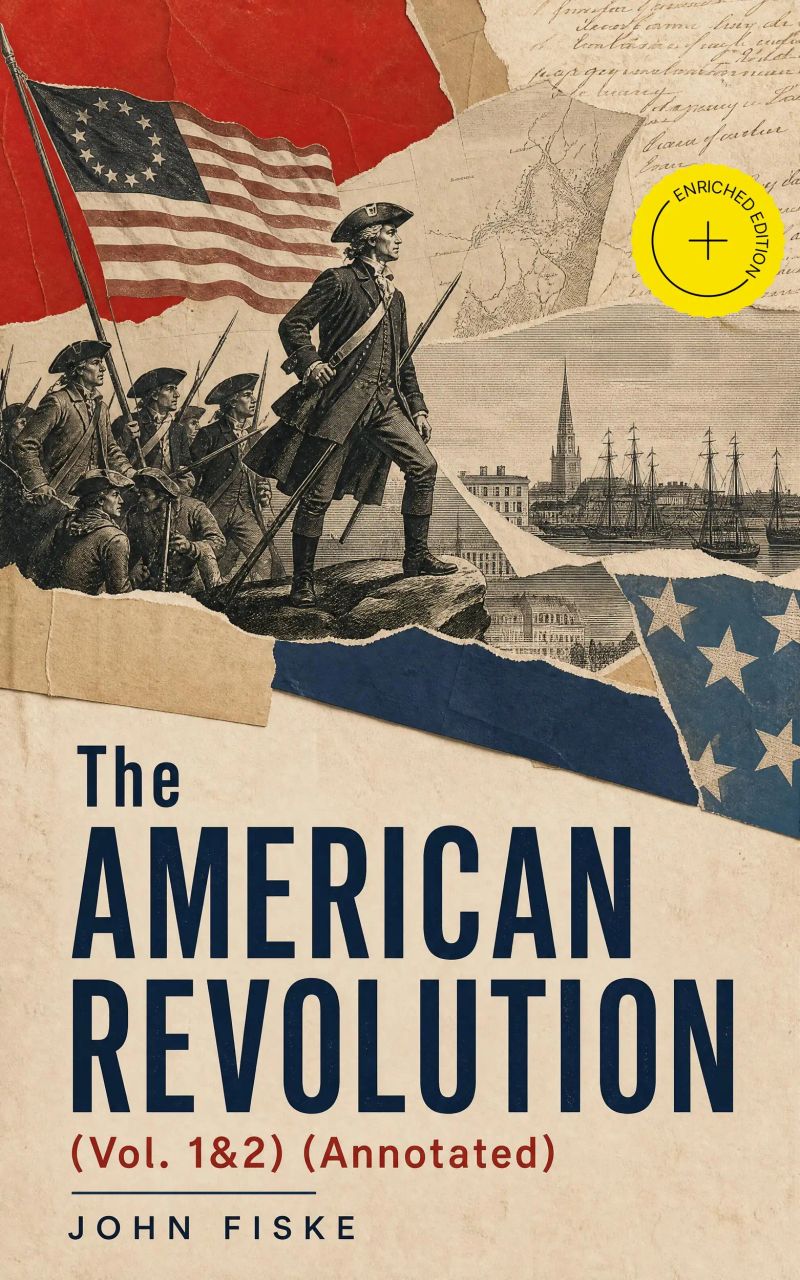
The American Revolution (Vol. 1&2) (Annotated)
Enriched Edition. Battle for American Independence: From the Rejection of the Stamp Act Until the Final VictoryBy John Fiske


Length19h 53m
About this audiobook
John Fiske's The American Revolution (Vols. 1–2) offers a sweeping narrative of the political, military, and constitutional forces that transformed colonial resistance into national independence. Written in the lucid, expansive style of nineteenth-century historical synthesis, the work combines dramatic storytelling with an interpretive emphasis on institutional development and Anglo-American liberty. Fiske situates battles, diplomacy, and revolutionary ideology within a broad evolutionary vision of history, making the Revolution not merely a war, but a decisive stage in the maturation of self-government. Fiske, an American historian, philosopher, and popularizer of Darwinian thought, brought to history a distinctive belief in progress, continuity, and the organic growth of democratic institutions. His intellectual formation in philosophy and comparative history shaped his interpretation of the Revolution as the culmination of long-standing English constitutional traditions transplanted to the New World. Writing for an educated public, he sought to make national origins intelligible, morally serious, and historically grounded. This book is recommended for readers seeking a richly contextualized, eloquent account of the Revolution from a classic American historian. While modern scholarship may revise some emphases, Fiske remains valuable for his narrative command, interpretive ambition, and insight into how nineteenth-century America understood its founding.
This enriched edition has been carefully crafted to add value to your reading experience.
- A succinct Introduction situates the work's timeless appeal and themes.
- The Synopsis outlines the central plot, highlighting key developments without spoiling critical twists.
- A detailed Historical Context immerses you in the era's events and influences that shaped the writing.
- A thorough Analysis dissects symbols, motifs, and character arcs to unearth underlying meanings.
- Reflection questions prompt you to engage personally with the work's messages, connecting them to modern life.
- Hand‐picked Memorable Quotes shine a spotlight on moments of literary brilliance.
- Interactive footnotes clarify unusual references, historical allusions, and archaic phrases for an effortless, more informed read.
Audiobook details
Rating★★★ 3.4 (133)
Includes Amazon, Goodreads
GenreHistory
Length19 hrs 53 mins
Narrated byListen with 1,000+ voices
FormateBook with Audio
Publish dateDec 15, 2023
LanguageEnglish
Table of contents
1The American Revolution (Vol. 1&2) (Annotated)
2Introduction
3Synopsis
4Historical Context
5VOLUME I
Show all chaptersShow less
6CHAPTER I THE BEGINNINGS
7The Lords of Trade
8The governor’s salary
9Sir Robert Walpole
10Weakness of the sentiment of union
11The Albany Congress
12Franklin’s plan of union, 1754
13Rejection of the plan
14Shirley recommends a stamp act
15Writs of assistance
16The chief justice of New York
17Otis’s “Vindication”
18Expenses of the French war
19Grenville’s Resolves
20Reply of the colonies
21The Stamp Act
22The Parson’s Cause
23Patrick Henry’s resolutions
24The Stamp Act Congress
25Declaration of the Massachusetts assembly
26Resistance to the Stamp Act in Boston
27And in New York
28Debate in the House of Commons
29Repeal of the Stamp Act
30The Duke of Grafton’s ministry
31The Townshend Acts
32Attack on the New York assembly
33Parliament did not properly represent the British people
34Difficulty of the problem
35Representation of Americans in Parliament
36Mr. Gladstone and the Boers
37Death of Townshend
38His political legacy to George III.
39Character of George III.
40English parties between 1760 and 1784
41George III. as a politician
42His chief reason for quarrelling with the Americans
43CHAPTER II THE CRISIS
44John Dickinson
45The Massachusetts circular letter
46Lord Hillsborough’s instructions to Bernard
47The “Illustrious Ninety-Two”
48Impressment of citizens
49Statute of Henry VIII. concerning “treason committed abroad”
50Samuel Adams makes up his mind, 1768
More from John Fiske

The Age of Revolution: History of the American & French Revolution (Vol. 1&2) (Annotated)John Fiske, Charles Downer Hazen29h 17m$2 · $0.00

THE AMERICAN REVOLUTION (Complete Edition In 2 Volumes) (Annotated)John Fiske19h 51m4.2 (64)$2 · $0.00

The American Revolution & The French Revolution (Annotated)John Fiske, Charles Downer Hazen29h 17m$2 · $0.00

Myths and Myth-MakersJohn Fiske8h 49m3.5 (148)$1 · $0.00

The Critical Period of American HistoryJohn Fiske8h 55m4.0 (276)$1 · $0.00

The Beginnings of New EnglandJohn Fiske8h 20m4.0 (27)$1 · $0.00

The American Revolution (Vol. 1&2)John Fiske20h 52m3.7 (160)$1 · $0.00

The American & The French RevolutionJohn Fiske, Charles Downer Hazen29h 9m$2 · $0.00

The History of American & French RevolutionJohn Fiske, Charles Downer Hazen29h 3m$1 · $0.00

Life EverlastingJohn Fiske8m$1 · $0.00

The Idea of God as Affected by Modern KnowledgeJohn Fiske3h 18m3.9 (37)$2 · $0.00

The American Revolution & The French RevolutionJohn Fiske, Charles Downer Hazen28h 23m$1 · $0.00

The Beginnings of New EnglandJohn Fiske7h 42m4.0 (98)$0.99 · $0.00

THE AMERICAN REVOLUTION (Complete Edition In 2 Volumes)John Fiske20h 3m4.0 (231)$1.99 · $0.00

A Brief History of IntelligenceMax S. Bennett12h 18m4.6 (6.6K)$29 · $0.00

The Gulag Archipelago Volume 3Aleksandr I. Solzhenitsyn21h 56m4.7 (8.9K)$46 · $0.00

Pearl of Great PriceJoseph Smith3h 8m4.7 (7.2K)$1.20 · $0.00

The Happiest Man on EarthEddie Jaku3h 48m4.6 (178K)$7 · $0.00

MotherlandJulia Ioffe17h 52m4.7 (2.5K)$40 · $0.00

Where Cowards Go to DieBenjamin Sledge8h 42m4.7 (351)$20 · $0.00

RevolutionariesSanjeev Sanyal11h 23m4.6 (2.6K)$29 · $0.00

Days of Love and Rage: A Story of RevolutionAnand Gopal22h 36m4.7 (584)$34 · $0.00

We Crossed a Bridge and It TrembledWendy Pearlman6h4.6 (5.2K)$24 · $0.00

Unbroken Bonds of BattleJohnny Joey Jones8h 31m4.6 (2.6K)$8 · $0.00

The Daughter of AuschwitzTova Friedman, Malcolm Brabant7h 54m4.6 (16.7K)$26 · $0.00

Lily's PromiseLily Ebert, Dov Forman8h 54m4.6 (16.1K)$29 · $0.00

On Democracies and Death CultsDouglas Murray10h 38m4.6 (6.5K)$29 · $0.00

Across the RiverKent Babb11h 40m4.6 (927)$29 · $0.00

Balcony Over Jerusalem: A Middle East Memoir - Israel, Palestine and BeyondJohn Lyons12h 37m4.6 (1.4K)$33 · $0.00

BeyondStephen Walker15h 39m4.6 (3.2K)$33 · $0.00
Kings and PawnsHoward Bryant10h 9m4.6 (678)$29 · $0.00

No EscapeNury Turkel9h 30m4.6 (809)$28 · $0.00

Jubal Stone: U.S. Marshal: Blood Trail To Hell: A Western Adventure NovelCasey Nash3h 42m4.6 (3.2K)$18 · $0.00

Fall and RiseMitchell Zuckoff17h 23m4.6 (9.8K)$40 · $0.00
You may also like

The History of the Peloponnesian WarThucydides22h 10m4.2 (54.2K)$2.30

The River War (History of the War in Sudan)Winston Churchill15h 2m4.1 (2.2K)$1.99 · $0.00
Darwin on TrialPhillip E. Johnson6h 35m4.0 (2.5K)$20

Memoirs of General William T. Sherman (Annotated)William Tecumseh Sherman40h 38m4.3 (4.2K)$2 · $0.00

Small Wars ManualUnited States Marine Corps20h 27m4.2 (355)$2 · $0.00
The Conscience of a ConservativeBarry Goldwater, CC Goldwater4h 7m4.0 (14.7K)$20

The Communist ManifestoKarl Marx1h 13m3.9 (240.6K)$3 · $0.00

Destruction and Reconstruction: / Personal Experiences of the Late WarRichard Taylor10h 51m4.1 (440)$2.30

Ten Days That Shook the World (Annotated)John Reed11h 40m4.2 (25.8K)$2 · $0.00
Lincoln's LieutenantsStephen W. Sears31h 36m4.4 (1.1K)$53 · $0.00

The Long Road to GettysburgJim Murphy2h4.1 (315)$13

Vietnam War: A Complete History of Conflict, Politics, and Human CostRaymond Webb57m$3.40 · $0.00

FredericksburgMajor G. W. Redway6h 59m$17

The Jacobite Rebellions (1689-1746) (Bell's Scottish History Source Books.) (Annotated)J. Pringle Thomson6h 6m$3 · $0.00

The U.S.-Mexican War (Vol. 1&2) (Annotated)Justin H. Smith55h 51m3.9 (26)$2 · $0.00

West Pointers and the Civil WarWayne Wei-siang Hsieh8h 58m3.6 (30)$20
Witness to AppomattoxRichard Wheeler8h 7m4.0 (36)$17

The Battle of WaterlooJohn Codman Ropes15h 1m4.1 (56)$1.99 · $0.00

The Story of the Great War, Volume 2 of 8Various18h 34m3.6 (25)$2.30

Military Reminiscences of the Civil War (Vol.1&2) (Annotated)Jacob D. Cox41h 19m4.3 (20)$1.99 · $0.00