
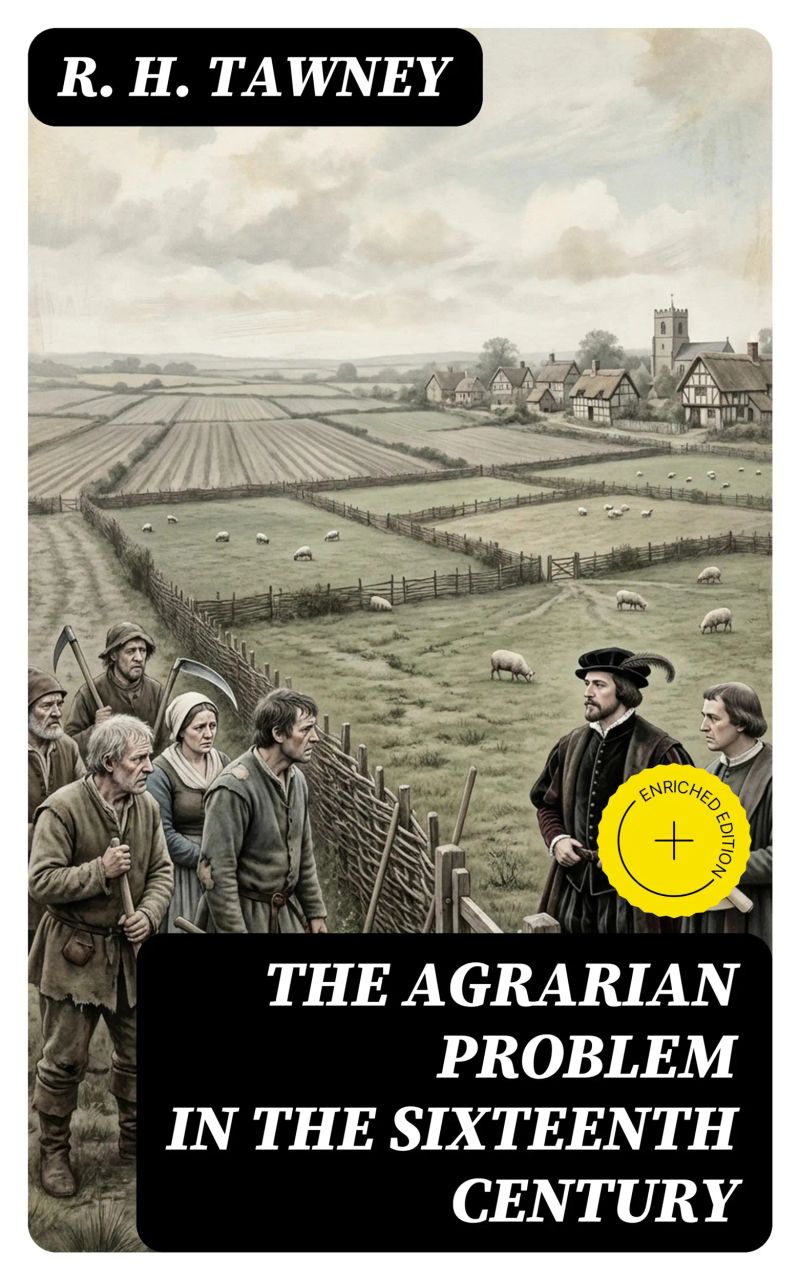
The Agrarian Problem in the Sixteenth Century (Annotated)
Enriched Edition. Land, Labor, and Inequality in Tudor England: From Feudalism to Agrarian CapitalismBy R. H. Tawney


Length16h 7m
About this audiobook
R. H. Tawney's The Agrarian Problem in the Sixteenth Century is a pioneering study of the social and economic transformations that reshaped Tudor England. Drawing on legal records, parliamentary material, contemporary commentary, and economic evidence, Tawney examines enclosure, engrossing, the decline of customary tenures, population growth, inflation, and the changing relations between landlords, yeomen, copyholders, and agricultural laborers. Its argument combines rigorous historical analysis with a strong moral and institutional perspective: agrarian change is presented not as an inevitable modernization, but as a contested process whose benefits and burdens were unequally distributed. Written in lucid, forceful prose, the book belongs to the formative tradition of early twentieth-century economic and social history, while anticipating later scholarship on class, rural society, and the origins of capitalism. Tawney (1880–1962), an influential economic historian, Christian socialist, and reformer, brought to the subject both archival discipline and a profound concern for social justice. His engagement with poverty, education, labor organization, and the ethical responsibilities of economic institutions informed his interpretation of the Tudor countryside. Rather than treating agrarian history as a specialized chronology, he understood it as a crucial foundation for explaining England's political economy and enduring social inequalities. This book remains essential for readers interested in Tudor England, the history of land and property, rural social relations, or the emergence of modern economic structures. Its detailed evidence rewards careful study, while its humane, challenging argument continues to provoke debate about progress, dispossession, and the purposes of historical scholarship.
This enriched edition has been carefully crafted to add value to your reading experience.
- A succinct Introduction situates the work's timeless appeal and themes.
- The Synopsis outlines the central plot, highlighting key developments without spoiling critical twists.
- A detailed Historical Context immerses you in the era's events and influences that shaped the writing.
- A thorough Analysis dissects symbols, motifs, and character arcs to unearth underlying meanings.
- Reflection questions prompt you to engage personally with the work's messages, connecting them to modern life.
- Hand‐picked Memorable Quotes shine a spotlight on moments of literary brilliance.
- Interactive footnotes clarify unusual references, historical allusions, and archaic phrases for an effortless, more informed read.
Audiobook details
Rating★★★★ 4.2 (52)
Includes LibraryThing, Goodreads
GenreHistory
Length16 hrs 7 mins
Narrated byListen with 1,000+ voices
FormateBook with Audio
Publish dateNov 21, 2022
LanguageEnglish
Table of contents
1The Agrarian Problem in the Sixteenth Century (Annotated)
2Introduction
3Synopsis
4Historical Context
5PREFACE
Show all chaptersShow less
6INTRODUCTION
7PART I THE SMALL LANDHOLDER
8CHAPTER I THE RURAL POPULATION
9(a) The Classes of Landholders
10(b) The Freeholders
11Table II
12(c) The Customary Tenants
13Table III
14CHAPTER II THE PEASANTRY
15(a) The Variety of Conditions
16(b) The Consolidation of Peasant Holdings
17Table IV
18(c) The Growth of a Land Market among the Peasants
19CHAPTER III THE PEASANTRY (continued)
20(d) The Economic Environment of the Small Cultivator
21Table V
22Table VI
23CHAPTER IV THE PEASANTRY (continued)
24(e) Signs of Change
25(f) The Growth of Competitive Rents on New Allotments
26(g) The Progress of Enclosure among the Peasantry
27PART II THE TRANSITION TO CAPITALIST AGRICULTURE
28CHAPTER I THE NEW RURAL ECONOMY
29(a) Motives and Causes
30(b) The Growth of the Large Leasehold Farm
31(c) Enclosure and Conversion by the Manorial Authorities
32Table IX
33Table X
34I
35II
36Composed of (a) Thirty-two Farms on
37Twenty-three Manors in Wilts and One Manor in Dorset
38(b) Sixteen Farms on Thirteen Manors in
39Norfolk and Suffolk
40(c) Seventeen Farms on Thirteen Other Manors
41Mainly in South and Midlands
42III
43Table XI
44CHAPTER II THE REACTION OF THE AGRARIAN CHANGES ON THE PEASANTRY
45(a) The Removing of Landmarks
46(b) The Struggle for the Commons
47(c) The Engrossing of Holdings and Displacement of Tenants
48In the West Felde
49Table XII
50(d) The Agrarian Changes and the Poor Law
More from R. H. Tawney


A Brief History of IntelligenceMax S. Bennett12h 18m4.6 (6.6K)$29 · $0.00

The Daughter of AuschwitzTova Friedman, Malcolm Brabant7h 54m4.6 (16.7K)$26 · $0.00

Lily's PromiseLily Ebert, Dov Forman8h 54m4.6 (16.1K)$29 · $0.00

On Democracies and Death CultsDouglas Murray10h 38m4.6 (6.5K)$29 · $0.00

Across the RiverKent Babb11h 40m4.6 (927)$29 · $0.00

Balcony Over Jerusalem: A Middle East Memoir - Israel, Palestine and BeyondJohn Lyons12h 37m4.6 (1.4K)$33 · $0.00

BeyondStephen Walker15h 39m4.6 (3.2K)$33 · $0.00

Kings and PawnsHoward Bryant10h 9m4.6 (678)$29 · $0.00

No EscapeNury Turkel9h 30m4.6 (809)$28 · $0.00

Jubal Stone: U.S. Marshal: Blood Trail To Hell: A Western Adventure NovelCasey Nash3h 42m4.6 (3.2K)$18 · $0.00

Fall and RiseMitchell Zuckoff17h 23m4.6 (9.8K)$40 · $0.00

The SurvivorJosef Lewkowicz, Michael Calvin9h 22m4.6 (2.5K)$29 · $0.00

Always FaithfulThomas Schueman, Zainullah Zaki12h 12m4.6 (977)$29 · $0.00

The State of Society in France Before the Revolution of 1789 (Annotated)Alexis de Tocqueville17h 25m4.6 (1.2K)$2 · $0.00

All the Gallant MenDonald Stratton, Ken Gire5h 55m4.6 (11.8K)$24 · $0.00

Saint Joan (Annotated)George Bernard Shaw6h 20m4.6 (1.2K)$1.20 · $0.00

Medgar and MyrlieJoy-Ann Reid10h 52m4.5 (27.8K)$29 · $0.00

The History of the Peloponnesian War (Annotated)Thucydides24h 3m4.6 (1.1K)$2 · $0.00

Where the Birds Never SingJack Sacco10h 31m4.6 (3.8K)$29 · $0.00

Serviceman J: The Untold Story of an NZSAS SoldierJamie Pennell5h 51m4.6 (452)$24 · $0.00
You may also like

The Memoirs of Madame Vigée LebrunLouise-Elisabeth Vigée-Lebrun8h 37m4.1 (387)$2 · $0.00

Queen of ExilesVanessa Riley17h 51m4.0 (2.2K)$40 · $0.00

The Great HungerCecil Woodham-Smith18h 23m4.3 (2.3K)$28

Stories of the PilgrimsMargaret B. Pumphrey4h 12m4.3 (746)$10

Blood, Sweat, and PixelsJason Schreier7h 58m4.3 (32.8K)$26 · $0.00

The History of the Colonial Virginia (Book 1-3)Thomas J. Wertenbaker26h 58m4.6 (11)$2 · $0.00

St. John's College, CambridgeRobert Forsyth Scott52m$2 · $0.00

Elizabethan EnglandSantiago Machain6h 48m$25 · $0.00

THE TRAIL OF TEARSDavid Whitcomb Hayes5h 22m$10 · $0.00

History of the United Netherlands, 1597-98John Lothrop Motley2h 38m$2 · $0.00

MuratAlexandre Dumas1h 41m3.5 (117)$1.20 · $0.00

The American Indian Under ReconstructionAnnie Heloise Abel7h 19m4.0 (11)$1 · $0.00

The american revolutionJames R. Whitfield2h 20m$9 · $0.00

Victorian Society and the Class SystemSantiago Machain9h 24m$29 · $0.00

Ireland under Coercion: The Diary of an American (Annotated)William Henry Hurlbert17h 18m$2 · $0.00

The Acadian Exiles : a Chronicle of the Land of EvangelineArthur G. Sir Doughty4h 32m3.9 (23)$2 · $0.00

Jewish History: A 12-Volume AnthologyMaurice H. Harris, Simon Dubnow, Max Radin, Flavius Josephus, Alfred Edersheim, Joseph Krauskopf, David Baron, Peter Wiernik, G. K. Chesterton, Lady Katie Magnus194h4.4 (15)$1.99
The Founding of New England (Summarized Edition)James Truslow Adams4h 23m3.9 (36)$2

The Story of Moors in Spain (Annotated)Stanley Lane-Poole7h 44m$2 · $0.00

The Development of Religious Liberty in ConnecticutM. Louise Greene10h 56m$2 · $0.00