
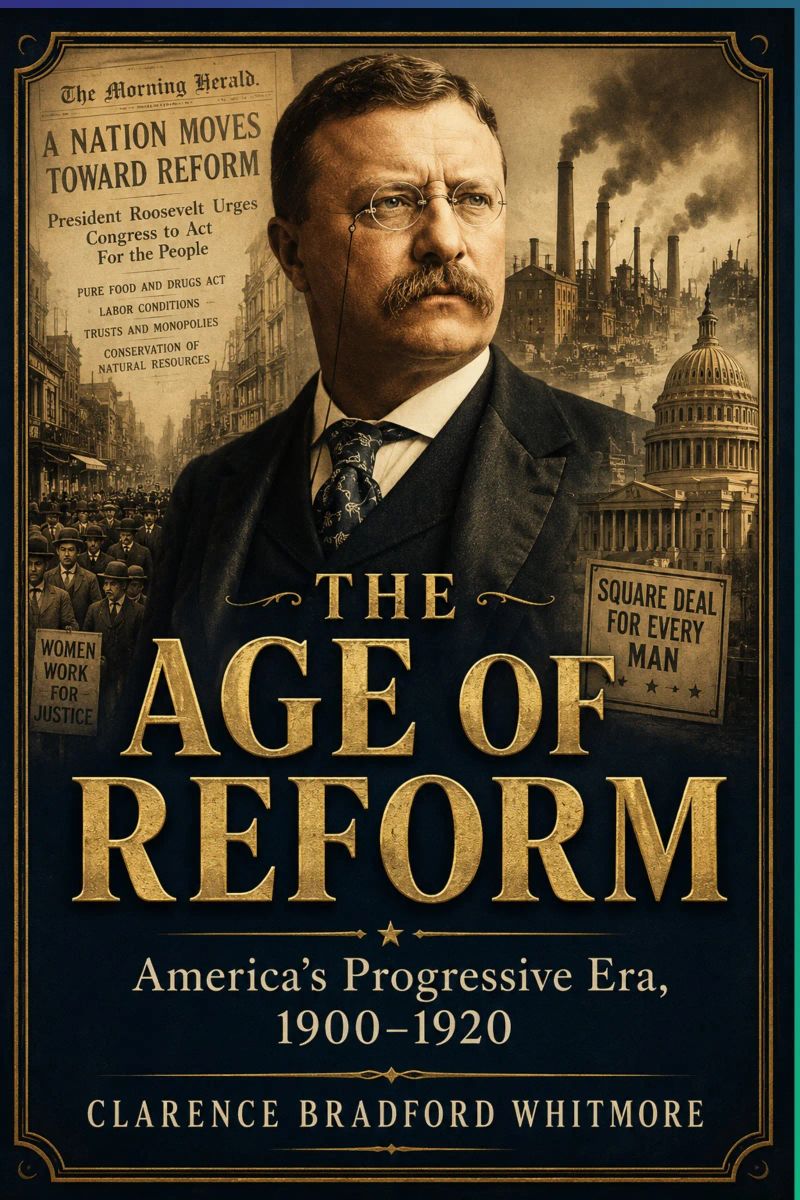
the age of reform
America's Progressive Era, 1900–1920By Clarence Bradford Whitmore


Length7h 13m
About this audiobook
The complete narrative history of America's Progressive Era — Theodore Roosevelt, Woodrow Wilson, the muckrakers, and the unfinished fight to tame American capitalism, 1900-1920.
In the autumn of 1902, a forty-four-year-old journalist named Ida Tarbell sat in the McClure's Magazine offices on East Twenty-Third Street, surrounded by three years of depositions and court records. Her target: the Standard Oil Company, the largest corporation in the world. Her platform: a nineteen-installment expose that would help dissolve a monopoly, reshape American journalism, and ignite the Progressive Era's most consequential reform movement.
This is the story of how Tarbell — and Theodore Roosevelt, Jane Addams, Upton Sinclair, Lincoln Steffens, Jacob Riis, Robert La Follette, W. E. B. Du Bois, and Woodrow Wilson — built the modern American state. Across twenty-four chapters in six parts, historian Clarence Bradford Whitmore traces the full arc of America's Progressive Era from McKinley's assassination in Buffalo in 1901 through the collapse of the reform consensus after World War I.
Inside this Progressive Era history:
• Trust-busting and the Square Deal — how a $4.50 revolver elevated Theodore Roosevelt to the presidency at age 42, and what he did with the antitrust laws (Chapters 1-4)
• The Jungle and the Pure Food and Drug Act — Upton Sinclair's seven weeks in the Chicago stockyards and the Neill-Reynolds report that horrified Roosevelt into action (Chapter 6)
• Hull House and the settlement movement — Jane Addams at 800 South Halsted Street, in a neighborhood with nineteen nationalities and a tuberculosis rate two and a half times the citywide average (Chapter 10)
• The Wisconsin Idea — Robert La Follette's state laboratory of reform that became a template for the New Deal (Chapter 9)
• The NAACP's founding — W. E. B. Du Bois, the Niagara Movement, and civil-rights organizing inside a reform movement that mostly looked away (Chapter 12)
• Wilson's New Freedom — the Federal Reserve, the Clayton Act, the income tax, women's suffrage, and the four constitutional amendments that bear the Progressive fingerprint (Chapters 16-18)
• The honest reckoning — the racial exclusions, paternalism, regulatory capture, and Prohibition gone wrong that the reformers built into the system even as they tried to reform it (Chapters 19, 22-23)
The Progressives left behind institutions that still shape American life — the national parks, the antitrust framework, federal food safety, the income tax, the Federal Reserve. They also left behind a question, the one Ida Tarbell was working on in 1902: can democratic government tame concentrated capital, or does that power always find a way to reconstitute itself? Their answer was provisional. Ours is still being written.
For readers of Doris Kearns Goodwin's THE BULLY PULPIT and Edmund Morris's THE RISE OF THEODORE ROOSEVELT.
Audiobook details
GenreHistory
Length7 hrs 13 mins
Narrated byListen with 1,000+ voices
FormateBook with Audio
Publish dateJun 2, 2026
LanguageEnglish
Table of contents
1Introduction
2Prologue: The Muckraker's America
3PART ONE: THEODORE ROOSEVELT AND THE SQUARE DEAL (1901–1909)
4Chapter 1: The Accidental President — Theodore Roosevelt Takes Power
5Chapter 2: Trust-Busting — Roosevelt and the Corporations
Show all chaptersShow less
6Chapter 3: Conservation — Roosevelt and the American Land
7Chapter 4: The Square Deal — Labor, Capital, and the Roosevelt Presidency
8PART TWO: THE MUCKRAKERS (1900–1914)
9Chapter 5: Ida Tarbell and Standard Oil — Journalism as Reform
10Chapter 6: The Jungle — Upton Sinclair and the Meatpacking Exposé
11Chapter 7: Lincoln Steffens and the Shame of the Cities
12Chapter 8: Jacob Riis and the Photography of Poverty
13PART THREE: THE REFORM MOVEMENT (1900–1916)
14Chapter 9: The Wisconsin Idea — Robert La Follette and State Reform
15Chapter 10: The Settlement House Movement — Jane Addams and Hull House
16Chapter 11: Women's Suffrage — The Long March to the Nineteenth Amendment
17Chapter 12: The NAACP — W. E. B. Du Bois and the Fight for Civil Rights
18PART FOUR: TAFT AND THE PARTY SPLIT (1909–1913)
19Chapter 13: William Howard Taft — The Reluctant Progressive
20Chapter 14: The Bull Moose Campaign — Roosevelt's Return and the Party Split
21Chapter 15: Woodrow Wilson and the New Freedom
22Chapter 16: The Constitutional Amendments — Income Tax, Senators, Prohibition, Suffrage
23PART FIVE: WILSON'S AMERICA (1913–1917)
24Chapter 17: The Federal Reserve — Reforming American Finance
25Chapter 18: Labor and the Law — The Clayton Act and Workers' Rights
26Chapter 19: Race in the Progressive Era — The Limits of Reform
27Chapter 20: The New Woman — Feminism, Work, and the Changing American Family
28PART SIX: THE PROGRESSIVE LEGACY (1917–PRESENT)
29Chapter 21: World War I and the End of Progressivism
30Chapter 22: Prohibition — The Progressive Crusade Gone Wrong
31Chapter 23: The Progressive Legacy — What Survived and What Didn't
32Chapter 24: The Progressive Tradition in American Politics
33Epilogue: What the Progressives Left Behind
34Acknowledgments
35Selected Bibliography
36About the Author
More from Clarence Bradford Whitmore


A Brief History of IntelligenceMax S. Bennett12h 18m4.6 (6.6K)$29 · $0.00

RevolutionariesSanjeev Sanyal11h 23m4.6 (2.6K)$29 · $0.00

We Crossed a Bridge and It TrembledWendy Pearlman6h4.6 (5.2K)$24 · $0.00

Unbroken Bonds of BattleJohnny Joey Jones8h 31m4.6 (2.6K)$8 · $0.00

The Daughter of AuschwitzTova Friedman, Malcolm Brabant7h 54m4.6 (16.7K)$26 · $0.00

Lily's PromiseLily Ebert, Dov Forman8h 54m4.6 (16.1K)$29 · $0.00

On Democracies and Death CultsDouglas Murray10h 38m4.6 (6.5K)$29 · $0.00

Across the RiverKent Babb11h 40m4.6 (927)$29 · $0.00

Balcony Over Jerusalem: A Middle East Memoir - Israel, Palestine and BeyondJohn Lyons12h 37m4.6 (1.4K)$33 · $0.00

BeyondStephen Walker15h 39m4.6 (3.2K)$33 · $0.00
Kings and PawnsHoward Bryant10h 9m4.6 (678)$29 · $0.00

No EscapeNury Turkel9h 30m4.6 (809)$28 · $0.00

Jubal Stone: U.S. Marshal: Blood Trail To Hell: A Western Adventure NovelCasey Nash3h 42m4.6 (3.2K)$18 · $0.00

Fall and RiseMitchell Zuckoff17h 23m4.6 (9.8K)$40 · $0.00

The SurvivorJosef Lewkowicz, Michael Calvin9h 22m4.6 (2.5K)$29 · $0.00

Always FaithfulThomas Schueman, Zainullah Zaki12h 12m4.6 (977)$29 · $0.00

The State of Society in France Before the Revolution of 1789 (Annotated)Alexis de Tocqueville17h 25m4.6 (1.2K)$2 · $0.00

All the Gallant MenDonald Stratton, Ken Gire5h 55m4.6 (11.8K)$24 · $0.00
Saint Joan (Annotated)George Bernard Shaw6h 20m4.6 (1.2K)$1.20 · $0.00
Medgar and MyrlieJoy-Ann Reid10h 52m4.5 (27.8K)$29 · $0.00
You may also like

John Lennon vs. the USALeon Wildes7h 52m4.1 (271)$20

Leave It to Plum!Matt Phelan1h 4m4.1 (605)$13 · $0.00

Just TransferredNamita Kala, Bhavdeep Kang7h 50m4.3 (389)$18 · $0.00
RiggedHemingway, Mollie15h 49m4.6 (12.6K)Free
ConvictionDenver Nicks, John Nicks6h 33m4.2 (284)$20

One Day In BudapestJ. F. Penn2h 50m4.1 (584) Only with Ultra

The Courage to Be FreeRon DeSantis9h4.1 (6.3K)$29 · $0.00

ObsessionByron York9h 23m4.5 (1.2K)$20

2024Vijai Trivedi, Rajdeep Sardesai24h 56m4.1 (465)$53 · $0.00

The Secret of MagicDeborah Johnson14h 15m3.9 (3.5K)$25

Alabama v. KingDavid Fisher, Dan Abrams12h 26m4.4 (1K)$4 · $0.00
Devil in the GroveGilbert King17h 53m4.5 (21.4K)$40 · $0.00

The Office Behind Closed DoorsLynvina Mance48m5.0 (9) Only with Ultra

Flint’s HonorRichard S. Wheeler11h 44m4.1 (36)$21

Pioneers of Social Justice & Relief – 3 Classic Human Rights TreatisesMaria Weston Chapman, Clara Barton, Ida B. Wells-Barnett12h 39m$2

SHADOWS ABOVE THE WATERSHEDJudson Powers56m4.6 (9) Only with Ultra

History of the Washington National Monument and of the Washington National Monument SocietyFrederick L. Harvey4h 10m$1 · $0.00
Give Us LibertyDick Armey, Matt Kibbe7h 8m3.5 (287)$24 · $0.00
William Jay and the Constitutional Movement for the Abolition of SlaveryBayard Tuckerman5h 14m$2 · $0.00

The PresidentJohn Stewart6h 44m$7 · $0.00