
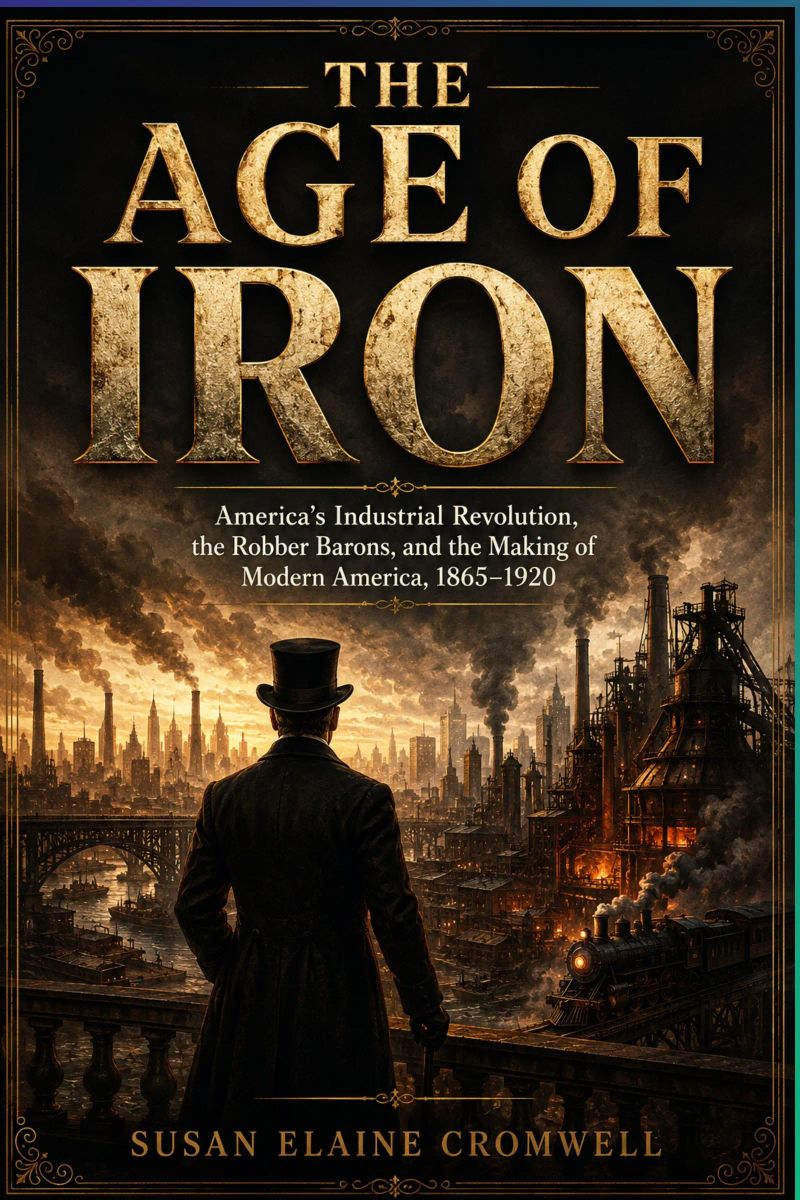
The age of iron
America's Industrial Revolution, the Robber Barons, and the Making of Modern America, 1865-1920By Susan Elaine Cromwell


Length6h 1m
About this audiobook
The complete narrative history of America's Industrial Revolution — Carnegie, Rockefeller, J.P. Morgan, the robber barons, the factory workers, and the making of modern America, 1865-1920.
In 1865, the United States was a nation of farms. By 1910, it produced more steel than Britain and Germany combined. Andrew Carnegie opened the Edgar Thomson Steel Works near Pittsburgh in 1875, hired Captain Bill Jones to drive production until it was the most efficient mill in the world, then sold the entire operation to J.P. Morgan in 1901 for $480 million — and spent his remaining years building 2,509 libraries while the workers who made his fortune labored twelve-hour days in mills where accidents killed by the hundreds each year.
This is the story of that transformation — of Andrew Carnegie, John D. Rockefeller, J.P. Morgan, Jay Gould, Ida Tarbell, Samuel Gompers, and Eugene Debs — across twenty-four chapters in six parts. Historian Susan Elaine Cromwell traces the full arc of American industrialization from the Bessemer revolution through the Progressive regulatory response, covering the robber barons, the immigrant factory city, child labor, workplace disasters, and the antitrust tradition that still shapes American law.
Inside this Industrial Revolution history:
• Carnegie's vertical integration — Mesabi Range ore, Great Lakes steamships, and connecting railroads giving Carnegie control from ore in the ground to finished rail on the loading dock (Chapter 1)
• Rockefeller's Standard Oil Trust — secret railroad rebates, the Cleveland Massacre that bought out 22 of 26 independent refineries in six weeks, and the 1882 trust controlling 90% of American refining (Chapters 2, 6)
• The railroad nation — 30,000 miles of track in 1860 growing to 163,000 by 1890, Chinese workers blasting through the Sierra Nevada with black powder, and the 1883 time zones that synchronized the nation's clocks (Chapter 3)
• The factory worker's world — twelve-hour days at 130-degree furnaces, an assumption-of-risk doctrine that blocked injury suits, and fifty-two years between the 1886 eight-hour demand and the 1938 Fair Labor Standards Act (Chapter 13)
• Workplace disasters — Monongah Mine, December 1907: 362 dead, the worst industrial accident in American history; Triangle Shirtwaist, March 1911: 146 young immigrant women dead in ten minutes (Chapter 16)
• The regulatory response — the Sherman Antitrust Act, Standard Oil's 1911 dissolution into 34 companies, and the Federal Reserve replacing J.P. Morgan's one-man financial rescues (Chapters 17-20)
The robber barons delivered steel rails and kerosene at falling prices — and did so through methods that suppressed competition, exploited workers, and concentrated economic power in ways that democratic politics found intolerable. Cromwell delivers both sides of that ledger and the unfinished argument the industrial revolution bequeathed to every generation since.
For readers of Ron Chernow's TITAN and T.J. Stiles's THE FIRST TYCOON.
Audiobook details
GenreHistory
Length6 hrs 1 min
Narrated byListen with 1,000+ voices
FormateBook with Audio
Publish dateJun 2, 2026
LanguageEnglish
Table of contents
1Introduction
2Prologue: The Factory Nation
3PART ONE: THE FOUNDATIONS (1865-1880)
4Chapter 1: Steel — Andrew Carnegie and the Bessemer Revolution
5Chapter 2: Oil — John D. Rockefeller and the Standard Oil Trust
Show all chaptersShow less
6Chapter 3: The Railroads — The Iron Network That Made a National Market
7Chapter 4: The Corporation — The New Business Form and Its Power
8PART TWO: THE ROBBER BARONS
9Chapter 5: Carnegie — Steel, Libraries, and the Gospel of Wealth
10Chapter 6: Rockefeller — Standard Oil and the Art of Monopoly
11Chapter 7: J.P. Morgan — Finance, Consolidation, and the Banker's Power
12Chapter 8: Vanderbilt, Gould, and Fisk — The Railroad Barons and Their Wars
13PART THREE: THE INDUSTRIAL CITY
14Chapter 9: Pittsburgh and Chicago — The Factory Cities
15Chapter 10: The Urban Poor — Tenements, Jacob Riis, and How the Other Half Lives
16Chapter 11: The Department Store and Consumer Culture — Macy's, Sears, and the New Commerce
17Chapter 12: Technology and Invention — Edison, Bell, and the Second Industrial Revolution
18PART FOUR: THE HUMAN COST
19Chapter 13: The Factory Worker — Hours, Wages, and Dangerous Conditions
20Chapter 14: Child Labor — The Mines, Mills, and the Children Who Worked Them
21Chapter 15: The Immigrant Worker — Ellis Island, the Ethnic Neighborhood, and Industrial Labor
22Chapter 16: Workplace Disasters — The Mines, the Mills, and the Price of Industry
23PART FIVE: THE REGULATORY RESPONSE
24Chapter 17: The Grange and Populism — Farmers Against the Railroads
25Chapter 18: The Interstate Commerce Act and the Sherman Antitrust Act
26Chapter 19: The Progressive Trust-Busters — Roosevelt, Taft, and the Breakup of Standard Oil
27Chapter 20: The Federal Reserve — Banking Reform and Financial Regulation
28PART SIX: LEGACIES
29Chapter 21: The American Standard of Living — What Industrialization Produced
30Chapter 22: The Corporate Economy — Big Business and Its Permanent Place in American Life
31Chapter 23: The Antitrust Tradition — From Sherman to the Twenty-First Century
32Chapter 24: The Industrial Legacy — Environmental Cost and Economic Transformation
33Epilogue: What Industry Made
34Acknowledgments
35Selected Bibliography
36About the Author
More from Susan Elaine Cromwell

A Brief History of IntelligenceMax S. Bennett12h 18m4.6 (6.6K)$29 · $0.00

The Happiest Man on EarthEddie Jaku3h 48m4.6 (178K)$7 · $0.00

MotherlandJulia Ioffe17h 52m4.7 (2.5K)$40 · $0.00

Where Cowards Go to DieBenjamin Sledge8h 42m4.7 (351)$20 · $0.00

RevolutionariesSanjeev Sanyal11h 23m4.6 (2.6K)$29 · $0.00

We Crossed a Bridge and It TrembledWendy Pearlman6h4.6 (5.2K)$24 · $0.00

Unbroken Bonds of BattleJohnny Joey Jones8h 31m4.6 (2.6K)$8 · $0.00

The Daughter of AuschwitzTova Friedman, Malcolm Brabant7h 54m4.6 (16.7K)$26 · $0.00

Lily's PromiseLily Ebert, Dov Forman8h 54m4.6 (16.1K)$29 · $0.00

On Democracies and Death CultsDouglas Murray10h 38m4.6 (6.5K)$29 · $0.00

Across the RiverKent Babb11h 40m4.6 (927)$29 · $0.00

Balcony Over Jerusalem: A Middle East Memoir - Israel, Palestine and BeyondJohn Lyons12h 37m4.6 (1.4K)$33 · $0.00

BeyondStephen Walker15h 39m4.6 (3.2K)$33 · $0.00
Kings and PawnsHoward Bryant10h 9m4.6 (678)$29 · $0.00

No EscapeNury Turkel9h 30m4.6 (809)$28 · $0.00

Jubal Stone: U.S. Marshal: Blood Trail To Hell: A Western Adventure NovelCasey Nash3h 42m4.6 (3.2K)$18 · $0.00

Fall and RiseMitchell Zuckoff17h 23m4.6 (9.8K)$40 · $0.00

The SurvivorJosef Lewkowicz, Michael Calvin9h 22m4.6 (2.5K)$29 · $0.00

Always FaithfulThomas Schueman, Zainullah Zaki12h 12m4.6 (977)$29 · $0.00

The State of Society in France Before the Revolution of 1789 (Annotated)Alexis de Tocqueville17h 25m4.6 (1.2K)$2 · $0.00
You may also like
The RockefellersPeter Collier, David Horowitz30h 45m4.0 (783)$28

The Stoic (Annotated)Theodore Dreiser15h 32m4.4 (3.1K)$2 · $0.00
Davos ManPeter S. Goodman13h 35m4.0 (1.8K)$33 · $0.00
TitanRon Chernow35h 1m4.3 (51.1K)$30
SeductionKarina Longworth20h 20m4.2 (2.6K)$46 · $0.00

THE LADIES' PARADISEÉmile Zola19h 41m4.2 (27.7K)$1.99 · $0.00

Major BarbaraGeorge Bernard Shaw3h 49m3.8 (9K)$2.30
Barbarians at the GateBryan Burrough, John Helyar3h 3m4.4 (52.7K)$18 · $0.00

A Clockwork OrangeAnthony Burgess7h 43m4.1 (964.8K)$7 · $0.00

Major BarbaraGeorge Bernard Shaw3h 51m3.9 (9.9K)$2.30 · $0.00
The Power and the GloryGraham Greene8h 51m4.1 (55.7K)$23

The Ladies' Paradise (The Ladies' Delight) - UnabridgedÉmile Zola19h 25m4.2 (27K)$2 · $0.00

The Billionaire RajJames Crabtree16h 31m4.0 (3.1K)$20 · $0.00
The age of ironSusan Elaine Cromwell5h 16m$10 · $0.00

Business Englisch lernen Audio – Beschwerden vorbringen und damit umgehenMelita Cameron-Wood55m$17

The LeverWilliam Dana Orcutt9h 11m$2 · $0.00
John D. Rockefeller: A short biography5 Minutes, 5 Minute Biographies, George Fritsche5m5.0 (1)$1 · $0.00
THE AGE OF GOLDEdith Greenleaf Burnham5h 39m$7 · $0.00
The Passing of the Idle Rich (Annotated)Frederick Townsend Martin3h 55m$2 · $0.00

In Exitu Israel, An Historical Novel Volume 1 (of 2)Sabine Baring-Gould7h 29m$2.30