


Length47m
About this audiobook
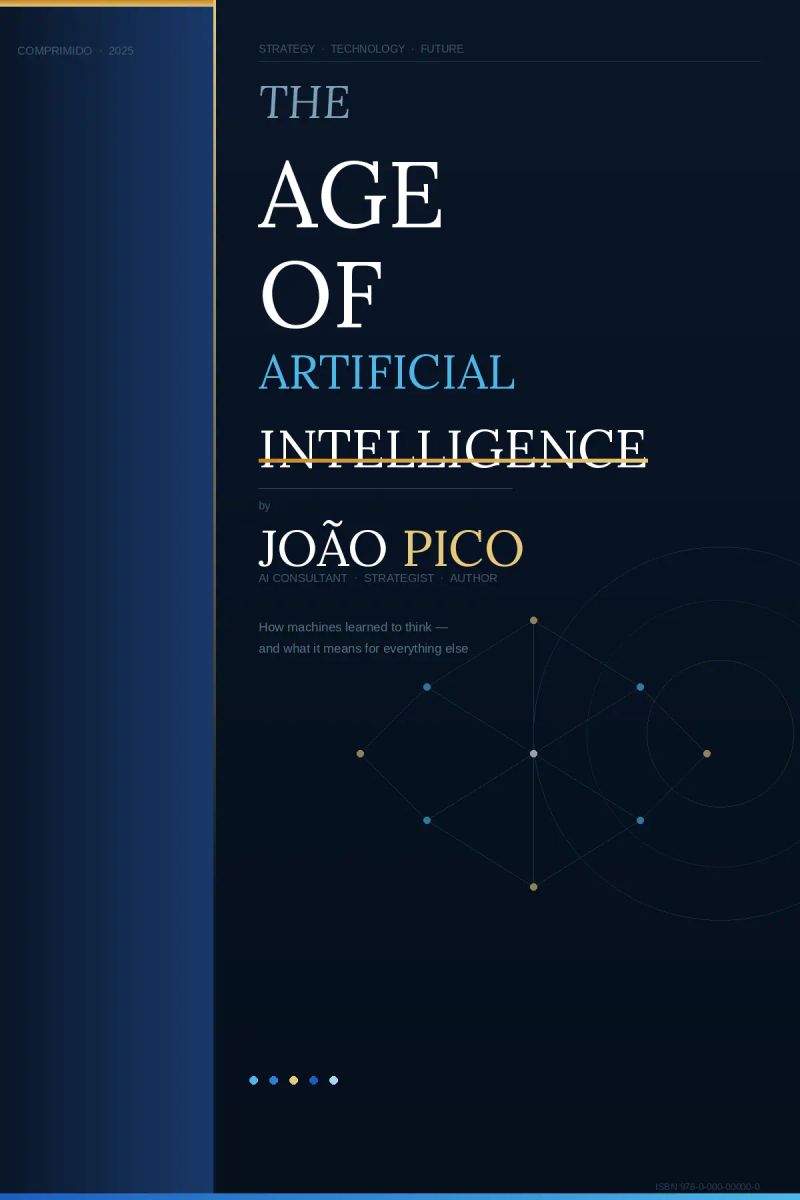
The Age of Artificial Intelligence argues that AI is not just another tool, but a civilizational shift. Unlike previous technologies that extended human physical abilities, AI operates in the domain of cognition: it interprets, writes, summarizes, recommends, and predicts. The book explores how this affects work, education, media, relationships, democracy, and meaning itself. It argues that AI will automate many coordination and knowledge tasks, but make human judgment, responsibility, and moral accountability more valuable. It warns against cognitive atrophy, synthetic reality, loneliness mediated by artificial companions, and the concentration of power in a few companies. At its core, the book claims that AI is a revealing technology: it exposes what is hollow in our institutions and forces us to ask what humans are for. Its answer is clear: machines generate outputs, but humans must still judge, choose, and bear consequences.
Audiobook details
GenreTechnology
Length47 mins
Narrated byListen with 1,000+ voices
FormateBook with Audio
Publish dateMar 28, 2026
LanguageEnglish

The Honey BusMeredith May9h 31m4.4 (16.6K)$25 · $0.00
Collected Writings of Nikola TeslaThomas Commerford Martin, Nikola Tesla19h 42m4.4 (2.8K)$1.99 · $0.00

Operation PedestalMax Hastings12h 29m4.4 (5.2K)$29 · $0.00

When the Heavens Went on SaleAshlee Vance18h 20m4.4 (3K)$40 · $0.00
Everybody Has a Podcast (Except You)Justin McElroy, Travis McElroy, Griffin McElroy5h 9m4.3 (2.3K)$24 · $0.00

Hands of TimeRebecca Struthers8h 8m4.4 (1.3K)$26 · $0.00
Never Lost AgainBill Kilday10h 1m4.4 (805)$29 · $0.00
How the Internet HappenedBrian McCullough13h 28m4.3 (2.7K)$23 · $0.00
Collected Writings of Nikola TeslaNikola Tesla, Thomas Commerford Martin21h 50m4.3 (1.7K)$1 · $0.00
Just AspireAjai Chowdhry9h 13m4.4 (260)$29 · $0.00
The Little Book of AliensAdam Frank8h 20m4.3 (1.3K)$26 · $0.00
The inventions, researches and writings of Nikola Tesla (Annotated)Thomas Commerford Martin16h 59m4.3 (1.3K)$2 · $0.00

KargilV.P. Malik15h 18m4.3 (2K)$24 · $0.00
Experiments with Alternating CurrentsNikola Tesla9h 16m4.3 (874)$1.99 · $0.00

Fire on the HorizonTom Shroder, John Konrad8h 23m4.3 (858)$26 · $0.00

The Smell of Kerosene (Annotated)National Aeronautics and Space Administration, Donald L. Mallick, Peter W. Merlin11h 32m4.3 (523)$2 · $0.00
The Boy Who Harnessed the WindWilliam Kamkwamba, Bryan Mealer10h 5m4.2 (78.9K)$29 · $0.00

Across the Airless WildsEarl Swift10h 8m4.3 (1.3K)$29 · $0.00

Console WarsBlake J. Harris20h 41m4.2 (13.7K)$46 · $0.00

Improvised Munitions HandbookU.S. Department of Defense4h 49m4.3 (1.6K)$1.99 · $0.00
You may also like
Making SenseSam Harris22h 27m4.1 (3K)$46 · $0.00

Big DataViktor Mayer-Schönberger, Kenneth Cukier9h 41m4.0 (27.3K)$29 · $0.00
The Last Economy: A Guide to the Age of Intelligent EconomicsEmad Mostaque3h 54m4.3 (345)Free
The MANIACBenjamín Labatut9h 51m4.3 (32.8K)$26 · $0.00

We Have Been HarmonizedKai Strittmatter10h 29m4.3 (4.3K)$29 · $0.00
The NumeratiStephen Baker7h 55m3.6 (2K)$17 · $0.00

System ErrorRob Reich, Mehran Sahami, Jeremy M. Weinstein11h 29m4.0 (1.6K)$29 · $0.00
The AI ConEmily M. Bender, Alex Hanna7h 51m3.7 (1.7K)$26 · $0.00
The Technological SocietyJacques Ellul21h 21m4.3 (2.3K)$30
The Art Of Conjuring Alternate RealitiesShivam Shankar Singh, Anand Venkatanarayanan9h 50m4.3 (371)$29 · $0.00
More Than WordsJohn Warner7h 46m4.0 (513)$23

ReplacedDisrupt.co.nz4h 4m$1.20 · $0.00
Masters or Slaves?Jeremy Peckham6h 44m4.2 (23)$23
No More WorkJames Livingston3h 16m3.7 (449)$15
Ai Revolution And Its Unstoppable Global ImpactEveraldo Santos Silva1h 27m$7 · $0.00
Mother of InventionKatrine Marçal6h 54m$17 · $0.00
Pay AttentionDavid Pakman9h 27m$29 · $0.00

What is AI?Will Douglas Heaven1h 17m4.7 (42) · 2916Free
The Masterclass of Machine LearningJohn9h 55m$6.80
What to Think About Machines That ThinkJohn Brockman14h 58m3.6 (605)$33 · $0.00