
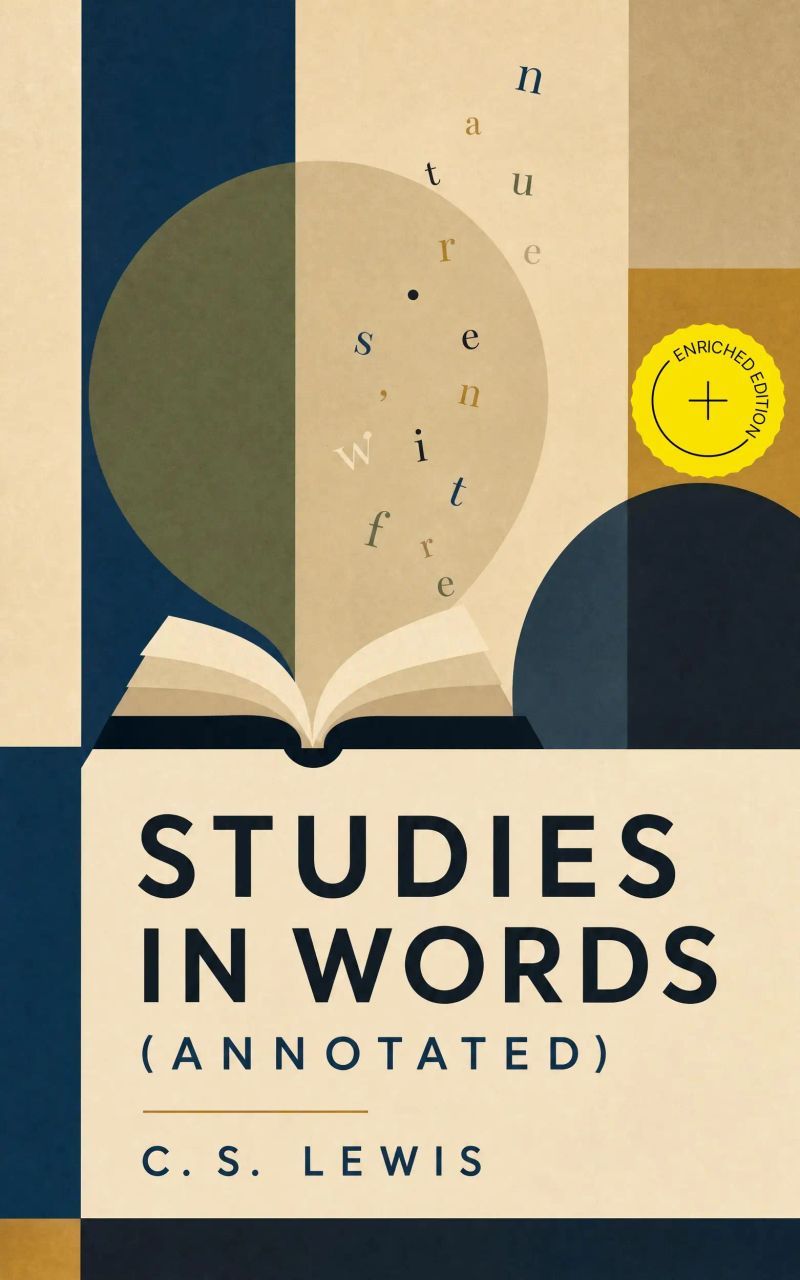
Studies in Words (Annotated)
Enriched Edition. Philological Essays on Semantic Change, Classical Terms, and Reading Older Literature Without AnachronismBy C. S. Lewis

Length8h 48m
About this audiobook
Studies in Words is C. S. Lewis's forensic journey through the changing meanings of English and classical terms whose histories illuminate literature itself. Examining words such as "nature," "sad," "wit," "free," "sense," and "conscience," Lewis shows how semantic drift can distort modern readings of older texts. The style is lucid, exacting, and conversationally learned, joining philology to literary criticism in the humanist tradition of Oxford and Cambridge scholarship. Lewis was not only the celebrated author of imaginative works such as The Chronicles of Narnia, but also a formidable medievalist, classicist, and historian of ideas. His academic life at Oxford and Cambridge trained him to hear older English with unusual sensitivity, while his Christian and philosophical interests sharpened his concern for moral and metaphysical vocabulary. This book grows directly from his lifelong conviction that language preserves, and sometimes conceals, intellectual history. Readers interested in literature, theology, philosophy, or the craft of interpretation will find Studies in Words indispensable. It is especially rewarding for those who wish to read pre-modern texts without anachronism and with a finer ear for nuance.
This enriched edition has been carefully crafted to add value to your reading experience.
- A succinct Introduction situates the work's timeless appeal and themes.
- The Synopsis outlines the central plot, highlighting key developments without spoiling critical twists.
- A detailed Historical Context immerses you in the era's events and influences that shaped the writing.
- An Author Biography reveals milestones in the author's life, illuminating the personal insights behind the text.
- A thorough Analysis dissects symbols, motifs, and character arcs to unearth underlying meanings.
- Reflection questions prompt you to engage personally with the work's messages, connecting them to modern life.
- Hand‐picked Memorable Quotes shine a spotlight on moments of literary brilliance.
- Interactive footnotes clarify unusual references, historical allusions, and archaic phrases for an effortless, more informed read.
Audiobook details
Rating★★★★ 4.3 (2.1K)
Includes Goodreads, Amazon, LibraryThing, StoryGraph
GenreOther
Length8 hrs 48 mins
Narrated byListen with 1,000+ voices
FormateBook with Audio
Publish dateDec 4, 2023
LanguageEnglish
Table of contents
1Introduction
2Introduction
3Synopsis
4Historical Context
5Author Biography
Show all chaptersShow less
6PREFACE
71 INTRODUCTION
8I. THE EFFECTS OF RAMIFICATION
9II. THE INSULATING POWER OF THE CONTEXT
10III. THE DANGEROUS SENSE
11IV. THE WORD’S MEANING AND THE SPEAKER’S MEANING
12V. TACTICAL DEFINITIONS
13VI. THE METHODOLOGICAL IDIOM
14VII. MORALISATION OF STATUS-WORDS
152 NATURE [WITH PHUSIS , KIND , PHYSICAL ETC.]
16I. ‘NATURA’
17II. ‘KIND’
18III. PHUSIS
19Eche thing in my cure is
20IV. ‘NATURE’ AND ITS OPPOSITES
21V. ‘NATURAL AND UNNATURAL’
22VI. THE ‘NATURAL’ AND THE INTERFERED WITH
23VII. THE ‘NATURAL’ AS AN ELEMENT IN MAN
24VIII. ‘NATURE’ AND GRACE
25IX. NATURE AND THE MIMETIC ARTS
26X. BY ‘NATURE’ OR BY LAW
27XI. THE STATE OF ‘NATURE’ AND THE CIVIL STATE
28XII. ‘NATURAL’ AND ‘SUPERNATURAL’
29XIII. PHYSICAL AND METAPHYSICAL
30XIV. THE ‘NATURAL’ AS THE EXCUSABLE
31XV. ‘NATURE’ IN EIGHTEENTH- AND NINETEENTH-CENTURY POETRY
323 SAD [WITH GRAVIS ]
33I. ‘GRAVIS’ AND ‘GRAVE’
34II. ‘SAD’: THE ‘FULL’-SENSES
35III. THE ‘GRAVE’-SENSES
36IV. ‘SAD (D.S.) ’
37V. OUR POLLY IS A ‘SAD’ SLUT
384 WIT [WITH INGENIUM ]
39I. EARLY HISTORY
40II. WITS
41III. ‘INGENIUM’
42IV. ‘INGENIUM’ AND WIT
43V. EARLY HISTORY OF THE ‘DANGEROUS SENSE’
44VI. THE AFFLICTIONS OF ‘WIT-INGENIUM’
45VII. HAPPY ENDING
465 FREE [WITH ELEUTHERIOS , LIBERAL , FRANK ETC.]
47I. ‘ELEUTHEROS’
48II. ‘LIBER’
49III. ‘FREE’
50IV. ‘FRANK’ AND ‘VILLAIN’
The Complete Works: Fantasy & Sci-Fi Novels, Religious Studies, Poetry & Autobiography (Annotated)C. S. Lewis165h 27m$2 · $0.00
THE SCREWTAPE LETTERS & SCREWTAPE PROPOSES A TOAST (Annotated)C. S. Lewis5h 6m4.4 (471K)$2 · $0.00
The Chronicles of Narnia - Complete 7 Books in One Edition (Annotated)C. S. Lewis35h 30m4.4 (781.2K)$2 · $0.00
Letters to Malcolm: Chiefly on Prayer (Annotated)C. S. Lewis5h 8m4.3 (7.8K)$2 · $0.00
The Four LovesC. S. Lewis5h 46m4.3 (82K)$1 · $0.00
That Hideous StrengthC. S. Lewis18h 20m4.1 (63.1K)$1 · $0.00
Out of the Silent PlanetC. S. Lewis6h 11m4.1 (141.6K)$1 · $0.00
Studies in WordsC. S. Lewis8h 30m4.3 (1.7K)$1 · $0.00
The Horse and his BoyC. S. Lewis5h 11m4.1 (545.5K)$2 · $0.00
TILL WE HAVE FACES (Cupid & Psyche – The Story Behind the Myth)C. S. Lewis9h 51m4.3 (104.5K)$1 · $0.00
The Lion, the Witch and the WardrobeC. S. Lewis5h 14m4.4 (3.3M)$1 · $0.00
Beyond Personality: The Christian Idea of GodC. S. Lewis2h 12m4.3 (228)$1 · $0.00
PerelandraC. S. Lewis8h 49m4.2 (124.3K)$1 · $0.00
The World's Last Night and Other EssaysC. S. Lewis3h 3m4.3 (3.5K)$1 · $0.00
PerelandraC. S. Lewis8h 49m4.2 (81.2K)$2 · $0.00
The Last BattleC. S. Lewis4h 38m4.2 (371.2K)$2 · $0.00
The Great Divorce (Annotated)C. S. Lewis4h 49m4.4 (195.6K)$2 · $0.00
A GRIEF OBSERVED: A Book that Questions the Nature of Grief (Based on a Personal Journal)C. S. Lewis2h 48m4.4 (170.2K)$2 · $0.00
THE PROBLEM OF PAIN (Unabridged)C. S. Lewis5h 36m4.3 (94.3K)$2 · $0.00
Prince Caspian. The Return to NarniaC. S. Lewis6h 17m4.1 (564.2K)$1 · $0.00
Mere ChristianityC. S. Lewis7h 7m4.4 (519.7K)$24 · $0.00
Her Daily BreadKate Wood12h 57m4.6 (153)$33 · $0.00
The Holy Bible - 1 SamuelKing James2h 13m4.8 (1.6K)$3 · $0.00
The American Standard Bible — The Gospel of MatthewMatthew3h 56m4.7 (3K)$2 · $0.00
Bad Fat Black GirlSesali Bowen6h 32m4.7 (2.8K)$24 · $0.00
The King James Audio Bible New Testament CompleteChristopher Glyn20h 2m4.7 (2.6K)$12 · $0.00
Faiths CheckbookCharles Spurgeon12h 44m4.7 (3.2K)$11 · $0.00
Ten Things I Wish You Knew About Your Child's Mental HealthDr. Billy Garvey4h 53m4.7 (2.4K)$20 · $0.00
Designing Terry Pratchett’s DiscworldPaul Kidby3h 52m4.7 (343)$20 · $0.00
The Chosen Book OneAmanda Jenkins, Kristen Hendricks, Dallas Jenkins3h 8m4.6 (4.9K)$10 · $0.00
The Lives of BrianBrian Johnson9h 45m4.6 (3.5K)$29 · $0.00
Expository Thoughts on the Gospel of LukeJ.C. Ryle27h 13m4.7 (536)$18 · $0.00
CrossroadsKaleb Dahlgren7h 56m4.6 (4.9K)$26 · $0.00

Across the RiverKent Babb11h 40m4.6 (927)$29 · $0.00
Brain Training for RidersAndrea Monsarrat Waldo5h 56m4.7 (550)$19 · $0.00
My Effin' LifeGeddy Lee17h 11m4.6 (13.1K)$40 · $0.00
Kings and PawnsHoward Bryant10h 9m4.6 (678)$29 · $0.00
The Elementia Chronicles #2: The New OrderSean Fay Wolfe11h 17m4.6 (841)$29 · $0.00
The ActsLuke2h 55m4.6 (19.7K)$12 · $0.00
New Testament - Easy NavigationWorld English Bible19h 35m4.6 (1.3K)$1.30 · $0.00
You may also like
PicassoGertrude Stein2h 39m3.7 (1.8K)$2 · $0.00
InheritanceElizabeth Acevedo5m4.5 (4.9K)$4 · $0.00

Self-Love and FinancePenelope I. Westwood4h 38m$4 · $0.00
Walt Whitman SpeaksWalt Whitman5h 17m4.5 (31)$17 · $0.00
On the Art of WritingArthur Quiller-Couch7h 51m4.0 (387)$1 · $0.00
VersesHilaire Belloc1h 53m4.2 (35)$2.30
FRIEDRICH NIETZSCHE: 10 Quintessential Philosophy Books, Including Autobiography, Essays & Letters – All in One Volume (Annotated)Friedrich Nietzsche93h 8m4.5 (14)$3 · $0.00
Preface to ShakespeareSamuel Johnson3h 16m3.6 (376)$1 · $0.00
GERTRUDE STEIN Premium Collection: 60+ Poems, Tales & Plays in One Volume (Annotated)Gertrude Stein37h 3m4.3 (16)$2 · $0.00
Words; Their Use and AbuseWilliam Mathews16h 25m4.1 (27)$1 · $0.00
The Greatest Works of Gertrude SteinGertrude Stein36h 45m4.2 (19)$1 · $0.00
Émile VerhaerenStefan Zweig8h 13m3.8 (50)$2 · $0.00
Jim Morrison: A short biography5 Minutes, 5 Minute Biographies, George Fritsche6m4.1 (13)$1 · $0.00
Leonardo da VinciEugène Müntz5h 17m3.7 (27)$13 · $0.00
Women Romantic Poets - Volume 4Felicia Hemans4h 3m$20
FRANK O'HARA Ultimate Collection: 100+ Poems in One Volume (Annotated)Frank O'Hara3h 34m$2 · $0.00
Anthology of Massachusetts PoetsVarious2h 16m$2 · $0.00
Franz Kafka: A short biography5 Minutes, 5 Minute Biographies, George Fritsche6m$1 · $0.00

The Negro in Literature and Art in the United StatesBenjamin Griffith Brawley3h$2 · $0.00
Christian Hymns of the First Three CenturiesRuth Ellis Messenger1h 18m$2 · $0.00