
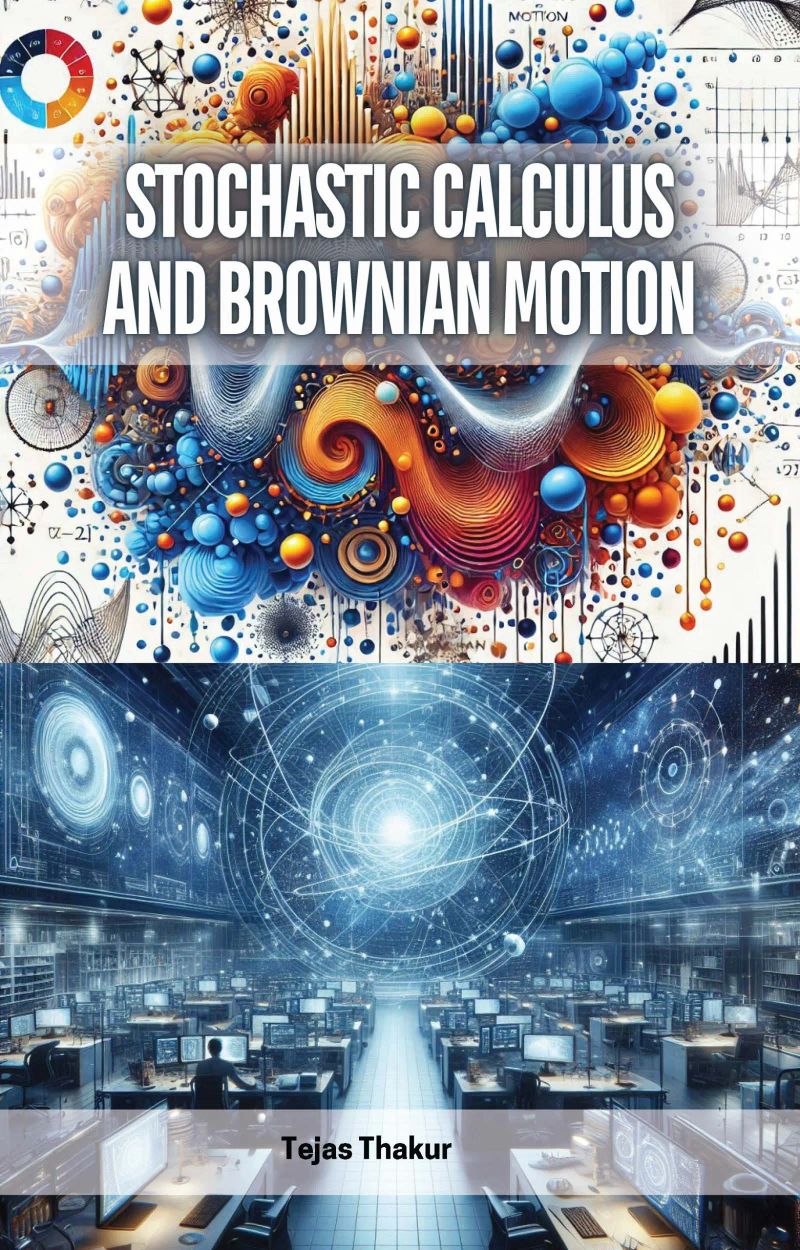
Stochastic Calculus and Brownian Motion
By Tejas Thakur


Length11h 52m
About this audiobook
"Stochastic Calculus and Brownian Motion" is a comprehensive guide crafted for students and professionals in mathematical sciences, focusing on stochastic processes and their real-world applications in finance, physics, and engineering. We explore key concepts and mathematical foundations of random movements and their practical implications.At its core, the book delves into Brownian motion, the random movement of particles suspended in a fluid, as described by Robert Brown in the 19th century. This phenomenon forms a cornerstone of modern probability theory and serves as a model for randomness in physical systems and financial models describing stock market behaviors.We also cover martingales, mathematical sequences where future values depend on present values, akin to a fair game in gambling. The book demonstrates how martingales are used to model stochastic processes and their calibration in real-world scenarios.Stochastic calculus extends these ideas into continuous time, integrating calculus with random processes. Our guide provides the tools to understand and apply Itô calculus, crucial for advanced financial models like pricing derivatives and managing risks.Written clearly and systematically, the book includes examples and exercises to reinforce concepts and showcase their real-world applications. It serves as an invaluable resource for students, educators, and professionals globally.
Audiobook details
GenreScience and Nature, Education and Learning
Length11 hrs 52 mins
Narrated byListen with 1,000+ voices
FormateBook with Audio
Publish dateFeb 20, 2025
LanguageEnglish
Table of contents
1Introduction to Stochastic Processes
21.1 Overview of Stochastic Processes
31.1.1 Definition and Basic Concepts
41.1.2 Classification of Stochastic Processes
51.1.3 Key Properties and Examples
Show all chaptersShow less
61.1.4 Applications and Implications
71.1.5 Challenges and Solutions
8Educational and Collaborative Efforts
91.2 Key Concepts and Definitions
101.2.1 Stochastic Process
111.2.2 Random Variable
121.2.3 Probability Space
131.2.4 Filtration
141.2.5 Adapted Process
151.2.6 Expectation
161.2.7 Independence
171.2.8 Stationarity
181.3 Importance in Finance and Science
191.3.1 Applications in Financial Markets
201.3.2 Influence in Scientific Research: 1.3.3 Interdisciplinary Approaches and Innovations
21Probability Theory Basics
222.1 Probability Spaces
232.1.1 Definition of a Probability Space
242.1.2 Properties of Probability Measures
252.1.3 Examples of Probability Spaces: 2.1.4 Importance in Stochastic Processes
262.2 Random Variables and Expectations
272.2.1 Definition of a Random Variable
282.2.2 Probability Distribution of a Random Variable: 2.2.2 Probability Distribution of a Random Variable
292.2.3 Expectation of Random Variables
302.2.4 Properties of Expectation
312.2.5 Conditional Expectation
322.3 Convergence of Sequences of Random Variables
332.3.1 Types of Convergence
342.3.2 Importance and Implications: 2.3.3 Key Theorems and Results
352.3.4 Practical Considerations
362.3.5 Challenges and Limitations
37Basics of Brownian Motion
383.1 Definition and Properties of Brownian Motion
393.1.1 What is Brownian Motion?
403.1.2 Key Properties of Brownian Motion
413.1.3 Examples and Applications of Brownian Motion: 3.1.4 Mathematical Framework and Calculus for Brownian Motion
423.2 The Wiener Process
433.2.1 Definition of the Wiener Process
443.2.2 Properties of the Wiener Process
453.2.3 Simulation of the Wiener Process
463.2.4 Applications of the Wiener Process: 3.2.5 Theoretical Implications of the Wiener Process
473.3 Path Properties of Brownian Motion
483.3.1 Continuity of Paths
493.3.2 Non-differentiability of Paths
503.3.3 Self-Similarity: 3.3.4 Zero Crossing and Oscillation
More from Tejas Thakur
A Brief History of IntelligenceMax S. Bennett12h 18m4.6 (6.6K)$29 · $0.00
The Story of BirdsSteve Brusatte11h 49m4.6 (401)$29 · $0.00

What It Takes to Save a LifeKwane Stewart6h4.6 (556)$24 · $0.00
Pastoral SongJames Rebanks8h 35m4.5 (12K)$26 · $0.00
How Stella Learned to TalkChristina Hunger7h4.5 (10.9K)$24 · $0.00

Craig & FredCraig Grossi8h 6m4.5 (9.6K)$26 · $0.00

Celebrating BirdsNatalia Rojas, Ana Maria Martinez6h 47m4.6 (330)$24 · $0.00

Saving JemimaJulie Zickefoose4h 59m4.5 (749)$20 · $0.00

Will's Red CoatTom Ryan8h 23m4.5 (2.3K)$26 · $0.00
Of Time and TurtlesSy Montgomery10h 34m4.5 (5K)$29 · $0.00

THE WOLF TRILOGY: Call of the Wild, White Fang & The Son of the WolfJack London17h 31m4.5 (2.4K)$1.99 · $0.00
Zen and the Art of Saving the PlanetThich Nhat Hanh9h 20m4.5 (3.9K)$29 · $0.00

BLACK BEAUTY (With Original Illustrations)Anna Sewell7h 31m4.5 (1.3K)$1.99 · $0.00

Bottle of LiesKatherine Eban14h 25m4.4 (12K)$33 · $0.00
IngrainedCallum Robinson8h 10m4.5 (1.1K)$26 · $0.00

The Lion Tracker's Guide To LifeBoyd Varty3h 1m4.4 (4.8K)$18 · $0.00

Born for LoveBruce D. Perry, Maia Szalavitz11h 42m4.4 (4K)$29 · $0.00

The Mountains of California (With Original Drawings & Photographs) (Annotated)John Muir11h 35m4.5 (1.1K)$2 · $0.00

The New GuysMeredith Bagby16h 50m4.4 (1.2K)$40 · $0.00
Blue PasturesMary Oliver3h 23m4.4 (3.8K)$18 · $0.00
A Brief History of IntelligenceMax S. Bennett12h 18m4.6 (6.6K)$29 · $0.00

HomeschooledStefan Merrill Block7h 10m3.6 (18.5K)$28 · $0.00

The State Must ProvideAdam Harris7h 15m4.5 (775)$24 · $0.00

The Call of the Wild and FreeAinsley Arment9h 7m4.4 (21.2K)$29 · $0.00
The Freelance WayRobert Vlach19h 48m4.5 (528)$40 · $0.00
Race to the BottomLuke Rosiak9h 20m4.5 (600)$29 · $0.00

They Came for the SchoolsMike Hixenbaugh9h 5m4.5 (2.6K)$8 · $0.00

Find Me UnafraidKennedy Odede, Jessica Posner11h 11m4.5 (2.7K)$29 · $0.00

Asking for ItKate Harding8h 55m4.4 (5.3K)$20 · $0.00
Defining Moments in Black HistoryDick Gregory7h 37m4.4 (6K)$26 · $0.00

The Emerald Tablets of Thoth the AtlanteanMaurice Doreal3h 4m4.4 (8.8K)$6 · $0.00

Learning AmericaLuma Mufleh6h 37m4.4 (564)$24 · $0.00
Math-ishJo Boaler7h 21m4.4 (588)$24 · $0.00

Daddy-Long-LegsJean Webster12h 18m4.2 (91K)$1.99 · $0.00
It Worked For MeColin Powell7h 42m4.3 (9.8K)$26 · $0.00

Little SoldiersLenora Chu11h 30m4.3 (3.1K)$29 · $0.00

Grammar-land; Or, Grammar in Fun for the Children of Schoolroom-shireM. L. Nesbitt2h 36m4.4 (488)$1 · $0.00

Financial FeministTori Dunlap8h 3m4.2 (22.2K)$8 · $0.00

DarkwaterWilliam Edward Burghardt Du Bois6h 40m4.3 (1.4K)$11 · $0.00

The Highway Code UKDepartment for Transport3h 33m4.2 (36.6K)$11 · $0.00
You may also like
How To Code For Quantum ComputersNivio Dos Santos2h 19m$46 · $0.00
The Definitive Guide To The World's Leading Artificial IntelligenceKael Novera6h 51m$8 · $0.00
Deep Learning on the JVMSofia Halloran7h 31m$5 · $0.00
Claude Code for Modern DevelopersLeon Grant8h 21m$6.50 · $0.00

Artificial Intelligence for Web DevelopmentJaxen Holt, Nadia Valentine4h 5m$6
Modern Data EngineeringOwen Fletcher7h 33m$6.50 · $0.00

Optical Transceivers and Photonic CircuitsAmara Okonkwo13h 9m$75

Monday.com Made SimpleRuth Callender4h 25m$7
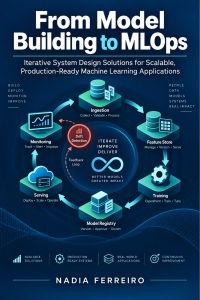
From Model Building to MLOpsNadia Ferreiro13h 33m$65
Introduction manual to S&OPCristina Peña1h 34m4.4 (15)$23 · $0.00

Home Assistant Made SimpleWalter Hemsley4h 12m$11
Fair GameRob Collie9h 39m3.9 (32)$20 · $0.00
The Evolution of Technologythe Speech Resource Company9h 30m$20

The AI Advantage for Data AnalystsMiles Draper4h 16m$8

The AI Advantage for Physical TherapistsMiles Draper4h 24m$8

On-Device AI: The Complete TinyML Guide for DevelopersCaroline Lennox3h 22m$4 · $0.00

Fire TV Stick Made SimpleWalter Hemsley4h 15m$8

Smartphones for SeniorsWalter Hemsley3h 38m$5
AI Tools for TeachersProf. Angelina Joel Adams2h 25m$6.50 · $0.00

Build Augmented Reality Apps Without CodeAdrian Vasquez7h 11m$5 · $0.00