
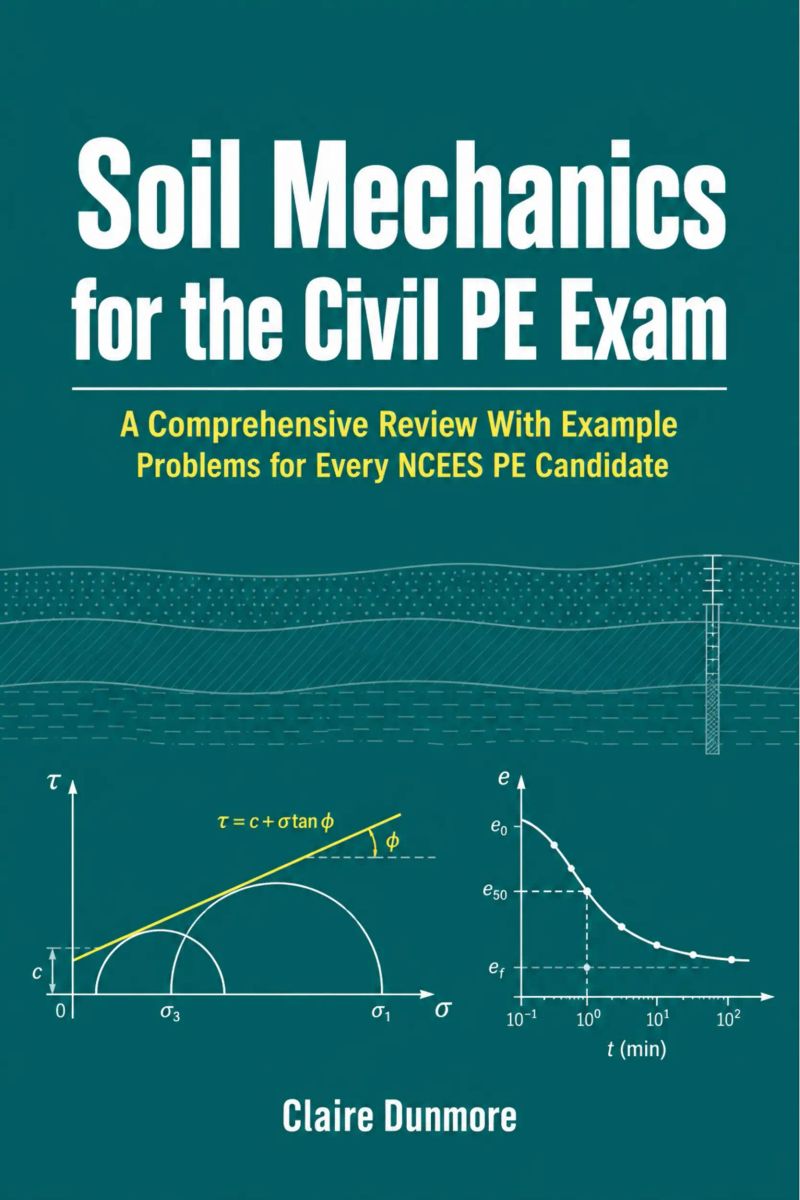
Soil Mechanics for the Civil PE Exam
A Comprehensive Review With Example Problems for Every NCEES PE CandidateBy Claire Dunmore


Length13h 36m
About this audiobook
Geotechnical problems sink more candidates than any other civil topic—usually through units, sign conventions, and pore pressure. This review fixes that.
Soil Mechanics for the Civil PE Exam is a focused, exam-aligned review that turns soil mechanics theory into the exact problem-solving moves the computer-based PE exam demands. Every chapter opens with the handbook equations you are allowed to use, then walks through worked examples that carry units through the arithmetic, name the equation, and flag the answer choice designed to catch you. You will not just read about soil mechanics—you will practice it in the format the exam actually uses.
Coverage spans the full geotechnical breadth of the NCEES PE Civil exam: phase diagrams and classification, compaction and borrow volumes, flow nets and exit gradients, effective stress profiles, consolidation settlement with time factors, Mohr circles from triaxial data, lateral earth pressures and wall stability, bearing capacity with eccentric loads, pile capacity and group effects, and slope stability. Timed mixed problem sets at the end of the book simulate exam-day pacing and help you identify weak areas before they cost you points.
What you will learn:
• Build and interpret phase diagrams, gradation curves, and plasticity indices for classification and index properties.
• Solve compaction and earthwork problems, including borrow volumes, shrinkage, and relative compaction.
• Apply Darcy's law, construct flow nets, and evaluate seepage, exit gradients, and quick conditions.
• Compute effective stress profiles with pore pressure and identify sign-convention traps.
• Calculate consolidation settlement, time factors, and degree of consolidation for staged loading.
• Determine shear strength parameters from triaxial and direct shear data using Mohr circles.
• Analyze lateral earth pressures, retaining wall stability, and overturning/sliding factors of safety.
• Evaluate shallow foundation bearing capacity with eccentric and inclined loads.
• Estimate deep foundation capacity, group effects, and slope stability under drained and undrained conditions.
This book is for civil engineering candidates preparing for the professional licensing exam and for practicing engineers who need a rapid, structured review of soil mechanics under time pressure. If you are sitting for the PE Civil exam with a geotechnical depth or breadth component, or you simply want to stop losing points to units and sign errors, this review is built for you.
Audiobook details
Rating★★★★ 4.1 (11)
Includes Amazon
GenreTechnology
Length13 hrs 36 mins
Narrated byListen with 1,000+ voices
FormateBook with Audio
Publish dateSep 27, 2026
LanguageEnglish
Table of contents
1Foreword
2Preface
3About This Book
4Important Safety Notice
5Chapter 1: Exam Scope and Strategy
Show all chaptersShow less
61.1 How Geotechnical Topics Appear in the Computer-Based Exam
71.2 Units, Significant Figures, and Calculator Discipline
81.3 Reading a Geotechnical Problem: Given, Find, Govern
91.4 Time Budgeting and the Six-Minute Solution
101.5 Building a Study Plan Around Weak Topics
111.6 Reference Handbook Navigation Drills
12Chapter 2: Classification and Index Properties
132.1 Phase Diagrams and Volumetric-Gravimetric Relations
142.2 Sieve and Hydrometer Analysis, Gradation Coefficients
152.3 Atterberg Limits and Plasticity Indices
162.4 Unified Soil Classification System Problems
172.5 Field Identification, Sampling, and Log Interpretation
18Chapter 3: Compaction and Earthwork
193.1 Compaction Fundamentals and the Proctor Curve
203.2 Structure, Sensitivity, and Compaction Specification
213.3 Shrink and Swell Factors, Borrow and Haul Volumes
223.4 Compaction Quality Control and Field Testing
23Chapter 4: Permeability and Seepage
244.1 Darcy’s Law and Permeability Measurement
254.2 Flow Nets, Seepage Quantity, and Uplift
264.3 Exit Gradient, Quick Conditions, and Piping
274.4 Layered Permeability and Two-Dimensional Flow
28Chapter 5: Effective Stress and Pore Pressure
295.1 Total, Effective, and Pore Water Stress
305.2 Capillary Rise and Partially Saturated Profiles
315.3 Seepage Effects on Effective Stress
325.4 Rapid Drawdown and Submerged Conditions
33Chapter 6: Consolidation and Settlement
346.1 Void Ratio Versus Pressure and the Compression Index
356.2 Overconsolidation Ratio and Preconsolidation Pressure
366.3 Time Rate of Consolidation and Time Factors
376.4 Secondary Compression and Settlement Estimates
38Chapter 7: Shear Strength
397.1 Mohr Circle Construction from Test Data
407.2 Direct Shear and Triaxial Test Interpretation
417.3 Drained and Undrained Strength in Practice
427.4 Stress Paths and Failure Criteria
43Chapter 8: Lateral Earth Pressure
448.1 At-Rest, Active, and Passive Pressures
458.2 Surcharge, Water, and Layered Backfill
468.3 Retaining Wall Stability: Overturning, Sliding, Bearing
478.4 Braced Excavations and Tieback Walls
48Chapter 9: Shallow Foundations
499.1 Bearing Capacity Equations and Factors
509.2 Eccentric and Inclined Loading

The Honey BusMeredith May9h 31m4.4 (16.6K)$25 · $0.00

Collected Writings of Nikola TeslaThomas Commerford Martin, Nikola Tesla19h 42m4.4 (2.8K)$1.99 · $0.00

Operation PedestalMax Hastings12h 29m4.4 (5.2K)$29 · $0.00

When the Heavens Went on SaleAshlee Vance18h 20m4.4 (3K)$40 · $0.00

Everybody Has a Podcast (Except You)Justin McElroy, Travis McElroy, Griffin McElroy5h 9m4.3 (2.3K)$24 · $0.00

Hands of TimeRebecca Struthers8h 8m4.4 (1.3K)$26 · $0.00

Never Lost AgainBill Kilday10h 1m4.4 (805)$29 · $0.00

How the Internet HappenedBrian McCullough13h 28m4.3 (2.7K)$23 · $0.00

Collected Writings of Nikola TeslaNikola Tesla, Thomas Commerford Martin21h 50m4.3 (1.7K)$1 · $0.00

Just AspireAjai Chowdhry9h 13m4.4 (260)$29 · $0.00

The Little Book of AliensAdam Frank8h 20m4.3 (1.3K)$26 · $0.00

The inventions, researches and writings of Nikola Tesla (Annotated)Thomas Commerford Martin16h 59m4.3 (1.3K)$2 · $0.00

KargilV.P. Malik15h 18m4.3 (2K)$24 · $0.00

Experiments with Alternating CurrentsNikola Tesla9h 16m4.3 (874)$1.99 · $0.00

Fire on the HorizonTom Shroder, John Konrad8h 23m4.3 (858)$26 · $0.00

The Smell of Kerosene (Annotated)National Aeronautics and Space Administration, Donald L. Mallick, Peter W. Merlin11h 32m4.3 (523)$2 · $0.00

The Boy Who Harnessed the WindWilliam Kamkwamba, Bryan Mealer10h 5m4.2 (78.9K)$29 · $0.00

Across the Airless WildsEarl Swift10h 8m4.3 (1.3K)$29 · $0.00

Console WarsBlake J. Harris20h 41m4.2 (13.7K)$46 · $0.00

Improvised Munitions HandbookU.S. Department of Defense4h 49m4.3 (1.6K)$0.99 · $0.00
You may also like

60 Seconds and You’re Hired!Robin Ryan5h 34m4.2 (2.4K)$14

EthicsAristotle10h 43m4.1 (212.6K)$2.30

Fundamental Principles of the Metaphysic of MoralsImmanuel Kant3h 22m4.0 (29K)$1.80 · $0.00

Now You KnowRyan Chamberlin2h 42m4.2 (782)$20

Think and Grow RichNapoleon Hill8h 49m4.3 (519.4K)$1 · $0.00

Get Your Dream Job!Made for Success7h 56m$20

The 6 Secrets To Sowing MoneyLucisco Lexicógrafo22m$8 · $0.00

Michigan Property and Casualty Insurance Exam Review 2026/2027Leopold Wrenfield17h 51m$30
THE LAW OF SUCCESS Lesson Ten - PLEASING PERSONALITYNapoleon Hill1h 4m4.3 (24)$4.70 · $0.00

BILLIONAIRE IN TRAININGBradley J Sugars9h 13m4.0 (549)Free
Communication Skills: Understanding and Improving Your Communication Skills (A Practical Guide to Navigating Workplace Challenges With Strategic Business Communication Skills)Kenneth Hutson49m$3.50 · $0.00

The Newsletter BusinessEstelle Bouvier7h 12m$10
CLERICAL ABILITY PRACTICE TEST 2026/2027Adrian Hartwell9h 31m$10

Life EverlastingJohn Fiske8m$1 · $0.00
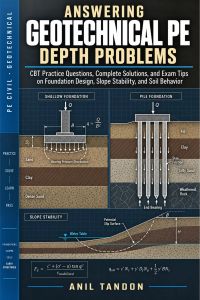
Answering Geotechnical PE Depth ProblemsAnil Tandon11h 42m4.6 (14)$65

How to Pass Job Interviews with EaseAnthony Ekanem39m$4 · $0.00

Pick up the PhoneUnknown Author1h 49m$9 · $0.00

The Palmer Method of Business Writing (Annotated)A. N. Palmer3h 25m$2 · $0.00

TouchdownTerry O'Reilly18m$1 · $0.00

PRAXIS CORE MATH EXAM PREP 2026/2027Adrian Hartwell8h 34m$10