
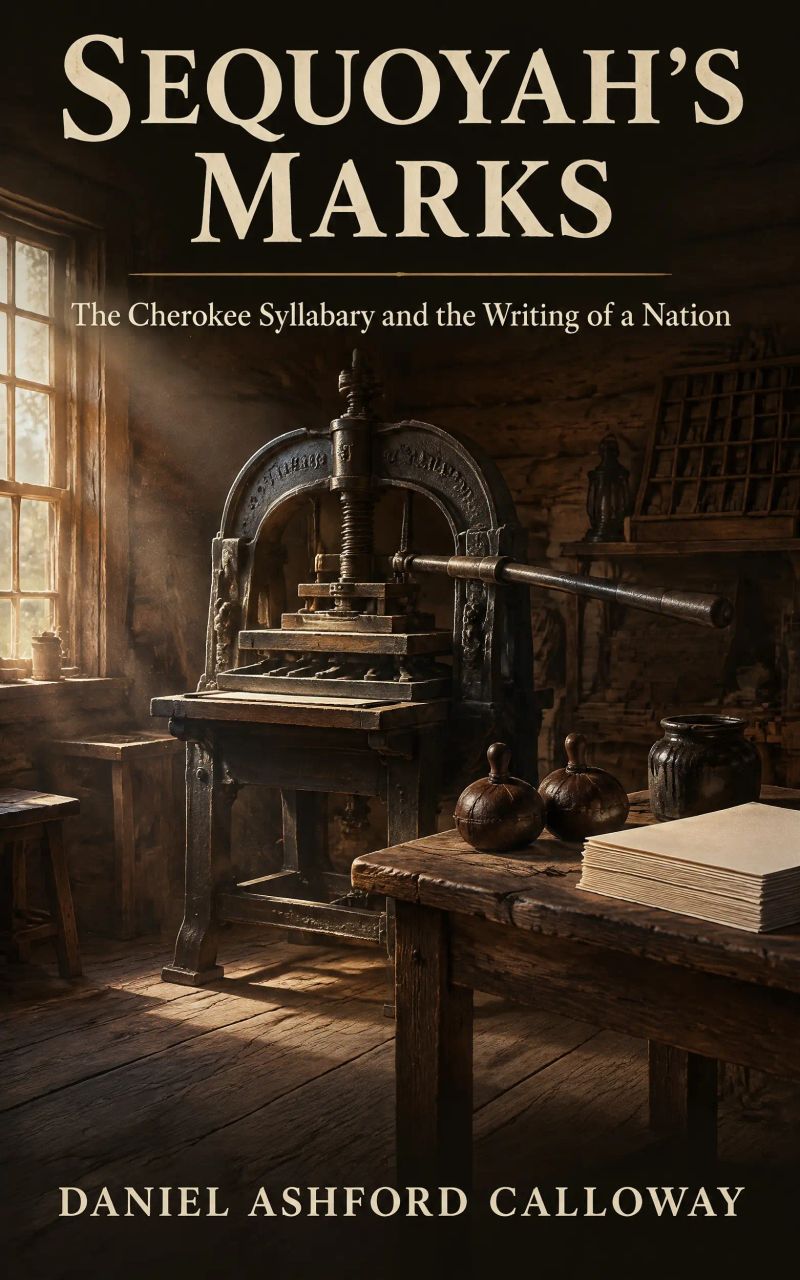
Sequoyah's Marks: The Cherokee Syllabary and the Writing of a Nation
By Daniel Ashford Calloway


Length4h 13m
About this audiobook
At a trading post on the Coosa, a white trader takes a paper from his coat, glances at it, and knows exactly how many deerskins he bought last fall, from whom, and for how much. The Cherokee silversmith watching him turns down the offer to learn his letters. Sequoyah wants the trick itself: the way a few marks can hold spoken words so still that they never drift in the retelling.
He could not read English, and a leg lamed since boyhood had left him more time than most men to sit and watch. Around 1809, at his forge in Wills Valley, in what is now northern Alabama, he set out to write his own language. It took twelve years. In 1821 he brought eighty-six characters to Willstown, each one a syllable of spoken Cherokee, and his young daughter Ayoka helped him prove to doubtful headmen that they worked. Within a few years the syllabary had spread across the Nation.
By 1828 a press at New Echota was printing the Cherokee Phoenix in English and Cherokee. Georgia's paper war against the Nation followed, and the Treaty of New Echota, and the removal the Cherokee remember as the trail where they cried. The characters went west with the people, through the bloodshed and new presses of Indian Territory, and on into Unicode, where the syllabary is typed and taught today. Sequoyah never did learn the trader's letters. He never needed them.
Audiobook details
GenreHistory
Length4 hrs 13 mins
Narrated byListen with 1,000+ voices
FormateBook with Audio
Publish dateSep 19, 2026
LanguageEnglish
Table of contents
1Chapter 1: The Bark and the Blade
2Chapter 2: Eighty-Six Sounds
3Chapter 3: Willstown, 1821
4Chapter 4: New Echota and the Press
5Chapter 5: Georgia's Paper War
Show all chaptersShow less
6Chapter 6: The Treaty of New Echota
7Chapter 7: The Trail Where They Cried
8Chapter 8: Blood and Ink in Indian Territory
9Chapter 9: The Road Back
10Chapter 10: The Flame in the Type Case
11Chapter 11: Unicode and the Living Syllabary
12Chapter 12: The Marks That Remain
13About the Author

A Brief History of IntelligenceMax S. Bennett12h 18m4.6 (6.6K)$29 · $0.00

MotherlandJulia Ioffe17h 52m4.7 (2.5K)$40 · $0.00

Where Cowards Go to DieBenjamin Sledge8h 42m4.7 (351)$20 · $0.00

RevolutionariesSanjeev Sanyal11h 23m4.6 (2.6K)$29 · $0.00

We Crossed a Bridge and It TrembledWendy Pearlman6h4.6 (5.2K)$24 · $0.00

Unbroken Bonds of BattleJohnny Joey Jones8h 31m4.6 (2.6K)$8 · $0.00

The Daughter of AuschwitzTova Friedman, Malcolm Brabant7h 54m4.6 (16.7K)$26 · $0.00

Lily's PromiseLily Ebert, Dov Forman8h 54m4.6 (16.1K)$29 · $0.00

On Democracies and Death CultsDouglas Murray10h 38m4.6 (6.5K)$29 · $0.00

Across the RiverKent Babb11h 40m4.6 (927)$29 · $0.00

Balcony Over Jerusalem: A Middle East Memoir - Israel, Palestine and BeyondJohn Lyons12h 37m4.6 (1.4K)$33 · $0.00

BeyondStephen Walker15h 39m4.6 (3.2K)$33 · $0.00
Kings and PawnsHoward Bryant10h 9m4.6 (678)$29 · $0.00

No EscapeNury Turkel9h 30m4.6 (809)$28 · $0.00
Jubal Stone: U.S. Marshal: Blood Trail To Hell: A Western Adventure NovelCasey Nash3h 42m4.6 (3.2K)$18 · $0.00

Fall and RiseMitchell Zuckoff17h 23m4.6 (9.8K)$40 · $0.00
The SurvivorJosef Lewkowicz, Michael Calvin9h 22m4.6 (2.5K)$29 · $0.00

Always FaithfulThomas Schueman, Zainullah Zaki12h 12m4.6 (977)$29 · $0.00

The State of Society in France Before the Revolution of 1789 (Annotated)Alexis de Tocqueville17h 25m4.6 (1.2K)$2 · $0.00

All the Gallant MenDonald Stratton, Ken Gire5h 55m4.6 (11.8K)$24 · $0.00
You may also like

Do it Like a WomanCaroline Criado-Perez8h 6m4.2 (1.5K)$20
The History of Mary Prince, a West Indian SlaveMary Prince2h 14m4.0 (5.3K)Free
Twenty-Two Years a Slave and Forty Years a FreemanAustin Steward8h 53m4.2 (255)$1 · $0.00

Life Among the Piutes: The First Autobiography of a Native American WomanSarah Winnemucca Hopkins9h4.1 (1.1K)$1 · $0.00
The True Story of Uncle Tom's Life: Autobiography of the Rev. Josiah HensonJosiah Henson4h 31m4.2 (266)$1 · $0.00
The True Story of Uncle Tom's Life: Autobiography of the Rev. Josiah HensonJosiah Henson4h 50m4.4 (1.7K)$1.99 · $0.00

The White GirlTony Birch7h 38m4.2 (8.4K)$26 · $0.00

Daughters of Smoke and FireAva Homa11h 6m4.3 (3.5K)$20

South to AmericaImani Perry16h 33m4.1 (10.7K)$40 · $0.00

Beneath the Tamarind TreeIsha Sesay12h 16m4.1 (2.1K)$29 · $0.00

Bring Back Our GirlsJoe Parkinson, Drew Hinshaw11h 8m4.4 (555)$29 · $0.00

Life Among the Piutes: The First Autobiography of a Native American WomanSarah Winnemucca Hopkins9h 10m4.2 (1.4K)$0.99 · $0.00
Stubborn TwigLauren Kessler12h 52m4.2 (1.2K)$23 · $0.00
My Bondage and My FreedomFrederick Douglass12h 14m4.5 (16.4K)$8 · $0.00
Frederick Douglass: All 3 Memoirs in One VolumeFrederick Douglass42h 36m4.7 (1.3K)$1 · $0.00
The True Story of Mary Prince, a West Indian SlaveMary Prince2h 51m4.1 (5.4K)$2 · $0.00
Voice for the VoicelessDalai Lama5h 47m4.4 (441)$24 · $0.00

The Rogerenes (Annotated)John R. Bolles, Anna B. Williams12h 9m$2 · $0.00
Of Blood and SweatClyde W. Ford12h 35m4.5 (235)$33 · $0.00
FREDERICK DOUGLASS Ultimate Collection: Autobiographies, 50+ Speeches, Articles & Letters (Annotated)Frederick Douglass63h 41m$2 · $0.00