
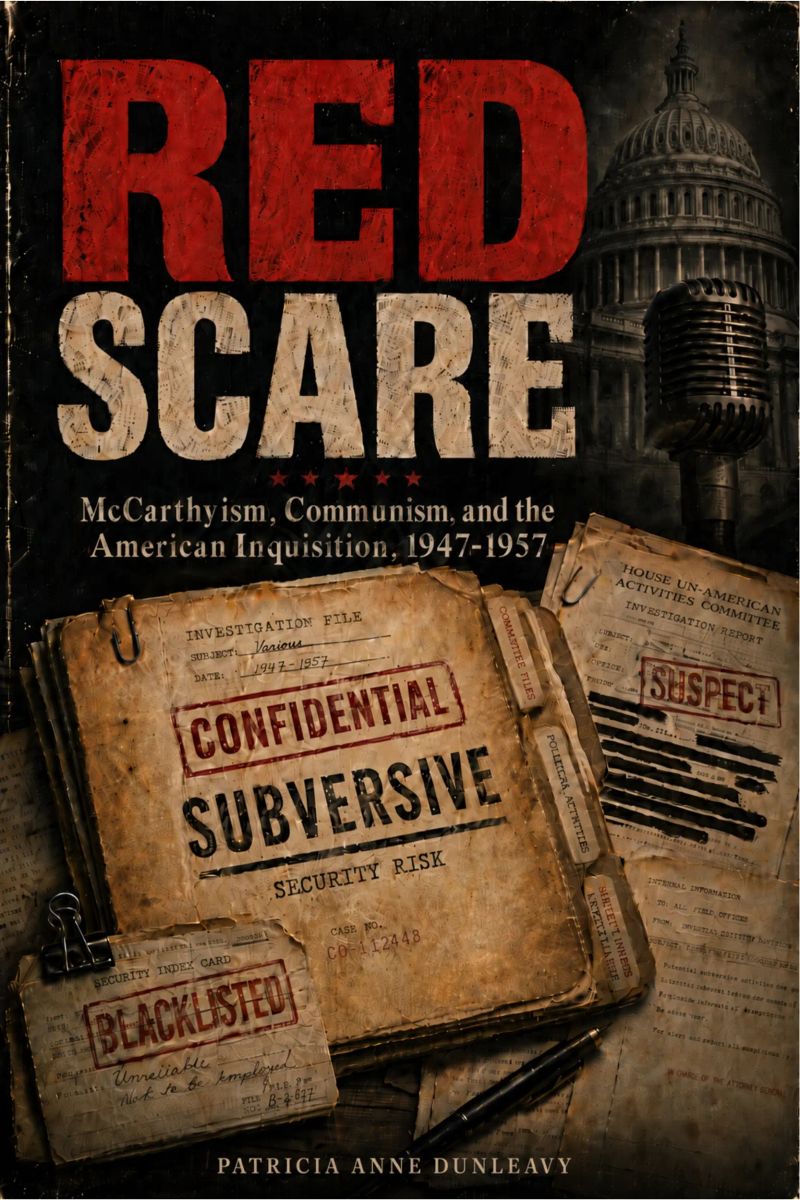
RED SCARE
McCarthyism, Communism, and the American Inquisition, 1947-1957By Patricia Anne Dunleavy


Length6h 4m
About this audiobook
**A senator holds up a piece of paper and claims it lists the communists hiding in your government.** He has no real list. It doesn't matter. Within months, careers are destroyed, families shattered, and a nation grows too frightened to speak.
Sound familiar? The fear, the accusations, the guilt-by-association, the demagogue who weaponizes panic — the Red Scare is one of the most important and most misunderstood chapters in American history. You've heard the word "McCarthyism" thrown around, but no one ever showed you how it actually worked, who it crushed, or how it was finally stopped. And in an age of renewed division and fear, not understanding it leaves you defenseless against the next one.
This book changes that.
**RED SCARE: McCarthyism, Communism, and the American Inquisition, 1947–1957** takes you inside the panic — the hearings, the blacklists, the executions, and the courageous few who fought back and won.
**Inside, you will discover:**
* **HOW** the Red Scare twisted a real Soviet threat into a witch hunt that devoured the innocent
* **WHO** Joseph McCarthy really was — and how one demagogue terrorized a superpower
* **WHAT** happened to the victims — the Hollywood Ten, the Rosenbergs, and the Lavender Scare
* **HOW** television and journalist Edward R. Murrow helped bring McCarthyism crashing down
* **WHY** the lessons of the American Inquisition still matter in today's age of fear and outrage
This isn't a dry history lesson. It's a gripping, cautionary thriller — and a survival guide for any democracy tempted by fear.
History warned us once. Don't look away.
**Scroll up and click "Buy Now" to start RED SCARE today.**
Audiobook details
GenreRomance, Historical Fiction, General Fiction
Length6 hrs 4 mins
Narrated byListen with 1,000+ voices
FormateBook with Audio
LanguageEnglish
Table of contents
1Introduction
2Author’s Note
3Prologue: The Red Menace
4PART ONE: ORIGINS (1945-1950)
5Chapter 1: The Soviet Threat — Espionage, the Atomic Bomb, and American Fear
Show all chaptersShow less
6Chapter 2: HUAC — The House Un-American Activities Committee and Its Methods
7Chapter 3: The Hollywood Ten — The Film Industry and the Blacklist
8Chapter 4: Alger Hiss — Espionage, Perjury, and the Case That Made Nixon
9PART TWO: McCARTHY'S RISE (1950-1952)
10Chapter 5: Wheeling, West Virginia — McCarthy's Speech and the List
11Chapter 6: The Tactics — Innuendo, Accusation, and the Big Lie
12Chapter 7: The Rosenbergs — Espionage, Trial, and Execution
13Chapter 8: The Korean War and the Red Scare — Fear at Home and Abroad
14PART THREE: THE INQUISITION AT ITS HEIGHT (1952-1954)
15Chapter 9: McCarthy vs. the State Department — Loyalty Investigations
16Chapter 10: The Army-McCarthy Hearings — Television and the Turning Point
17Chapter 11: Edward R. Murrow — Journalism and the Challenge to McCarthy
18Chapter 12: McCarthyism in the States — Local Red Scares Across America
19PART FOUR: THE VICTIMS
20Chapter 13: The Blacklist — Hollywood, Broadway, and the Entertainment Industry
21Chapter 14: Academia and the Red Scare — Universities and the Loyalty Oath
22Chapter 15: Government Workers — Purges, Investigations, and Ruined Careers
23Chapter 16: The Gay Purge — The Lavender Scare Within the Red Scare
24PART FIVE: RESISTANCE AND COLLAPSE
25Chapter 17: Those Who Fought Back — Lawyers, Journalists, and Civil Libertarians
26Chapter 18: The ACLU, the NAACP, and Civil Liberties Under Pressure
27Chapter 19: McCarthy's Fall — Censure and the Senate's Verdict
28Chapter 20: Eisenhower and McCarthyism — The President's Complicated Role
29PART SIX: LEGACIES
30Chapter 21: The Permanent Security State — Surveillance After McCarthy
31Chapter 22: The Cold War Consensus — Anticommunism and American Politics
32Chapter 23: The Rehabilitation — Clearing the Names of McCarthy's Victims
33Chapter 24: McCarthyism's Lessons — Demagoguery, Fear, and Democratic Resilience
34Epilogue: Have You No Sense of Decency?
35Acknowledgments
36Selected Bibliography
37About the Author
More from Patricia Anne Dunleavy

Blizzard ShowdownShirlee McCoy5h 16m4.6 (1.1K)$12 · $0.00

To Hold and ProtectSandra Owens7h 59m4.6 (1.1K)$8 · $0.00

Arctic WitnessHeather Woodhaven5h 46m4.6 (985)$12 · $0.00

Following the TrailLynette Eason6h 35m4.6 (2.3K)$12 · $0.00

Defending from DangerJodie Bailey5h 46m4.6 (588)$24 · $0.00

White HotIlona Andrews13h 18m4.5 (136.9K)$5 · $0.00

Explosive RevengeMaggie K. Black6h 18m4.6 (545)$12 · $0.00

Her Brand of JusticeB.J. Daniels6h 48m4.6 (1.3K)$12 · $0.00

Search And DetectTerri Reed5h 51m4.6 (706)$24 · $0.00

Driving ForceElle James4h 58m4.6 (407)$20 · $0.00

Danger in the WildernessDarlene L. Turner6h 54m4.7 (299)$12 · $0.00

Yukon JusticeDana Mentink6h 15m4.6 (751)$12 · $0.00

The Rogue WarriorCindy Roland Anderson5h 44m4.6 (410)$17 · $0.00

Her Duty Bound DefenderSharee Stover6h 30m4.6 (1.1K)$24 · $0.00

DRACULA (Annotated)Bram Stoker17h 36m4.5 (6.9K)$0.99 · $0.00

Trail Of ThreatsJessica R. Patch5h 47m4.6 (425)$24 · $0.00

Ironwood, a Fae Universe SeriesAlessa Thorn26h 57m4.6 (835)$30 · $0.00

Ready to ProtectValerie Hansen5h 38m4.6 (981)$24 · $0.00

Searching For EvidenceCarol J. Post6h 21m4.6 (552)$24 · $0.00

Anne Shirley: Anne of Green Gables, Anne of Avonlea & Anne of the Island (3 Books in One Edition)Lucy Maud Montgomery28h 17m4.5 (21.4K)$1.99 · $0.00

Lieutenant Hornblower (Annotated)C. S. Forester11h 41m4.5 (2.9K)$2 · $0.00

A Christmas Carol (Illustrated Edition)Charles Dickens3h 23m4.5 (21.2K)$1.99 · $0.00

Rilla of InglesideLucy Maud Montgomery11h 44m4.5 (48.2K)$2 · $0.00

The Viennese DressmakerKathryn Gauci11h 46m4.5 (2.1K)$23 · $0.00

The Man in the Brown Suit & They Came to BaghdadAgatha Christie15h 43m4.6 (495)$33 · $0.00

Under the Light of the Italian MoonJennifer Anton12h 28m4.5 (5.3K)$23 · $0.00

Jubilee, 50th Anniversary EditionMargaret Walker15h 43m4.5 (9.5K)$25 · $0.00

Pride and PrejudiceJane Austen14h 44m4.4 (4.7M)$2 · $0.00

Flying Colours (Annotated)Cecil Louis Troughton Smith9h 26m4.4 (10.1K)$2 · $0.00
With Love from HarlemReShonda Tate13h 48m4.5 (2K)$6 · $0.00

Sweet Home Highland ChristmasMay McGoldrick, Jan Coffey2h 54m4.5 (1.4K)$7 · $0.00

Rilla of InglesideL. M. Montgomery12h 25m4.4 (67.5K)$2 · $0.00

Death Comes for the Archbishop (Annotated)Willa Cather9h 13m4.4 (4.7K)$2 · $0.00

The Alice NetworkKate Quinn15h 7m4.4 (887.1K)$33 · $0.00

The Goddess of WarsawLisa Barr13h 4m4.4 (36.4K)$33 · $0.00

The Ohio River Trilogy: Betty Zane, The Spirit of the Border & The Last TrailZane Grey29h 8m4.4 (1.8K)$1 · $0.00

The Attic ChildLola Jaye14h 46m4.4 (21K)$33 · $0.00

Martyr of the CatacombsJames De Mille3h 41m4.5 (744)$1 · $0.00

Quo VadisHenryk Sienkiewicz22h 52m4.4 (62K)$21 · $0.00

Bring Up The BodiesHilary Mantel14h 35m4.4 (150K)$33 · $0.00

WhistlerAnn Patchett10h 45m4.6 (4.6K)$29 · $0.00

Demon CopperheadBarbara Kingsolver21h 3m4.5 (949.4K)$46 · $0.00

To Kill a MockingbirdHarper Lee12h 18m4.5 (7.4M)$29 · $0.00

Remarkably Bright CreaturesShelby Van Pelt11h 17m4.4 (1.7M)$29 · $0.00

The Old Man and the Sea (Annotated)Ernest Hemingway4h 27m4.6 (1.4K)$2 · $0.00
White HotIlona Andrews13h 18m4.5 (136.9K)$5 · $0.00

The Ghost by the Billabong (The Matilda Saga, #5)Jackie French14h 58m4.6 (773)$33 · $0.00

Cast in BloodMichelle Sagara16h 35m4.6 (607)$33 · $0.00
The Captain Blood Trilogy (Annotated)Rafael Sabatini29h 20m4.6 (1K)$3 · $0.00

Ship of the Line (Annotated)Cecil Louis Troughton Smith11h 13m4.6 (1K)$2 · $0.00

The George Orwell CollectionGeorge Orwell24h 46m4.5 (14.4K)$12 · $0.00

ShivajiRanjit Desai25h 13m4.6 (3.1K)$24 · $0.00

Time RegainedMarcel Proust15h 38m4.5 (9.2K)$2 · $0.00
Driving ForceElle James4h 58m4.6 (407)$20 · $0.00

When God Calls the HeartBrian Bird, Michelle Cox3h 24m4.6 (439)$10 · $0.00

Five Little IndiansMichelle Good10h 34m4.5 (64.5K)$29 · $0.00

Lolth's WarriorR. A. Salvatore13h 20m4.6 (2.4K)$33 · $0.00

The Things We Cannot SayKelly Rimmer13h 48m4.5 (359.1K)$33 · $0.00

The Love Songs of W.E.B. Du BoisHonoree Fanonne Jeffers29h 49m4.5 (58K)$8 · $0.00
Going PostalTerry Pratchett11h 23m4.5 (189.9K)$29 · $0.00
You may also like

The Senate Intelligence Committee Report on TortureSenate Select Committee on Intelligence16h 45m4.2 (506)$25 · $0.00

The SmearSharyl Attkisson11h 20m4.2 (2.8K)$29 · $0.00
Nixon and KissingerRobert Dallek11h 13m4.1 (3.3K)$29 · $0.00

The CIA as Organized CrimeDouglas Valentine16h 51m4.3 (712)$23

Legacy of AshesTim Weiner21h 37m4.2 (16.9K)$28

Red-HandedPeter Schweizer7h 48m4.3 (7.5K)$26 · $0.00

The Invisible CoupPeter Schweizer7h 14m4.4 (1.3K)$24 · $0.00

Blood MoneyPeter Schweizer7h 43m4.5 (3.8K)$28 · $0.00
The MissionTim Weiner17h 7m4.1 (1.5K)$40 · $0.00
The Devil's ChessboardDavid Talbot25h 23m4.3 (10.4K)$53 · $0.00
HubrisMichael Isikoff, David Corn18h 55m4.0 (2.3K)$32
The Great Crash 1929John Kenneth Galbraith6h 33m4.1 (9.3K)$24 · $0.00
Secret EmpiresPeter Schweizer6h 54m4.2 (3.4K)$24 · $0.00

The Black Banners (Declassified)Ali H. Soufan19h 15m4.4 (2.7K)$30

The BrothersStephen Kinzer13h 27m4.2 (7K)$23 · $0.00

50 Things They Don't Want You to KnowJerome Hudson7h 45m4.2 (323)$26 · $0.00

Betrayal in BerlinSteve Vogel17h 46m4.3 (2.6K)$40 · $0.00
Manipulation: The Machinery of Manipulation and the Quiet Destruction of the Mind (How to Recognize Toxic Tactics, Spot Emotional Manipulation, Protect Your Mind, and Take Back Control)Jose Long1h 56m$3.50 · $0.00
Striking BackLucas Kello10h 32m3.5 (16)$20 · $0.00

Unlimited AccessGary Aldrich2h 54m3.8 (776)$17 · $0.00