
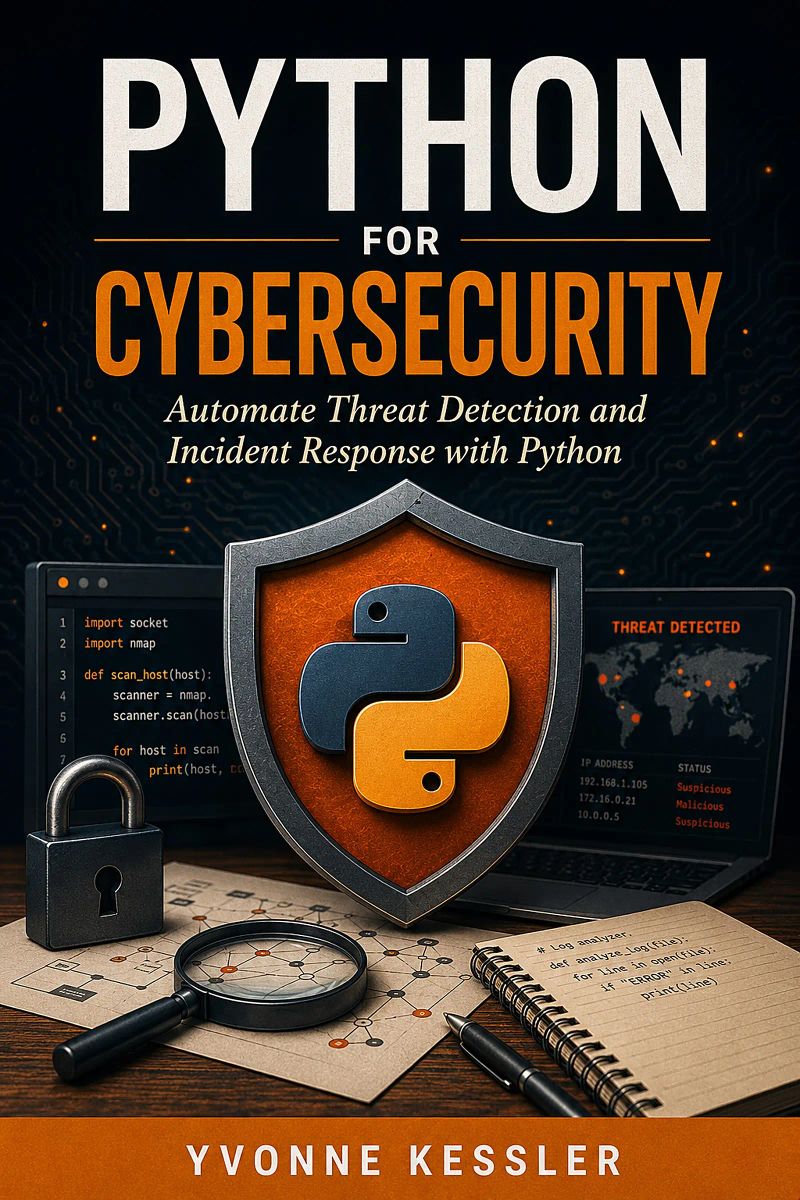
Python for Cybersecurity
Automate Threat Detection and Incident Response with PythonBy Yvonne Kessler


Length8h 2m
About this audiobook
Python cybersecurity and ethical hacking Python.
Python for Cybersecurity is your hands-on guide to building security tools, scanners, and scripts from scratch. Python programming meets cybersecurity skills in this practical, project-driven book. From packet sniffers to password auditors and log analyzers, you'll learn by doing. No fluff—just real code and real attacks. Whether you're a beginner or a pro, you'll master Python while defending networks, automating exploits, and writing custom security solutions. This book stands out from Python Crash Course and The Pragmatic Programmer by focusing exclusively on security. Start your journey today.What You'll Build:
• Packet sniffer
• Port scanner
• Password strength auditor
• Log analyzer
• Network mapper
• SQL injection tester
• Keylogger detector
• Brute-force script
Each chapter includes a project, code walkthrough, and security tips. You'll also learn to bypass firewalls, crack hashes, and detect intrusions. Yvonne Kessler teaches you to think like a hacker—and defend like one. No prior security experience needed. Just Python basics and a curious mind.
Compare with Python Crash Course by Eric Matthes and The Pragmatic Programmer by David Thomas and Andrew Hunt. While those books teach general programming, this one dives deep into cybersecurity. You'll write tools that actually work on real networks. Perfect for ethical hackers, IT pros, and students.
Get ready to automate attacks, analyze traffic, and secure systems. Python for Cybersecurity is the only book you need to build a complete security toolkit. Start today.
Audiobook details
GenreTechnology
Length8 hrs 2 mins
Narrated byListen with 1,000+ voices
FormateBook with Audio
Publish dateSep 30, 2026
LanguageEnglish
Table of contents
1Preface
2Chapter 1 — Your First Sentinel Module: The Python Foundation
3Chapter 2 — Structuring Code for Security: Functions, Modules, and Error Handling
4Chapter 3 — Object-Oriented Python for Scalable Tools
5Chapter 4 — Network Reconnaissance with Sentinel: Port Scanning and Packet Sniffing
Show all chaptersShow less
6Chapter 5 — Web Intelligence Gathering: HTTP, APIs, and Web Scraping
7Chapter 6 — Data Storage and Log Analysis: Managing Threat Intelligence
8Chapter 7 — Cryptography in Action: Encrypting Communications and Data
9Chapter 8 — Automating Security Workflows: Scripting Repetitive Tasks
10Chapter 9 — Web Application Security Testing with Python
11Chapter 10 — Malware Analysis Fundamentals: Static and Dynamic Techniques
12Chapter 11 — API Intelligence: Integrating Threat Feeds and External Services
13Chapter 12 — Fuzzing and Exploit Development Basics
14Chapter 13 — Secure Coding Practices for Defenders
15Chapter 14 — Multi-Platform Deployment: Packaging and Distribution
16Chapter 15 — Incident Response Automation with Sentinel
17Chapter 16 — Performance Optimization and Parallelism
18Chapter 17 — Testing and Continuous Integration for Security Tools
19Chapter 18 — Capstone: Sentinel Full Deployment and Customization
20About the Author

Hands of TimeRebecca Struthers8h 8m4.4 (1.3K)$26 · $0.00
Never Lost AgainBill Kilday10h 1m4.4 (805)$29 · $0.00
How the Internet HappenedBrian McCullough13h 28m4.3 (2.7K)$23 · $0.00

Collected Writings of Nikola TeslaNikola Tesla, Thomas Commerford Martin21h 50m4.3 (1.7K)$1 · $0.00

Just AspireAjai Chowdhry9h 13m4.4 (260)$29 · $0.00

The Little Book of AliensAdam Frank8h 20m4.3 (1.3K)$26 · $0.00

The inventions, researches and writings of Nikola Tesla (Annotated)Thomas Commerford Martin16h 59m4.3 (1.3K)$2 · $0.00

KargilV.P. Malik15h 18m4.3 (2K)$24 · $0.00
Experiments with Alternating CurrentsNikola Tesla9h 16m4.3 (874)$1.99 · $0.00

Fire on the HorizonTom Shroder, John Konrad8h 23m4.3 (858)$26 · $0.00

The Smell of Kerosene (Annotated)National Aeronautics and Space Administration, Donald L. Mallick, Peter W. Merlin11h 32m4.3 (523)$2 · $0.00

The Boy Who Harnessed the WindWilliam Kamkwamba, Bryan Mealer10h 5m4.2 (78.9K)$29 · $0.00

Across the Airless WildsEarl Swift10h 8m4.3 (1.3K)$29 · $0.00

Console WarsBlake J. Harris20h 41m4.2 (13.7K)$46 · $0.00
Improvised Munitions HandbookU.S. Department of Defense4h 49m4.3 (1.6K)$0.99 · $0.00

Escaping GravityLori Garver10h 54m4.2 (2.2K)$20 · $0.00

Wireless WarsJonathan Pelson8h 2m4.3 (418)$20 · $0.00

Let There Be WaterSeth M. Siegel8h 36m4.2 (2.3K)$20 · $0.00

The PerfectionistsSimon Winchester11h 46m4.2 (9.9K)$29 · $0.00
Rethinking NarcissismDr. Craig Malkin6h 7m4.2 (3.4K)$24 · $0.00
You may also like

Four-Day PlanetH. Beam Piper5h 6m3.9 (1.1K)$1 · $0.00

Robur the ConquerorJules Verne5h 59m3.6 (3.1K)$2.30 · $0.00

The Amazon CodeNick Thacker10h 55m3.9 (9.6K) Only with Ultra

The Sargasso Ogre: A Doc Savage AdventureLester Bernard Dent5h 56m4.0 (535)$2 · $0.00

U.S. MarshalsMike Earp, David Fisher10h 45m4.2 (753)$29 · $0.00

Scratch OneMichael Crichton writing as John LangeTM8h 24m3.6 (3.6K)$23
Tom Swift Among the Diamond Makers, or, The Secret of Phantom MountainVictor Appleton4h 38m3.8 (4.1K)$2.30
The Rule of NineSteve Martini11h 10m4.0 (5.2K)$29 · $0.00

Dr. NoIan Fleming8h 27m3.9 (36.7K)$26 · $0.00

CovertJanie Crouch6h 15m4.5 (2K)$12 · $0.00

The Skylark of SpaceE. E. Smith9h 32m3.8 (7.6K)$2.30

I AM BOND, JAMES BOND – The Books Behind The Movies: Premium Collection – 20 Titles in One Volume (Annotated)Ian Fleming101h 33m4.5 (1.1K)$2 · $0.00

Silent WatersJan Coffey, May McGoldrick7h 45m3.9 (453)$10 · $0.00

The Deadline MurdersRon Morgans8h 28m$20

Unwise ChildRandall Garrett6h 2m$2.30

The Giggling Ghosts: A Doc Savage AdventureLester Bernard Dent4h 58m3.7 (108)$2 · $0.00

The Gay Triangle: The Romance of the First Air AdventuresWilliam Le Queux5h 30m4.3 (14)$2.30

The Moon ColonyWilliam Dixon Bell5h 55m3.4 (11)$2.30

Choosing the ExecutionerNatalia Brandt11h 28m$5

Tom Swift and His Electric Locomotive; Or, Two Miles a Minute on the RailsVictor Appleton3h 43m3.9 (75)$1 · $0.00