
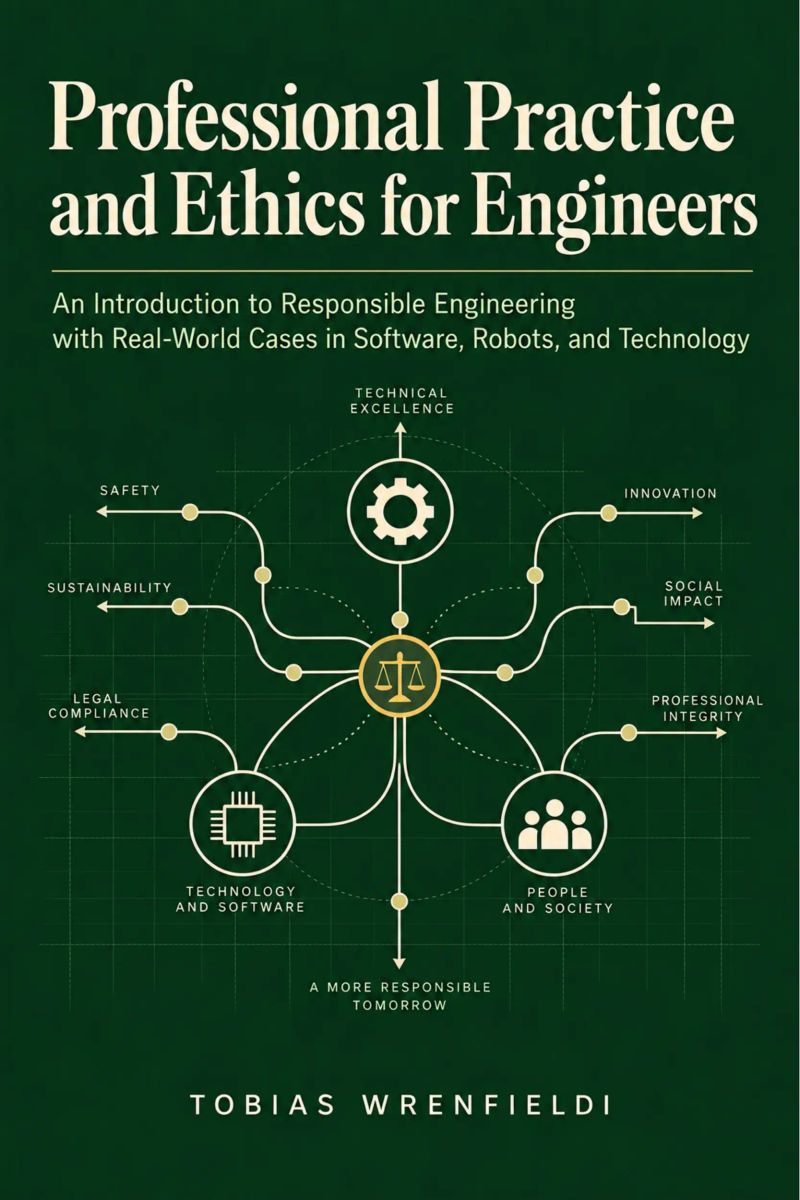
Professional Practice and Ethics for Engineers
An Introduction to Responsible Engineering with Real-World Cases in Software, Robots, and TechnologyBy Tobias Wrenfield

Length12h 47m
About this audiobook
Engineering ethics is usually taught as a list of principles nobody disputes, followed by cases nobody resolves. This book does the opposite.
It gives you a working method for analysing a decision: establish the facts, identify who is affected and what is owed to them, draw lines against clear cases, search for a middle way, then document what you decided and why. That method is then applied to the situations engineers actually face, from risk acceptance and design margins to test data integrity, dissent and whistleblowing, conflicts of interest and international business norms, intellectual property and post-employment obligations, privacy and algorithmic accountability, and autonomous system oversight.
Historical and contemporary cases are analysed in full, with more left for you. The book is designed for engineering students and practising professionals who want a rigorous, practical approach to responsible engineering in software, robots, and technology.
What you will learn:
• How engineering became a profession and what that means for your obligations
• The structure and limits of professional codes of ethics
• Moral frameworks that are actually useful for practical decisions
• A step-by-step method for case analysis you can apply to any situation
• How to reason about safety, risk, and acceptable risk
• How to maintain truthfulness in technical work and handle data integrity
• How to navigate loyalty, dissent, and whistleblowing
• How to recognise and manage conflicts of interest and business conduct issues
• How to handle intellectual property, confidentiality, and post-employment obligations
• How to address privacy, algorithmic accountability, and autonomous system oversight
Who it is for: This book is written for engineering students and practising professionals who want a working method for ethical decision-making, not just a list of principles. It is suitable for courses in engineering ethics, professional practice, and technology policy, as well as for engineers in software, robotics, and other technology fields who want to think more clearly about responsibility in their work.
Audiobook details
GenreTechnology
Length12 hrs 47 mins
Narrated byListen with 1,000+ voices
FormateBook with Audio
Publish dateSep 27, 2026
LanguageEnglish
Table of contents
1Professional Practice and Ethics for Engineers
2Foreword
3Preface
4About This Book
5Chapter 1: Engineering as a Profession
Show all chaptersShow less
61.1 Specialized Knowledge and the Public Trust
71.2 Licensure, Registration and Scope of Practice
81.3 Duty of Care to Clients, Employers and the Public
91.4 Employment, Contracts and the Limits of Obligation
101.5 Professional Identity and Continuing Development
11Chapter 2: Codes of Ethics and Their Structure
122.1 The Paramountcy of Public Safety
132.2 Comparing Codes Across Jurisdictions
142.3 Enforceable Rules Versus Aspirational Statements
152.4 Disciplinary Processes and Consequences
162.5 When Codes Conflict With Instructions
17Chapter 3: Moral Frameworks for Practical Use
183.1 Consequentialist Reasoning and Its Limits
193.2 Duty-Based and Rights-Based Reasoning
203.3 Virtue and Character-Based Approaches
213.4 Where Frameworks Stall and How to Combine Them
223.5 Disagreement Between Reasonable Engineers
23Chapter 4: A Method for Case Analysis
244.1 Gathering Facts and Handling Uncertainty
254.2 Identifying Stakeholders and Their Claims
264.3 Line Drawing and Clear Cases
274.4 Searching for Creative Middle Ways
284.5 Documenting and Defending a Decision
29Chapter 5: Safety, Risk and Acceptable Risk
305.1 Hazard, Risk and the Anatomy of Failure
315.2 Design Margins and Factors of Safety
325.3 Risk-Benefit Reasoning and Its Boundaries
335.4 Informed Consent and Disclosure
345.5 Communicating Residual Risk to Non-Engineers
35Chapter 6: Truthfulness in Technical Work
366.1 Test Data Integrity and Record Keeping
376.2 Selective Reporting and Misleading Presentation
386.3 Uncertainty, Error Bars and Honest Estimates
396.4 Peer Review and Internal Challenge
406.5 Reporting Adverse Results to Management
41Chapter 7: Loyalty, Dissent and Whistleblowing
427.1 The Nature and Limits of Loyalty
437.2 Internal Reporting Channels and Escalation
447.3 When External Disclosure Is Justified
457.4 Legal Protection and Its Gaps
467.5 The Personal Cost and How to Prepare
47Chapter 8: Conflicts of Interest and Business Conduct
488.1 Recognizing Conflicts of Interest
498.2 Gifts, Hospitality and Influence
508.3 Competitive Bidding and Design-Build Arrangements

The Honey BusMeredith May9h 31m4.4 (16.6K)$25 · $0.00

Collected Writings of Nikola TeslaThomas Commerford Martin, Nikola Tesla19h 42m4.4 (2.8K)$1.99 · $0.00

Operation PedestalMax Hastings12h 29m4.4 (5.2K)$29 · $0.00

When the Heavens Went on SaleAshlee Vance18h 20m4.4 (3K)$40 · $0.00

Everybody Has a Podcast (Except You)Justin McElroy, Travis McElroy, Griffin McElroy5h 9m4.3 (2.3K)$24 · $0.00

Hands of TimeRebecca Struthers8h 8m4.4 (1.3K)$26 · $0.00

Never Lost AgainBill Kilday10h 1m4.4 (805)$29 · $0.00

How the Internet HappenedBrian McCullough13h 28m4.3 (2.7K)$23 · $0.00

Collected Writings of Nikola TeslaNikola Tesla, Thomas Commerford Martin21h 50m4.3 (1.7K)$1 · $0.00

Just AspireAjai Chowdhry9h 13m4.4 (260)$29 · $0.00

The Little Book of AliensAdam Frank8h 20m4.3 (1.3K)$26 · $0.00

The inventions, researches and writings of Nikola Tesla (Annotated)Thomas Commerford Martin16h 59m4.3 (1.3K)$2 · $0.00

KargilV.P. Malik15h 18m4.3 (2K)$24 · $0.00

Experiments with Alternating CurrentsNikola Tesla9h 16m4.3 (874)$1.99 · $0.00

Fire on the HorizonTom Shroder, John Konrad8h 23m4.3 (858)$26 · $0.00

The Smell of Kerosene (Annotated)National Aeronautics and Space Administration, Donald L. Mallick, Peter W. Merlin11h 32m4.3 (523)$2 · $0.00

The Boy Who Harnessed the WindWilliam Kamkwamba, Bryan Mealer10h 5m4.2 (78.9K)$29 · $0.00

Across the Airless WildsEarl Swift10h 8m4.3 (1.3K)$29 · $0.00

Console WarsBlake J. Harris20h 41m4.2 (13.7K)$46 · $0.00

Improvised Munitions HandbookU.S. Department of Defense4h 49m4.3 (1.6K)$1.99 · $0.00
You may also like
The Problem of Increasing Human Energy (Annotated)Nikola Tesla6h 44m4.2 (3.2K)$2 · $0.00

AutobiographyNikola Tesla4h 11m4.1 (26K)$2 · $0.00

Tesla: The Problem of Increasing Human EnergyNikola Tesla5h 38m4.2 (1.9K)$1.99 · $0.00
Successful Self-Publishing: How to Self-Publish and Market Your BookJoanna Penn3h 23m4.4 (2.9K) Only with Ultra
SiliconFederico Faggin9h 46m4.2 (376)$20

Set My Heart to FiveSimon Stephenson11h 4m3.9 (3.3K)$29 · $0.00

12 BytesJeanette Winterson9h4.0 (2.5K)$20

WTF?Tim O'Reilly16h 15m4.2 (2.6K)$33 · $0.00

Human Work in the Age of Smart MachinesJamie Merisotis6h 30m3.9 (164)$15 · $0.00
The AI RevolutionTorsten J. Koerting3h 11m$5 · $0.00
Me, My Customer, and AIHenrik Werdelin, Nicholas Thorne3h 41m3.3 (16)$20
Reprogramming The American DreamKevin Scott, Greg Shaw8h 31m3.9 (687)$26 · $0.00

The Artificial AuthorSimone Aliprandi7h 42m$15 · $0.00
Maximizing LinkedIn for Business GrowthNeal Schaffer3h 15m4.3 (31)$14.99
How to Future-Proof Your Career for an AI-Driven WorldMax Paradox7h 22m$7.70 · $0.00
Open to WorkRyan Roslansky, Aneesh Raman5h 56m$24 · $0.00

Tesla: Collected Writings (Annotated)Nikola Tesla50h 10m4.3 (23)$1.99 · $0.00

Unlock Your Intelligent EdgeJasper Livingstone4h 20m$10
Think, Focus, Grow RichRobert4h 38m$6 · $0.00
I'm Afraid AI Will Take My Job - How to Prepare for the Future Without Refreshing LinkedIn Every Seven MinutesMax Paradox7h 10m$7.70 · $0.00