
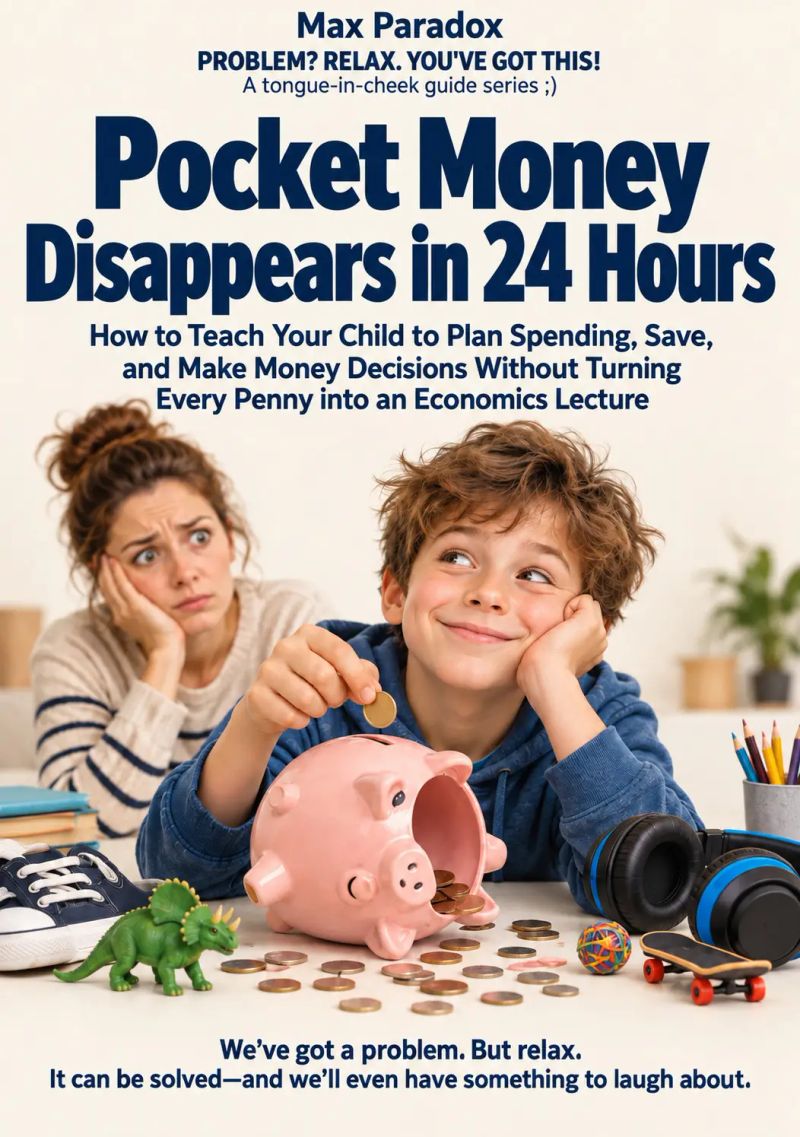
Pocket Money Disappears in 24 Hours - How to Teach Your Child to Plan Spending, Save, and Make Money Decisions Without Turning Every Penny into an Economics Lecture
By Max Paradox


Length6h 35m
About this audiobook
Friday: Your child receives £20 in pocket money.
Saturday: They are financially independent and extremely optimistic.
Sunday: "Can I borrow a tenner?"
Somewhere between Friday and Sunday, the money has been transformed into snacks, gaming accessories, three mysterious purchases and a small plastic object that nobody can identify.
Your child is delighted. Your wallet is concerned. And you're preparing another speech about how money doesn't grow on trees.
Unfortunately, your child appears to believe that it grows in your bank account.
Pocket Money Disappears in 24 Hours by Max Paradox is a practical, funny and refreshingly realistic parenting guide about teaching children to manage money without turning every purchase into a family investigation.
Because teaching financial responsibility shouldn't require a degree in economics, a collection of spreadsheets or the ability to deliver a motivational speech every time someone buys another unnecessary gadget.
Children don't always spend money impulsively because they don't understand its value. Sometimes they struggle to connect small purchases with a shrinking balance. Sometimes the promise of immediate enjoyment overwhelms a carefully considered saving goal. And sometimes their friends possess something so spectacular that financial common sense temporarily leaves the building.
This book explores what happens inside those everyday decisions and, more importantly, what parents can actually do about them.
You'll discover how to establish pocket-money rules that make sense, help children distinguish needs from wants, and introduce budgeting without making it feel like homework.
You'll learn how to encourage saving for meaningful goals while leaving room for enjoyable spending, guide children through real shopping decisions, and help them understand the full cost of purchases, including digital transactions and recurring payments.
The book also tackles the situations that make family finances particularly complicated: children comparing allowances with friends, requests for emergency top-ups, unexpected birthday money, lending between classmates, charitable donations and the excitement of earning money for the first time.
And what happens when your child knows every sensible financial rule but still doesn't follow a single one?
Or when your family simply cannot afford the allowance you previously agreed?
Max Paradox approaches these questions with practical explanations, relatable situations and observational humour that takes the pressure off parents without pretending that difficult decisions are always easy.
Throughout the book, you'll explore ways to:
Make pocket-money expectations clear and realistic.
Help children recognise spending patterns and plan ahead.
Encourage thoughtful shopping without criticising every purchase.
Build saving habits without turning money into something children are afraid to spend.
Handle financial mistakes, peer pressure and disagreements constructively.
Gradually give children more independence while maintaining appropriate safety boundaries.
This isn't about raising a miniature accountant who calculates the long-term economic consequences of buying a biscuit.
It's about raising someone who can eventually say, "I'd love to buy that, but I have something more important planned."
The goal isn't to stop pocket money from being spent. It's to help children understand the decisions behind spending it.
A warm, practical and humorous guide for parents who want fewer arguments about money and more confidence in their children's growing independence.
Because pocket money may disappear in 24 hours.
But the skills children learn from managing it can remain useful long after childhood.
This publication was prepared using tools that support the creative process, including artificial intelligence solutions. The final concept, structure and editing are the responsibility of the author.
Audiobook details
GenreSelf-Help
Length6 hrs 35 mins
Narrated byListen with 1,000+ voices
FormateBook with Audio
Publish dateOct 26, 2026
LanguageEnglish
Table of contents
1INTRO
2Chapter 1 - Why Pocket Money Vanishes Before Your Child Has Even Enjoyed Having It
3Chapter 2 - What Is Pocket Money Actually For? The Family Agreement Nobody Knew They Needed
4Chapter 3 - "But I Really Need It!" How to Tell a Necessity from a Very Convincing Want
5Chapter 4 - The Bank of Mum and Dad: Why Rescuing Every Purchase Can Make Things Worse
Show all chaptersShow less
6Chapter 5 - The Invisible Budget: Where Did All the Money Actually Go?
7Chapter 6 - The Savings Jar Full of Good Intentions: Why Saving Is Harder Than It Sounds
8Chapter 7 - "Everyone Else Gets More!" When Pocket Money Becomes a Popularity Contest
9Chapter 8 - "I'm Not Telling You What I Bought!" When Pocket Money Becomes a Family Secret
10Chapter 9 - A Budget That Survives Until Sunday: Teaching Children to Plan Before the Money Disappears
11Chapter 10 - The Price Tag Is Only the Beginning: Helping Children Make Better Buying Decisions
12Chapter 11 - The Supermarket Test: Letting Your Child Take Charge of a Real Shopping Trip
13Chapter 12 - My First Earnings! Why Money Coming In Isn't Always Money You've Made
14Chapter 13 - A Birthday Envelope Full of Possibilities: What to Do When Your Child Suddenly Has More Money Than Usual
15Chapter 14 - A Generous Heart and a Limited Wallet: Teaching Children to Give Without Going Broke
16Chapter 15 - They Know the Rules, So Why Don't They Follow Them? When Good Financial Plans Meet Real Life
17Chapter 16 - When the Family Budget Says No: Teaching Children About Money During Financially Difficult Times
18Chapter 17 - "Can We Stop Talking About Money?" When Your Child Refuses to Cooperate
19Chapter 18 - The First Month Was Perfect. What Happened Next? Making Good Money Habits Last
20Chapter 19 - "I'll Decide for Myself!" How to Hand Over Financial Control Without Constantly Checking the Balance
21Chapter 20 - Pocket Money Ends, but the Decisions Don't: Raising Someone Who Can Think About Money

I Bought Supplies for My Hobby and Now I'm Afraid to Use Them - How to Actually Start Painting, Sewing, Gluing, Building, and Creating Without Saving the Best Materials for "Later" That Never ComesMax Paradox8h 29m$7.70 · $0.00

Kieszonkowe Znika w 24 Godziny - Jak uczyć dziecko planowania wydatków, oszczędzania i podejmowania decyzji o pieniądzach bez zamieniania każdej złotówki w wykład ekonomicznyMax Paradox6h 14m$7.70 · $0.00

Mam 40+ i Nagle Regeneracja Ma Regulamin - Jak mądrzej zarządzać snem, ruchem, energią i odpoczynkiem, kiedy organizm przestaje honorować warunki z czasów studenckichMax Paradox8h 19m$7.70 · $0.00

Klikam „Akceptuj Wszystko”, Bo Chcę Tylko Zobaczyć Przepis - Jak rozumieć cookies, zgody i uprawnienia aplikacji, wybierać ustawienia prywatności, które mają sens, i przestać oddawać dane jednym nerwowym kliknięciem „byle dalej”Max Paradox6h 14m$7.70 · $0.00

I'm Over 40 and Suddenly Recovery Comes with Terms and Conditions - How to Manage Sleep, Movement, Energy, and Rest More Wisely When Your Body Stops Honoring the Deal from Your Student DaysMax Paradox8h 15m$7.70 · $0.00

Ktoś Zabrał Mój Pomysł na Spotkaniu i Jeszcze Dostał Brawa - Jak zaznaczać autorstwo, odzyskiwać głos i reagować na przypisywanie sobie cudzej pracy bez rozpoczynania firmowej wojny domowejMax Paradox6h 51m$7.70 · $0.00

Someone Took My Idea in a Meeting and Even Got Applause - How to Claim Credit, Reclaim Your Voice, and Respond When Others Take Credit for Your Work Without Starting an Office Civil WarMax Paradox7h 4m$7.70 · $0.00

Muszę Dogadać Pięć Działów, z Których Żaden Mi Nie Podlega - Jak wpływać bez formalnej władzy, uzgadniać interesy i domykać współpracę między działami, które mają pięć priorytetów i jeden wspólny terminMax Paradox6h 12m$7.70 · $0.00

Mój Partner Nie Lubi Moich Przyjaciół, a Moi Przyjaciele Nie Lubią Mojego Partnera - Jak ustalać granice między związkiem a własnymi relacjami, reagować na napięcia i nie zmuszać nikogo do udawanej przyjaźni przy wspólnym stoleMax Paradox6h 2m$7.70 · $0.00

Moja Rola Zmieniła Się Trzy Razy, Tylko Umowa Tego Nie Zauważyła - Jak nazwać rozszerzony zakres, uporządkować odpowiedzialności i renegocjować warunki, kiedy twoje stanowisko ewoluowało szybciej niż dokumentyMax Paradox6h 15m$7.70 · $0.00

Kupiłem Materiały do Hobby i Teraz Boję Się Ich Zużyć - Jak zacząć naprawdę malować, szyć, kleić, budować i tworzyć bez trzymania najlepszych rzeczy „na później”, które nigdy nie nadchodziMax Paradox8h 49m$7.70 · $0.00

Mój Partner Ma Byłego w Pakiecie z Dziećmi - Jak ustalać granice kontaktu z byłym partnerem, szanować współrodzicielstwo i nie robić z każdej wiadomości o odbiorze dziecka odcinka serialuMax Paradox6h 10m$7.70 · $0.00

I Click “Accept All” Because I Just Want to See the Recipe - How to Understand Cookies, Consent, and App Permissions, Choose Privacy Settings That Make Sense, and Stop Giving Away Data with One Frantic “Just Let Me Through” ClickMax Paradox6h 24m$7.70 · $0.00

Mam Lukę w CV i Czuję, Jakby Była Napisana Czerwonym Markerem - Jak opowiadać o przerwie zawodowej spokojnie i konkretnie, pokazywać aktualne kompetencje oraz przestać traktować kilka miesięcy lub lat poza etatem jak skazęMax Paradox6h 33m$7.70 · $0.00

Mam w Zespole Cztery Pokolenia i Cztery Definicje „Normalnej Pracy” - Jak dogadać różne oczekiwania wobec komunikacji, feedbacku, czasu pracy i kariery bez robienia z metryki aktu oskarżeniaMax Paradox6h 16m$7.70 · $0.00

Mamy Dziecko w Dwóch Domach i Dwa Zestawy Zasad - Jak budować przewidywalność między dwoma domami, uzgadniać kluczowe zasady i nie używać dziecka jako kuriera do przenoszenia pretensjiMax Paradox6h 6m$7.70 · $0.00

Moja Praca Mierzy Wszystko Oprócz Tego, Co Naprawdę Robię - Jak pracować z KPI, które nie pokazują całej pracy, rozmawiać o jakości i wpływie oraz nie zamieniać każdego dnia w polowanie na zielone cyferkiMax Paradox6h 27m$7.70 · $0.00

Mój Lot Odwołali, a Aplikacja Życzy Mi Miłej Podróży - Jak reagować na opóźnienia i odwołania, układać plan B i zbierać potrzebne informacje bez urządzania biura kryzysowego przy bramceMax Paradox6h 26m$7.70 · $0.00

Mam Nieregularne Dochody, a Rachunki Są Regularne - Jak budować budżet przy zmiennych wpływach, tworzyć bufor i wypłacać sobie przewidywalną kwotę bez życia od świetnego miesiąca do słabegoMax Paradox5h 48m$7.70 · $0.00
Learning to PrayJames Martin13h 24m4.5 (3.4K)$33 · $0.00

Finding MeViola Davis9h 15m4.6 (256.4K)$29 · $0.00

Spiritual AnatomyDaaji Kamlesh D. Patel9h 47m4.7 (319)$29 · $0.00

The Dangerous Truth about Today’s MarijuanaLaura Stack CSP, MBA9h 57m4.7 (385)$20 · $0.00

The Gospel according to Spiritualism (Translated)Allan Kardec14h 39m4.6 (3.9K)$5.70 · $0.00

Birdie & HarlowTaylor Wolfe7h 50m4.6 (6.5K)$26 · $0.00

CrossroadsKaleb Dahlgren7h 56m4.6 (4.9K)$26 · $0.00

Life on the BridgeKaelynn Partlow5h 40m4.6 (1.1K)$24 · $0.00

Keep Your Love OnDanny Silk9h 4m4.6 (8.1K)$10 · $0.00

The Tao of Joy Every DayDerek Lin10h 24m4.6 (762)$20 · $0.00

UndividedVicky Beeching9h 2m4.6 (1.3K)$29 · $0.00

HE CAN WHO THINKS HE CAN & OTHER BOOKS ON SUCCESSOrison Swett Marden5h 54m4.6 (1.2K)$1.99 · $0.00
Level UpRob Dial7h 42m4.6 (3.3K)$26 · $0.00

Burn the HaystackJennie Young, PhD9h 30m4.6 (543)$29 · $0.00

ACRES OF DIAMONDS: Our Every-day Opportunities (Wisdom & Empowerment Series) (Annotated)Russell Conwell2h 26m4.6 (1K)$2 · $0.00

Good InsideBecky Kennedy9h 55m4.5 (59.3K)$29 · $0.00

The Lost VoiceGreta Morgan8h 30m4.7 (285)$26 · $0.00

Stripped DownBunnie Xo8h 25m4.5 (32.9K)$26 · $0.00

UnthinkableJamie Raskin15h 8m4.5 (9.3K)$8 · $0.00

Wallace D. Wattles Ultimate Collection Wallace D. Wattles16h 53m4.6 (1.3K)$1 · $0.00
You may also like

Puppies For DummiesSarah Hodgson3h 31m3.9 (3.8K)$18 · $0.00

ChildhoodLeo Tolstoy4h 8m3.9 (2.9K)$4.70 · $0.00

The Marriage Trap: The new 2026 story of rebellion and freedom from the bestselling author of The Radio Hour. For readers of Lessons in ChemistryVictoria Purman8h 55m4.0 (266)$29 · $0.00

Some Thoughts Concerning EducationJohn Locke9h 17m3.9 (5.3K)$1 · $0.00

The Four FeathersA. E. W. Mason11h 42m4.0 (7.7K)$3

The Mother DanceHarriet Lerner9h 39m4.0 (3.2K)$29 · $0.00

The Four FeathersA.E.W. Mason11h 40m4.0 (8.6K)$1.20 · $0.00

Anton ChekhovDonald Rayfield28h 30m4.3 (590)$35

Live WireKelly Ripa9h 59m4.1 (18.5K)$29 · $0.00

TurnerW. Cosmo Monkhouse3h 1m$2 · $0.00

The Complete Works: Novels, Short Stories, Plays, Essays, Memoirs and Letters (Annotated)Henry James758h 45m$2 · $0.00

Why Are Baby Milestones So ImportantAurora Brooks1h 22m$3.50 · $0.00
Toddler Discipline: The Ultimate Guide to Happy and Successful Parenting (Practical Discipline Strategies for Empathetic and Cooperative Parenting From Birth to Adolescence)Brandon Frates3h 9m$3.50 · $0.00

My Parents Still Treat Me Like a Child - How to Be an Adult Even at Family DinnerMax Paradox7h 33m$7.80 · $0.00

The Science Behind Positive Discipline- A Parent's GuideAurora Brooks58m$3.50 · $0.00

The Greatest Works of Henry JamesHenry James730h 17m$1.99 · $0.00

Why the Perfect Parenting Style Doesn't ExistAurora Brooks1h$3.50 · $0.00

Connecticut Home Health Aide Competency Exam Review 2026/2027Rosalind Kettering12h 7m$22

Linda CondonJoseph Hergesheimer6h 53m$2 · $0.00

The Role of Siblings in Baby Milestone DevelopmentAurora Brooks1h 18m$3.50 · $0.00