
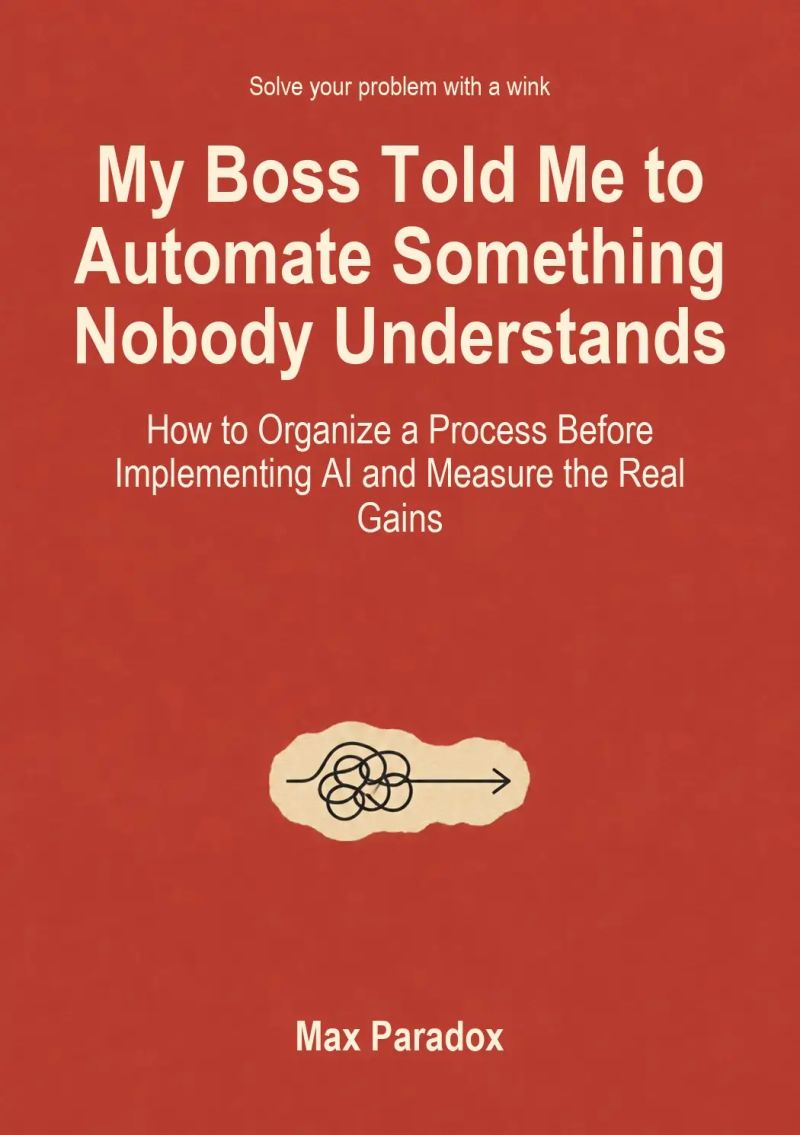
My Boss Told Me to Automate Something Nobody Understands - How to Organize a Process Before Implementing AI and Measure the Real Gains
By Max Paradox


Length5h 46m
About this audiobook
Your boss wants artificial intelligence implemented immediately. There's just one small problem: nobody can explain what the process is supposed to do.
The deadline is approaching. Management expects spectacular savings. IT wants specifications. Finance wants numbers. Employees use six different spreadsheets, and the only person who understands how everything works is currently on vacation.
Welcome to the wonderful world of corporate automation, where artificial intelligence is expected to solve problems that nobody has bothered to define.
In My Boss Told Me to Automate Something Nobody Understands, Max Paradox takes readers behind the polished presentations, ambitious transformation strategies, and suspiciously impressive efficiency charts to examine what actually makes automation worthwhile.
With sharp workplace humor, recognizable business situations, and practical explanations, this book explores a simple but frequently overlooked principle: before you automate a process, you need to understand it.
Because making a broken process run faster doesn't necessarily improve anything. Sometimes it simply produces mistakes at an industrial scale.
What will you discover inside?
You'll learn how to identify the real boundaries of a business process, uncover hidden activities, and distinguish genuine problems from symptoms disguised as technical challenges.
You'll explore the difference between improving a process, implementing conventional automation, and introducing artificial intelligence. Not every spreadsheet needs a language model, and not every repetitive task deserves an expensive digital transformation project.
You'll discover why data quality matters more than impressive demonstrations, why unofficial employee workarounds sometimes protect organizations from serious mistakes, and why unclear responsibilities can undermine even technically successful implementations.
The book also examines the human side of automation: employee concerns, unrealistic management expectations, changing responsibilities, and the importance of meaningful oversight.
Most importantly, you'll learn to question the numbers.
Does saving eight hours of work mean saving eight hours of salary costs? What happens when licensing, maintenance, verification, and corrections consume the expected benefits? How do you distinguish genuine financial savings from released operational capacity? And how can you tell whether improved performance actually resulted from AI?
Through twenty accessible chapters, the book covers process mapping, project scope, realistic pilot testing, data governance, implementation risks, cost assessment, return on investment, performance measurement, and long-term maintenance.
It also explains when reducing automation, choosing a simpler solution, or abandoning an investment may be the most sensible business decision.
Who is this book for?
Managers, team leaders, business analysts, project coordinators, process owners, and professionals who have been asked to introduce AI without being given clear objectives, reliable data, or a realistic budget.
You don't need programming experience or a technical background. You need curiosity, sound judgment, and the courage to ask questions that may briefly interrupt an enthusiastic management meeting.
This isn't a manifesto against artificial intelligence. It's a practical, humorous guide to using technology where it creates measurable value instead of merely producing another dashboard.
Because successful automation isn't about how many systems you've implemented.
It's about what actually improved, what it cost, and whether the benefits are real.
This publication was prepared using tools that support the creative process, including artificial intelligence solutions. The final concept, structure and editing are the responsibility of the author.
Audiobook details
GenreBusiness and Economics
Length5 hrs 46 mins
Narrated byListen with 1,000+ voices
FormateBook with Audio
Publish dateNov 22, 2026
LanguageEnglish
Table of contents
1INTRO
2Chapter 1 - Before You Switch On AI, Figure Out What Is Actually Supposed to Work
3Chapter 2 - The Process According to the Presentation Versus the Process According to the People Doing the Work
4Chapter 3 - Not Every Problem Needs Artificial Intelligence, Even If Your Boss Has Already Bought a License
5Chapter 4 - Automating Chaos: How to Spend Money Making Mistakes Faster
Show all chaptersShow less
6Chapter 5 - Data Is Everywhere, but the Truth Is Nowhere to Be Found
7Chapter 6 - People Aren't Afraid of Automation. They're Afraid of What the Company Will Do to Them Afterwards
8Chapter 7 - The Project That Was Supposed to Do One Thing and Is Now Expected to Save the Entire Company
9Chapter 8 - The Never-Ending Pilot: Artificial Intelligence That Works Brilliantly Until Someone Actually Uses It
10Chapter 9 - From Chaos to Instructions Even a Computer Can Understand
11Chapter 10 - How Much Does Automation Really Earn When We Stop Believing the Presentation?
12Chapter 11 - Test AI as Though It's Going to Make a Mistake. Because Sooner or Later, It Will
13Chapter 12 - Human in the Loop: Who Has the Authority to Tell AI to Stop?
14Chapter 13 - The Big Launch Day, or Why Monday at 8:00 a.m. Is a Terrible Time for a Revolution
15Chapter 14 - The Dashboard Says Success. But How Do We Know AI Deserves the Credit?
16Chapter 15 - When AI Fails and Everyone Pretends It's Just a Minor Inconvenience
17Chapter 16 - When Automation Doesn't Deliver Savings, Even Though Everyone Tried Really Hard
18Chapter 17 - We Have No Budget, No People, and No Time: Automation in a Real Company
19Chapter 18 - Automation Isn't Furniture. You Can't Just Install It and Forget About It
20Chapter 19 - When Automation Becomes a Sacred Cow: How Not to Lose the Courage to Simplify
21Chapter 20 - The Next Time Your Boss Says "We're Implementing AI," You'll Know What to Do

Mom Asks for a Transfer. So Does Her Voice - How to Check a Suspicious Money Request When a Scammer Pretends to Be Someone Close to YouMax Paradox8h 20m$7.40

Meine Telefonnummer hat gerade einen neuen Besitzer bekommen - Wie du dich auf einen Nummernwechsel vorbereitest und den Zugang zu deinen wichtigen Konten behältstMax Paradox6h 58m$7.40

I'm Selling a Sofa, So Why Does the Buyer Want My Card? - How to Buy and Sell Safely on Online Classifieds PlatformsMax Paradox6h 8m$7.40

Mój szef kazał zautomatyzować coś, czego nikt nie rozumie - Jak uporządkować proces przed wdrożeniem AI i mierzyć realny zyskMax Paradox5h 35m$7.40

Pan z banku zna moje imię i ma za dużo czasu - Jak rozpoznać fałszywy telefon z banku i samodzielnie zweryfikować rozmówcęMax Paradox5h 30m$7.40

The App Asks About My Health, I Ask About My Privacy - How to Use Health Apps Wisely and Limit the Personal Data You ShareMax Paradox5h 54m$7.40

Mama bittet um eine Überweisung. Ihre Stimme auch. - Wie du eine verdächtige Geldforderung überprüfst, wenn ein Betrüger sich als eine nahestehende Person ausgibtMax Paradox8h$7.40

The Man from the Bank Knows My Name and Has Way Too Much Time - How to Spot a Fake Bank Call and Verify the Caller YourselfMax Paradox5h 41m$7.40

My Address Is Traveling the Internet Without a Suitcase - How to Find Where Your Personal Data Appears and Reduce Its Public VisibilityMax Paradox5h 54m$7.40

Mam pięć paczek i nie pamiętam, którą zamówiłem - Jak śledzić zakupy, reklamacje i zwroty bez polowania na potwierdzeniaMax Paradox5h 52m$7.40

Mój numer telefonu właśnie zmienił właściciela - Jak przygotować się do zmiany numeru i utrzymać dostęp do ważnych kontMax Paradox5h 45m$7.40

Der Mann von der Bank kennt meinen Namen und hat viel zu viel Zeit - Wie du einen gefälschten Bankanruf erkennst und die Identität des Anrufers selbst überprüfstMax Paradox6h 33m$7.40

Die kostenlose Testphase dauert schon drei Jahre - Wie du vergessene Abonnements findest, ordnest und erfolgreich kündigstMax Paradox6h 33m$7.40

Mein Chef hat mir aufgetragen, etwas zu automatisieren, das niemand versteht - Wie man einen Prozess vor der Einführung von KI strukturiert und den tatsächlichen Nutzen misstMax Paradox6h 41m$7.40

Aplikacja pyta o zdrowie, ja pytam o prywatność - Jak świadomie korzystać z aplikacji zdrowotnych i ograniczać ilość oddawanych danychMax Paradox5h 54m$7.40

I Have Five Packages and Can't Remember Which One I Ordered - How to Track Purchases, Complaints, and Returns Without Hunting for ConfirmationsMax Paradox6h 9m$7.40

Wszystko jest w chmurze, tylko nie wiem, w której - Jak uporządkować dokumenty cyfrowe, ich dostępność i kopie zapasoweMax Paradox6h 13m$7.40

Everything Is in the Cloud, I Just Don't Know Which One - How to Organize Your Digital Documents, Keep Them Accessible, and Back Them UpMax Paradox6h 22m$7.40

Zmienił się system, przeciążyłem się ja - Jak przejść przez obowiązkową zmianę narzędzi w pracy bez brania całej migracji na siebieMax Paradox6h 8m$7.40

Ich habe das perfekte Jobangebot gefunden. Offenbar hat es mich zuerst gefunden. - Wie du gefälschte Stellenanzeigen erkennst und deine persönlichen Daten bei der Jobsuche schütztMax Paradox7h 23m$7.40

Never Split the DifferenceChris Voss, Tahl Raz8h 7m4.4 (277.7K)$26 · $0.00

The Intelligent Investor Rev Ed.Benjamin Graham17h 48m4.3 (191.5K)$40 · $0.00

The Hard Thing About Hard ThingsBen Horowitz7h 57m4.2 (134.3K)$26 · $0.00

Boundaries for LeadersHenry Cloud7h 36m4.3 (3.6K)$26 · $0.00

Good to GreatJim Collins9h 59m4.1 (325.2K)$29 · $0.00
The Way of ExcellenceBrad Stulberg6h 46m4.2 (1.1K)$24 · $0.00

Trillion Dollar CoachEric Schmidt, Jonathan Rosenberg, Alan Eagle5h 40m4.1 (22.2K)$24 · $0.00

Be ExceptionalJoe Navarro, Toni Sciarra Poynter9h 11m4.0 (1.3K)$29 · $0.00

The Power of the OtherHenry Cloud5h 52m4.2 (3.5K)$24 · $0.00

Basic EconomicsThomas Sowell18h 32m4.5 (29.3K)$28 · $0.00

The Ambuja StoryNarotam Sekhsaria13h 59m4.5 (830)$33 · $0.00

The Secret Door to SuccessFlorence Scovel Shinn2h 25m4.5 (2.1K)$1.20 · $0.00

This Is Going to HurtAdam Kay5h 47m4.4 (444.7K)$24 · $0.00

Big TrustShadé Zahrai, Fayçal Sekkouah8h 36m4.6 (406)$26 · $0.00

The Intelligent Investor Third EditionBenjamin Graham, Jason Zweig20h4.4 (156.6K)$46 · $0.00

Bottle of LiesKatherine Eban14h 25m4.4 (12K)$33 · $0.00

The Antiracist Business BookTrudi Lebrón6h 10m4.6 (275)$17 · $0.00

The FormulaJoshua Robinson, Jonathan Clegg10h 41m4.4 (6.9K)$29 · $0.00

Let Them LeadJohn U. Bacon7h 10m4.5 (1.4K)$24 · $0.00

Secrets of the Millionaire MindT. Harv Eker5h 11m4.4 (301.4K)$24 · $0.00
You may also like

Leader Airport A Complete Guide - 2020 EditionGerardus Blokdyk4h 48m$78

Service Request Complete Self-Assessment GuideGerardus Blokdyk1h 56m$42

Periodic inventory Second EditionGerardus Blokdyk4h 6m$71
SAP NetWeaver Third EditionGerardus Blokdyk1h 54m$42

3D secure The Ultimate Step-By-Step GuideGerardus Blokdyk4h$42

Case Management And Workflow A Complete Guide - 2020 EditionGerardus Blokdyk7h$21

Vendor Performance Management A Complete Guide - 2021 EditionGerardus Blokdyk4h 42m$78

Quality Management Solution A Complete Guide - 2020 EditionGerardus Blokdyk4h 39m$71

Cash Flow Management A Complete Guide - 2021 EditionGerardus Blokdyk4h 42m$78

Baseline Assessment A Complete GuideGerardus Blokdyk4h 10m$71

Revision Control System A Complete GuideGerardus Blokdyk1h 45m$42
Data Capabilities A Complete Guide - 2021 EditionGerardus Blokdyk4h 26m$78

Privileged Management Practices A Complete Guide - 2019 EditionGerardus Blokdyk4h 42m$71

Social Responsibilities A Complete Guide - 2020 EditionGerardus Blokdyk4h 36m$78

Privacy Software A Complete Guide - 2020 EditionGerardus Blokdyk4h 27m$78

Influencer Marketing Platform Second EditionGerardus Blokdyk4h 19m$71

Integration Platform Services A Complete Guide - 2020 EditionGerardus Blokdyk4h 39m$71

Monetization Strategy Standard RequirementsGerardus Blokdyk4h 11m$71
RWD-Based Studies Second EditionGerardus Blokdyk4h 8m$71

Enterprise Resource Planning A Complete Guide - 2020 EditionGerardus Blokdyk4h 33m$71