
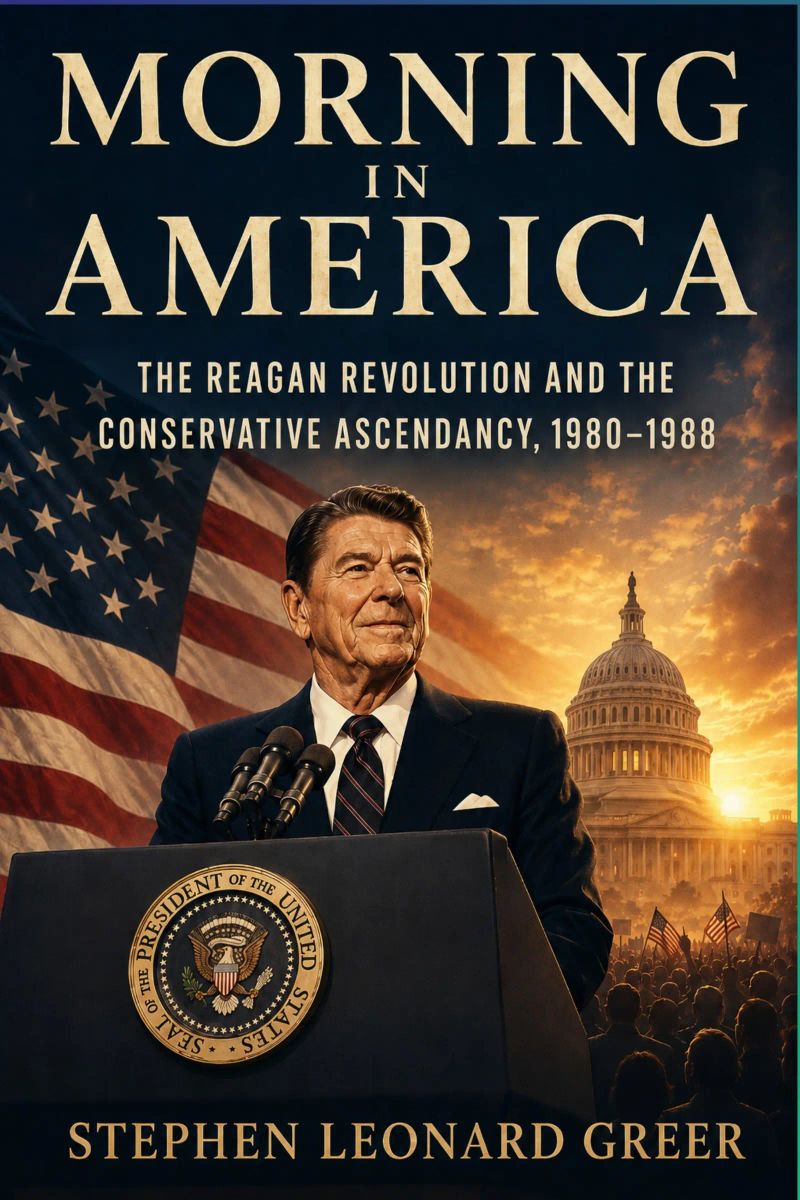
Morning In America
The Reagan Revolution and the Conservative Ascendancy, 1980-1988By Stephen Leonard Greer


Length6h 13m
About this audiobook
Reagan Revolution history — narrative of the conservative ascendancy, Reaganomics, the Cold War endgame, Iran-Contra, the AIDS crisis, and the political transformation that reshaped America, 1980-1988.
On January 20, 1981, Ronald Reagan said seven words that announced a governing philosophy: "Government is not the solution to our problem." Sixteen years earlier he had delivered "A Time for Choosing" on behalf of a man losing in a landslide. The journey from that 1964 speech to the presidency was the founding of modern conservatism as a governing ideology — and its consequences, America has been living with ever since.
This Reagan Revolution history traces the conservative ascendancy across twenty-four chapters. Historian Stephen Leonard Greer follows the movement from Goldwater's loss through the coalition Reagan assembled — Falwell's Moral Majority, Heritage Foundation infrastructure — to Reagan's 44-state landslide. The book examines what the revolution delivered: the Economic Recovery Tax Act cutting the top rate from 70 to 50 percent; the PATCO strike; the Evil Empire speech; the Reykjavik summit; and the Iran-Contra affair. Greer also delivers the record admirers prefer not to examine: the AIDS crisis in which Reagan gave no major address until 1987, after more than twenty thousand Americans had died; the 100-to-1 crack sentencing disparity; and the structural deficit that permanently altered American fiscal politics.
Inside this conservative history of the Reagan era:
• The road to Reagan — "A Time for Choosing" in 1964, stagflation and the Iran hostage crisis, Viguerie's direct mail operation, and Heritage Foundation's "Mandate for Leadership" distributed to the incoming cabinet (Chapters 1-4)
• Reaganomics — the Laffer Curve, Stockman's admission that supply-side was "trickle-down," the deficit rising from 2.7 to 6 percent of GDP, and the 1986 Tax Reform Act driving the top rate to 28 percent (Chapters 5, 7)
• Reagan's Cold War — SDI, the Reykjavik summit that nearly produced total nuclear disarmament, and the INF Treaty (Chapters 9, 11-12)
• The AIDS crisis — twelve thousand deaths before Reagan mentioned the epidemic publicly in 1985, ACT UP's die-ins at the FDA, and Surgeon General Koop's 1986 report the White House was reluctant to authorize (Chapter 15)
• Iran-Contra — North's document shredding, the Tower Commission's finding that Reagan was too detached from his own policy, and the constitutional question about covert operations never adjudicated (Chapter 16)
• The Reagan legacy — income inequality through the 1980s, the Cold War's end and the credit Reagan deserves, and the conservative era's consequences four decades on (Chapters 21-24)
In 1980, after stagflation and the Iran hostage crisis, Reagan's optimism was a genuine resource. Whether the morning he promised arrived — and for whom — is the question this Reagan Revolution history answers with the full weight of evidence from the eight years that followed.
For readers of Rick Perlstein's THE INVISIBLE BRIDGE and Sean Wilentz's THE AGE OF REAGAN.
Audiobook details
GenreHistory, Biography and Memoir
Length6 hrs 13 mins
Narrated byListen with 1,000+ voices
FormateBook with Audio
Publish dateJun 2, 2026
LanguageEnglish
Table of contents
1Introduction
2Prologue: The City on a Hill
3PART ONE: THE ROAD TO REAGAN (1964-1980)
4Chapter 1: Goldwater's Heir — Reagan's Rise in the Conservative Movement
5Chapter 2: The Seventies Crisis — Stagflation, Malaise, and the Carter Years
Show all chaptersShow less
6Chapter 3: The New Right — Evangelicals, Neoconservatives, and the Coalition
7Chapter 4: The Election of 1980 — Reagan's Landslide and the Conservative Mandate
8PART TWO: REAGANOMICS (1981-1984)
9Chapter 5: Supply-Side Economics — Tax Cuts, Deficits, and the Theory
10Chapter 6: Breaking PATCO — Reagan, the Air Traffic Controllers, and Labor
11Chapter 7: Deregulation — Loosening Government's Hold on the Economy
12Chapter 8: The Recession of 1981-1982 and the Recovery
13PART THREE: REAGAN'S COLD WAR (1981-1989)
14Chapter 9: The Evil Empire — Reagan's Confrontational Cold War Stance
15Chapter 10: The Reagan Doctrine — Arming Anti-Communist Rebels Worldwide
16Chapter 11: SDI — Star Wars, the Strategic Defense Initiative, and Its Impact
17Chapter 12: Gorbachev — The Summit Diplomacy That Helped End the Cold War
18PART FOUR: THE REAGAN DOMESTIC AGENDA
19Chapter 13: Social Conservatism — The Moral Majority and the Culture Wars
20Chapter 14: The War on Drugs — Nancy Reagan, Crack Cocaine, and Just Say No
21Chapter 15: The AIDS Crisis — Reagan's Silence and Its Human Cost
22Chapter 16: Iran-Contra — The Scandal That Almost Brought Down the Presidency
23PART FIVE: THE MAN AND HIS PRESIDENCY
24Chapter 17: Ronald Reagan — Actor, Governor, President
25Chapter 18: The Reagan Style — Communication, Optimism, and the Great Communicator
26Chapter 19: Nancy Reagan — The First Lady's Influence
27Chapter 20: The 1984 Landslide — Morning in America and the Campaign
28PART SIX: LEGACIES
29Chapter 21: The Reagan Revolution — What Changed and What Didn't
30Chapter 22: Income Inequality — The Long Economic Legacy of the Eighties
31Chapter 23: The End of the Cold War — How Much Credit Belongs to Reagan?
32Chapter 24: Reagan's America — The Conservative Era and Its Consequences
33Epilogue: What Reagan Built
34Acknowledgments
35Selected Bibliography
36About the Author
More from Stephen Leonard Greer



A Brief History of IntelligenceMax S. Bennett12h 18m4.6 (6.6K)$29 · $0.00

The Happiest Man on EarthEddie Jaku3h 48m4.6 (178K)$7 · $0.00

MotherlandJulia Ioffe17h 52m4.7 (2.5K)$40 · $0.00

Where Cowards Go to DieBenjamin Sledge8h 42m4.7 (351)$20 · $0.00

RevolutionariesSanjeev Sanyal11h 23m4.6 (2.6K)$29 · $0.00

Days of Love and Rage: A Story of RevolutionAnand Gopal22h 36m4.7 (584)$34 · $0.00

We Crossed a Bridge and It TrembledWendy Pearlman6h4.6 (5.2K)$24 · $0.00

Unbroken Bonds of BattleJohnny Joey Jones8h 31m4.6 (2.6K)$8 · $0.00

The Daughter of AuschwitzTova Friedman, Malcolm Brabant7h 54m4.6 (16.7K)$26 · $0.00

Lily's PromiseLily Ebert, Dov Forman8h 54m4.6 (16.1K)$29 · $0.00

On Democracies and Death CultsDouglas Murray10h 38m4.6 (6.5K)$29 · $0.00

Across the RiverKent Babb11h 40m4.6 (927)$29 · $0.00

Balcony Over Jerusalem: A Middle East Memoir - Israel, Palestine and BeyondJohn Lyons12h 37m4.6 (1.4K)$33 · $0.00

BeyondStephen Walker15h 39m4.6 (3.2K)$33 · $0.00
Kings and PawnsHoward Bryant10h 9m4.6 (678)$29 · $0.00

No EscapeNury Turkel9h 30m4.6 (809)$28 · $0.00

Jubal Stone: U.S. Marshal: Blood Trail To Hell: A Western Adventure NovelCasey Nash3h 42m4.6 (3.2K)$18 · $0.00

Fall and RiseMitchell Zuckoff17h 23m4.6 (9.8K)$40 · $0.00

The SurvivorJosef Lewkowicz, Michael Calvin9h 22m4.6 (2.5K)$29 · $0.00

Always FaithfulThomas Schueman, Zainullah Zaki12h 12m4.6 (977)$29 · $0.00

How to Test Negative for StupidJohn Kennedy8h 13m4.7 (9.7K)$28 · $0.00

Bad Fat Black GirlSesali Bowen6h 32m4.7 (2.8K)$24 · $0.00

Send MeMarty Skovlund, Joe Kent8h 10m4.7 (1.6K)$26 · $0.00

John Muir: The Story of My Boyhood and Youth & Letters to a Friend (Annotated)John Muir10h 13m4.7 (1.1K)$0.99 · $0.00

Invisible StormJason Kander6h 48m4.7 (3.2K)$24 · $0.00

Forever BoyKate Swenson9h 27m4.7 (5K)$29 · $0.00

You Are Worth ItKyle Carpenter, Don Yaeger8h 53m4.7 (4.8K)$29 · $0.00
The Happiest Man on EarthEddie Jaku3h 48m4.6 (178K)$7 · $0.00
MotherlandJulia Ioffe17h 52m4.7 (2.5K)$40 · $0.00

Evidence Not SeenDarlene Deibler Rose11h 11m4.6 (11.9K)$29 · $0.00
Where Cowards Go to DieBenjamin Sledge8h 42m4.7 (351)$20 · $0.00

Will You Love Me?Cathy Glass9h 5m4.6 (9.3K)$29 · $0.00

Designing Terry Pratchett’s DiscworldPaul Kidby3h 52m4.7 (343)$20 · $0.00

HostageEli Sharabi5h 25m4.6 (10.8K)$24 · $0.00

Finding MeViola Davis9h 15m4.6 (256.4K)$29 · $0.00

The Dangerous Truth about Today’s MarijuanaLaura Stack CSP, MBA9h 57m4.7 (385)$20 · $0.00

Birdie & HarlowTaylor Wolfe7h 50m4.6 (6.5K)$26 · $0.00

The Lives of BrianBrian Johnson9h 45m4.6 (3.5K)$29 · $0.00

I Am The StormJanice Dean9h4.6 (1.5K)$8 · $0.00

Black History CollectionFrederick Douglass, Harriet Ann Jacobs, Booker T. Washington, W.E.B. Du Bois27h 9m4.6 (2.6K)$18 · $0.00
You may also like

No TreasonLysander Spooner3h 5m4.4 (1.2K)$1 · $0.00

50 Things They Don't Want You to KnowJerome Hudson7h 45m4.2 (323)$26 · $0.00

NemesisChalmers Johnson11h 59m4.2 (1.2K)$21 · $0.00

The CIA as Organized CrimeDouglas Valentine16h 51m4.3 (712)$23
Capitalist PunishmentVivek Ramaswamy7h4.3 (430)$24 · $0.00

Barbarous MexicoJohn Kenneth Turner11h 49m4.2 (2K)$1 · $0.00
The Last Days of StalinJoshua Rubenstein8h 46m4.1 (1.8K)$20

I Can’t BreatheDavid Horowitz6h 7m4.3 (604)$17 · $0.00

ImpeachNeal Katyal, Sam Koppelman6h 41m4.5 (2K)$24 · $0.00

The Case for ImpeachmentAllan J. Lichtman6h 33m3.9 (1.9K)$24 · $0.00

Power GrabJason Chaffetz10h 35m4.2 (767)$29 · $0.00

The Goslings A Study of American SchoolsUpton Sinclair19h 26m4.3 (17)$2.30

Vaccination a Delusion: Its Penal Enforcement a CrimeAlfred Russel Wallace5h 14m$1 · $0.00

Privileged ResolutioDennis Kucinich4h 40m$1 · $0.00

A Letter to Grover ClevelandLysander Spooner5h 50m4.1 (19)$2 · $0.00

The Atomic BazaarWilliam Langewiesche5h 8m3.9 (655)$14 · $0.00

A Letter to Thomas F. BayardLysander Spooner20m3.6 (11)$2 · $0.00

The Fabric of Europe: 5 Classic Books on European PoliticsGeorge W. T. Omond, Lector, Harold Spender, Karl Paul August Friedrich Liebknecht17h 21m$0.99 · $0.00

The Abolition Fight in EnglandThomas Clarkson25h 17m$2 · $0.00

Letters to Judd, an American WorkingmanUpton Sinclair3h 33m$2.30