
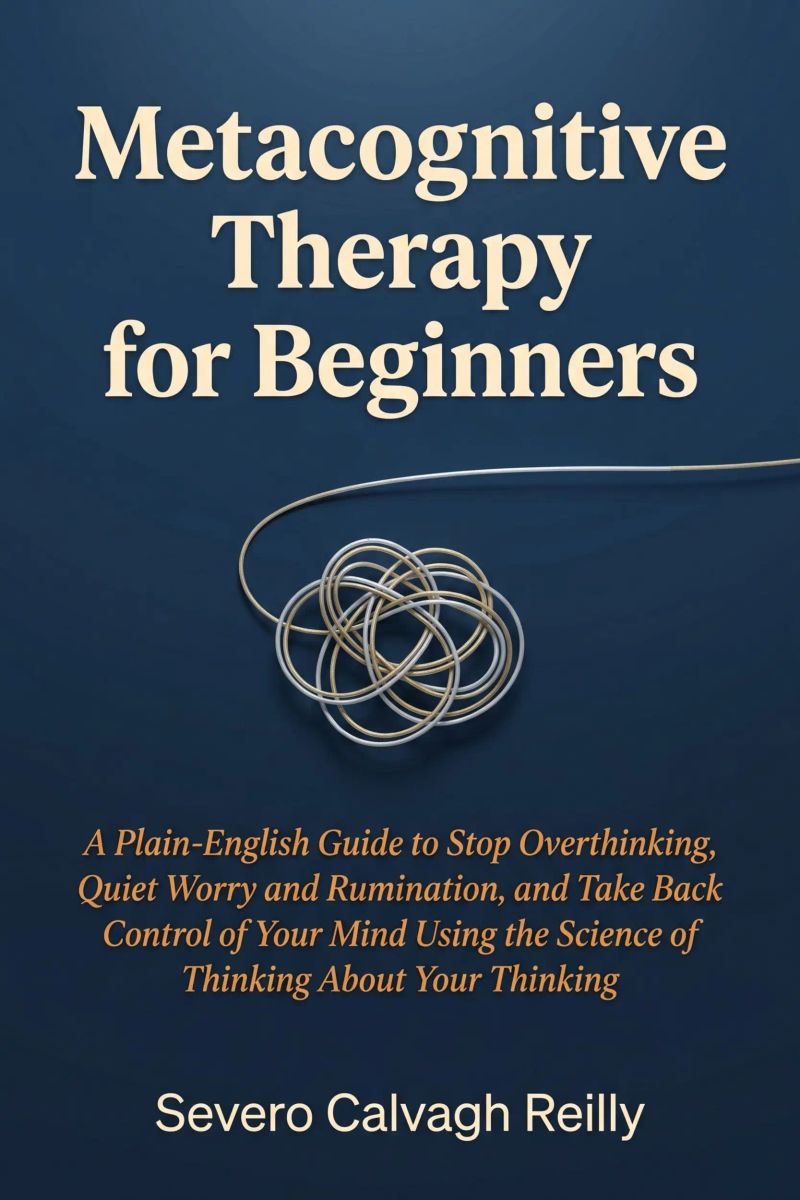
Metacognitive Therapy for Beginners
A Plain-English Guide to Stop Overthinking, Quiet Worry and Rumination, and Take Back Control of Your Mind Using the Science of Thinking About Your ThinkingBy Severo Calvagh Reilly


Length7h 33m
About this audiobook
Your Mind Won't Slow Down. Here's Why Nothing Has Worked.
Lying awake at 2 a.m. replaying conversations. Spending hours worrying about what might go wrong. Analyzing why you feel the way you feel until you feel worse. If this sounds familiar, you have probably tried everything: self-help books, meditation apps, maybe even therapy. And the worry is still there.
Here is what almost no one tells you. The problem is not your thoughts. The problem is what you do with them.
A Science-Backed Alternative to CBT and Mindfulness
Metacognitive Therapy (MCT), developed by Professor Adrian Wells at the University of Manchester, is one of the fastest-growing, most research-supported approaches in modern mental health. Clinical trials have shown MCT matching or exceeding traditional Cognitive Behavioral Therapy for generalized anxiety disorder, chronic depression, obsessive thoughts, and more. Instead of challenging your thoughts, it changes how you relate to them, so they lose their grip instead of sticking to you.
Written for Real People, Not Therapists
Most MCT books are dense clinical manuals. This one isn't. Every chapter opens with a real-life story, walks you through the concept in plain American English, and shows you exactly what to practice today. You will meet the Cognitive Attentional Syndrome, learn Detached Mindfulness, practice the Attention Training Technique (ATT), discover worry postponement, and run simple behavioral experiments that update the beliefs keeping you stuck.
What You Will Learn Inside
The hidden driver behind chronic worry, depression, and overthinking. Why "just stop thinking about it" has never worked for you. How to quiet rumination without suppressing your thoughts. Daily routines that take under 30 minutes and actually produce change. How MCT applies to generalized anxiety, depression, OCD, social anxiety, health anxiety, and PTSD. When self-guided practice is enough, and how to find professional help when it isn't.
For Anyone Told They "Think Too Much"
Written for absolute beginners, this guide assumes no prior knowledge of psychology. No clinical jargon without translation. No motivational filler. Just a clear, warm, research-grounded introduction to a method that has helped people take back control of their attention, their evenings, and their peace of mind.
If you have read anxiety workbooks that didn't stick, tried mindfulness and felt like you were doing it wrong, or finished CBT knowing the tools but still feeling trapped in your head, this is the doorway book you have been looking for.
Start reading today and discover why changing how you respond to your thoughts may be the single most important shift you ever make.
Audiobook details
GenrePsychology, Self-Help
Length7 hrs 33 mins
Narrated byListen with 1,000+ voices
FormateBook with Audio
Publish dateApr 23, 2026
LanguageEnglish
Table of contents
1Metacognitive Therapy for Beginners
2Preface
3PART I: UNDERSTANDING METACOGNITIVE THERAPY
4Chapter 1.0: What MCT Actually Is
5Chapter 2.0: Thinking About Your Thinking
Show all chaptersShow less
6Chapter 3.0: How MCT Stands Apart
7Chapter 4.0: The Science Behind MCT
8PART II: THE HIDDEN MECHANISM KEEPING YOU STUCK
9Chapter 5.0: The Cognitive Attentional Syndrome
10Chapter 6.0: Worry And Rumination
11Chapter 7.0: Scanning For Danger
12Chapter 8.0: Coping That Backfires
13Chapter 9.0: Beliefs About Your Thoughts
14PART III: THE CORE TECHNIQUES OF MCT
15Chapter 10.0: Meeting Detached Mindfulness
16Chapter 11.0: Training Your Attention
17Chapter 12.0: Putting Worry On Hold
18Chapter 13.0: Refocusing In Real Situations
19Chapter 14.0: Testing Your Own Beliefs
20PART IV: APPLYING MCT TO COMMON PROBLEMS
21Chapter 15.0: MCT For Chronic Worry
22Chapter 16.0: Breaking The Rumination Spiral
23Chapter 17.0: Three Related Problems
24Chapter 18.0: When Trauma Persists
25PART V: MAKING IT STICK
26Chapter 19.0: Your Daily MCT Practice
27Chapter 20.0: When Things Get Stuck
28Chapter 21.0: Finding Real Help
29Conclusion
30Appendix A: Glossary Of MCT Terms
31Appendix B: Quick Reference Exercise Library
32Appendix C: Further Reading And Resources
More from Severo Calvagh Reilly


What to Make of a LifeJim Collins13h 31m4.4 (793)$33 · $0.00

TerraformPropaganda5h 39m4.7 (594)$24 · $0.00

Southern Horrors: Lynch Law in All Its Phases (Annotated)Ida B. Wells-Barnett2h 44m4.6 (1.3K)$2 · $0.00

Hour of the HeartIrvin D. Yalom, Benjamin Yalom8h 19m4.6 (2.3K)$26 · $0.00

Braving the TruthRachel Held Evans11h 31m4.7 (359)$29 · $0.00
Level UpRob Dial7h 42m4.6 (3.3K)$26 · $0.00

As a JewSarah Hurwitz8h 36m4.6 (1.2K)$26 · $0.00

Burn the HaystackJennie Young, PhD9h 30m4.6 (543)$29 · $0.00

Woman and the New Race (Annotated)Margaret Sanger6h 30m4.6 (1K)$1.99 · $0.00

Good InsideBecky Kennedy9h 55m4.5 (59.3K)$29 · $0.00

Du Bois: EssaysW.E.B. Du Bois6h 22m4.6 (1.5K)$1 · $0.00

The North American Indian (Illustrated Edition)Edward S. Curtis, Frederick Webb Hodge5h 59m4.6 (1.4K)$2 · $0.00

Valley of the BirdtailAndrew Stobo Sniderman, Douglas Sanderson10h 1m4.6 (2.4K)$29 · $0.00

Lies My Therapist Told MeGreg E. Gifford9h 3m4.6 (503)$29 · $0.00

Disturbed in Their NestsAlephonsion Deng, Judy A. Bernstein11h 22m4.6 (595)$23 · $0.00

No Name in the StreetJames Baldwin5h4.5 (8.5K)$20 · $0.00

Magic SeasonWade Rouse6h 41m4.6 (855)$24 · $0.00

Consent Laid BareChanel Contos7h 11m4.5 (1.7K)$24 · $0.00

The Big RevealSasha Velour6h 15m4.5 (2.1K)$24 · $0.00

Pastoral SongJames Rebanks8h 35m4.5 (12K)$26 · $0.00

Learning to PrayJames Martin13h 24m4.5 (3.4K)$33 · $0.00

Finding MeViola Davis9h 15m4.6 (256.4K)$29 · $0.00

Spiritual AnatomyDaaji Kamlesh D. Patel9h 47m4.7 (319)$29 · $0.00

The Dangerous Truth about Today’s MarijuanaLaura Stack CSP, MBA9h 57m4.7 (384)$20 · $0.00

Birdie & HarlowTaylor Wolfe7h 50m4.6 (6.5K)$26 · $0.00

CrossroadsKaleb Dahlgren7h 56m4.6 (4.9K)$26 · $0.00

Life on the BridgeKaelynn Partlow5h 40m4.6 (1.1K)$24 · $0.00

Keep Your Love OnDanny Silk9h 4m4.6 (8.1K)$10 · $0.00

The Tao of Joy Every DayDerek Lin10h 24m4.6 (762)$20 · $0.00

UndividedVicky Beeching9h 2m4.6 (1.3K)$29 · $0.00
Level UpRob Dial7h 42m4.6 (3.3K)$26 · $0.00
Burn the HaystackJennie Young, PhD9h 30m4.6 (543)$29 · $0.00

ACRES OF DIAMONDS: Our Every-day Opportunities (Wisdom & Empowerment Series) (Annotated)Russell Conwell2h 26m4.6 (1K)$2 · $0.00
Good InsideBecky Kennedy9h 55m4.5 (59.3K)$29 · $0.00

The Lost VoiceGreta Morgan8h 30m4.7 (285)$26 · $0.00

Stripped DownBunnie Xo8h 25m4.5 (32.9K)$26 · $0.00

UnthinkableJamie Raskin15h 8m4.5 (9.3K)$8 · $0.00

Wallace D. Wattles Ultimate Collection Wallace D. Wattles16h 53m4.6 (1.3K)$1 · $0.00

Inquire WithinIn-Q2h 18m4.6 (993)$16 · $0.00

Under His WingsEmily Compagno7h 16m4.6 (848)$22 · $0.00
You may also like
EMILE COUE: Self Mastery Through Conscious Autosuggestion & The Practice of Autosuggestion (Including the Study of the Emile Coue's Method & Biography)Emile Coue6h 9m4.2 (2.7K)$2 · $0.00

My Magic BreathNick Ortner, Alison Taylor4m4.3 (1.7K)$4 · $0.00

Your Brain at WorkDavid Rock9h 42m4.2 (15.2K)$29 · $0.00

GutGiulia Enders8h 48m4.2 (70.9K)$29 · $0.00

The Extended MindAnnie Murphy Paul11h 26m4.2 (4.5K)$29 · $0.00

Peak MindAmishi P. Jha9h 29m4.1 (3.8K)$29 · $0.00

Boost Your BrainMajid Fotuhi9h 58m4.1 (414)$29 · $0.00

Keep HappyEustace Milles56m$2.30

Put Anxiety to RestDr. Larry Iverson, Dr. Mort Ormon5h 17m$23

Subliminal to Clear BrainfogMiss Smilla59m$2 · $0.00

Recovering misplaced things - through hypnosisMichael Bauer40m$35 · $0.00

Super MemoryMade for Success12h 13m3.6 (25)$20

InsomniaHerika Negri Brito de Vasconcelos3h 6m$12 · $0.00

The Toilet of FloraPierre-Joseph Buc'hoz2h 49m$1 · $0.00

Applied Psychology for NursesMary F. Porter2h 30m3.7 (49)$1 · $0.00

Fragile BrainScientific American7h 53m4.3 (34)$20

Sound Waves For HypnosisHypnotic Sound Waves, Laura Bloom11h 53m$21 · $0.00

Power Speed-Reading Performance SystemLiv Montgomery2h 9m2.2 (16)$15

Process Old Memories & Heal Trauma SubliminalHolly von Bonin58m$2 · $0.00
How To Solve Overthinking and Anxiety In RelationshipsAlec Moody1h 54m5.0 (8) Only with Ultra