
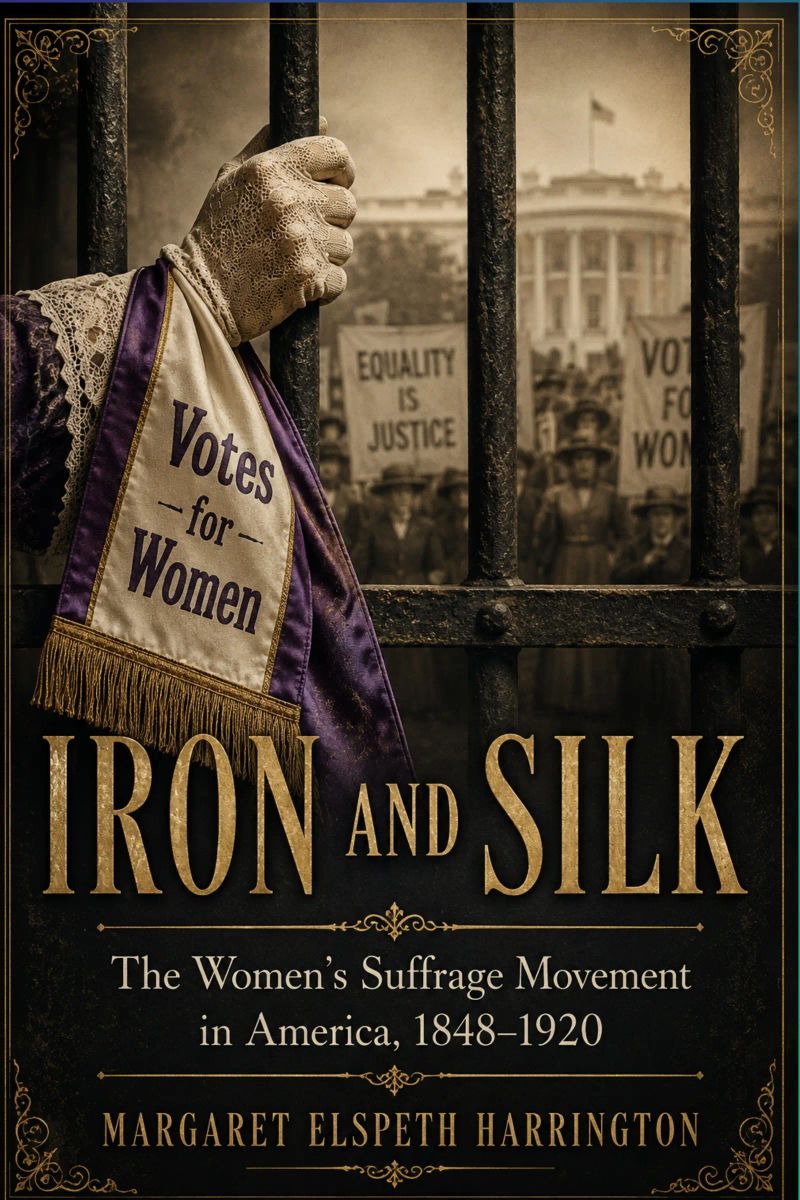
Iron And Silk
The Women's Suffrage Movement in America, 1848-1920By Margaret Elspeth Harrington


Length4h 49m
About this audiobook
Women's suffrage movement history, Seneca Falls to Nineteenth Amendment 1848-1920, Susan B. Anthony, Elizabeth Cady Stanton, Alice Paul — the complete 72-year narrative history of American women's fight for the vote.
On August 18, 1920, Tennessee legislator Harry Burn walked into the state House chamber wearing an antisuffrage red rose. In his pocket was a penciled letter from his mother: "Hurrah and vote for Suffrage and don't keep them in doubt... Don't forget to be a good boy." When his name was called, Burn voted yes. By one vote, Tennessee ratified the Nineteenth Amendment, and twenty-six million American women became eligible to vote.
Iron and Silk traces the full arc of women's suffrage history — from the 300 people at Seneca Falls in July 1848 hearing Elizabeth Cady Stanton read a Declaration modeled on the Declaration of Independence, through Susan B. Anthony's 1872 arrest and directed-verdict trial, through Alice Paul's 1917 White House pickets and the Night of Terror at the Occoquan Workhouse, to the Winning Plan that Carrie Chapman Catt executed with the precision of a military campaign.
Inside this women's suffrage book:
Seneca Falls, July 1848 — the Declaration of Sentiments, Frederick Douglass's argument that the ballot was the foundation of all other rights, and the suffrage resolution that barely passed even among the organizers (Chapter 1)
Susan B. Anthony's arrest — handcuffed by a U.S. marshal, tried before a judge who delivered a directed verdict without jury deliberation, fined $100 she told him she would never pay (Chapter 13)
The Night of Terror — November 14-15, 1917, Occoquan Workhouse: guards beating Alice Paul's pickets, Dora Lewis knocked unconscious, Lucy Burns throttled — and how the outrage accelerated Wilson's conversion (Chapter 11)
Catt's Winning Plan — the secret 1916 Atlantic City strategy dividing states into referendum targets and congressional pressure campaigns; winning New York in 1917 changed the math for every Eastern senator (Chapter 10)
The honest reckoning — the racial exclusions made to secure Southern support, the Amendment's failure to protect Black women in the South, and what 72 years of organizing achieved and left unfinished (Chapters 18, 22-23)
The women's suffrage movement succeeded because Catt and Paul made the political cost of continued denial higher than the cost of conceding. Febb Burn's penciled letter is proof it worked all the way down — to a farm woman who had no formal connection to the movement but had absorbed its arguments. This is the complete narrative history of women's rights in America, from Seneca Falls to the Nineteenth Amendment.
For readers of Doris Kearns Goodwin's NO ORDINARY TIME and Stacy Schiff's THE WITCHES.
Audiobook details
GenreHistory, Psychology
Length4 hrs 49 mins
Narrated byListen with 1,000+ voices
FormateBook with Audio
Publish dateJun 2, 2026
LanguageEnglish
Table of contents
1Introduction
2Prologue: A Half-Century Campaign
3PART ONE: THE ROOTS OF WOMEN'S RIGHTS (1848-1869)
4Chapter 1: Seneca Falls — The Declaration of Sentiments, 1848
5Chapter 2: Stanton and Anthony — The Partnership That Changed America
Show all chaptersShow less
6Chapter 3: The Civil War and the Broken Promise — Reconstruction and the Fifteenth Amendment
7Chapter 4: The Split — NWSA vs. AWSA and the Question of Strategy
8PART TWO: THE LONG CAMPAIGN (1870-1900)
9Chapter 5: State by State — The Western Strategy
10Chapter 6: The New Woman — Education, Work, and the Changing American Female
11Chapter 7: The Anti-Suffrage Forces — Liquor Interests, Southern Democrats, and Conservative Women
12Chapter 8: Wyoming Leads — The First States to Grant Women the Vote
13PART THREE: THE FINAL PUSH (1900-1920)
14Chapter 9: The Progressive Era Alliance — Suffrage and Reform
15Chapter 10: Carrie Chapman Catt and the Winning Plan
16Chapter 11: Militant Suffrage — Alice Paul and the National Woman's Party
17Chapter 12: The Nineteenth Amendment — Ratification and Victory
18PART FOUR: THE MOVEMENT'S LEADERS
19Chapter 13: Susan B. Anthony — The Pioneer
20Chapter 14: Elizabeth Cady Stanton — Philosopher of the Movement
21Chapter 15: Sojourner Truth — Race, Gender, and the Suffrage Question
22Chapter 16: Working Women and Suffrage — Labor and the Vote
23PART FIVE: OPPOSITION, COMPROMISE, AND THE FINAL BATTLE
24Chapter 17: Why Men Opposed Women's Suffrage
25Chapter 18: The Southern Question — Race, Class, and the White Suffragists' Compromise
26Chapter 19: Tennessee Ratifies — The Thirty-Sixth State and Harry Burn's Vote
27Chapter 20: International Suffrage — America in Global Context
28PART SIX: LEGACIES
29Chapter 21: What the Vote Changed — Women in Politics After 1920
30Chapter 22: The Unfinished Agenda — Women's Rights Beyond Suffrage
31Chapter 23: The ERA — Equal Rights and Its Long Struggle
32Chapter 24: The Suffragists' Legacy — A Movement That Transformed Democracy
33Epilogue: The Unfinished Vote
34Acknowledgments
35Selected Bibliography
36About the Author
More from Margaret Elspeth Harrington

A Brief History of IntelligenceMax S. Bennett12h 18m4.6 (6.6K)$29 · $0.00

MotherlandJulia Ioffe17h 52m4.7 (2.5K)$40 · $0.00

Where Cowards Go to DieBenjamin Sledge8h 42m4.7 (351)$20 · $0.00
RevolutionariesSanjeev Sanyal11h 23m4.6 (2.6K)$29 · $0.00

We Crossed a Bridge and It TrembledWendy Pearlman6h4.6 (5.2K)$24 · $0.00

Unbroken Bonds of BattleJohnny Joey Jones8h 31m4.6 (2.6K)$8 · $0.00

The Daughter of AuschwitzTova Friedman, Malcolm Brabant7h 54m4.6 (16.7K)$26 · $0.00
Lily's PromiseLily Ebert, Dov Forman8h 54m4.6 (16.1K)$29 · $0.00
On Democracies and Death CultsDouglas Murray10h 38m4.6 (6.5K)$29 · $0.00

Across the RiverKent Babb11h 40m4.6 (927)$29 · $0.00

Balcony Over Jerusalem: A Middle East Memoir - Israel, Palestine and BeyondJohn Lyons12h 37m4.6 (1.4K)$33 · $0.00
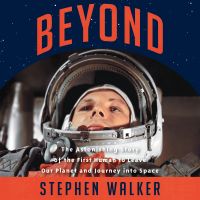
BeyondStephen Walker15h 39m4.6 (3.2K)$33 · $0.00
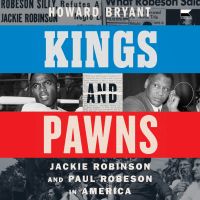
Kings and PawnsHoward Bryant10h 9m4.6 (678)$29 · $0.00

No EscapeNury Turkel9h 30m4.6 (809)$28 · $0.00
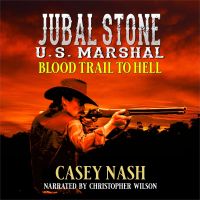
Jubal Stone: U.S. Marshal: Blood Trail To Hell: A Western Adventure NovelCasey Nash3h 42m4.6 (3.2K)$18 · $0.00
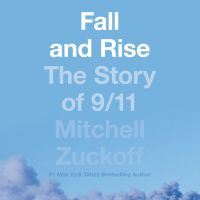
Fall and RiseMitchell Zuckoff17h 23m4.6 (9.8K)$40 · $0.00
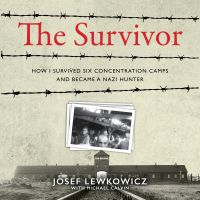
The SurvivorJosef Lewkowicz, Michael Calvin9h 22m4.6 (2.5K)$29 · $0.00

Always FaithfulThomas Schueman, Zainullah Zaki12h 12m4.6 (977)$29 · $0.00

The State of Society in France Before the Revolution of 1789 (Annotated)Alexis de Tocqueville17h 25m4.6 (1.2K)$2 · $0.00

All the Gallant MenDonald Stratton, Ken Gire5h 55m4.6 (11.8K)$24 · $0.00
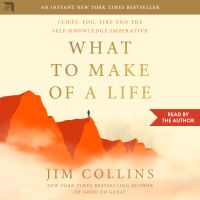
What to Make of a LifeJim Collins13h 31m4.4 (794)$33 · $0.00

I Am The StormJanice Dean9h4.6 (1.5K)$8 · $0.00
On Democracies and Death CultsDouglas Murray10h 38m4.6 (6.5K)$29 · $0.00

TerraformPropaganda5h 39m4.7 (594)$24 · $0.00
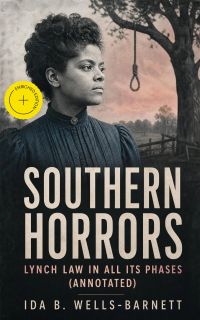
Southern Horrors: Lynch Law in All Its Phases (Annotated)Ida B. Wells-Barnett2h 44m4.6 (1.3K)$2 · $0.00
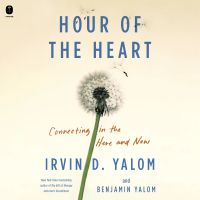
Hour of the HeartIrvin D. Yalom, Benjamin Yalom8h 19m4.6 (2.3K)$26 · $0.00
Braving the TruthRachel Held Evans11h 31m4.7 (359)$29 · $0.00
Level UpRob Dial7h 42m4.6 (3.3K)$26 · $0.00
As a JewSarah Hurwitz8h 36m4.6 (1.2K)$26 · $0.00
Saint Joan (Annotated)George Bernard Shaw6h 20m4.6 (1.2K)$1.20 · $0.00
Burn the HaystackJennie Young, PhD9h 30m4.6 (543)$29 · $0.00

Woman and the New Race (Annotated)Margaret Sanger6h 30m4.6 (1K)$0.99 · $0.00

Good InsideBecky Kennedy9h 55m4.5 (59.3K)$29 · $0.00
The Mis-Education of the NegroCarter Godwin Woodson5h 4m4.5 (29.4K)$1.20 · $0.00
Du Bois: EssaysW.E.B. Du Bois6h 22m4.6 (1.5K)$1 · $0.00

The North American Indian (Illustrated Edition)Edward S. Curtis, Frederick Webb Hodge5h 59m4.6 (1.4K)$2 · $0.00

Valley of the BirdtailAndrew Stobo Sniderman, Douglas Sanderson10h 1m4.6 (2.4K)$29 · $0.00
Lies My Therapist Told MeGreg E. Gifford9h 3m4.6 (503)$29 · $0.00
Disturbed in Their NestsAlephonsion Deng, Judy A. Bernstein11h 22m4.6 (595)$23 · $0.00
No Name in the StreetJames Baldwin5h4.5 (8.5K)$20 · $0.00
You may also like
Bearing the CrossDavid J. Garrow34h 22m4.3 (2.5K)$28
Sisters in LawLinda Hirshman13h 29m4.0 (7.9K)$33 · $0.00
Girls Resist!KaeLyn Rich5h 48m4.3 (423)$20

My Own StoryEmmeline Pankhurst13h 15m4.2 (3.7K)$1 · $0.00

Anarchism and Other EssaysEmma Goldman7h 48m4.2 (9.2K)$3

RFKRobert F. Kennedy, C. Richard Allen, Edwin O. Guthman14h 7m4.5 (363)$33 · $0.00

Victory for the VoteDoris Weatherford13h 28m4.3 (59)$23

The Complete History of the Women's Suffrage Movement in U.S.Harriot Stanton Blatch, Elizabeth Cady Stanton, Jane Addams, Ida Husted Harper, Anna Howard Shaw, Susan B. Anthony, Alice Stone Blackwell, Matilda Gage393h 42m4.4 (40)$0.99 · $0.00
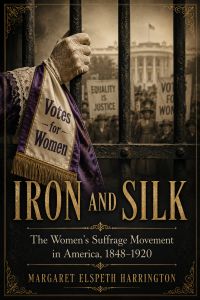
IRON AND SILKMargaret Elspeth Harrington4h 57m$6 · $0.00
The Diversity PrincipleDavid B. Oppenheimer13h 28m$27
Lincoln, the PoliticianT. Aaron Levy5h 48m$2 · $0.00
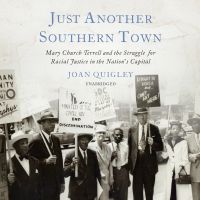
Just Another Southern TownJoan Quigley13h 9m3.9 (47)$23
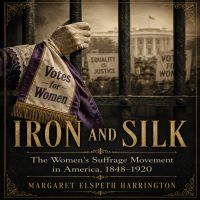
Iron And SilkMargaret Elspeth Harrington3h 55m$8 · $0.00
Women's Suffrage: The Short History of a Great MovementMillicent Garrett Fawcett4h 9m3.9 (155)$1.99 · $0.00
History of the Women's Suffrage Movement in America (Annotated)Harriot Stanton Blatch, Elizabeth Cady Stanton, Jane Addams, Ida Husted Harper, Anna Howard Shaw, Susan B. Anthony, Alice Stone Blackwell, Matilda Gage394h 51m$1.99 · $0.00
Yes you can do justice in the worldBarbra Bowes7h 44m$10 · $0.00
The Women of the Suffrage MovementJane Addams, Elizabeth Cady Stanton, Ida Husted Harper, Anna Howard Shaw, Millicent Garrett Fawcett, Emmeline Pankhurst, Alice Stone Blackwell409h 49m4.5 (12)$1.99 · $0.00
The ProducerDunstan Prial12h 22m4.1 (106)$23 · $0.00

Medical Women (Annotated)Sophia Jex-Blake6h 36m$1.99 · $0.00
Lucy Stone: Pioneer of Women's RightsAlice Stone Blackwell7h 22m4.3 (15)$1 · $0.00