
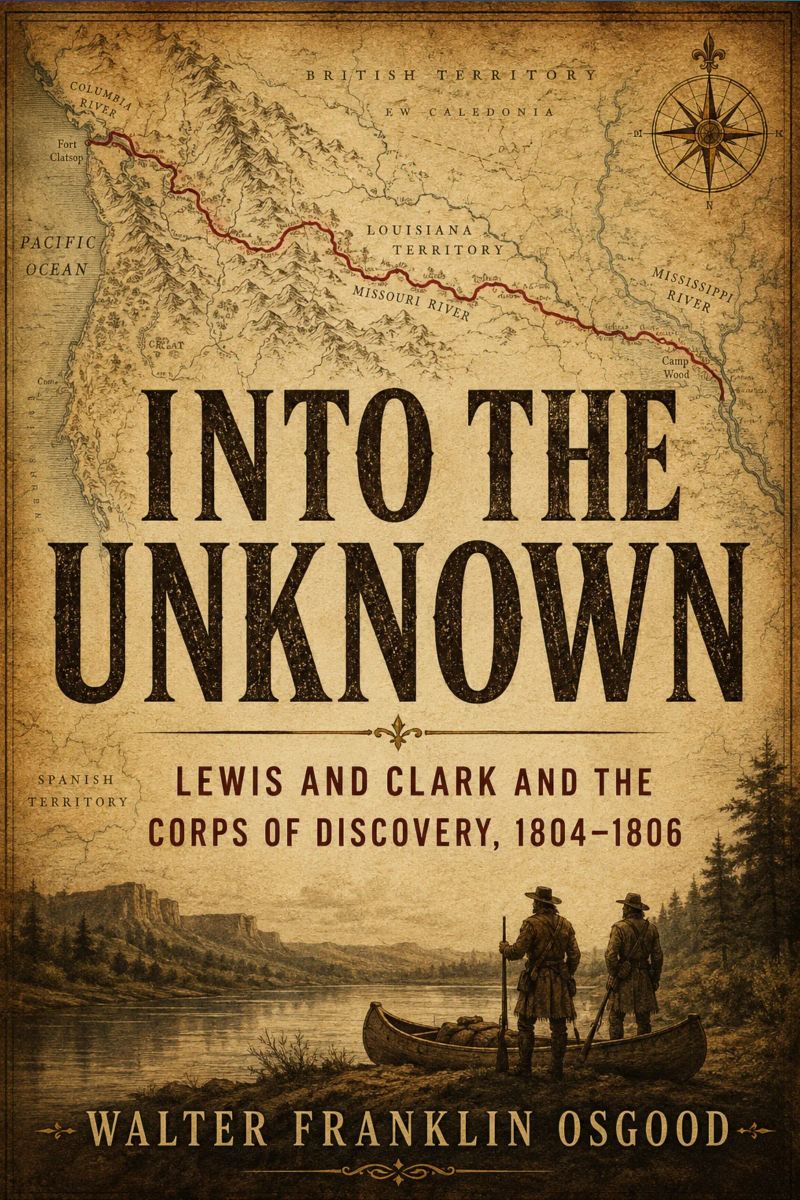
INTO THE UNKNOWN
Lewis and Clark and the Corps of Discovery, 1804-1806By Walter Franklin Osgood


Length5h 38m
About this audiobook
Lewis and Clark history, Corps of Discovery narrative, Sacagawea, Louisiana Purchase, American exploration 1804-1806 — the complete story of the expedition that mapped a continent.
On June 13, 1805, Meriwether Lewis crested a rise and heard the Great Falls of the Missouri — cascades dropping nearly ninety feet. He wrote that it was "the grandest sight I ever beheld," then spent four weeks portaging eighteen miles around it through cactus and heat that exceeded 100 degrees. Awe and ordeal, inseparable: that is the texture of the Lewis and Clark history.
Into the Unknown is the complete story of the Corps of Discovery: eight thousand miles, two and a half years from Camp Dubois to the Pacific and back. Walter Franklin Osgood traces every stage — from Jefferson's Louisiana Purchase and his 1803 scientific instructions to Lewis, through the Bad River standoff, the winter at Fort Mandan where Sacagawea joined the Corps, her reunion on the continental divide when she recognized Shoshone chief Cameahwait as her own brother, the eleven-day Bitterroot ordeal, and the return to St. Louis in September 1806.
Inside this American exploration book:
Jefferson's Louisiana Purchase — a $15 million purchase that doubled the republic overnight and made the Corps of Discovery a matter of national sovereignty (Chapter 1)
The Bad River confrontation — Clark's drawn sword, the aimed swivel gun, and the Partisan's grabbed bowline: the most dangerous diplomatic moment of the expedition (Chapter 6)
Sacagawea — she saved the navigational instruments from a capsizing pirogue, overheard Cameahwait's plan to abandon the Corps, and wept when she recognized the Shoshone chief as her own brother (Chapters 8, 10)
The Great Falls portage — eighteen miles, four weeks, prickly pear through their moccasins, a failed iron boat, and Sacagawea's near-fatal illness (Chapter 9)
Crossing the Bitterroots — eleven days, snow covering the trail, hunters returning with nothing, and the decision Clark recorded as the most critical moment of the journey (Chapter 11)
The honest reckoning — diplomatic promises never kept, the 1837 smallpox epidemic that reduced the Mandan from 1,600 to fewer than 150, and the full consequences for the peoples the expedition encountered (Chapters 20, 24)
The Corps returned with 178 new plant species, 122 new animal species, and Clark's maps that guided American geography for decades. This narrative American history of the Lewis and Clark expedition holds both the achievement and the reckoning: the blank map filled in, and the full human cost of what filling it in meant for the peoples already living there.
For readers of Stephen Ambrose's UNDAUNTED COURAGE and S.C. Gwynne's EMPIRE OF THE SUMMER MOON.
Audiobook details
GenreHistory
Length5 hrs 38 mins
Narrated byListen with 1,000+ voices
FormateBook with Audio
Publish dateJun 2, 2026
LanguageEnglish
Table of contents
1Introduction
2Prologue: The Blank Map
3PART ONE: THE ORIGINS OF THE EXPEDITION
4Chapter 1: Jefferson's Dream — The Louisiana Purchase and the Unknown West
5Chapter 2: The Captains — Meriwether Lewis and William Clark
Show all chaptersShow less
6Chapter 3: Building the Corps — Recruiting, Training, and Equipping the Expedition
7Chapter 4: Setting Out — Camp Dubois and the Journey Begins, May 1804
8PART TWO: UP THE MISSOURI (1804)
9Chapter 5: The Missouri River — Navigating America's Great Highway
10Chapter 6: The Sioux Confrontation — Diplomacy and the Near-Disaster at Bad River
11Chapter 7: Winter at Fort Mandan — The Expedition's First Winter with the Mandan People
12Chapter 8: Sacagawea — The Shoshone Woman Who Guided the Corps
13PART THREE: ACROSS THE CONTINENT (1805)
14Chapter 9: The Great Falls and the Portage — Summer 1805 on the Upper Missouri
15Chapter 10: Meeting the Shoshone — Sacagawea's Brother and the Horses the Corps Needed
16Chapter 11: Crossing the Bitterroots — The Most Dangerous Part of the Journey
17Chapter 12: Down the Columbia — The Pacific in Sight
18PART FOUR: FORT CLATSOP AND THE RETURN (1805-1806)
19Chapter 13: Fort Clatsop — Winter on the Pacific Coast
20Chapter 14: The Return Journey — Splitting the Corps and the Exploration of the Yellowstone
21Chapter 15: The Lewis and Ordway Fight — The Expedition's Only Violent Incident
22Chapter 16: St. Louis — The Corps Returns, September 1806
23PART FIVE: THE PEOPLES OF THE WEST
24Chapter 17: The Mandan and Hidatsa — Life in the Upper Missouri Villages
25Chapter 18: The Nez Perce — Hospitality, Horses, and the Mountain People
26Chapter 19: The Chinook — Pacific Coast Trade and the Mouth of the Columbia
27Chapter 20: The Expedition's Impact on Native Peoples — Diplomacy, Disease, and Displacement
28PART SIX: LEGACIES
29Chapter 21: The Journals — Natural History, Geography, and the Written Record
30Chapter 22: The Scientific Legacy — Plants, Animals, and the Knowledge of the West
31Chapter 23: Westward Expansion — How the Expedition Opened the Oregon Country
32Chapter 24: Lewis and Clark in American Memory — Myth, History, and Reassessment
33Epilogue: What the Journey Made
34Acknowledgments
35Selected Bibliography
36About the Author
More from Walter Franklin Osgood

A Brief History of IntelligenceMax S. Bennett12h 18m4.6 (6.6K)$29 · $0.00

Where Cowards Go to DieBenjamin Sledge8h 42m4.7 (351)$20 · $0.00
RevolutionariesSanjeev Sanyal11h 23m4.6 (2.6K)$29 · $0.00

We Crossed a Bridge and It TrembledWendy Pearlman6h4.6 (5.2K)$24 · $0.00
Unbroken Bonds of BattleJohnny Joey Jones8h 31m4.6 (2.6K)$8 · $0.00

The Daughter of AuschwitzTova Friedman, Malcolm Brabant7h 54m4.6 (16.7K)$26 · $0.00

Lily's PromiseLily Ebert, Dov Forman8h 54m4.6 (16.1K)$29 · $0.00

On Democracies and Death CultsDouglas Murray10h 38m4.6 (6.5K)$29 · $0.00

Across the RiverKent Babb11h 40m4.6 (927)$29 · $0.00

Balcony Over Jerusalem: A Middle East Memoir - Israel, Palestine and BeyondJohn Lyons12h 37m4.6 (1.4K)$33 · $0.00

BeyondStephen Walker15h 39m4.6 (3.2K)$33 · $0.00
Kings and PawnsHoward Bryant10h 9m4.6 (678)$29 · $0.00

No EscapeNury Turkel9h 30m4.6 (809)$28 · $0.00
Jubal Stone: U.S. Marshal: Blood Trail To Hell: A Western Adventure NovelCasey Nash3h 42m4.6 (3.2K)$18 · $0.00

Fall and RiseMitchell Zuckoff17h 23m4.6 (9.8K)$40 · $0.00
The SurvivorJosef Lewkowicz, Michael Calvin9h 22m4.6 (2.5K)$29 · $0.00
Always FaithfulThomas Schueman, Zainullah Zaki12h 12m4.6 (977)$29 · $0.00

The State of Society in France Before the Revolution of 1789 (Annotated)Alexis de Tocqueville17h 25m4.6 (1.2K)$2 · $0.00
All the Gallant MenDonald Stratton, Ken Gire5h 55m4.6 (11.8K)$24 · $0.00
Saint Joan (Annotated)George Bernard Shaw6h 20m4.6 (1.2K)$1.20 · $0.00
You may also like
Through the Brazilian Wilderness - An Epic Adventure of the Roosevelt-Rondon Scientific ExpeditionTheodore Roosevelt13h 10m4.1 (2.4K)$1 · $0.00
Captain Cook's Journal During the First Voyage Round the World made in H.M. bark "Endeavour" (Annotated)James Cook24h 32m4.2 (794)$2 · $0.00
EndeavourPeter Moore19h 36m4.1 (1.1K)$25
The Lewis and Clark JournalsGary E. Moulton19h 31m4.3 (894)$32

Through the Brazilian Wilderness - An Epic Adventure of the Roosevelt-Rondon Scientific Expedition (Annotated)Theodore Roosevelt13h 48m4.1 (1.1K)$2 · $0.00
The Wanderings of an Elephant HunterWalter Dalrymple Maitland Bell8h 5m4.5 (436)$1 · $0.00

Jungle of StoneWilliam Carlsen16h 36m4.3 (3.4K)$40 · $0.00
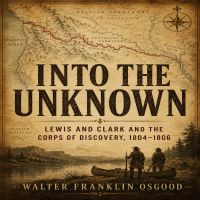
INTO THE UNKNOWNWalter Franklin Osgood4h 48m$9 · $0.00
Horizon’s WestOld Time Radio6h 40m$25
Palmer's Journal of Travels Over the Rocky Mountains, 1845-1846Joel Palmer9h 59m4.0 (54)$1 · $0.00
Captain Cook's Journal During His First Voyage Round the WorldJames Cook25h 49m4.1 (160)$2 · $0.00

Palmer's Journal of Travels Over the Rocky Mountains, 1845-1846 (Annotated)Joel Palmer10h 6m4.2 (48)$2 · $0.00

A Voyage to Terra Australis (Annotated)Matthew Flinders38h 46m4.2 (225)$2 · $0.00

The Paper and the River: Lewis and Clark, the Mandan Villages, and the Making of the American WestDaniel Whitcomb Avery5h 29m$6

A Voyage to the South Sea (Autobiography)William Bligh9h 54m4.0 (533)$2 · $0.00
The Romance of the Colorado RiverFrederick Samuel Dellenbaugh11h 19m3.8 (34)$2 · $0.00

Journals of Travels in Assam, Burma, Bhootan, Afghanistan and the Neighbouring CountriesWilliam Griffith23h 46m$1 · $0.00

Aurora AustralisSir Ernest Henry Shackleton, Frank Wild, Tannatt William Edgeworth David, George Marston, Alistair Mackay, James Murray, Douglas Mawson2h 42m4.1 (36)$2 · $0.00
Lewis and Clark (Annotated)William R. Lighton2h 47m4.1 (185)$1.99 · $0.00
The Explorations of Père MarquetteJim Kjelgaard3h 22m4.0 (351)$1 · $0.00