
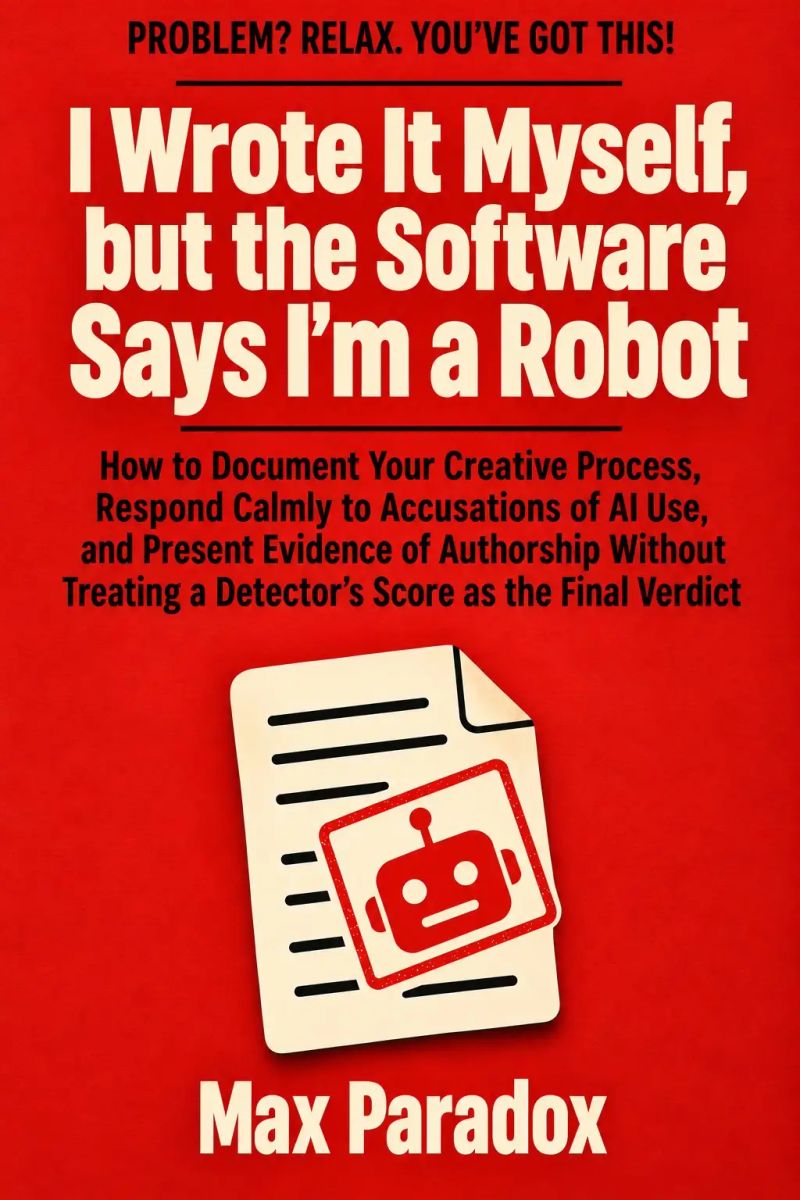
I Wrote It Myself, but the Software Says I'm a Robot - How to Document Your Creative Process, Respond Calmly to Accusations of AI Use, and Present Evidence of Authorship Without Treating a Detector's Score as the Final Verdict
By Max Paradox


Length6h 40m
About this audiobook
You wrote it yourself. The software disagrees. Apparently, you're a robot now.
You spent hours researching, drafting, deleting terrible sentences, and improving the good ones. You finally submitted your work, expecting feedback on its quality.
Instead, someone ran it through an AI detector.
The result? Your writing has been classified as suspicious.
Congratulations! Your ability to construct a coherent paragraph has become evidence against you.
I Wrote It Myself, but the Software Says I'm a Robot is a practical, witty guide to navigating one of the strangest problems facing modern writers: being accused of using artificial intelligence when the real story of how the work was created is more complicated than a detector's score.
Written in Max Paradox's distinctive blend of observational humor, common sense, and practical advice, this book helps you understand what automated detection can and cannot establish.
It's for students, authors, freelancers, journalists, copywriters, educators, and professionals who create written material and need to protect their credibility without turning every assignment into a forensic investigation.
Inside, you'll discover how to preserve meaningful evidence of your creative process, including early drafts, revision histories, research notes, editorial decisions, and relevant correspondence.
You'll learn how to organize those records into an understandable account rather than presenting an overwhelmed reviewer with forty attachments named "FINAL_FINAL_REALLY_FINAL."
The book also explores why polished, well-structured human writing can attract suspicion, why detection percentages require careful interpretation, and why an automated classification should not automatically become a finding of misconduct.
But this isn't an invitation to deceive detection systems.
You'll learn to distinguish independent writing from different kinds of AI assistance, explain the actual contributions of tools and collaborators, and understand why honest disclosure matters.
When someone challenges your authorship, you'll have practical guidance for responding calmly, identifying the specific allegation, presenting relevant information, and addressing questions without making the situation worse.
The book examines difficult situations too: missing drafts, contradictory timestamps, confidential documents, public accusations, disputed decisions, and appeals that require more than a passionate email about the decline of civilization.
It also considers the responsibilities of teachers, editors, employers, and organizations that assess authorship. Fair verification requires meaningful standards, relevant evidence, and human judgment rather than unquestioning faith in software.
Finally, you'll discover how to develop manageable documentation habits that support your work without consuming it. Because spending three hours proving that you wrote a two-hour article is not exactly a productivity breakthrough.
You won't find promises of guaranteed vindication or a magical technique that makes every detector approve of your writing.
You will find realistic explanations, useful decisions, relatable situations, and enough humor to make an otherwise frustrating subject considerably easier to handle.
Your writing deserves to be evaluated on facts, not just percentages.
You don't need to write worse to look more human.
And you certainly don't need a software-generated certificate confirming that you possess a functioning brain.
Read the book, understand your options, and take back control of your creative process.
This publication was prepared using tools that support the creative process, including artificial intelligence solutions. The final concept, structure and editing are the responsibility of the author.
Audiobook details
GenreOther
Length6 hrs 40 mins
Narrated byListen with 1,000+ voices
FormateBook with Audio
Publish dateNov 9, 2026
LanguageEnglish
Table of contents
1INTRO
2Chapter 1 - When a Question About Your Writing Becomes an Accusation
3Chapter 2 - What an AI Detector Actually Knows
4Chapter 3 - Apparently, You're Too Good at Writing to Be Human
5Chapter 4 - The Evidence Panic: How to Make a Bad Situation Worse
Show all chaptersShow less
6Chapter 5 - Your Writing History Shouldn't Disappear Every Time You Click Save
7Chapter 6 - When AI Helps You Write and When It Starts Writing for You
8Chapter 7 - Whose Words Are These, Anyway?
9Chapter 8 - How to Have the Conversation Without Turning It into a Trial
10Chapter 9 - Build an Evidence File That Makes Sense Without You in the Room
11Chapter 10 - Write the Reply That Actually Moves the Case Forward
12Chapter 11 - Follow One Paragraph Back to Its Beginnings
13Chapter 12 - The Decision Went Against You. Now What?
14Chapter 13 - Agree on the Rules Before Someone Starts Looking for a Robot
15Chapter 14 - Verify Authorship Without Starting a Witch Hunt
16Chapter 15 - When an AI Accusation Escapes into the Wild
17Chapter 16 - When Your Own Evidence Starts Contradicting Itself
18Chapter 17 - The Evidence Exists, but You Can't Show It
19Chapter 18 - A Writing Routine That Doesn't Need Its Own Assistant
20Chapter 19 - When the Fear Comes Back After the Problem Is Over
21Chapter 20 - You Do Not Need a Certificate of Humanity

Someone Got Something in My Name, and I Wasn't Even in the Store - How to Organize Your Response to Suspected Identity Theft, Preserve Evidence and Manage Communications with Institutions, and Track the Case Without Repeating Everything to Every HelpMax Paradox6h 33m$5.10

Mam sąsiada z innego kraju i więcej obaw niż wspólnych słów - Jak nawiązywać zwyczajne kontakty, uzgadniać sprawy budynku i sprawdzać własne założenia w wielokulturowym sąsiedztwie bez robienia z różnicy pochodzenia gotowego konfliktuMax Paradox6h 9m$5.10

Ktoś wziął coś na moje nazwisko, a ja nawet nie byłem w sklepie - Jak uporządkować działania po podejrzeniu kradzieży tożsamości, zabezpieczać dowody i kontakt z instytucjami oraz śledzić sprawę bez chaotycznego powtarzania wszystkiego każdej infolinMax Paradox5h 53m$5.10

I Want to Sell My Own Food, Not Collect Inspection Surprises - How to Prepare Questions for the Right Authorities, Plan Costs, Organize a Small Food Business, and Verify Requirements Before Launch Without Treating a Family Recipe as a Complete BusineMax Paradox6h 45m$5.10

I'm the Only One Without a Partner on the Family Vacation - How to Agree on the Destination, Costs, and Responsibilities in a Group Made Up Mostly of Couples and Families, and Plan Your Own Part Without Becoming the Unpaid Helper or the Permanent RolMax Paradox6h 30m$5.10

We're a Couple, But We Don't Want to Live Together - How to Build an Intentional Relationship Across Two Homes, Share Time and Responsibility, and Talk to Others Without Treating One Address as the Only Proof of CommitmentMax Paradox6h 42m$5.10

Ktoś chce kupić moją firmę, a ja nie wiem, co właściwie sprzedaję - Jak przygotować dane i pytania do doradców, rozumieć etapy rozmów oraz porównywać warunki wyjścia z małego biznesu bez mylenia pierwszej oferty z gotowym przelewemMax Paradox6h 19m4.9 (29)$5.10

The City Is Changing, but My Neighborhood Missed the Consultations - How to Check Local Plans, Take Part in Public Consultations, and Build Well-Founded Arguments About Public Space Instead of Finding Out Only After the Fence Goes UpMax Paradox6h 51m$5.10

Internet sprzedaje moje prace, chociaż mnie nikt nie pytał - Jak dokumentować nieuprawnione wykorzystanie własnych materiałów, porządkować zasady licencjonowania i dobierać pomoc specjalistyczną bez samodzielnego ścigania całego internetuMax Paradox6h 10m$5.10

Someone Close to Me Is Getting Sober, but I'm Still Living on High Alert - How to Work With Available Professional Support to Clarify Your Boundaries, Rebuild Everyday Agreements, and Return Responsibility to the Person in Recovery Without Taking OveMax Paradox6h 34m$5.10

Jestem jedyną osobą bez partnera na rodzinnych wakacjach - Jak uzgadniać miejsce, koszty i podział obowiązków w grupie złożonej głównie z par i rodzin oraz organizować własny udział bez przyjmowania roli darmowego pomocnika i wiecznego dostawianego łMax Paradox6h 23m$5.10

Miasto się zmienia, a moje osiedle nie było na konsultacjach - Jak sprawdzać lokalne plany, uczestniczyć w konsultacjach i zbierać rzeczowe argumenty w sprawach przestrzeni publicznej bez dowiadywania się o wszystkim dopiero po ustawieniu płotuMax Paradox6h 21m$5.10

I Have an ROD Allotment and Run a Tiny Country with a Garden Shed - How to Organize the Season, Manage Water and Expenses, Share Responsibility for the Plot, and Check the Rules Before the First DisputeMax Paradox6h 28m$5.10

Faktura jest po terminie, a klient nadal pisze „Już puszczam” - Jak porządkować należności, dokumentować ustalenia i stopniować działania z pomocą odpowiednich specjalistów bez finansowania działalności klienta własną cierpliwościąMax Paradox6h 13m$5.10
I Want to Help by Donating Things, but Nobody Needs My Old Printer - How to Check What Organizations and Recipients Actually Need, Prepare Useful Donations, and Plan the Handover Without Passing the Costs of Your Own Decluttering on to OthersMax Paradox6h 42m$5.10

Chcemy pomóc sąsiadce, ale nie wiemy, kto ma klucze - Jak za zgodą zainteresowanych zorganizować sąsiedzką sieć drobnej pomocy, ustalić kontakty i odpowiedzialności oraz chronić prywatność bez improwizowanego sztabu opiekiMax Paradox6h$5.10

A Customer Gave Me One Star, and Now My Whole Day Is One Star - How to Respond to Public Reviews, Separate Legitimate Complaints from Abuse, and Improve Customer Service Without Turning Your Business Profile into a Personal BattlegroundMax Paradox6h 49m$5.10

We Want Shared Tools, Not a Shared Fight Over the Drill - How to Organize Neighborhood Tool Sharing, Arrange Reservations and Repair Responsibilities, and Decide Whether Joint Purchases Are Worth It Without Creating a Library of Lost ItemsMax Paradox6h 24m$5.10

I Have a Neighbor from Another Country and More Worries Than Words We Share - How to Make Everyday Connections, Agree on Building Matters, and Question Your Own Assumptions in a Multicultural Neighborhood Without Turning Different Origins into an AutMax Paradox6h 31m$5.10

We Love Each Other, But We Experience Faith Differently - How to Talk About Religious Practices, Family Celebrations, and Raising Children as a Couple with Different Religious Beliefs Without Trying to Convert Your Partner Whenever an Important DecisMax Paradox6h 54m$5.10

The Holy Bible - 1 SamuelKing James2h 13m4.8 (1.6K)$3 · $0.00

The American Standard Bible — The Gospel of MatthewMatthew3h 56m4.7 (3K)$2 · $0.00

Bad Fat Black GirlSesali Bowen6h 32m4.7 (2.8K)$24 · $0.00

The King James Audio Bible New Testament CompleteChristopher Glyn20h 2m4.7 (2.6K)$10 · $0.00

Faiths CheckbookCharles Spurgeon12h 44m4.7 (3.2K)$11 · $0.00

Ten Things I Wish You Knew About Your Child's Mental HealthDr. Billy Garvey4h 53m4.7 (2.4K)$20 · $0.00

Designing Terry Pratchett’s DiscworldPaul Kidby3h 52m4.7 (343)$20 · $0.00

The Lives of BrianBrian Johnson9h 45m4.6 (3.5K)$29 · $0.00

Expository Thoughts on the Gospel of LukeJ.C. Ryle27h 13m4.7 (536)$18 · $0.00

CrossroadsKaleb Dahlgren7h 56m4.6 (4.9K)$26 · $0.00

Across the RiverKent Babb11h 40m4.6 (927)$29 · $0.00

Brain Training for RidersAndrea Monsarrat Waldo5h 56m4.7 (550)$19 · $0.00

My Effin' LifeGeddy Lee17h 11m4.6 (13.1K)$40 · $0.00

Kings and PawnsHoward Bryant10h 9m4.6 (678)$29 · $0.00

The Elementia Chronicles #2: The New OrderSean Fay Wolfe11h 17m4.6 (841)$29 · $0.00

The ActsLuke2h 55m4.6 (19.7K)$12 · $0.00

New Testament - Easy NavigationWorld English Bible19h 35m4.6 (1.3K)$1.30 · $0.00

Woodcraft and Camping (Annotated)George Washington Sears3h 30m4.6 (1.2K)$1.99 · $0.00

The Hate U GiveAngie Thomas11h 50m4.5 (1.1M)$8 · $0.00

The King of AttoliaMegan Whalen Turner10h 23m4.5 (61.3K)$29 · $0.00
You may also like

The Science of Getting RichWallace D. Wattles2h 6m4.1 (63K)$15 · $0.00
Brain BugsDean Buonomano8h 38m3.9 (3.5K)$20
More Than WordsJohn Warner7h 46m4.0 (513)$23

THE POWER OF CONCENTRATIONWilliam Walker Atkinson5h 15m4.0 (4.7K)$0.99 · $0.00
Memory: How to Develop, Train, and Use ItWilliam Walker Atkinson4h 9m3.9 (1.4K)$1.99 · $0.00
The Problem of Increasing Human Energy (Annotated)Nikola Tesla6h 44m4.2 (3.2K)$2 · $0.00
Fair GameRob Collie9h 39m3.9 (32)$20 · $0.00

The Last Skill You'll Ever NeedDr. Josh Harari2h 5m$7.90 · $0.00

Immanuel Kant: The Master of ReasonSaraban K. K. 52m5.0 (8) Only with Ultra

AI Is Doing More and More for Me, and I've Kind of Forgotten How to Do Things Myself - How to Use Artificial Intelligence While Still Thinking for Yourself, Checking the Results, and Not Outsourcing Your SkillsMax Paradox6h 10m4.7 (23)$5.10
I'm Afraid AI Will Take My Job - How to Prepare for the Future Without Refreshing LinkedIn Every Seven MinutesMax Paradox7h 10m$5.10

I Asked AI. It Sounded Right. - A Satirical Guide to Life That Makes Sense NowMax Paradox2h 20m$5.10

I May Be Too Close to My Chatbot - How to Use AI Without Replacing Everyone You KnowMax Paradox6h 29m$5.10

I Can't Think Without AI Anymore - How to Use Artificial Intelligence Without Handing Over Your BrainMax Paradox7h 25m$5.10

How to Future-Proof Your Career for an AI-Driven WorldMax Paradox7h 22m$5.10

DyslexiaAnthony Ekanem54m$5 · $0.00

My Child Has a Friend Who Is a Bot - How to Talk About Chatbot Relationships, Privacy, and Emotions, and Help Your Child Distinguish an Easy Conversation from a Real BondMax Paradox6h 21m$5.10

plan BSara Mamdouh Alrassan4h$26 · $0.00

Fake IDAbdu Murray6h 20m4.3 (31)$17 · $0.00
AI in the Writing WorkshopDennis Magliozzi, Kristina Peterson5h 28m4.2 (25)$20