
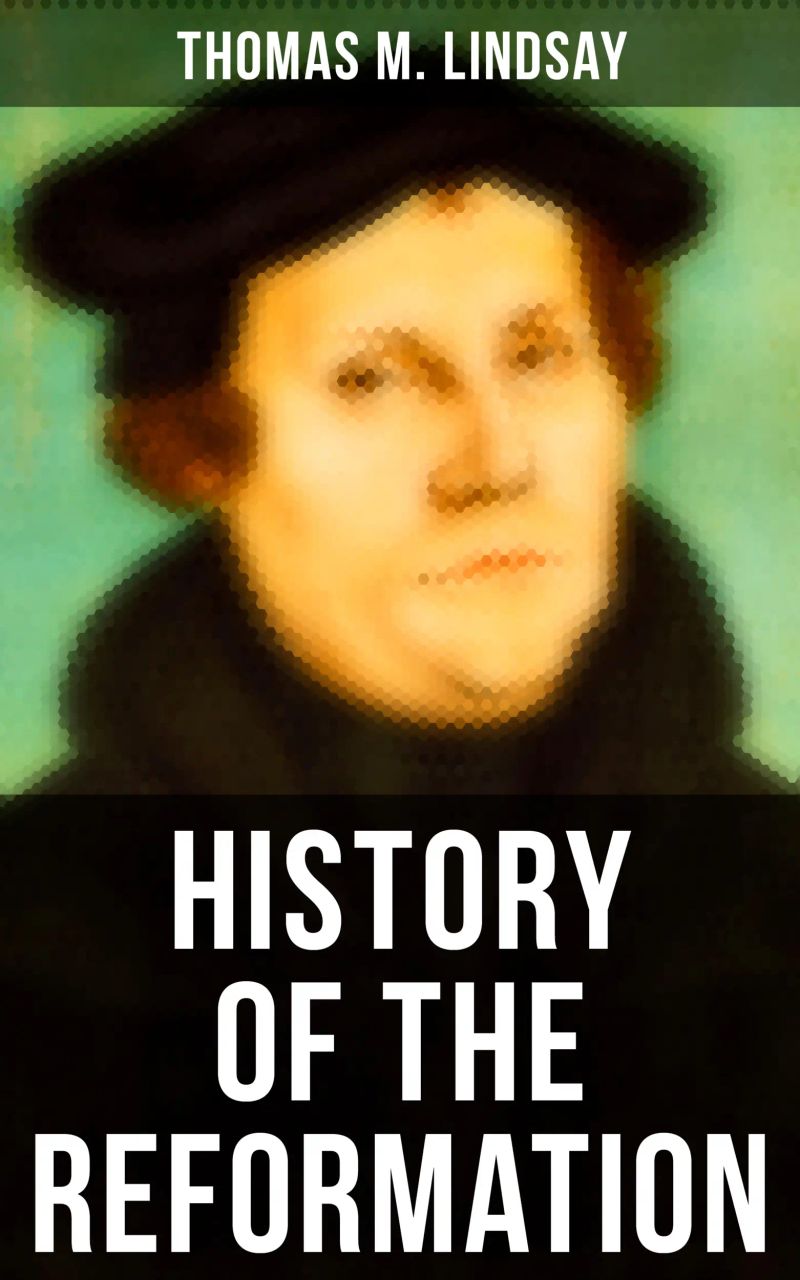


Length38h 39m
About this audiobook
Thomas M. Lindsay's 'History of the Reformation' is a comprehensive account of the religious movement that reshaped Europe in the 16th century. Lindsay's writing style is scholarly and well-researched, providing readers with a detailed examination of the key events, figures, and theological debates of the Reformation. The book not only offers a historical narrative but also delves into the social, political, and cultural context in which the Reformation took place, making it a valuable resource for understanding this pivotal period in Western history. Lindsay's thorough analysis and clear prose make this book an essential read for students and scholars interested in the Protestant Reformation. Thomas M. Lindsay, a renowned Scottish theologian and church historian, was well-equipped to write this authoritative history of the Reformation. His extensive knowledge of theology and church history, combined with his critical thinking skills, enabled him to offer readers a nuanced and insightful perspective on this complex historical event. Lindsay's expertise and passion for the subject shine through in his meticulous research and thoughtful analysis. I highly recommend Thomas M. Lindsay's 'History of the Reformation' to anyone seeking a comprehensive and engaging exploration of this transformative period in European history. This book is a must-read for students, scholars, and anyone interested in understanding the intellectual and religious currents that shaped the modern world.
Audiobook details
Rating★★★★ 4.2 (121)
Includes Amazon, LibraryThing, Goodreads
GenreSpirituality and Religion
Length38 hrs 39 mins
Narrated byListen with 1,000+ voices
FormateBook with Audio
Publish dateMay 7, 2021
LanguageEnglish
Table of contents
1Treatise On the Incarnation
2Volume 1
3BOOK I. ON THE EVE OF THE REFORMATION.
4CHAPTER I. THE PAPACY.
5§ 1. Claim to Universal Supremacy.
Show all chaptersShow less
6§ 2. The Temporal Supremacy.
7§ 3. The Spiritual Supremacy.
8CHAPTER II. THE POLITICAL SITUATION.
9§ 1. The small extent of Christendom.
10§ 2. Consolidation.
11§ 3. England.
12§ 4. France.
13§ 5. Spain.
14§ 6. Germany and Italy.
15§ 7. Italy.
16§ 8. Germany.
17CHAPTER III. THE RENAISSANCE.
18§ 1. The Transition from the Mediæval to the Modern World.
19§ 2. The Revival of Literature and Art.
20§ 3. Its earlier relation to Christianity.
21§ 4. The Brethren of the Common Lot.
22§ 5. German Universities, Schools, and Scholarship.
23§ 6. The earlier German Humanists.
24§ 7. The Humanist Circles in the Cities.
25§ 8. Humanism in the Universities.
26§ 9. Reuchlin.
27§ 10. The “Epistolæ Obscurorum Virorum.”
28§ 11. Ulrich von Hutten.
29CHAPTER IV. SOCIAL CONDITIONS.
30§ 1. Towns and Trade.
31§ 2. Geographical Discoveries and the beginning of a World Trade.
32§ 3. Increase in Wealth and luxurious Living.
33§ 4. The Condition of the Peasantry.
34§ 5. Earlier Social Revolts.
35§ 6. The religious Socialism of Hans Böhm.
36§ 7. Bundschuh Revolts.
37§ 8. The Causes of the continuous Revolts.
38CHAPTER V. FAMILY AND POPULAR RELIGIOUS LIFE IN THE DECADES BEFORE THE REFORMATION.
39§ 1. Devotion of Germany to the Roman Church.
40§ 2. Preaching.
41§ 3. Church Festivals.
42§ 4. The Family Religious Life.
43§ 5. A superstitious Religion based on Fear.
44§ 6. A non-Ecclesiastical Religion.
45§ 7. The “Brethren.”
46CHAPTER VI. HUMANISM AND REFORMATION.
47§ 1. Savonarola.
48§ 2. John Colet.
49§ 3. Erasmus.
50BOOK II. THE REFORMATION.
More from Thomas M. Lindsay


Loved BabySarah Philpott4h 51m4.8 (1.4K)$10 · $0.00

The QuranAllah23h 7m4.7 (136.1K)$1 · $0.00

The Secret of the RosaryLouis de Montfort6h 1m4.7 (16K)$2 · $0.00

The Holy Qur-an: Text, Translation and CommentaryAbdullah Yusuf Ali22h 16m4.7 (133K)$1 · $0.00

All of Grace (Annotated)Charles Spurgeon5h 1m4.7 (1.3K)$1.99 · $0.00

Steps to ChristEllen G. White3h 12m4.7 (13.8K)$2 · $0.00
The Doctrine and Selected CovenantsJoseph Smith13h 53m4.7 (10.4K)$1.99 · $0.00

Sinners in the Hands of an Angry God & Other Sermons (Annotated)Jonathan Edwards7h 51m4.7 (1.5K)$2 · $0.00

Swayam Ki AwaazPrem Rawat8h 34m4.7 (1.1K)$26 · $0.00

Behind the BadgeAdam Davis10h 18m4.7 (2.7K)$10 · $0.00

The New Human Revolution, vol. 1Daisaku Ikeda7h 46m4.7 (669)$12 · $0.00

You Are Worth ItKyle Carpenter, Don Yaeger8h 53m4.7 (4.8K)$29 · $0.00
Praying GraceDavid A. Holland3h 2m4.7 (658)$10 · $0.00

Evidence Not SeenDarlene Deibler Rose11h 11m4.6 (11.9K)$29 · $0.00

The Christ KeyChad Bird, Chad Bird7h 33m4.7 (592)$17.40 · $0.00
He and IGabrielle Bossis10h 12m4.7 (554)$17 · $0.00

Your Body Already KnowsNidhi Pandya Bhanshali9h 7m4.7 (360)$16 · $0.00

The Complete WorksFlorence Scovel Shinn7h 59m4.6 (6.6K)$2 · $0.00
Driven by EternityJohn Bevere3h 50m4.6 (3.2K)$10 · $0.00

Spiritual AnatomyDaaji Kamlesh D. Patel9h 47m4.7 (319)$29 · $0.00
You may also like

The Proletarian Revolution and the Renegade KautskyVladimir Lenin4h 34m4.3 (1K)$1.99 · $0.00

The State and RevolutionVladimir lenin4h 10m4.3 (19.8K)$4 · $0.00

The Constitution of the United States of AmericaVarious70h 42m4.5 (46.3K)$1 · $0.00

The Wealth of NationsAdam Smith41h 55m4.1 (40.9K)$3.50 · $0.00

The Age of ReasonThomas Paine6h 53m4.1 (38.4K)$1.20 · $0.00
The Suppression Of The African Slave Trade To The United States Of AmericaW. E. B. Du Bois12h 54m4.2 (1.6K)$2.30
Marx in 90 MinutesPaul Strathern1h 24m3.5 (1.6K)$7

Manifesto of the Communist PartyKarl Marx, Friedrich Engels3h 10m3.9 (248.9K)$1 · $0.00

Opium Inc.Thomas Manuel9h 27m4.2 (263)$29 · $0.00
The Constitution of the United States and The Declaration of IndependenceDelegates of The Constitutional Convention1h 7m4.6 (12.3K)Free

The Autobiography of Thomas JeffersonThomas Jefferson8h 32m4.0 (2.8K)$1.99 · $0.00

The Wealth of Nations (Annotated)Adam Smith42h 48m4.2 (35.4K)$2 · $0.00

Socialism: Utopian and Scientific (Annotated)Frederick Engels3h 35m4.3 (29.7K)$1.99 · $0.00

The French Revolution and NapoleonJean-Jacques Rousseau, Alexis de Tocqueville, Montesquieu, Charles Downer Hazen62h 54m4.1 (574)$2 · $0.00

The PlaybookJoshua Robinson, Jonathan Clegg8h 50m$29 · $0.00

Constitution of the State of Minnesota — 1964 VersionGovernment of the State of Minnesota2h 32m$2 · $0.00

The Complete WorksThomas Jefferson210h 44m4.4 (197)$1.99 · $0.00

A Source Book for Mediæval HistoryOliver J. Thatcher, Edgar Holmes McNeal21h 26m4.0 (43)$1 · $0.00
The History of Rome: Rise and Fall of the EmpireJohn Bagnell Bury72h 52m4.0 (88)$2 · $0.00

Magna Carta: A Commentary on the Great Charter of King JohnWilliam Sharp McKechnie22h 46m4.2 (43)$2 · $0.00