
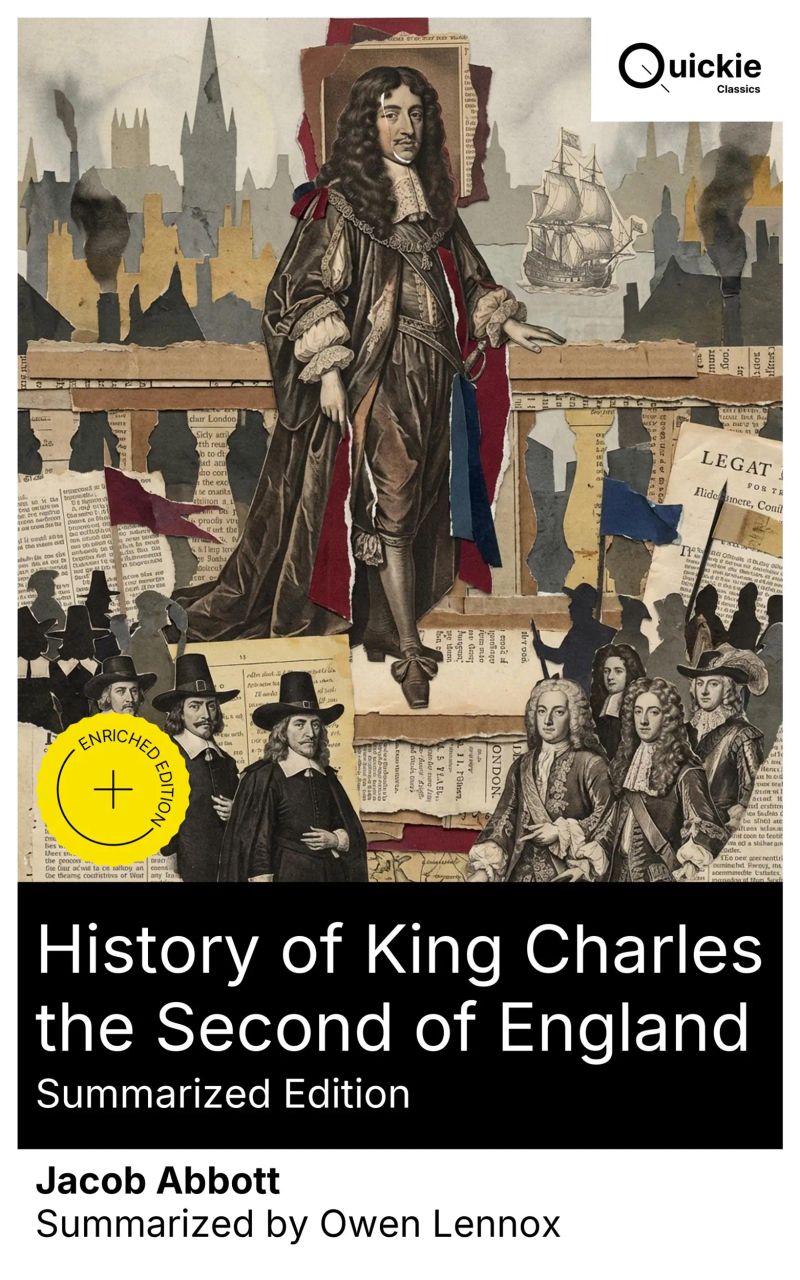
History of King Charles the Second of England (Summarized Edition)
Enriched edition. Restoration-era politics, civil war aftermath, and the trials of a charismatic 17th-century monarchBy Jacob Abbott

Length2h 44m
About this audiobook
In History of King Charles the Second of England, Jacob Abbott traces the Restoration monarch from civil-war exile to the hazards of rule after 1660—plague, fire, and Anglo‑Dutch wars—while charting the court's pleasures and intrigues. His brisk, moralizing narrative clarifies religious and constitutional tensions, from the Clarendon Code to the Test Act and Popish Plot. Written within the nineteenth‑century Makers of History tradition, the book privileges character, motive, and cause‑and‑effect over archival minutiae, yielding a lucid, scene‑driven synthesis. Abbott, a nineteenth‑century American educator, minister, and prolific author of the Rollo tales and Makers of History, wrote for moral and pedagogical ends. Classroom practice shaped his clear, incremental explanations; wide reading in accessible chronicles supplied texture. In Charles II he found a case study in prudence, statecraft, spectacle, and the costs of private vice. Readers seeking a concise, engaging primer on the Restoration will profit from this volume's clarity and narrative momentum. It suits students and general readers alike, and usefully complements modern scholarship by framing events in moral and political terms without losing sight of personalities, contingency, and consequence.
Quickie Classics summarizes timeless works with precision, preserving the author's voice and keeping the prose clear, fast, and readable—distilled, never diluted. Enriched Edition extras: Introduction · Synopsis · Historical Context · Brief Analysis · 4 Reflection Q&As · Editorial Footnotes.
Audiobook details
GenreHistory
Length2 hrs 44 mins
Narrated byListen with 1,000+ voices
FormateBook with Audio
Publish dateJan 10, 2026
LanguageEnglish
Table of contents
1Introduction
5History of King Charles the Second of England
2Introduction
6Analysis
3Synopsis
7Reflection
4Historical Context

The Life and Legacy of Cyrus the GreatJacob Abbott7h 12m3.8 (1.5K)$1.99 · $0.00

Mary Queen of Scots (Annotated)Jacob Abbott4h 33m3.8 (794)$1.99 · $0.00
Romans Who Shaped Rome: 15 Most Influential People of Ancient RomeJacob Abbott, A. H. Beesly, Edward Spencer Beesly, W. Lucas Collins, Evelyn S. Shuckburgh, John Charles Tarver, Philo, Stephen Phillips, Tacitus, Georg Ebers, George Lang, John B. Firth98h 53m$0.99
The History of Genghis KhanJacob Abbott7h 22m$0.99 · $0.00

Masters of War: Top 10 Greatest Conquerors of All TimeJacob Abbott, Alfred John Church, John S. C. Abbott, William Milligan Sloane116h 34m4.2 (18)$0.99

Cyrus the GreatJacob Abbott7h 5m3.9 (219)$6 · $0.00

HannibalJacob Abbott6h 6m4.0 (493)$6 · $0.00
The History of Genghis KhanJacob Abbott7h3.8 (1.2K)$6 · $0.00
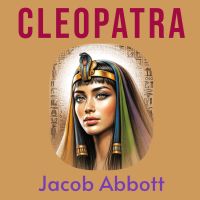
CleopatraJacob Abbott6h 23m3.8 (3.7K)$6 · $0.00
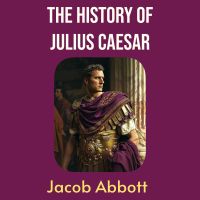
History of Julius CaesarJacob Abbott4h 43m3.9 (1.3K)$6 · $0.00
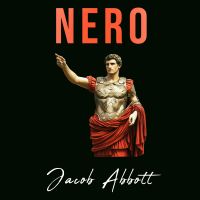
NeroJacob Abbott7h 31m3.8 (420)$6 · $0.00
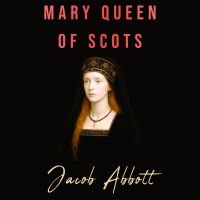
Mary Queen of ScotsJacob Abbott5h 2m3.6 (580)$6 · $0.00

Margaret of AnjouJacob Abbott4h 40m3.7 (228)$6 · $0.00
PyrrhusJacob Abbott7h 25m3.7 (162)$6 · $0.00

Peter the GreatJacob Abbott6h 53m4.1 (888)$6 · $0.00

Richard IIJacob Abbott5h 18m3.2 (69)$6 · $0.00

Richard IJacob Abbott6h 19m3.8 (328)$6 · $0.00

XerxesJacob Abbott7h 12m3.7 (313)$6 · $0.00
RomulusJacob Abbott6h 24m3.7 (196)$6 · $0.00

William the ConquerorJacob Abbott6h$6 · $0.00

A Brief History of IntelligenceMax S. Bennett12h 18m4.6 (6.6K)$29 · $0.00

RevolutionariesSanjeev Sanyal11h 23m4.6 (2.6K)$29 · $0.00

We Crossed a Bridge and It TrembledWendy Pearlman6h4.6 (5.2K)$24 · $0.00

Unbroken Bonds of BattleJohnny Joey Jones8h 31m4.6 (2.6K)$8 · $0.00

The Daughter of AuschwitzTova Friedman, Malcolm Brabant7h 54m4.6 (16.7K)$26 · $0.00

Lily's PromiseLily Ebert, Dov Forman8h 54m4.6 (16.1K)$29 · $0.00

On Democracies and Death CultsDouglas Murray10h 38m4.6 (6.5K)$29 · $0.00

Across the RiverKent Babb11h 40m4.6 (927)$29 · $0.00

Balcony Over Jerusalem: A Middle East Memoir - Israel, Palestine and BeyondJohn Lyons12h 37m4.6 (1.4K)$33 · $0.00

BeyondStephen Walker15h 39m4.6 (3.2K)$33 · $0.00
Kings and PawnsHoward Bryant10h 9m4.6 (678)$29 · $0.00

No EscapeNury Turkel9h 30m4.6 (809)$28 · $0.00

Jubal Stone: U.S. Marshal: Blood Trail To Hell: A Western Adventure NovelCasey Nash3h 42m4.6 (3.2K)$18 · $0.00

Fall and RiseMitchell Zuckoff17h 23m4.6 (9.8K)$40 · $0.00

The SurvivorJosef Lewkowicz, Michael Calvin9h 22m4.6 (2.5K)$29 · $0.00

Always FaithfulThomas Schueman, Zainullah Zaki12h 12m4.6 (977)$29 · $0.00

The State of Society in France Before the Revolution of 1789 (Annotated)Alexis de Tocqueville17h 25m4.6 (1.2K)$2 · $0.00

All the Gallant MenDonald Stratton, Ken Gire5h 55m4.6 (11.8K)$24 · $0.00
Saint Joan (Annotated)George Bernard Shaw6h 20m4.6 (1.2K)$1.20 · $0.00
Medgar and MyrlieJoy-Ann Reid10h 52m4.5 (27.8K)$29 · $0.00
You may also like

A Good True ThaiSunisa Manning11h 26m4.1 (579)$11 · $0.00

The Noodle Maker of KalimpongGyalo Thondup, Anne F. Thurston11h 41m4.1 (602)$20
FoundationPeter Ackroyd18h 20m4.2 (7.8K)$25

The History of England for ChildrenCharles Dickens32h 3m3.8 (2.8K)$2 · $0.00

WAR AND PEACE Complete Edition – All 15 Books in One Volume (World Classics Series)Leo Tolstoy71h 15m4.3 (14.1K)$1.99 · $0.00

Letters of a Javanese PrincessRaden Adjeng Kartini8h 51m4.2 (1.9K)Free

Diary of Samuel PepysSamuel Pepys121h 36m4.2 (20K)$1.99 · $0.00

The Diary of Samuel PepysSamuel Pepys122h 13m4.2 (12K)Free

Historic BoyhoodsRupert Sargent Holland5h 59m$2 · $0.00

Elisabeth Louise Vigée-LebrunW. H. Helm4h 14m$16 · $0.00
Queen Hortense: A Life Picture of the Napoleonic EraL. Mühlbach10h 50m3.4 (10)$1 · $0.00
Ireland under the TudorsRichard Bagwell49h 55m4.1 (17)$2.99 · $0.00
Louis PhilippeJohn S. C. Abbott6h 21m3.3 (20)$1 · $0.00
History of the Habsburg Empire (Annotated)John S. C. Abbott18h 50m3.9 (223)$0.99 · $0.00

HandelThomas Tapper14m4.1 (23)$1 · $0.00

Victorian BritainSantiago Machain5h 32m$21 · $0.00

Twenty Centuries of ParisMabell S. C. Smith9h 24m$2.30

Memoirs of Lady FanshaweAnn Fanshawe7h 13m3.2 (25)$1 · $0.00
The First Duke and Duchess of Newcastle-upon-TyneThomas Longueville8h 7m$2 · $0.00

Queen ElizabethJacob Abbott6h 20m3.8 (455)$2 · $0.00