
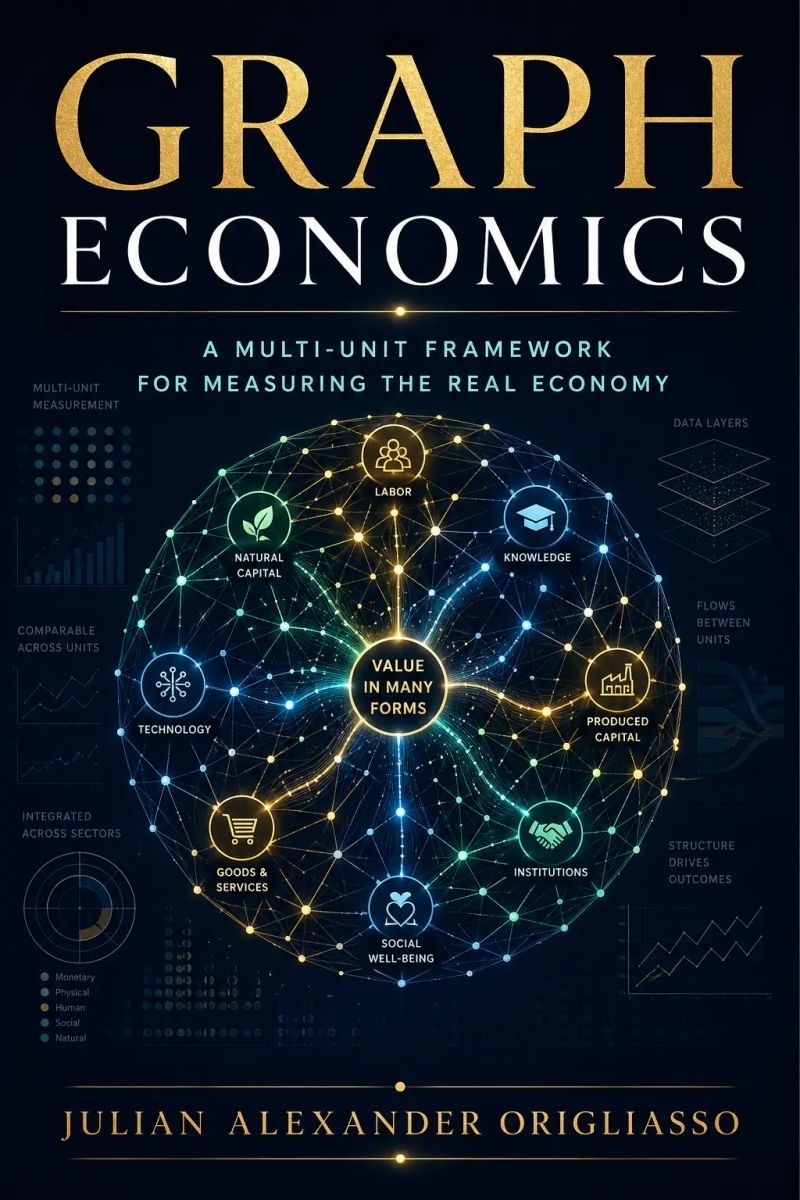
Graph Economics
A Multi-Unit Framework for Measuring the Real EconomyBy Julian Alexander Origliasso


Length23h 50m
About this audiobook
Graph Economics: A Multi-Unit Framework for Measuring the Real Economy introduces a new way to understand economic life beyond money alone. Traditional measures like GDP, prices, wages, and financial accounts remain important, but they do not capture the full reality of modern value creation. The real economy also moves through time, work, energy, materials, skills, care, trust, risk, emissions, natural capital, technology, and institutional performance.
Graph Economics proposes a multi-unit framework for recording these dimensions as connected economic accounts, not loose indicators. It links events, resources, activities, outcomes, and consequences so organisations, governments, and communities can better understand how value is created, used, damaged, or renewed. This book is about measuring what matters and building economic systems that account for productivity, wellbeing, responsibility, and long-term stewardship.
Audiobook details
GenreBusiness and Economics, Politics and Government
Length23 hrs 50 mins
Narrated byListen with 1,000+ voices
FormateBook with Audio
Publish dateMay 3, 2026
LanguageEnglish
Table of contents
1Graph Economics
2A Multi-Unit Framework for Measuring the Real Economy
3Book Version AB2 - Monday 4th May 2026
4Book Thesis
5Introduction — Money Is Not the Economy
Show all chaptersShow less
6Part I — The Measurement Problem
7Chapter 1 — The Economy We Measure
8Chapter 2 — The Economy We Miss
9Chapter 3 — Price Is Not Value
10Part II — Foundations of Graph Economics
11Chapter 4 — The Limits of Single-Unit Economics
12Chapter 5 — What Is Graph Economics?
13Chapter 6 — The Economy as a Graph
14Chapter 7 — Events Before Aggregates
15Chapter 8 — Multi-Unit Measurement
16Chapter 9 — Multi-Chart Economics
17Chapter 10 — From Transactions to Economic Events
18Part III — The Architecture of the Real Economy
19Chapter 11 — Data, Workflows, Journals, Statements
20Chapter 12 — Economic Journals Beyond Money
21Chapter 13 — The Explainability Chain
22Chapter 14 — Value Flows and Value Stocks
23Chapter 15 — Hidden Costs and Delayed Consequences
24Chapter 16 — The Real Economy Statement
25Part IV — Applications
26Chapter 17 — Business Performance
27Chapter 18 — Government and Public Value
28Chapter 19 — Not-for-Profits and Impact Measurement
29Chapter 20 — Work, Time, and Human Capacity
30Chapter 21 — Quality, Risk, and Failure
31Chapter 22 — Trust, Relationships, and Institutional Confidence
32Chapter 23 — Environment, Energy, and Resource Use
33Chapter 24 — Wellbeing as an Economic Measure
34Part V — Beyond GDP
35Chapter 25 — The Problem with GDP Alone
36Chapter 26 — National Graph Accounts
37Chapter 27 — Economic Policy in a Multi-Unit World
38Chapter 28 — Capital Allocation and Real Value
39Part VI — Technology and Governance
40Chapter 29 — The Technology Stack for Graph Economics
41Chapter 30 — Measurement Without Surveillance
42Chapter 31 — Rules, Evidence, and Accountability
43Chapter 32 — The Risks of Measuring the Wrong Things
44Chapter 33 — From Dashboards to Decision Systems
45Part VII — The Measured Economy
46Chapter 34 — The Measured Economy
47Chapter 35 — A New Language of Value
48Chapter 36 — Building the Transition
49Chapter 37 — The Future of Economic Accounting
50Conclusion — What We Measure, We Become
More from Julian Alexander Origliasso

Never Split the DifferenceChris Voss, Tahl Raz8h 7m4.4 (277.7K)$26 · $0.00
The Intelligent Investor Rev Ed.Benjamin Graham17h 48m4.3 (191.5K)$40 · $0.00
The Hard Thing About Hard ThingsBen Horowitz7h 57m4.2 (134.3K)$26 · $0.00
Boundaries for LeadersHenry Cloud7h 36m4.3 (3.6K)$26 · $0.00

Not Everything Counts but Everything Matters: The powerful and inspirational new book about leadership and achieving success from the visionary multi-premiership winning Panthers coachIvan Cleary6h 1m4.6 (680)$24 · $0.00
BuildTony Fadell11h 5m4.5 (14.3K)$8 · $0.00
The Joys Of CompoundingGautam Baid17h 34m4.5 (2.5K)$18 · $0.00
Basic EconomicsThomas Sowell18h 32m4.5 (29.3K)$28 · $0.00

Poor Charlie’s AlmanackGrover Gardener, Charles T. Munger13h 9m4.5 (24.7K)$18 · $0.00

The Ambuja StoryNarotam Sekhsaria13h 59m4.5 (830)$33 · $0.00

The Secret Door to SuccessFlorence Scovel Shinn2h 25m4.5 (2.1K)$1.20 · $0.00

This Is Going to HurtAdam Kay5h 47m4.4 (444.7K)$24 · $0.00

Big TrustShadé Zahrai, Fayçal Sekkouah8h 36m4.6 (406)$26 · $0.00
The Intelligent Investor Third EditionBenjamin Graham, Jason Zweig20h4.4 (156.6K)$46 · $0.00

Bottle of LiesKatherine Eban14h 25m4.4 (12K)$33 · $0.00

The Antiracist Business BookTrudi Lebrón6h 10m4.6 (275)$17 · $0.00
The FormulaJoshua Robinson, Jonathan Clegg10h 41m4.4 (6.9K)$29 · $0.00

Let Them LeadJohn U. Bacon7h 10m4.5 (1.4K)$24 · $0.00

Secrets of the Millionaire MindT. Harv Eker5h 11m4.4 (301.4K)$24 · $0.00

The Person You Mean to BeDolly Chugh9h 6m4.4 (7.2K)$29 · $0.00

The Gulag Archipelago Volume 3Aleksandr I. Solzhenitsyn21h 56m4.7 (8.9K)$46 · $0.00

MotherlandJulia Ioffe17h 52m4.7 (2.5K)$40 · $0.00

HostageEli Sharabi5h 25m4.6 (10.8K)$24 · $0.00
Days of Love and Rage: A Story of RevolutionAnand Gopal22h 36m4.7 (584)$34 · $0.00

KrantikariSanjeev Sanyal11h 44m4.6 (1.3K)$16 · $0.00

Unbroken Bonds of BattleJohnny Joey Jones8h 31m4.6 (2.6K)$8 · $0.00

On Democracies and Death CultsDouglas Murray10h 38m4.6 (6.5K)$29 · $0.00

Balcony Over Jerusalem: A Middle East Memoir - Israel, Palestine and BeyondJohn Lyons12h 37m4.6 (1.4K)$33 · $0.00
RiggedMollie Hemingway12h 48m4.6 (4.2K)$23 · $0.00

SledgehammerDavid Friedman8h 21m4.7 (589)$26 · $0.00

Citizenship in a Republic (Annotated)Theodore Roosevelt2h 44m4.6 (1.4K)$2 · $0.00

No EscapeNury Turkel9h 30m4.6 (809)$28 · $0.00

Always FaithfulThomas Schueman, Zainullah Zaki12h 12m4.6 (977)$29 · $0.00

UnthinkableJamie Raskin15h 8m4.5 (9.3K)$8 · $0.00

My Fourth Time, We DrownedSally Hayden13h 59m4.6 (2.9K)$23 · $0.00
A Revolution of Common SenseScott Jennings9h 29m4.6 (528)$29 · $0.00

Statement From the Dock at the Rivonia TrialNelson Mandela2h 18m4.6 (1.3K)$1 · $0.00

Lessons from the EdgeMarie Yovanovitch17h 11m4.5 (5.9K)$40 · $0.00

To Rescue the American SpiritBret Baier10h 12m4.5 (2.7K)$8 · $0.00

StonewalledSharyl Attkisson15h 19m4.5 (4.3K)$33 · $0.00
You may also like
The Zero Marginal Cost SocietyJeremy Rifkin14h 14m3.9 (3.2K)$23 · $0.00
Mission EconomyMariana Mazzucato6h 45m4.0 (4.1K)$24 · $0.00
Advantage India : From Challenge to OppourtunityA.P.J Abdul Kalam, Srijan Pal Singh6h 9m4.5 (252)$8

BauhausMichael Siebenbrodt, Lutz Schöbe8h 28m4.3 (282)$18 · $0.00
Experiments with Alternate Currents of High Potential and High Frequency (Annotated)Nikola Tesla6h 4m4.3 (641)$2 · $0.00

Door to DoorEdward Humes11h 20m3.9 (1.4K)$29 · $0.00

Cool ItBjorn Lomborg6h 15m3.9 (1.7K)$20

The Best American Science and Nature Writing 2022Ayana Elizabeth Johnson, Jaime Green12h 27m4.0 (623)$29 · $0.00

The Shark’s PaintbrushJay Harman11h 50m4.1 (459)$20

The Good AncestorRoman Krznaric7h 52m4.1 (2.3K)$20 · $0.00
Tesla's Experiments with Alternate Currents of High Potential and High FrequencyNikola Tesla5h 53m4.3 (646)$1.99 · $0.00

Amazon BrazilianCarlos Araujo Carujo2h 56m$7 · $0.00

Conversations About The EnvironmentHoward Burton9h 54m$10 · $0.00

Path to ZeroTucker Perkins4h 33m3.5 (13)$20

A Better PlanetDaniel C. Esty14h 40m3.9 (85)$23
Engage with ImpactNicholas Bruneau4h 22m4.8 (14)Free

The Fifth SeasonRuby M. Harris11h 12m$4.10 · $0.00

In the DarkJason Bawden-Smith4h 40m4.5 (11)$15
How To Spend a Trillion DollarsRowan Hooper8h 19m3.9 (505)$14 · $0.00

Deepseek: The Quiet Giant Leading China’s AI RaceJordan Schneider35m5.0 (7)Free