
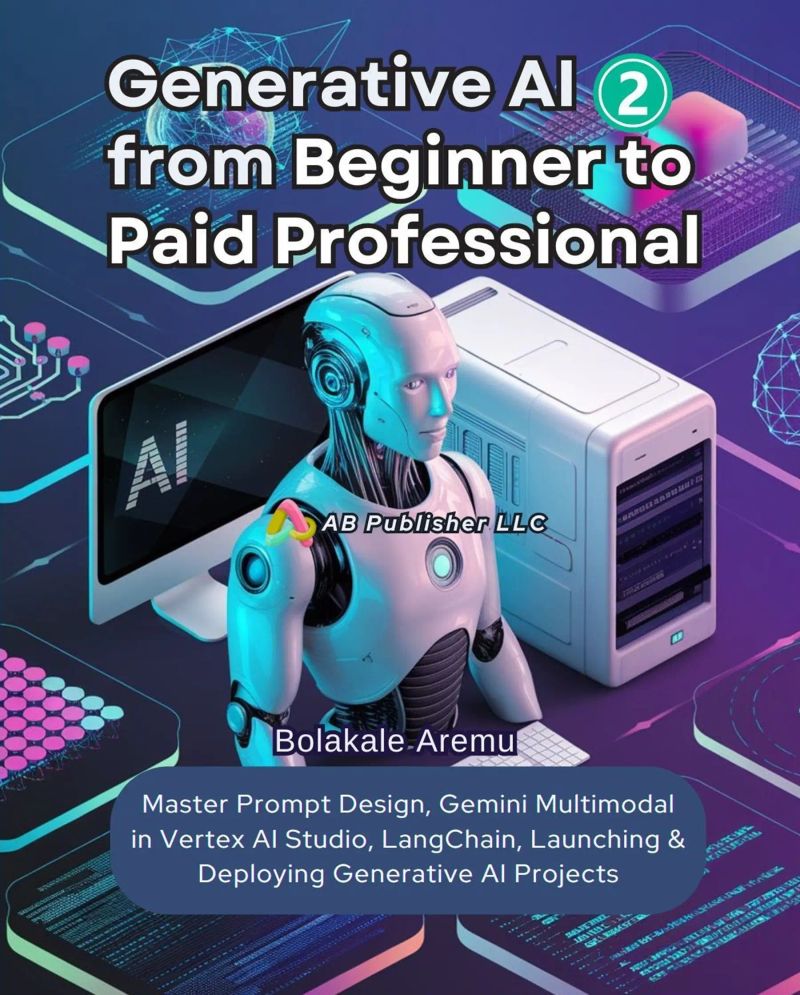
Generative AI From Beginner to Paid Professional, Part 2
Master Prompt Design, Gemini Multimodal in Vertex AI Studio, LangChain, Launching & Deploying Generative AI ProjectsBy Bolakale Aremu

Length5h 30m
About this audiobook
Unlock the Future of Generative AI and Skyrocket Your Career.
This book is your comprehensive roadmap from grasping the fundamentals of AI to mastering the tools and techniques that will set you apart in today’s AI-driven world. Perfect for anyone serious about a career in AI, this book bridges the gap between knowledge and action, giving you the tools to earn, build, and innovate with generative AI technologies. Whether you’re building your first AI project or refining your professional skills, this is the guide you’ve been waiting for.
Packed with hands-on projects and practical exercises, this book empowers you to build and launch your very own generative AI solutions. By the end, you’ll not only be equipped with in-demand AI skills but also be prepared to launch your AI projects in the real world.
Welcome to Generative AI from Beginner to Paid Professional, Part 2: Master Prompt Design, Gemini Multimodal in Vertex AI Studio, LangChain, Launching & Deploying Generative AI Projects.
In Part 2 of this transformative guide, you'll delve deep into powerful AI frameworks and cutting-edge technologies, including Gemini Multimodal, Vertex AI Studio, and LangChain, gaining the expertise needed to design custom AI solutions and deploy scalable AI projects. Whether you’re an aspiring professional or a seasoned developer, this book is your step-by-step companion to navigating the evolving landscape of generative AI.
What You’ll Learn:
Master Prompt Design: Craft perfect prompts that make your AI work for you, no matter the use case.
Gemini Multimodal & Vertex AI Studio: Learn to integrate multimodal models into your AI pipeline, revolutionizing how you build intelligent systems that understand and generate both text and images.
LangChain for Real-World AI Projects: Leverage LangChain to create robust, API-powered workflows that bring your AI projects to life.
Launching & Deploying AI Projects: From conceptualization to deployment, turn your AI ideas into real-world applications with proven strategies.
Audiobook details
GenreTechnology, Science and Nature
Length5 hrs 30 mins
Narrated byListen with 1,000+ voices
FormateBook with Audio
Publish dateNov 10, 2024
LanguageEnglish
Table of contents
10. About The Series
21. Introduction: 1.1. Learning Objectives
32. Generative AI Workflow
42.1. Introduction to the Vertex AI Studio
52.2. Generative AI
Show all chaptersShow less
62.3. Foundation Models: 2.3.1. How Foundation Models Power Your Applications
73. The Gemini Multimodal
83.1. Gemini Business Use Cases
93.2. How to Interact with Gemini Multimodal
103.2.1. Starting with a Prompt
113.2.2. Anatomy of a Prompt
123.3. Language Capabilities: Prompt Design Modes
133.3.1. Free-form Prompt Design: Hands-on Practice 1
143.3.2. Structured Prompt Design: Hands-on Practice 2
153.3.3. Practical Examples for Understanding Model Parameters (Temperature, Top K & Top P)
163.4. Model Tuning
173.4.1. How to Customize & Tune a GenAI Model
183.4.2. How to Start a Tuning Job in the Vertex AI Studio
193.5. Wrap up
204. LangChain for Generative AI
214.1. Introduction to LangChain and Generative AI: 4.1.2. Setting Up Your Environment for LangChain Development
224.2. Core Concepts and Architecture
234.2.1. Understanding Chains in LangChain
244.2.2. Modules: The Building Blocks of LangChain
254.2.3. Key Components: Models, Prompts, and Parsers
264.3. Models and Prompt Design
274.3.1. Choosing the Right Model for Your Needs
284.3.2. Prompt Design Fundamentals
294.3.3. Advanced Prompting Techniques for Custom Responses
304.4. Building Chains and Workflows
314.4.1. Creating Simple Chains
324.4.2. Designing Multi-Step Workflows
334.4.3. Handling Errors and Fallbacks in Chains
344.5. Integrating APIs with LangChain
354.5.1. API Integration Basics
364.5.2. Leveraging External APIs for Enhanced Functionality
374.5.3. Using Web Scraping and Other Data Sources
384.6. Memory Management in LangChain
394.6.1. Introduction to Memory in AI Models
404.6.2. Implementing State Management in LangChain
414.6.3. Best Practices for Memory Optimization
424.7. User Input and Parsing Responses
434.7.1. Capturing and Validating User Input
444.7.2. Parsing Model Outputs
454.7.3. Using Parsers for Structured Data Handling
464.8. Custom Modules and Extensions
474.8.1. Writing Custom Modules in LangChain
484.8.2. Extending LangChain’s Capabilities with Plugins
494.8.3. Using OpenAI Plugins and Integrations
504.9. Debugging and Optimization
Series
More from Bolakale Aremu

Cell and Molecular Biology EssentialsBolakale Aremu2h 44m$10

Hardware y Sistemas OperativosBolakale Aremu4h 29m$12

Preguntas y Respuestas de Entrevistas en CiberseguridadBolakale Aremu4h 13m$16

Cybersecurity Interview Questions & AnswersBolakale Aremu4h 2m$20

Biología Celular y Molecular EsencialBolakale Aremu3h 5m$12

Tablas dinámicas y Gráficas para ExcelBolakale Aremu1h 32m$11

DeepSeek AI from Beginner to Paid ProfessionalBolakale Aremu1h 33m$10
Introduction to Algorithms and Data StructuresBolakale Aremu2h 22m$10

Never Lost AgainBill Kilday10h 1m4.4 (805)$29 · $0.00

How the Internet HappenedBrian McCullough13h 28m4.3 (2.7K)$23 · $0.00

Collected Writings of Nikola TeslaNikola Tesla, Thomas Commerford Martin21h 50m4.3 (1.7K)$1 · $0.00
Just AspireAjai Chowdhry9h 13m4.4 (260)$29 · $0.00

The Little Book of AliensAdam Frank8h 20m4.3 (1.3K)$26 · $0.00
The inventions, researches and writings of Nikola Tesla (Annotated)Thomas Commerford Martin16h 59m4.3 (1.3K)$2 · $0.00

KargilV.P. Malik15h 18m4.3 (2K)$24 · $0.00

Experiments with Alternating CurrentsNikola Tesla9h 6m4.3 (874)$1 · $0.00

Fire on the HorizonTom Shroder, John Konrad8h 23m4.3 (858)$26 · $0.00

The Smell of Kerosene (Annotated)National Aeronautics and Space Administration, Donald L. Mallick, Peter W. Merlin11h 32m4.3 (523)$2 · $0.00

The Boy Who Harnessed the WindWilliam Kamkwamba, Bryan Mealer10h 5m4.2 (78.9K)$29 · $0.00

Across the Airless WildsEarl Swift10h 8m4.3 (1.3K)$29 · $0.00

Console WarsBlake J. Harris20h 41m4.2 (13.7K)$46 · $0.00

Improvised Munitions HandbookU.S. Department of Defense4h 49m4.3 (1.6K)$1.99 · $0.00
Escaping GravityLori Garver10h 54m4.2 (2.2K)$20 · $0.00

Wireless WarsJonathan Pelson8h 2m4.3 (418)$20 · $0.00

Let There Be WaterSeth M. Siegel8h 36m4.2 (2.3K)$20 · $0.00
The PerfectionistsSimon Winchester11h 46m4.2 (9.9K)$29 · $0.00

Rethinking NarcissismDr. Craig Malkin6h 7m4.2 (3.4K)$24 · $0.00

Project Animal FarmSonia Faruqi11h 23m4.3 (563)$20 · $0.00

A Brief History of IntelligenceMax S. Bennett12h 18m4.6 (6.6K)$29 · $0.00
The Story of BirdsSteve Brusatte11h 49m4.6 (401)$29 · $0.00

What It Takes to Save a LifeKwane Stewart6h4.6 (556)$24 · $0.00

Pastoral SongJames Rebanks8h 35m4.5 (12K)$26 · $0.00

How Stella Learned to TalkChristina Hunger7h4.5 (10.9K)$24 · $0.00

Craig & FredCraig Grossi8h 6m4.5 (9.6K)$26 · $0.00
Celebrating BirdsNatalia Rojas, Ana Maria Martinez6h 47m4.6 (330)$24 · $0.00

Saving JemimaJulie Zickefoose4h 59m4.5 (749)$20 · $0.00

Will's Red CoatTom Ryan8h 23m4.5 (2.3K)$26 · $0.00

Of Time and TurtlesSy Montgomery10h 34m4.5 (5K)$29 · $0.00

Zen and the Art of Saving the PlanetThich Nhat Hanh9h 20m4.5 (3.9K)$29 · $0.00

Bottle of LiesKatherine Eban14h 25m4.4 (12K)$33 · $0.00
IngrainedCallum Robinson8h 10m4.5 (1.1K)$26 · $0.00

The Lion Tracker's Guide To LifeBoyd Varty3h 1m4.4 (4.8K)$18 · $0.00

Born for LoveBruce D. Perry, Maia Szalavitz11h 42m4.4 (4K)$29 · $0.00

The Mountains of California (With Original Drawings & Photographs) (Annotated)John Muir11h 35m4.5 (1.1K)$2 · $0.00
The New GuysMeredith Bagby16h 50m4.4 (1.2K)$40 · $0.00

Blue PasturesMary Oliver3h 23m4.4 (3.8K)$18 · $0.00
The Rise and Reign of the MammalsSteve Brusatte13h 26m4.4 (11.1K)$33 · $0.00

VaccinatedPaul A. Offit8h 30m4.4 (3.7K)$26 · $0.00
You may also like
Collected Writings of Nikola TeslaNikola Tesla, Thomas Commerford Martin21h 50m4.3 (1.7K)$1 · $0.00

Remarks on the Proposed Railway Between Birmingham and LondonAnonymous57m$2 · $0.00

The Recent Revolution in Organ BuildingGeorge Laing Miller4h 27m$2 · $0.00
Technology ManagamentRobson Paniago Et Al13h$6 · $0.00

Town Life in AustraliaRichard Ernest Nowell Twopeny7h 48m3.3 (17)$1.20 · $0.00
What's the Difference?Brette Warshaw4h 38m4.0 (501)$20 · $0.00

The Sky Is CryingBill Brown Jr.1h4.8 (11)$10

Sauces and DipsNaumann & Göbel Verlag2h 30m4.5 (11)$5 · $0.00

Ice Cream and SorbetsNaumann & Göbel Verlag2h 42m4.5 (10)$5 · $0.00
Jacquard Weaving and DesigningT. F. Bell6h 32m$1.99 · $0.00

How To Code For Quantum ComputersNivio Dos Santos2h 19m$46 · $0.00
RepluggedSatnam Bains13h 47m$14 · $0.00

Story Behind HyperfaceRekha Balakrishnan9m$4
The Systems EngineBradley J Sugars1h 54m3.9 (115)Free

The Evolution of Technologythe Speech Resource Company9h 30m$20

Polyglotpython:Jimmy L. De Mello1h 41m$30 · $0.00

Social Media Marketing BoostFernando Moreira0m1.0 (1)$7 · $0.00

Business-Englisch lernen Audio - Eine kraftvolle PräsentationMelita Cameron-Wood58m$17
AI: From the Breakroom to the BoardroomMatthew Fischer3h 8m4.5 (132)$14.99

Generation and Transfer of Knowledge for Digital TransformationUnknown Author6h 15m$8 · $0.00