
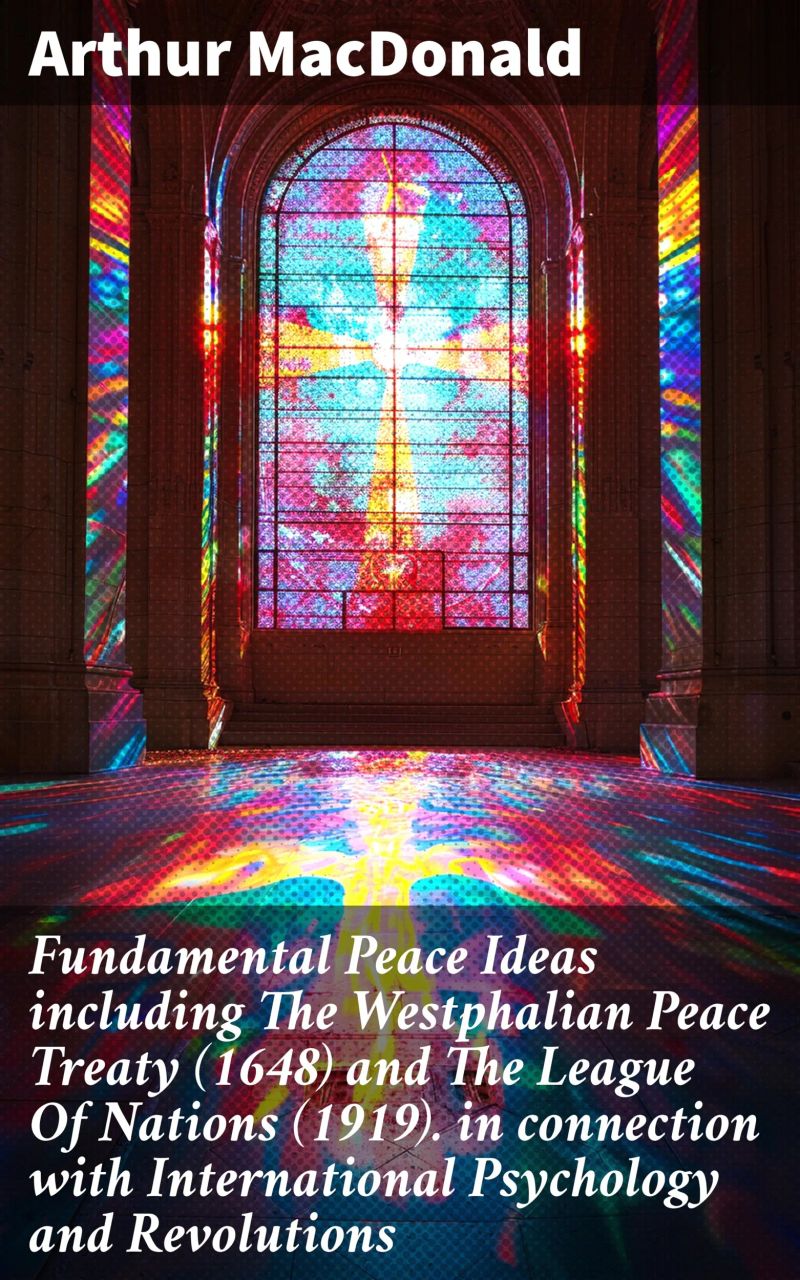
Fundamental Peace Ideas including The Westphalian Peace Treaty (1648) and The League Of Nations (1919). in connection with International Psychology and Revolutions
By Arthur MacDonald


Length1h 12m
About this audiobook
In "Fundamental Peace Ideas including The Westphalian Peace Treaty (1648) and The League Of Nations (1919) in connection with International Psychology and Revolutions," Arthur MacDonald presents a comprehensive exploration of the historical frameworks that have shaped international peace discourse. MacDonald adeptly contextualizes the Westphalian paradigm and the subsequent formation of the League of Nations, delving into their impact on modern diplomatic relations and conflict resolution. Employing a blend of historical analysis and psychological inquiry, the book examines how peace treaties reflect societal values and collective consciousness, making it a crucial text for understanding the evolution of international politics and the psychology of revolutions. Arthur MacDonald, a prominent scholar in peace studies and international relations, draws from his extensive background in psychology, history, and political science. His interdisciplinary approach is informed by years of research and teaching, providing him with a unique lens to analyze the motivations behind peace treaties and the psychological undercurrents of societal change. This fusion of disciplines allows MacDonald to illuminate the intricate connections between historical events and contemporary peace initiatives. This thought-provoking work is essential for students, scholars, and practitioners in fields such as international relations, peace studies, and psychology. MacDonald'Äôs insights invite readers to critically engage with the historical context of peace processes and encourage a deeper understanding of the complexities of international cooperation and conflict resolution. A vital addition to any academic collection, this book challenges readers to reflect on the enduring quest for peace in a tumultuous world.
Audiobook details
GenrePolitics and Government
Length1 hr 12 mins
Narrated byListen with 1,000+ voices
FormateBook with Audio
Publish dateOct 5, 2023
LanguageEnglish
Table of contents
1Introduction
2WASHINGTON 1919
3SUGGESTIONS OF THE PEACE TREATY OF WESTPHALIA FOR THE LEAGUE OF NATIONS.[1]
4NEW FIELD FOR ANTHROPOLOGY.
5PRINCIPLES OF A PEACE CONFERENCE.
Show all chaptersShow less
6THE PEACE OF WESTPHALIA.
7THE THIRTY YEARS' WAR.
8TERRIBLE RESULTS OF THE WAR.
9CAUSES OF THE LENGTH OF THE WAR.
10CAUSES OF THE WAR.
11IGNORANCE THE FUNDAMENTAL CAUSE OF THE WAR.
12COMPARISONS BETWEEN THE THIRTY YEARS' WAR AND THE EUROPEAN WAR.
13REFERENCES.
14INTERDEPENDENCE OF NATIONS A DEMOGRAPHIC LAW.
15INTERNATIONAL ORGANIZATIONS AND DEMOGRAPHIC LAW OF INTERDEPENDENCE OF STATES.
16POWER OF INTERNATIONAL ORGANIZATIONS.
17SOVEREIGNTY CHANGES ACCORDING TO THE DEMOGRAPHIC LAW OF INTERDEPENDENCE OF NATIONS.
18CAUSE OF WAR NOT NECESSARILY ECONOMIC.
19NO INTERNATIONAL GOVERNMENT; NO LASTING PEACE.
20NATIONALISM MAY CONFLICT WITH THE PEOPLES' INTEREST.
21WAR WORST METHOD OF SETTLING DIFFICULTIES.
22SECRET DIPLOMACY INSIDIOUS.
23COMPETITIVE ARMAMENTS LEAD TO WAR.
24PERMANENT PEACE HINDERED BY SPIRIT OF HATE.
25NO PERMANENT PEACE WITH NATIONALISM ALONE.
26A FEW SUGGESTIONS FOR PERMANENT PEACE.
27PROHIBITIONS FOR RECALCITRANT STATES.
28THE PSYCHOLOGICAL MOMENT FOR PREVENTING WAR IS SOON AFTER WAR.
29THE HAGUE RULES ONLY SUGGESTIONS.
30EQUATION OF THE DEMOGRAPHIC LAW OF INTERDEPENDENCE OF NATIONS.
31Laws of Revolution.[8]
32FOOTNOTES:
The Gulag Archipelago Volume 3Aleksandr I. Solzhenitsyn21h 56m4.7 (8.9K)$46 · $0.00

MotherlandJulia Ioffe17h 52m4.7 (2.5K)$40 · $0.00

HostageEli Sharabi5h 25m4.6 (10.8K)$24 · $0.00

KrantikariSanjeev Sanyal11h 44m4.6 (1.3K)$16 · $0.00
Unbroken Bonds of BattleJohnny Joey Jones8h 31m4.6 (2.6K)$8 · $0.00
On Democracies and Death CultsDouglas Murray10h 38m4.6 (6.5K)$29 · $0.00

Balcony Over Jerusalem: A Middle East Memoir - Israel, Palestine and BeyondJohn Lyons12h 37m4.6 (1.4K)$33 · $0.00
RiggedMollie Hemingway12h 48m4.6 (4.2K)$23 · $0.00

SledgehammerDavid Friedman8h 21m4.7 (589)$26 · $0.00
Citizenship in a Republic (Annotated)Theodore Roosevelt2h 44m4.6 (1.4K)$2 · $0.00

No EscapeNury Turkel9h 30m4.6 (809)$28 · $0.00

Always FaithfulThomas Schueman, Zainullah Zaki12h 12m4.6 (977)$29 · $0.00

UnthinkableJamie Raskin15h 8m4.5 (9.3K)$8 · $0.00
My Fourth Time, We DrownedSally Hayden13h 59m4.6 (2.9K)$23 · $0.00
A Revolution of Common SenseScott Jennings9h 29m4.6 (528)$29 · $0.00
Statement From the Dock at the Rivonia TrialNelson Mandela2h 18m4.6 (1.3K)$1 · $0.00

Lessons from the EdgeMarie Yovanovitch17h 11m4.5 (5.9K)$40 · $0.00
To Rescue the American SpiritBret Baier10h 12m4.5 (2.7K)$8 · $0.00

StonewalledSharyl Attkisson15h 19m4.5 (4.3K)$33 · $0.00
The World According to Orwell: 1984 & Animal FarmGeorge Orwell15h 42m4.6 (1.1K)$1 · $0.00
You may also like

"The Kingdom of God Is Within You"Leo graf Tolstoy15h 8m4.2 (6.7K)$2 · $0.00
When Books Went to WarMolly Guptill Manning6h 49m4.1 (14.1K)$17

Autocrats vs. DemocratsMichael McFaul19h 25m4.1 (271)$40 · $0.00

"The Kingdom of God Is Within You" (Annotated)Leo Tolstoy12h 40m4.3 (13.4K)$0.99 · $0.00
The Origins of TotalitarianismHannah Arendt23h 24m4.3 (23.3K)$32

American BreakdownJennifer Lunden12h 46m4.1 (284)$33 · $0.00
They Don't Represent UsLawrence Lessig10h 32m4.2 (347)$29 · $0.00
The Indolence of the Filipino José Rizal1h 24m4.3 (544)Free
The Constitution of KnowledgeJonathan Rauch12h 23m4.3 (2.4K)$23 · $0.00
The ShieldVarious3h 11m3.9 (1.7K)$2 · $0.00
Under Fire (Historical Novel)Henri Barbusse13h 18m4.0 (4.1K)$1.99 · $0.00

What Shall We Do?Leo graf Tolstoy11h 50m4.2 (2.3K)$2 · $0.00

Love Your EnemiesArthur C. Brooks6h 55m4.3 (5.3K)$24 · $0.00
The Healing of Nations and the Hidden Sources of Their StrifeEdward Carpenter3h 53m$2 · $0.00

The War That Will End WarH. G. Wells2h 38m3.1 (124)$5 · $0.00
Inaugural Speeches from the Presidents of the United States - Complete EditionGeorge Washington, John Adams, Thomas Jefferson, James Madison, James Monroe, John Quincy Adams, Andrew Jackson, Martin Van Buren, William Henry Harrison, James Knox Polk, Zachary Taylor, Franklin Pierce, James Buchanan, Abraham Lincoln, Ulysses S. Grant, Rutherford B. Hayes, James A. Garfield, Grover Cleveland, Benjamin Harrison, William McKinley, Theodore Roosevelt, William Howard Taft, Woodrow Wilson, Warren G. Harding, Calvin Coolidge, Herbert Hoover, Franklin D. Roosevelt, Harry S. Truman, Dwight D. Eisenhower, John F. Kennedy, Lyndon Baines Johnson, Richard Milhous Nixon, Jimmy Carter, Ronald Reagan, George Bush, Bill Clinton, George W. Bush, Barack Obama, Donald John Trump15h 37m3.7 (91)$0.99 · $0.00
Civilization 1914-1918 (Annotated)Georges Duhamel5h 31m$2 · $0.00
Our Best WorkNilofer Merchant12h 29m4.4 (14)$29 · $0.00

The Good FightPeter Beinart6h 27m3.7 (172)$24 · $0.00
The Essential Essays of Woodrow WilsonWoodrow Wilson10h 28m4.7 (10)$1.99 · $0.00