
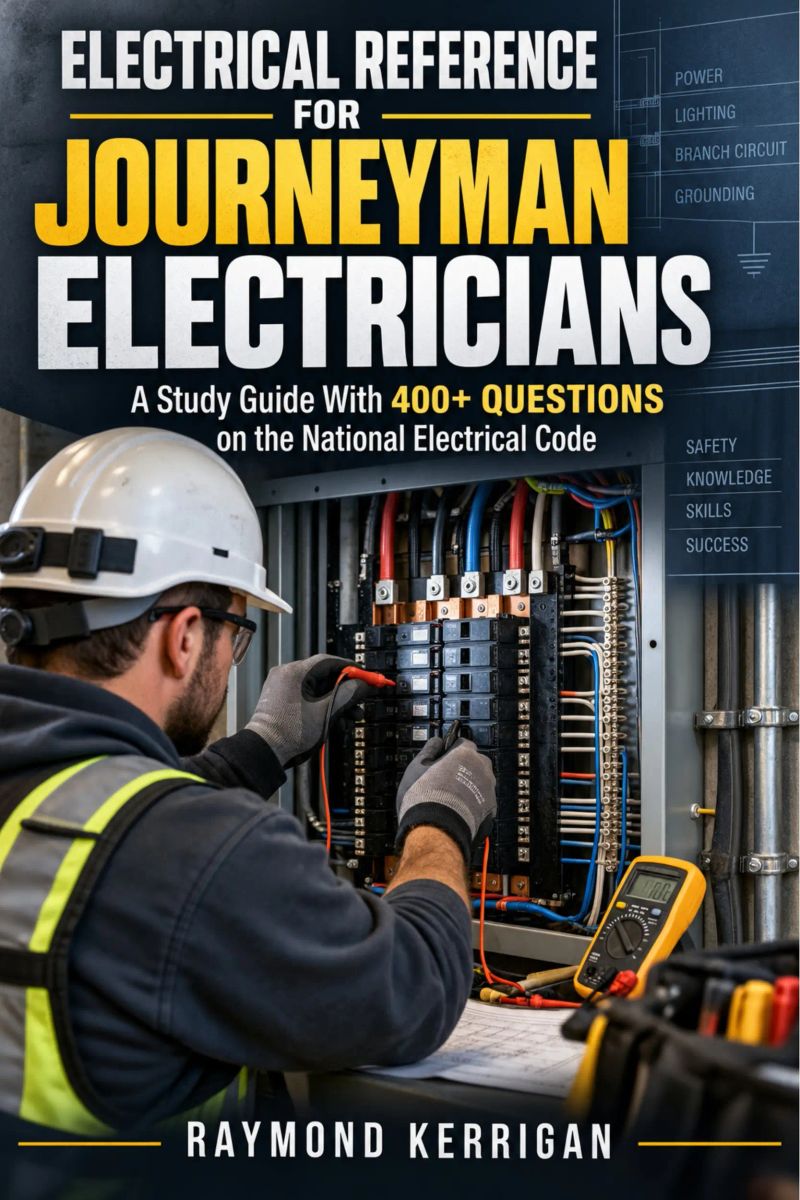
Electrical Reference for Journeyman Electricians
A Study Guide With 400+ Questions on the National Electrical CodeBy Raymond Kerrigan


Length15h 11m
About this audiobook
Passing the journeyman exam is not a memory test—it is a speed test in a book you are allowed to bring.
This study guide teaches you to navigate the National Electrical Code the way the exam demands: find the article, read the exception, run the numbers, move on. Instead of memorizing isolated facts, you will learn a repeatable method for locating code requirements quickly, applying exceptions correctly, and performing the calculations that appear on every journeyman examination. The focus is on the skills that actually save time in the exam room: knowing how the Code is organized, recognizing which article governs a question, and working through the math without hesitation.
You will work through conductor ampacity and correction factors, voltage drop, raceway and box fill, branch circuits and required outlets, dwelling and commercial load calculations, services, grounding and bonding, overcurrent protection, motor and air conditioning circuits, transformers, and special occupancies. More than four hundred practice questions across four timed exams show the calculation and the article behind every answer, so you can see not only what the correct answer is but where it comes from in the Code. Each chapter builds the habits that separate candidates who finish from those who run out of time.
What you will learn:
• How the National Electrical Code is organized and how to find the right article fast
• Electrical theory the exam assumes you already know
• Conductor ampacity, correction factors, and adjustment for temperature and conduit fill
• Voltage drop calculations and conductor selection
• Wiring methods, raceway fill, boxes, conduit bodies, and enclosures
• Branch circuits, required outlets, and receptacle placement
• Dwelling, commercial, and multifamily load calculations
• Services, service equipment, grounding, bonding, and overcurrent protection
• Motors, air conditioning circuits, transformers, and special occupancies
Written for apprentices sitting the journeyman exam, electricians upgrading their licence, and instructors running exam-prep classes, this guide turns the Code into a working tool. If you need to build speed, accuracy, and confidence with the National Electrical Code before exam day, this book is designed for you.
Audiobook details
GenreTechnology, Education and Learning
Length15 hrs 11 mins
Narrated byListen with 1,000+ voices
FormateBook with Audio
Publish dateSep 26, 2026
LanguageEnglish
Table of contents
1Foreword
2Preface
3About This Book
4Important Safety Notice
5Chapter 1: How the Code Is Organised
Show all chaptersShow less
61.1 The Architecture of the Code Book
71.2 Mandatory, Permissive and Prohibitive Language
81.3 The Definitions Article and How to Use It
91.4 Tables, Annexes and the Notes That Change the Answer
101.5 A Sixty-Second Lookup Routine
11Chapter 2: Electrical Theory the Exam Assumes
122.1 Ohm’s Law and the Power Wheel
132.2 Series and Parallel Circuits
142.3 Real Power, Apparent Power and Power Factor
152.4 Three-Phase Wye and Delta Relationships
16Chapter 3: Conductors and Ampacity
173.1 Conductor Types, Insulation and Temperature Ratings
183.2 Reading the Ampacity Table
193.3 Ambient Temperature Correction
203.4 Conduit-Fill Adjustment Factors
213.5 Continuous Loads and the 125 Percent Rule
22Chapter 4: Voltage Drop and Conductor Selection
234.1 Why Voltage Drop Matters and Where It Is Required
244.2 Single-Phase Voltage Drop Calculation
254.3 Three-Phase Voltage Drop Calculation
264.4 Parallel Conductors and Their Effect on Drop
274.5 Upsizing the Equipment Grounding Conductor
28Chapter 5: Wiring Methods and Raceway Fill
295.1 Choosing a Wiring Method
305.2 Raceway Fill and Conductor Count
315.3 Bend Limits, Securing and Support
325.4 Expansion, Contraction and Wet Locations
33Chapter 6: Boxes, Conduit Bodies and Enclosures
346.1 Box Fill Counting Rules
356.2 Box Volume Tables and Selecting a Box
366.3 Pull and Junction Box Sizing
376.4 Enclosure Types and Locations
38Chapter 7: Branch Circuits and Outlet Requirements
397.1 Branch-Circuit Ratings and Loading
407.2 Receptacle Spacing and Required Outlets
417.3 Ground-Fault and Arc-Fault Protection
427.4 Multiwire Branch Circuits
43Chapter 8: Dwelling Load Calculations
448.1 General Lighting and Small-Appliance Loads
458.2 Appliance Loads and Demand Factors
468.3 Heating and Air Conditioning
478.4 The Standard Method and the Optional Method
48Chapter 9: Commercial and Multifamily Load Calculations
499.1 Receptacle and Show-Window Loads
509.2 Kitchen Equipment and Motor Loads

The Honey BusMeredith May9h 31m4.4 (16.6K)$25 · $0.00
Collected Writings of Nikola TeslaThomas Commerford Martin, Nikola Tesla19h 42m4.4 (2.8K)$1.99 · $0.00

Operation PedestalMax Hastings12h 29m4.4 (5.2K)$29 · $0.00

When the Heavens Went on SaleAshlee Vance18h 20m4.4 (3K)$40 · $0.00
Everybody Has a Podcast (Except You)Justin McElroy, Travis McElroy, Griffin McElroy5h 9m4.3 (2.3K)$24 · $0.00

Hands of TimeRebecca Struthers8h 8m4.4 (1.3K)$26 · $0.00
Never Lost AgainBill Kilday10h 1m4.4 (805)$29 · $0.00
How the Internet HappenedBrian McCullough13h 28m4.3 (2.7K)$23 · $0.00
Collected Writings of Nikola TeslaNikola Tesla, Thomas Commerford Martin21h 50m4.3 (1.7K)$1 · $0.00

Just AspireAjai Chowdhry9h 13m4.4 (260)$29 · $0.00

The Little Book of AliensAdam Frank8h 20m4.3 (1.3K)$26 · $0.00
The inventions, researches and writings of Nikola Tesla (Annotated)Thomas Commerford Martin16h 59m4.3 (1.3K)$2 · $0.00

KargilV.P. Malik15h 18m4.3 (2K)$24 · $0.00
Experiments with Alternating CurrentsNikola Tesla9h 16m4.3 (874)$1.99 · $0.00

Fire on the HorizonTom Shroder, John Konrad8h 23m4.3 (858)$26 · $0.00

The Smell of Kerosene (Annotated)National Aeronautics and Space Administration, Donald L. Mallick, Peter W. Merlin11h 32m4.3 (523)$2 · $0.00

The Boy Who Harnessed the WindWilliam Kamkwamba, Bryan Mealer10h 5m4.2 (78.9K)$29 · $0.00

Across the Airless WildsEarl Swift10h 8m4.3 (1.3K)$29 · $0.00

Console WarsBlake J. Harris20h 41m4.2 (13.7K)$46 · $0.00
Improvised Munitions HandbookU.S. Department of Defense4h 49m4.3 (1.6K)$0.99 · $0.00

A Brief History of IntelligenceMax S. Bennett12h 18m4.6 (6.6K)$29 · $0.00

HomeschooledStefan Merrill Block7h 10m3.6 (18.5K)$28 · $0.00
EXPERIENCE AND EDUCATION – Premium Edition (Including Democracy & Education) (Annotated)John Dewey19h 17m4.6 (1K)$2 · $0.00
WitnessAriel Burger8h 1m4.6 (1.3K)$20 · $0.00

EducationEllen G. White9h 41m4.6 (1.5K)$2 · $0.00

Parents and Children (Annotated)Charlotte Mason9h 23m4.6 (988)$2 · $0.00

Children Under FireJohn Woodrow Cox10h 17m4.5 (1.6K)$29 · $0.00

The State Must ProvideAdam Harris7h 15m4.5 (775)$24 · $0.00
The Call of the Wild and FreeAinsley Arment9h 7m4.4 (21.2K)$29 · $0.00
The Freelance WayRobert Vlach19h 48m4.5 (528)$40 · $0.00

Race to the BottomLuke Rosiak9h 20m4.5 (600)$29 · $0.00

They Came for the SchoolsMike Hixenbaugh9h 5m4.5 (2.6K)$8 · $0.00

Find Me UnafraidKennedy Odede, Jessica Posner11h 11m4.5 (2.7K)$29 · $0.00

Asking for ItKate Harding8h 55m4.4 (5.3K)$20 · $0.00
Defining Moments in Black HistoryDick Gregory7h 37m4.4 (6K)$26 · $0.00

The Emerald Tablets of Thoth the AtlanteanMaurice Doreal3h 4m4.4 (8.8K)$6 · $0.00

Learning AmericaLuma Mufleh6h 37m4.4 (564)$24 · $0.00
Math-ishJo Boaler7h 21m4.4 (588)$24 · $0.00

Daddy-Long-LegsJean Webster12h 18m4.2 (91K)$1.99 · $0.00
It Worked For MeColin Powell7h 42m4.3 (9.8K)$26 · $0.00
You may also like
Elements of ChemistryAntoine Lavoisier12h 24m4.1 (685)$9.10 · $0.00
Hegel: Lectures on PhilosophyGeorg Wilhelm Friedrich Hegel86h 27m4.1 (12.7K)$2 · $0.00
Up Around the BendBill Brown Jr.29m$2

Dear Hearts and Gentle PeopleBill Brown Jr.37m$4
Iron ManBill Brown Jr.46m$5
GuiltyBill Brown Jr.31m$4

ItalianMade for Success6h 41m$23

AP World History Exam Study GuideMarie Peterson8h 47m$10
LauraBill Brown Jr.26m$2
Guitar by Ear: Solos Box Set 3Bill Brown14h 1m$23

The Plain-English Guide to CanvaMiles Draper4h 17m$8
Guitar by Ear: Pop and Standards Box Set 2Bill Brown17h 11m$25
Boom BoomBill Brown Jr.35m$4

The HomecomingBill Brown Jr.52m$5

I'll Never Fall in Love AgainBill Brown Jr.30m$2
Mrs. Robinson AccompanimentBill Brown Jr.22m$2

March in GBill Brown Jr.28m$2

Beyond The SunsetBill Brown Jr.19m$2
The Big Sewing BookEva-Maria Heller2h 17m$5 · $0.00

Learn Spanish for Beginners - Lesson 1Jasmin Voges44m$12 · $0.00