
Audio only
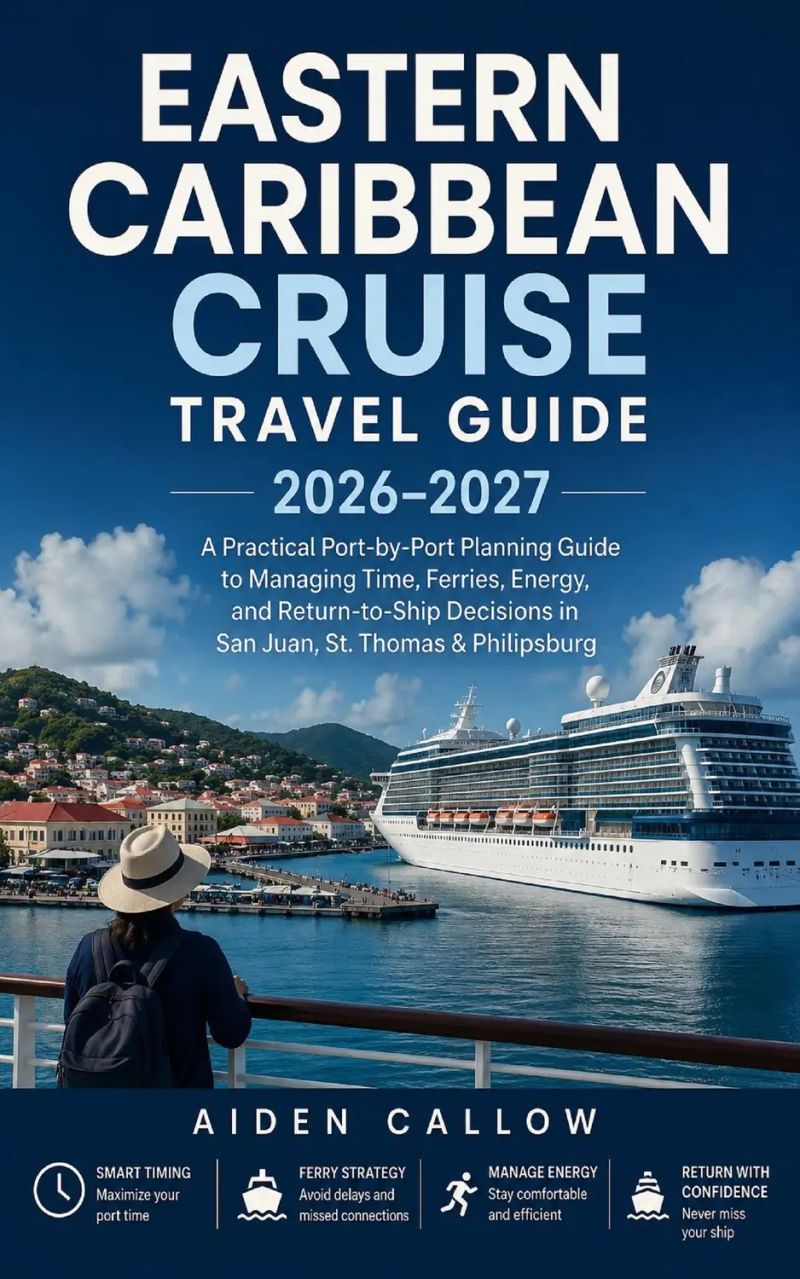
Eastern Caribbean Cruise Travel Guide 2026–2027
A Practical Port-by-Port Planning Guide to Managing Time, Ferries, Energy, and Return-to-Ship Decisions in San Juan, St. Thomas & PhilipsburgBy Aiden Callow


Length2h 21m
About this audiobook
Most Eastern Caribbean cruise itineraries look simple on paper—short distances, multiple islands, and “easy” port days that seem straightforward to explore.
But once you are actually in port, the experience often feels less predictable than expected.
Travelers commonly run into the same challenges: ferry timings that don’t behave like schedules, heat and exposure that quietly reduce energy, transport dependencies that add hidden delays, and return-to-ship timing that becomes more restrictive than it first appears. What looks like flexible exploration can quickly turn into time pressure, fragmented decisions, and uncertainty about how much can realistically be done in a single stop.
This guide focuses on turning that uncertainty into structure.
It explains how Eastern Caribbean cruise ports actually function in practice—not just geographically, but operationally—so you can plan with clearer expectations around timing, energy use, transport friction, and return windows. Instead of assuming everything is easily combinable, it helps you understand what fits safely into a port day and what tends to break under real conditions.
Inside, you will find a practical framework for making better on-the-ground decisions:
How to structure a port day around realistic timing, not ideal schedules
How to anticipate energy drop-offs caused by heat and movement
How to evaluate whether ferries, tours, or independent exploration are actually compatible with cruise return limits
The goal is not to do more in each port, but to make each decision clearer before you commit to it.
By the end, you have a more stable way to interpret cruise port days—where timing, movement, and energy are treated as constraints to plan around, not surprises to manage in real time.
Audiobook details
GenreTravel
Length2 hrs 21 mins
Narrated byListen with 1,000+ voices
FormateBook with Audio
Publish dateJul 14, 2026
LanguageEnglish
Table of contents
1Introduction
2© Copyright Notice: Disclaimer
3CHAPTER 1 — The Eastern Caribbean Isn’t a Destination, It’s a Time System
4The illusion of open time when the ship arrives
5Ports behave like time windows, not locations
Show all chaptersShow less
6Why ferries, taxis, and “quick access” don’t change the structure
7Time does not stay linear in port environments
8The hidden structure behind every port day
9Why cruise travel amplifies timing sensitivity
10The misjudgment that shapes most port-day problems
11Why “freedom” is not the correct frame
12Risk replaces distance as the real constraint
13When the system becomes noticeable in practice
14CHAPTER 2 — Port Reality vs Cruise Expectations
15The mental model travelers bring into ports
16The first contradiction: “walkable” does not mean “usable”
17The second contradiction: “nearby” is not operationally near
18The third contradiction: schedules are not neutral
19Where expectation breaks: the illusion of recoverability
20The invisible cost of “just one more thing”
21Why return logic is absent in early planning
22The difference between “possible” and “stable”
23Why “easy ports” often create the most mistakes
24The structural mismatch between itinerary and behavior
25What actually changes once expectations adjust
26The underlying reality of port systems
27CHAPTER 3 — The Hidden Cost of Ferry Travel
28Why ferries feel simpler than they are
29The ferry is not one step—it is a chain of friction points
30The illusion of frequency
31Why ferries compress your entire day without warning
32The return problem becomes more complex offshore
33Why “just take an earlier ferry back” is not a stable strategy
34The hidden psychological cost: constant time monitoring
35Why ferries amplify “miss anxiety” more than other transport
36When ferries actually work well
37When ferries quietly fail in cruise contexts
38The real issue is not transport—it is dependency stacking
39What changes once ferry systems are treated as constraints instead of tools
40CHAPTER 4 — “Port Time Is Not Free Time”
41CHAPTER 5 — “Transport Is the Real Itinerary”
42CHAPTER 6 — “The Beach Problem: When Relaxation Becomes Time Pressure”
43CHAPTER 7 — “The Psychology of the Last Hour in Port”
44CHAPTER 8 — “Ship Return: The Quiet System That Reorganizes Everything”
45CHAPTER 9 — “Why ‘Flexibility’ Is the Most Misleading Word in Cruise Planning”
46CHAPTER 10 — Sun, Sweat, and Energy Management as a Travel Skill
47Sun exposure builds in phases, not moments
48Hydration only works when it is ahead of fatigue
49Clothing is a control system, not appearance
50Movement style shapes how long the port feels
More from Aiden Callow


A Cook's TourAnthony Bourdain5h 50m4.2 (38.2K)$28 · $0.00

Little PrincesConor Grennan9h 38m4.3 (27.6K)$29 · $0.00

We are Soldiers StillHarold G. Moore, Joseph L. Galloway7h 46m4.4 (2.4K)$26 · $0.00

The Road to San DonatoRobert Cocuzzo7h 29m4.4 (397)$17 · $0.00

Around the World in 60 SecondsNuseir Yassin7h 48m4.4 (836)$26 · $0.00

The Midwest Survival GuideCharlie Berens6h 6m4.3 (4.9K)$24 · $0.00

The Home of the Blizzard (Annotated)Sir Douglas Mawson19h 2m4.3 (1.3K)$2 · $0.00

Local WondersTed Kooser6h 21m4.4 (978)$14 · $0.00

Over the Edge of the WorldLaurence Bergreen6h 14m4.3 (23.2K)$24 · $0.00

What Really Happened In WuhanSharri Markson16h 28m4.3 (4.8K)$40 · $0.00

American RambleNeil King10h 58m4.3 (2.8K)$29 · $0.00

Seven Pillars of Wisdom (Unabridged Edition)T. E. Lawrence27h 31m4.3 (32.4K)$5.70 · $0.00

In The Footsteps Of RamaVikrant Pande, Neelesh Kulkarni9h 45m4.3 (778)$16 · $0.00

Never Leave the Dogs BehindBrianna Madia5h 37m4.2 (7.8K)$24 · $0.00

Touch the Top of the WorldErik Weihenmayer11h 18m4.3 (2.9K)$20 · $0.00

Mud, Sweat, and TearsBear Grylls9h 25m4.2 (20K)$29 · $0.00

NorthboundNaomi Arnold7h 21m4.3 (669)$24 · $0.00

China RoadRob Gifford10h 35m4.2 (4.7K)$20 · $0.00

Love, AfricaJeffrey Gettleman11h 55m4.2 (3.1K)$29 · $0.00
Pasta, Pane, VinoMatt Goulding9h 9m4.3 (985)$29 · $0.00
You may also like

Manuscript Found in a bottleEdgar Allan Poe27m3.7 (5.4K)$2.30

The Survivors of the ChancellorJules Verne5h 53m3.8 (1.7K)$2 · $0.00

The Island of Doctor MoreauH.G. Wells5h 19m3.9 (166.1K)$16 · $0.00

The Island of Doctor MoreauH. G.4h 43m3.9 (169.1K)$3.50 · $0.00
Great by ChoiceJim Collins, Morten T. Hansen8h 45m4.2 (26.1K)$26 · $0.00

The Pit and the PendulumEdgar Allan Poe21m4.2 (76.3K)$2.30 · $0.00

Manuscript Found in a BottleEdgar Allan Poe30m3.9 (12.1K)$1

An Antarctic MysteryJules Verne9h 4m3.8 (3.3K)$1.20 · $0.00

THE NARRATIVE OF ARTHUR GORDON PYM (Illustrated Edition) (Annotated)Edgar Allan Poe19h 43m3.7 (42.9K)$2 · $0.00

MS. Found in a BottleEdgar Allan Poe29m3.9 (11.5K)$2.30 · $0.00
AquanautRick Stanton12h 22m4.4 (2.6K)$23 · $0.00

An Antarctic MysteryJules Verne9h 2m3.8 (2.5K)$1.20 · $0.00

The Narrative of Arthur Gordon Pym of NantucketEdgar Allan Poe8h 4m3.6 (18.9K)$7

The Bet, and Other StoriesAnton Pavlovich Chekhov6h 4m4.1 (2.3K)$2.30

A Passion in the DesertHonoré de Balzac35m3.7 (1.2K)$2.30

GEORGIA MOTORCYCLE PERMIT EXAM PREP 2026–2027Tyler Knox7h 58m$10

Kansas Motorcycle Permit & License Test Prep 2026/2027Tobias Vantreese11h 36m$15

Astounding Stories Of Super Science August 1931Various Various7h 52m3.6 (27)$2.30

100 Timeless Mental Models for Entrepreneurs Sagar Nepal1h 46m5.0 (2) Only with Ultra

Gates Of The Arctic National ParkOrion C. Valemont3h 40m$2.30 · $0.00