
Audio only
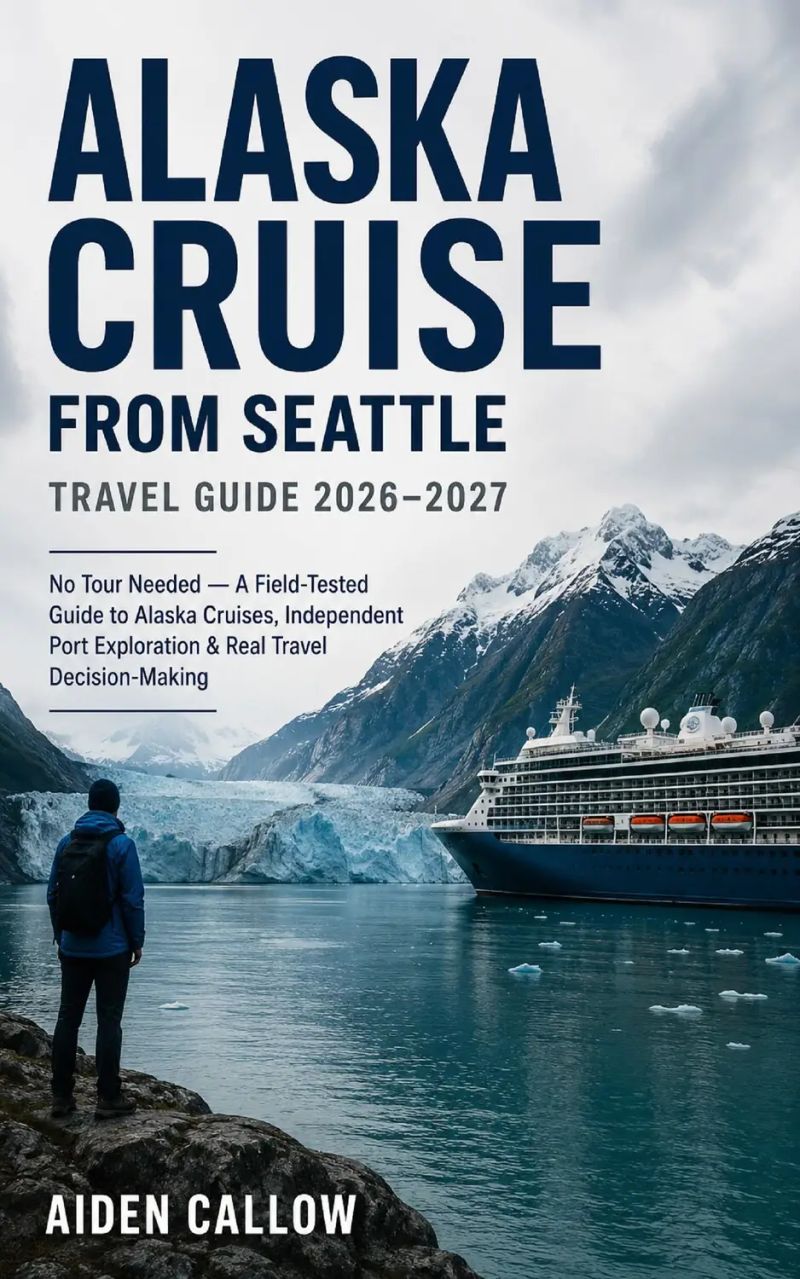
Alaska Cruise From Seattle Travel Guide 2026–2027
No Tour Needed — A Field-Tested Guide to Alaska Cruises, Independent Port Exploration & Real Travel Decision-MakingBy Aiden Callow


Length2h 54m
About this audiobook
Most travelers step onto an Alaska cruise expecting the scenery to do the work. In practice, the experience is shaped just as much by timing, weather, crowds, and small on-the-spot decisions as it is by the itinerary itself.
What often creates confusion is not a lack of information, but a lack of clarity in how everything fits together once the journey begins. Seattle pre-cruise logistics, Inside Passage conditions, wildlife sightings, glacier viewing windows, and port pacing in places like Juneau, Ketchikan, and Skagway all operate on different rhythms than first-time travelers expect.
Many visitors underestimate how quickly comfort, timing, and positioning affect what they actually get to see. Others over-plan excursions and still miss key moments simply because they are not in the right place at the right time.
This guide is designed to bring structure to those decisions in real-world terms.
It explains how to think through the cruise step by step, not as a checklist of attractions, but as a sequence of practical choices—where to stay in Seattle before embarkation, how to move through ports efficiently, when to prioritize decks over indoor spaces, and how to recognize the short windows where wildlife and glacier activity are most visible.
Instead of relying on tours or assumptions, the focus is on independent decision-making that still fits within cruise time constraints.
Inside, you will learn how to:
Plan Seattle arrival and embarkation timing to reduce early travel friction
Navigate Alaska ports efficiently without losing time in low-value zones
Position yourself on the ship for wildlife, glacier, and Inside Passage viewing
Adjust pacing based on weather, crowds, and limited shore windows
This is a practical travel field guide built around how Alaska cruising actually unfolds in real conditions, not how it appears in brochures or highlight lists.
A clear approach to the journey makes the experience easier to navigate—and helps ensure the time on board and on shore is used with intention rather than uncertainty.
Audiobook details
GenreTravel
Length2 hrs 54 mins
Narrated byListen with 1,000+ voices
FormateBook with Audio
Publish dateJul 10, 2026
LanguageEnglish
Table of contents
1Introduction
2© Copyright Notice: Disclaimer
3INTRODUCTION — The Alaska Cruise That Is Not a Vacation, But a Sequence of Decisions
4I arrive at the edge of the journey before the journey begins
5Alaska cruising is misunderstood before departure
Show all chaptersShow less
6Seattle is not a starting point. It is a filter
7Sightseeing vs environmental immersion: the real divide
8What “no tour needed” actually demands
9What I would tell myself before starting this journey again
10The real beginning of the cruise is not departure—it is awareness
11CHAPTER 1 — Arrival in Seattle: Pre-Cruise Reality Check
12I arrive in Seattle already slightly behind schedule—before the cruise has even begun
13Jet lag, hotel zoning, and the illusion of “close enough”
14Why staying near the port often fails in practice
15The quiet escalation of embarkation day timing pressure
16What first-time cruisers consistently misjudge
17A small moment that reveals everything
18What I would do differently if I returned
19CHAPTER 2 — The Night Before Embarkation: Positioning Yourself for Departure
20I arrive at the night before departure with more decisions already made than I realize
21Choosing between downtown comfort vs. port adjacency
22Walking feasibility vs. rideshare dependency
23Dining, sleep quality, and the illusion of a “relaxed final evening”
24Sleep as operational alignment, not recovery
25What I would personally optimize differently on return
26CHAPTER 3 — Embarkation Morning: The Controlled Chaos Window
27I arrive at the threshold where the trip stops being theoretical
28Boarding queues and the rhythm of luggage movement
29Terminal arrival timing strategy: the invisible advantage window
30What actually slows people down at check-in
311. Document hesitation
322. Luggage clarification moments
333. First-time navigation confusion
344. Emotional checking behavior
35The slow transformation of waiting into boarding
36What happens once I step onboard: the psychological inversion
37What first-time cruisers consistently misjudge
38What I would do differently if I returned
39CHAPTER 4 — First 24 Hours at Sea: Learning the Vessel
40I arrive at sea, but I am still behaving as if land rules apply
41Orientation patterns and the invisible mapping of crowds
42Deck behavior in cold maritime wind: the reality of exposure
43Food timing strategies vs peak crowd cycles
44What areas become useless vs essential
45Areas that become functionally useless (for most of the journey):
46Areas that become essential:
47The quiet shift from novelty to system awareness
48What first-time cruisers consistently misjudge
49What I would do differently if I returned
50CHAPTER 5 — Inside Passage Transit: When the Cruise Stops Being a Ship
More from Aiden Callow


A Cook's TourAnthony Bourdain5h 50m4.2 (38.2K)$28 · $0.00

Local WondersTed Kooser6h 21m4.4 (978)$14 · $0.00

Over the Edge of the WorldLaurence Bergreen6h 14m4.3 (23.2K)$24 · $0.00

What Really Happened In WuhanSharri Markson16h 28m4.3 (4.8K)$40 · $0.00

American RambleNeil King10h 58m4.3 (2.8K)$29 · $0.00

Seven Pillars of Wisdom (Unabridged Edition)T. E. Lawrence27h 31m4.3 (32.4K)$5.70 · $0.00

In The Footsteps Of RamaVikrant Pande, Neelesh Kulkarni9h 45m4.3 (778)$16 · $0.00

Never Leave the Dogs BehindBrianna Madia5h 37m4.2 (7.8K)$24 · $0.00

Touch the Top of the WorldErik Weihenmayer11h 18m4.3 (2.9K)$20 · $0.00

Mud, Sweat, and TearsBear Grylls9h 25m4.2 (20K)$29 · $0.00

NorthboundNaomi Arnold7h 21m4.3 (669)$24 · $0.00

China RoadRob Gifford10h 35m4.2 (4.7K)$20 · $0.00

Love, AfricaJeffrey Gettleman11h 55m4.2 (3.1K)$29 · $0.00

Pasta, Pane, VinoMatt Goulding9h 9m4.3 (985)$29 · $0.00

StraysBritt Collins6h 44m4.2 (1.4K)$20 · $0.00

The Voyage of the BeagleCharles Darwin21h 21m4.2 (17.1K)$1.20 · $0.00

Seven League BootsRichard Halliburton11h 53m4.3 (303)$2 · $0.00

Tiny MoonsNina Mingya Powles2h 36m4.2 (3.3K)$16 · $0.00

Ten Thousand Miles with a Dog SledHudson Stuck8h 7m4.3 (258)$1.99 · $0.00

WoodcraftNessmuk3h 29m4.2 (1.6K)$6 · $0.00
You may also like

Hunting with the Bow & ArrowSaxton T. Pope7h 14m4.3 (750)$1 · $0.00

The Explorer's GeneAlex Hutchinson9h 26m3.9 (1.1K)$8 · $0.00

The Critique of Judgement Part IImmanuel Kant5h 48m4.1 (1.2K)$4.70 · $0.00

The Malay Archipelago (Vol. 1&2)Alfred Russel Wallace25h 11m4.3 (2.9K)$1 · $0.00

A Lady's Life In The Rocky MountainsIsabella L. Bird7h 30m4.1 (6.2K)Free

Pete the Cat: Scuba-CatJames Dean5m4.4 (3.5K)$4 · $0.00

Through the Brazilian Wilderness - An Epic Adventure of the Roosevelt-Rondon Scientific ExpeditionTheodore Roosevelt12h 3m4.2 (828)$1 · $0.00

In Africa: Hunting Adventures in the Big Game Country (Annotated)John T. McCutcheon9h 54m4.1 (191)$2 · $0.00

Letters from Switzerland and Travels in ItalyJohann Wolfgang von Goethe16h 10m4.0 (45)$2.30

The Joy of Mathematics - A Conversation with Ian StewartHoward Burton1h 28m$3 · $0.00

An Inland VoyageRobert Louis Stevenson3h 51m3.7 (287)$2.30

The Adventures of Elizabeth in RügenElizabeth Von Arnim7h 19m3.9 (685)$2.30 · $0.00

Popular Books on Natural ScienceAaron David Bernstein5h3.7 (21)$2 · $0.00
Journal of an African CruiserHoratio Bridge7h 19m3.7 (43)$2 · $0.00

The Art of FlavorDaniel Patterson, Mandy Aftel4h 44m4.0 (599)$20 · $0.00

KashmirFrancis Edward Younghusband6h 10m3.5 (28)$2.30

Cruise of the Revenue-Steamer Corwin in Alaska and the N.W. Arctic Ocean in 1881: Botanical NotesJohn Muir33m$2 · $0.00

Robert Louis Stevenson: Travel Sketches, Memoirs & Island Literature (Annotated)Robert Louis Stevenson53h 23m4.6 (12)$2 · $0.00

The Sea and Its Living WondersG. Hartwig16h 35m$2 · $0.00

The zoology of the voyage of H.M.S. Beagle: MammaliaG. R. Waterhouse4h 53m$2 · $0.00