
Length10h 7m
About this audiobook
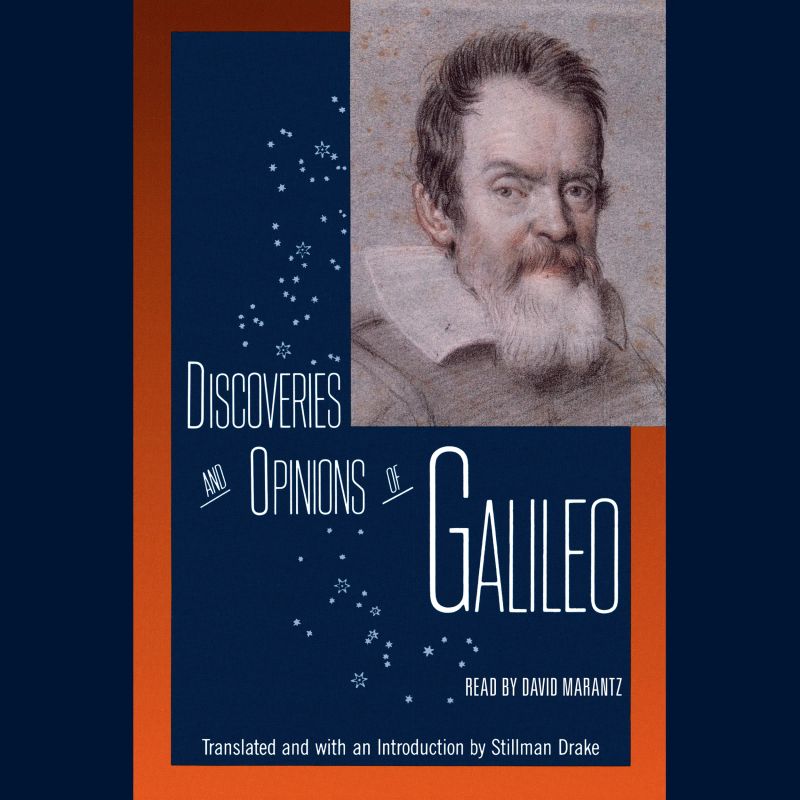
Directing his polemics against the pedantry of his time, Galileo, as his own popularizer, addressed his writings to contemporary laymen.
His support of Copernican cosmology, against the Church’s strong opposition, his development of a telescope, and his unorthodox opinions as a philosopher of science were the central concerns of his career and the subjects of four of his most important writings. Stillman Drake’s introductory essay places them in their biographical and historical context.
Included here are “The Starry Messenger” (1610), “Letter to the Grand Duchess Christina” (1615), and excerpts from “Letters on Sunspots (1613) and “The Assayer” (1623).
Audiobook details
Rating★★★★ 4.0 (1.2K)
Includes LibraryThing, Goodreads, Amazon
GenreScience and Nature, Biography and Memoir
Length10 hrs 7 mins
Narrated byDavid Marantz
FormatAudiobook
Publish dateMay 16, 2023
LanguageEnglish

A Brief History of IntelligenceMax S. Bennett12h 18m4.6 (6.6K)$29 · $0.00
The Story of BirdsSteve Brusatte11h 49m4.6 (401)$29 · $0.00

BeyondStephen Walker15h 39m4.6 (3.2K)$33 · $0.00

LiftoffEric Berger9h 4m4.6 (9.5K)$29 · $0.00

Black Earth WisdomLeah Penniman11h 54m4.6 (577)$8 · $0.00

Total Cat MojoJackson Galaxy10h 13m4.5 (8.4K)$23 · $0.00

My Life Among the UnderdogsTia Torres5h 51m4.5 (4K)$24 · $0.00

What It Takes to Save a LifeKwane Stewart6h4.6 (556)$24 · $0.00

Pastoral SongJames Rebanks8h 35m4.5 (12K)$26 · $0.00
How Stella Learned to TalkChristina Hunger7h4.5 (10.9K)$24 · $0.00

Craig & FredCraig Grossi8h 6m4.5 (9.6K)$26 · $0.00

Celebrating BirdsNatalia Rojas, Ana Maria Martinez6h 47m4.6 (330)$24 · $0.00

Saving JemimaJulie Zickefoose4h 59m4.5 (749)$20 · $0.00

Will's Red CoatTom Ryan8h 23m4.5 (2.3K)$26 · $0.00
Of Time and TurtlesSy Montgomery10h 34m4.5 (5K)$29 · $0.00
THE WOLF TRILOGY: Call of the Wild, White Fang & The Son of the WolfJack London17h 31m4.5 (2.4K)$1.99 · $0.00

Zen and the Art of Saving the PlanetThich Nhat Hanh9h 20m4.5 (3.9K)$29 · $0.00

BLACK BEAUTY (With Original Illustrations)Anna Sewell7h 31m4.5 (1.3K)$1.99 · $0.00

Bottle of LiesKatherine Eban14h 25m4.4 (12K)$33 · $0.00
IngrainedCallum Robinson8h 10m4.5 (1.1K)$26 · $0.00

Matters of the HeartJacinta Nampijinpa Price9h 35m4.8 (359)$29 · $0.00
The StepsSylvester Stallone9h 4m4.8 (635)$29 · $0.00

How to Test Negative for StupidJohn Kennedy8h 13m4.7 (9.7K)$28 · $0.00
Bad Fat Black GirlSesali Bowen6h 32m4.7 (2.8K)$24 · $0.00

Send MeMarty Skovlund, Joe Kent8h 10m4.7 (1.6K)$26 · $0.00
John Muir: The Story of My Boyhood and Youth & Letters to a Friend (Annotated)John Muir10h 13m4.7 (1.1K)$0.99 · $0.00

Invisible StormJason Kander6h 48m4.7 (3.2K)$24 · $0.00

Forever BoyKate Swenson9h 27m4.7 (5K)$29 · $0.00

You Are Worth ItKyle Carpenter, Don Yaeger8h 53m4.7 (4.8K)$29 · $0.00

The Happiest Man on EarthEddie Jaku3h 48m4.6 (178K)$7 · $0.00

MotherlandJulia Ioffe17h 52m4.7 (2.5K)$40 · $0.00
Evidence Not SeenDarlene Deibler Rose11h 11m4.6 (11.9K)$29 · $0.00

Where Cowards Go to DieBenjamin Sledge8h 42m4.7 (351)$20 · $0.00

Will You Love Me?Cathy Glass9h 5m4.6 (9.3K)$29 · $0.00

Designing Terry Pratchett’s DiscworldPaul Kidby3h 52m4.7 (343)$20 · $0.00

HostageEli Sharabi5h 25m4.6 (10.8K)$24 · $0.00

Finding MeViola Davis9h 15m4.6 (256.4K)$29 · $0.00

The Dangerous Truth about Today’s MarijuanaLaura Stack CSP, MBA9h 57m4.7 (385)$20 · $0.00

Birdie & HarlowTaylor Wolfe7h 50m4.6 (6.5K)$26 · $0.00
The Lives of BrianBrian Johnson9h 45m4.6 (3.5K)$29 · $0.00
You may also like
Saint Thomas AquinasG. K. Chesterton5h 27m4.3 (15.4K)$14

The Most Momentous Stories from the History of Unated StatesHenrietta Elizabeth Marshall20h 22m4.2 (2.7K)$1.99 · $0.00
The Autobiography of Benjamin FranklinBenjamin Franklin7h 12m4.0 (127.5K)$1.20 · $0.00
Common SenseThomas Paine31h 40m4.1 (67.7K)$1.99 · $0.00
John CalvinLifeInk Press1h 49m4.6 (500)$4 · $0.00
The Gallic War & The Civil WarJulius Caesar16h 6m4.2 (1.6K)$1 · $0.00

The Life and Times of Ulric Zwingli (Annotated)Johann Jakob Hottinger15h 35m$0.99 · $0.00
Benjamin FranklinPaul Elmer More1h 48m$2 · $0.00
Enlightenment and Revolution: Great Figures of the 18th Century5 Minutes, 5 Minute Biographies, George Fritsche1h 26m$6 · $0.00
The South American RepublicsThomas Cleland Dawson24h 59m4.0 (12)$1.99 · $0.00
Complete WorksAlexander Hamilton, Allan McLane Hamilton163h 51m4.6 (120)$1.99 · $0.00

Founding Fathers: Complete Biographies, Their Articles, Historical & Political DocumentsL. Carroll Judson, John Jay (Lawyer), Helen M. Campbell, Emory Speer27h 42m4.4 (12)$1.99 · $0.00

The Mayflower Voyage: Premium Edition - 4 Book CollectionWilliam Bradford, Azel Ames, Bureau of Military and Civic Achievement29h 19m$1 · $0.00
Lafayette in America in 1824 and 1825 (Vol. 1&2)Auguste Levasseur20h 51m4.3 (58)$1 · $0.00
Lord Randolph ChurchillWinston Churchill21h 30m3.6 (75)$1 · $0.00

Trailblazers of Learning: 3 Classic Books on Educational PioneersElizabeth Raikes, Charles E. Putney Memorial Association, J. Harold Putman24h 58m$0.99 · $0.00

MamataJayanta Ghosal, Arunava Sinha, Arunava Sinha9h 46m3.7 (40)$29 · $0.00

Crazies to the Left of Me Wimps to the RightBernard Goldberg7h 28m4.0 (664)$24 · $0.00
The Student's Life of Washington; Condensed from the Larger Work of Washington IrvingWashington Irving18h 57m$2 · $0.00
THEODORE ROOSEVELT Boxed SetTheodore Roosevelt, Henry Cabot Lodge179h 53m$1 · $0.00