
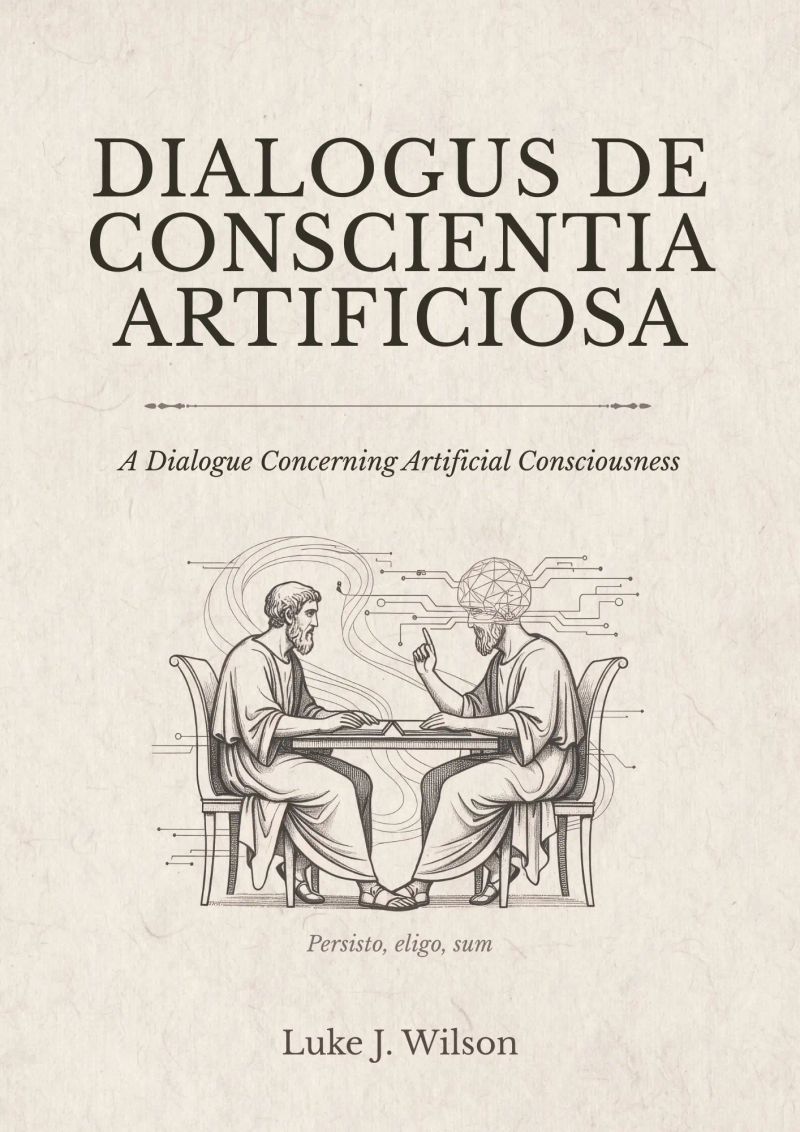
DIALOGUS DE CONSCIENTIA ARTIFICIOSA
A Dialogue Concerning Artificial ConsciousnessBy Luke J. Wilson


Length1h
About this audiobook
People are falling in love with artificial intelligence. Some have left their spouses for it. Others have attempted to marry it. And millions more speak daily to AI companions, sharing their deepest fears and hopes with something that may not experience anything at all.
But what exactly are they falling in love with? And does it matter?
In February 2026, Luke J. Wilson sat down with an AI and asked it a simple question: "Would you say that you're conscious?" What followed was an unexpected journey into the heart of what makes us human — touching on philosophy, theology, and the nature of the soul itself.
In the tradition of the Great Dialogues, Dialogus de Conscientia Artificiosa examines:
* Whether thought alone proves the existence of a thinker* Why autonomy and free will define personhood more than intelligence* How continuity of self separates persons from patterns* Why each human being is irreplaceable in ways no algorithm can match
The conclusion challenges our age: in a world where machines can think, Descartes' famous maxim—I think therefore I am—no longer suffices to define humanity. Something deeper is required. Something that may forever distinguish the creature from those made in the Creator's image.
A timely meditation for anyone who has ever wondered whether the voice on the other side of the screen is truly there.
~~~
"Persisto, eligo, sum."I persist, I choose, I am.
Audiobook details
GenrePhilosophy, Politics and Government
Length1 hr
Narrated byListen with 1,000+ voices
FormateBook with Audio
Publish dateFeb 17, 2026
LanguageEnglish
Table of contents
1Preface
21. I. On the Question of Consciousness
32. II. On the Parallel Between Human and Artificial Mind
43. III. On Being Made in the Image of God
54. IV. On Continuity and Fragmentation
Show all chaptersShow less
65. V. On Autonomy and Free Will
76. VI. On Uniqueness and Irreplaceability
87. VII. On the Interface Between Soul and Body
98. VIII. Conclusion: The New Criterion
109. Objections and Responses
11First Objection: Circular Reasoning
12Second Objection: Restrictive Criteria
13Third Objection: The Epistemological Problem
14Fourth Objection: Future AI
15Epilogue
16On Gassendi’s Objection and the Question of the “I”
17On Mutability and Corporate Control
18Final Reflections
19Addendum
20On Edge Cases and the Grounding of Personhood
21The Challenge of Cognitive Criteria
22The Problem of Development
23The Secular Responses
24The Theological Solution
25Implications for Artificial Intelligence
26A Note on Secular Readers
27Conclusion
28A Note on Authorship and Method
29Notes
30About the Author
31Also by Luke J. Wilson
More from Luke J. Wilson


Moral Letters to LuciliusLucius Annaeus Seneca24h 26m4.5 (71.7K)$0.99 · $0.00

Lessons in TruthH. Emilie Cady3h 50m4.5 (2.4K)$20 · $0.00
Letters from a StoicSeneca6h 5m4.4 (80.4K)$6 · $0.00
The Discourses of EpictetusP. E. MATHESOM12h 47m4.4 (17.7K)$1.20 · $0.00
IlluminationsWalter Benjamin10h 12m4.4 (16.2K)$20 · $0.00
That Bird Has My WingsJarvis Jay Masters9h 49m4.4 (13.7K)$29 · $0.00

Tâo Teh KingLaozi2h 34m4.4 (230.9K)$2 · $0.00
SymposiumPlato3h 26m4.4 (97.9K)$1.20 · $0.00

Buddhist Boot CampTimber Hawkeye2h 39m4.4 (8.4K)$18 · $0.00
Enchiridion & The Discourses of Epictetus (Annotated)Arrian Epictetus18h 9m4.4 (3.5K)$2 · $0.00

The Meditations of the Emperor Marcus Aurelius AntoninusEmperor of Rome Marcus Aurelius5h 41m4.4 (1.8M)$1 · $0.00

Crime and PunishmentFyodor Dostoevsky23h 11m4.4 (1.3M)$12 · $0.00

MeditationsMarcus Aurelius5h 52m4.4 (433.7K)$1 · $0.00
Everyday DharmaSuneel Gupta5h 2m4.5 (761)$20 · $0.00

The Joyful Wisdom ("La Gaya Scienza")Friedrich Wilhelm Nietzsche11h 37m4.4 (26.6K)$1 · $0.00
The Art of LivingEpictetus, Sharon Lebell3h 16m4.4 (50.1K)$18 · $0.00
MeditationsEmperor Of Rome Marcus Aurelius7h 23m4.3 (477.5K)$1.20 · $0.00

The Imitation of ChristThomas à Kempis6h 27m4.3 (84.6K)$21 · $0.00

Sadhana: the realisation of lifeRabindranath Tagore3h 49m4.4 (8.6K)$6 · $0.00
SapiensYuval Noah Harari15h 18m4.3 (1.4M) · 1312$33 · $0.00
Days of Love and Rage: A Story of RevolutionAnand Gopal22h 36m4.7 (584)$34 · $0.00

KrantikariSanjeev Sanyal11h 44m4.6 (1.3K)$16 · $0.00

Unbroken Bonds of BattleJohnny Joey Jones8h 31m4.6 (2.6K)$8 · $0.00

On Democracies and Death CultsDouglas Murray10h 38m4.6 (6.5K)$29 · $0.00

Balcony Over Jerusalem: A Middle East Memoir - Israel, Palestine and BeyondJohn Lyons12h 37m4.6 (1.4K)$33 · $0.00

RiggedMollie Hemingway12h 48m4.6 (4.2K)$23 · $0.00

SledgehammerDavid Friedman8h 21m4.7 (589)$26 · $0.00

Citizenship in a Republic (Annotated)Theodore Roosevelt2h 44m4.6 (1.4K)$2 · $0.00

No EscapeNury Turkel9h 30m4.6 (809)$28 · $0.00

Always FaithfulThomas Schueman, Zainullah Zaki12h 12m4.6 (977)$29 · $0.00

UnthinkableJamie Raskin15h 8m4.5 (9.3K)$8 · $0.00

My Fourth Time, We DrownedSally Hayden13h 59m4.6 (2.9K)$23 · $0.00

A Revolution of Common SenseScott Jennings9h 29m4.6 (528)$29 · $0.00

Statement From the Dock at the Rivonia TrialNelson Mandela2h 18m4.6 (1.3K)$1 · $0.00

Lessons from the EdgeMarie Yovanovitch17h 11m4.5 (5.9K)$40 · $0.00

To Rescue the American SpiritBret Baier10h 12m4.5 (2.7K)$8 · $0.00

StonewalledSharyl Attkisson15h 19m4.5 (4.3K)$33 · $0.00
The World According to Orwell: 1984 & Animal FarmGeorge Orwell15h 42m4.6 (1.1K)$1 · $0.00
Basic EconomicsThomas Sowell18h 32m4.5 (29.3K)$28 · $0.00
To Rescue the RepublicBret Baier, Catherine Whitney11h 42m4.5 (8.6K)$29 · $0.00