
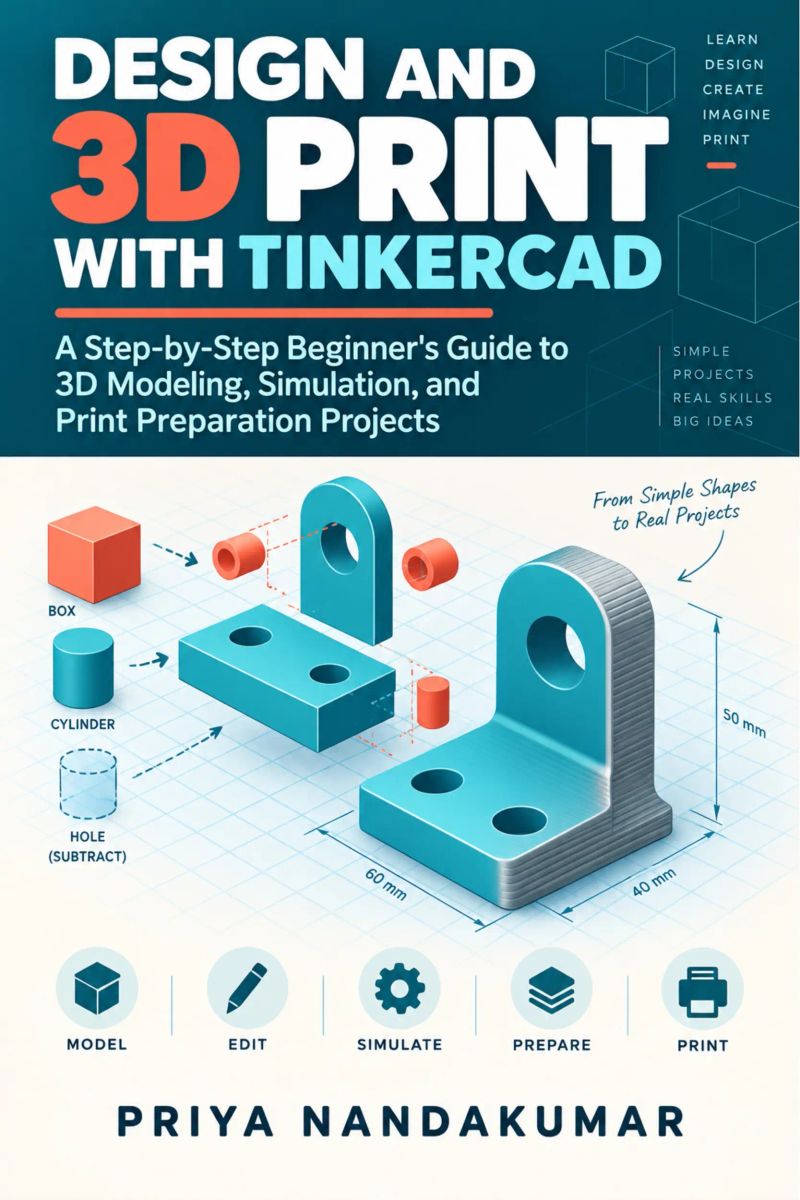
Design and 3D Print with Tinkercad
A Step-by-Step Beginner's Guide to 3D Modeling, Simulation, and Print Preparation ProjectsBy Priya Nandakumar


Length7h 52m
About this audiobook
You can learn the whole of Tinkercad in an afternoon and still print parts that do not fit. This book closes that gap.
Most Tinkercad guides stop at dragging shapes onto the workplane. This one starts where those books end: with the rules that decide whether a design survives the printer. You will begin by grouping solids and holes, then move to the ruler and custom workplanes so your models carry real dimensions. From there you build a first complete project from an empty workplane through to a sliced file, learning wall thickness, overhang angle, bridging, orientation, and the clearances that make a pin turn in a hole or a snap fit click.
Written for beginners, makers, students, and teachers new to 3D design, the book pairs clear step-by-step instruction with projects that grow in difficulty. Codeblocks add parametric designs that resize themselves, and the Circuits workspace lets you simulate an Arduino project and print an enclosure to match. Every chapter is built around the workflow of a real print, so you are never learning a tool in isolation from the object it produces.
What you will learn:
• Navigate the Tinkercad workspace and set up an efficient first session
• Combine primitives, holes, and grouping to build complex shapes
• Use the ruler and custom workplanes for precision modelling
• Complete a first project: a printed phone stand from empty workplane to sliced file
• Apply FDM design rules for wall thickness, overhang angle, bridging, and orientation
• Add text, logos, and imported artwork to your models
• Work with shape generators and advanced boolean operations
• Design mechanical fits, moving parts, and snap-fit clearances
• Use Codeblocks for parametric designs and simulate Arduino projects in Circuits
Whether you are a complete beginner, a hobbyist maker, a student, or a teacher looking for a classroom-ready introduction to 3D design and printing, this book gives you the practical foundation to design parts that fit, function, and print successfully.
Audiobook details
GenreTechnology
Length7 hrs 52 mins
Narrated byListen with 1,000+ voices
FormateBook with Audio
Publish dateSep 27, 2026
LanguageEnglish
Table of contents
1Design and 3D Print with Tinkercad
2Foreword
3Preface
4About This Book
5Chapter 1: Getting Started in Tinkercad
Show all chaptersShow less
61.1 Creating an Account and Joining a Classroom
71.2 The Workplane, the Grid and the Three Axes
81.3 Orbiting, Panning and Zooming
91.4 Choosing Units and Reading the Shape Panel
101.5 Keyboard Shortcuts Worth Learning First
11Chapter 2: Primitives, Holes and Grouping
122.1 The Solid Primitives and Their Parameters
132.2 Holes, Grouping and Boolean Results
142.3 Align, Flip and Rotate
152.4 Building a Shape from Three Blocks
16Chapter 3: Precision Modelling
173.1 The Ruler and Exact Dimensions
183.2 The Snap Grid and Nudge Steps
193.3 Offset and Angled Workplanes
203.4 Measuring an Existing Design
21Chapter 4: First Project: A Printed Phone Stand
224.1 Concept Sketch and Dimensions
234.2 Modelling the Stand
244.3 Wall Check and Design Review
254.4 Export, Slice and Print
264.5 The Printed Result and What to Change
27Chapter 5: Designing for FDM Printing
285.1 Wall Thickness and Nozzle Diameter
295.2 Overhangs and Bridging
305.3 Orientation and Anisotropy
315.4 Shrinkage, Warping and Bed Adhesion
325.5 Design Rules Summary and a Checklist
33Chapter 6: Text, Logos and Imported Artwork
346.1 The Text Shape and Scribble
356.2 Importing SVG Artwork
366.3 Embossing and Engraving
376.4 Keeping Small Features Printable
38Chapter 7: Shape Generators and Advanced Booleans
397.1 Built-in Shape Generators
407.2 Negative-Space Modelling
417.3 Fillets and Chamfers by Subtraction
427.4 Combining Generators with Booleans
43Chapter 8: Mechanical Fits and Moving Parts
448.1 Pin and Hole Clearance
458.2 Press Fits and Snap Fits
468.3 Printed Threads
478.4 Living Hinges and Simple Gear Trains
48Chapter 9: Codeblocks for Parametric Design
499.1 The Codeblocks Workspace and Variables
509.2 Loops and Repeated Geometry
More from Priya Nandakumar





The Honey BusMeredith May9h 31m4.4 (16.6K)$25 · $0.00

Collected Writings of Nikola TeslaThomas Commerford Martin, Nikola Tesla19h 42m4.4 (2.8K)$1.99 · $0.00

Operation PedestalMax Hastings12h 29m4.4 (5.2K)$29 · $0.00

When the Heavens Went on SaleAshlee Vance18h 20m4.4 (3K)$40 · $0.00

Everybody Has a Podcast (Except You)Justin McElroy, Travis McElroy, Griffin McElroy5h 9m4.3 (2.3K)$24 · $0.00

Hands of TimeRebecca Struthers8h 8m4.4 (1.3K)$26 · $0.00

Never Lost AgainBill Kilday10h 1m4.4 (805)$29 · $0.00

How the Internet HappenedBrian McCullough13h 28m4.3 (2.7K)$23 · $0.00

Collected Writings of Nikola TeslaNikola Tesla, Thomas Commerford Martin21h 50m4.3 (1.7K)$1 · $0.00

Just AspireAjai Chowdhry9h 13m4.4 (260)$29 · $0.00

The Little Book of AliensAdam Frank8h 20m4.3 (1.3K)$26 · $0.00

The inventions, researches and writings of Nikola Tesla (Annotated)Thomas Commerford Martin16h 59m4.3 (1.3K)$2 · $0.00

KargilV.P. Malik15h 18m4.3 (2K)$24 · $0.00

Experiments with Alternating CurrentsNikola Tesla9h 16m4.3 (874)$1.99 · $0.00

Fire on the HorizonTom Shroder, John Konrad8h 23m4.3 (858)$26 · $0.00

The Smell of Kerosene (Annotated)National Aeronautics and Space Administration, Donald L. Mallick, Peter W. Merlin11h 32m4.3 (523)$2 · $0.00

The Boy Who Harnessed the WindWilliam Kamkwamba, Bryan Mealer10h 5m4.2 (78.9K)$29 · $0.00

Across the Airless WildsEarl Swift10h 8m4.3 (1.3K)$29 · $0.00

Console WarsBlake J. Harris20h 41m4.2 (13.7K)$46 · $0.00

Improvised Munitions HandbookU.S. Department of Defense4h 49m4.3 (1.6K)$1.99 · $0.00
You may also like

Elements of ChemistryAntoine Lavoisier12h 24m4.1 (685)$9.10 · $0.00
How to Speak ScienceBruce Benamran13h 10m4.2 (419)$23

DesperadoBill Brown Jr.52m4.8 (12)$5

Rapid Mandarin, Vol. 1Earworms Learning1h 15m3.9 (167)$15

Be Thou My VisionBill Brown Jr.41m4.6 (12)$4

AP World History Exam Study GuideMarie Peterson8h 47m$10

Learn German for Beginners - Lesson 2Jasmin Voges38m$12 · $0.00

Why You Should Ditch the Rice Cereal- Alternative First FoodsAurora Brooks1h 8m$3.50 · $0.00

Shame the DevilBill Brown Jr.51m$5

AfghansSpool Cotton Co.33m$1 · $0.00

Tequila - VenturesBill Brown Jr.45m$4

I am learning HungarianJM Gardner4h 17m$18 · $0.00
Soldering, Brazing and WeldingVarious2h 49m$3 · $0.00

Maple Leaf RagBill Brown Jr.1h 29m$10

LloroBill Brown Jr.1h 11m$10
PatienceBill Brown Jr.2h 13m$10

REST APIs, Endpoint by EndpointOmar Brandt7h 36m$5 · $0.00

The Little Girl's Sewing BookVarious2h 41m$1 · $0.00

Washington Journeyman & Master Plumber Exam Workbook 2026/2027Garrick Pellowe13h 59m$30

FE Chemical Practice Exams SimplifiedEllis Tanaka13h 15m$85