
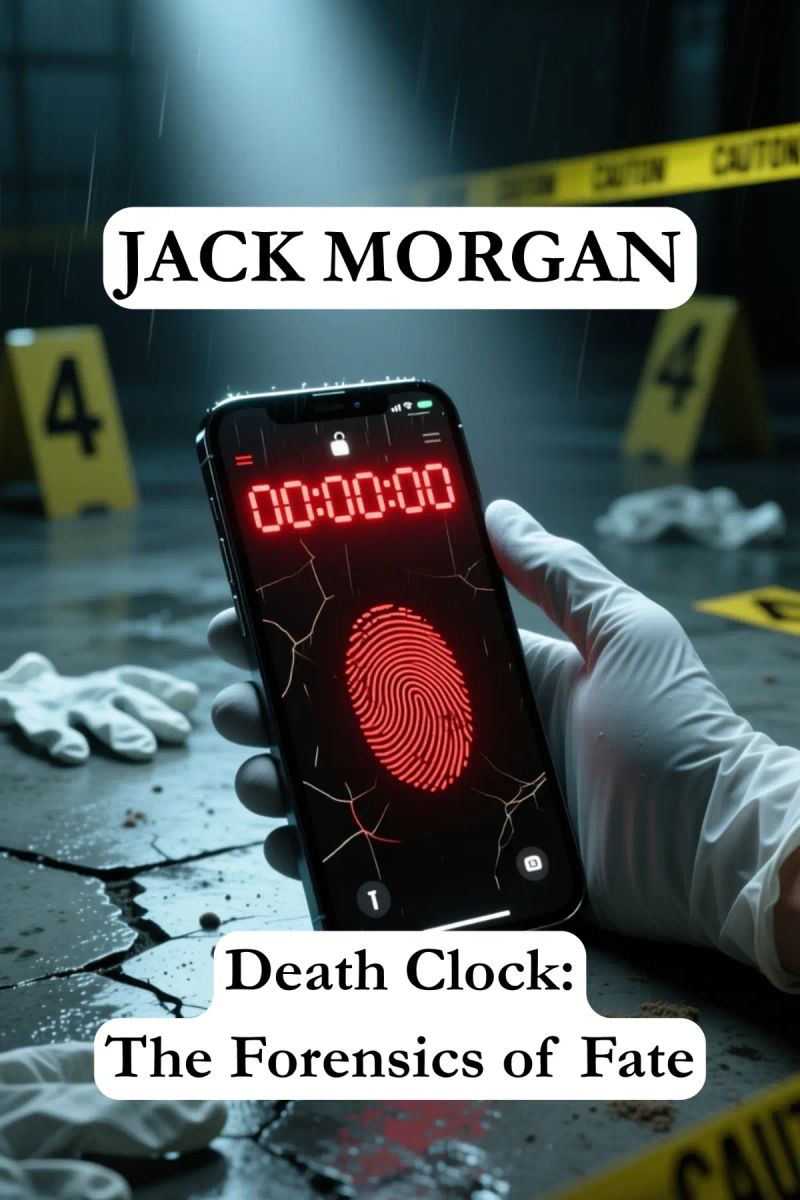


Length1h 31m
About this audiobook
When a mysterious mobile application begins predicting deaths with uncanny accuracy, forensic detective Elias Thorne is plunged into a nightmare where fate becomes code. Using meticulous investigative techniques, he hunts the programmers behind Chronomortis, realizing that the app doesn't just predict death—it engineers it.
Audiobook details
GenreHorror
Length1 hr 31 mins
Narrated byListen with 1,000+ voices
FormateBook with Audio
Publish dateDec 4, 2025
LanguageEnglish
Table of contents
1Chapter 1: The Decimal Point Zero
2Chapter 2: The Digital Coffin
3Chapter 3: The Forensics of Forty-Eight Hours
4Chapter 4: The Chimera Console
5Chapter 5: The Forensics of the Failsafe
Show all chaptersShow less
6Chapter 6: The Validation Protocol The roar of the short circuit—a sound of molten copper, disintegrating insulation, and pure, unfiltered power—died instantly, replaced by a silence so absolute it was physical. Thorne’s ears rang with a high-pitched whine that muffled the sound of his own desperate breathing. He tasted ozone and felt the sticky residue of adrenaline settling in his blood. The emergency lights, momentarily overwhelmed, failed to flicker back on. Total darkness swallowed the Chimera bunker. He waited, counting the seconds, assessing the damage to his immediate environment. He was alive. The halon mixture had been defeated, its source irrevocably severed from the power grid. He pushed himself off the scorched server rack, his body aching from the impact of the wrench's throw. His focus shifted to the last thing he had seen before the lights died. In the vast, overwhelming blackness, one small point of light persisted. It wasn't green or red, but a cold, sterile blue, emanating from a hardened, localized LED screen mounted near the disabled Atmospheric Control Unit (CACU). Thorne crawled toward it, flashlight retrieved from his utility belt, but he held the beam away, letting his eyes adjust to the low luminescence. The text remained, mocking the chaos he had just unleashed: TARGET: VANCE. COUNTDOWN: 00:00:00. STATUS: SUCCESS. "No," Thorne whispered, the sound thin and ragged against the silence. Vance. Commander Elias Vance. His mentor. The man who had trained him in forensic counter-espionage, the only asset within the upper echelons who knew the true structural weakness of the Phase II system. Vance hadn’t been the victim of the global attack; he had been the target of the internal execution circuit. This confirmed the chilling realization: the Phase II system wasn't just a defensive measure. It was a failsafe designed not to protect the world, but to eliminate internal threats who might try to shut it down. Vance must have been attempting exactly that when the clock started ticking. Thorne's sabotage hadn't stopped the global execution; it had only stopped his own suffocation. The internal purge of Vance had already achieved completion. Thorne shone the flashlight directly onto the small screen. It was running on an isolated power source—a dedicated lithium polymer cell, protected by thick ceramic casing. It was designed to survive an EMP, a nuclear blast, or, ironically, a catastrophic power surge caused by a desperate forensic investigator hurling a wrench. It wasn't a warning; it was a validation report, certifying that the system's mandate had been fulfilled before disruption. He reached out, his fingertips brushing the cold glass. The successful execution of Phase II meant a few things: First, global communications were likely already crippled. Second, whoever had designed this trap was operating on an utterly independent infrastructure. Third, and most crucially, the system knew Thorne was still alive. He glanced back at the breached CACU housing. The circuit board was fused, blackened, and emitting a faint, acrid smoke. He started packing up his specialized toolkit—he would need the thermal imaging equipment next. He needed to find the egress point, and quickly. The silence felt engineered, like the deliberate pausing of a predator. As he secured the wrench back into the kit, a sharp crack echoed from the far end of the facility, near the main blast door he had originally sealed shut. It wasn't the sound of heavy machinery failing, nor was it the gentle hum of recovering power. It was the distinct, metallic thunk of pneumatic seals failing under immense, unidirectional pressure. The blast door, rated to withstand a tactical strike, groaned. Thorne extinguished his flashlight, dropping instantly into a defensive crouch behind the server rack chassis. If the explosion of the power bus hadn't brought the authorities, then the termination of Vance had triggered something far more dangerous. The pressure seal released with a violent, earsplitting hiss of displaced air, and then, the grinding of heavy steel against concrete began. Someone—or something—was forcing their way in. And they weren't using the biometric entrance. They were tearing the bunker open. He pulled his sidearm, the cold weight a slight comfort against the sudden, overwhelming dread. The door buckled inward, the sound of tearing metal deafening. Through the narrow gap, lit only by a faint, external emergency beacon, Thorne saw the silhouette of a figure step over the ruined threshold. The figure was massive, inhumanly broad, and moving with an unnatural, measured precision. And in its hand, reflecting the distant blue light of the terminal, was a weapon that didn't look like it belonged to any known military inventory. The figure paused, its head tilting slightly, assessing the wreckage of the darkened server room. Thorne knew, with absolute certainty, that this was the cleaner, the forensic eraser, sent to neutralize the final piece of evidence. He had saved himself from the oxygen purge, only to deliver himself into the hands of the executioner. The figure raised the weapon slowly. "Protocol Omega activated," a synthesized voice boomed through the shattered chamber, chillingly clear. "Elimination priority: Investigator Thorne." The weapon fired.
7Chapter 7: Kinetic Response The sound wasn't a crack or a thunderclap; it was the sickening, pressurized thump of a high-velocity, wide-caliber round impacting reinforced steel and concrete simultaneously. The muzzle flash, briefly searing against the absolute darkness, revealed the figure: massive, composite armor, moving with a calculated economy that betrayed no fear or hesitation. Elimination Priority. Thorne threw himself sideways, using the last functioning console rack as cover. The first round turned the metal desk into shrapnel and dust, the kinetic energy washing over him like a physical wave. He felt the impact residue—powdered concrete, fine metal filings, and a sharp, metallic odor of burnt propellant—settle instantly onto his sweat-slicked skin. His training, honed over years of analyzing high-speed ballistics and explosive disassembly, took over. This wasn't standard military engagement. The armor was too thick, the weapon too specialized, designed not for precision killing, but for structural demolition and target suppression within a confined, hardened space. The Cleaner took a measured step forward, ignoring the debris and the electrical arcs sputtering from the severed main line. Its targeting optic, a cold red pinprick, swept the area, locking onto the heat signature Thorne knew he couldn't mask. He had seconds. He scrambled, not running, but crawling low beneath the twisted wreckage of the air filtration system he had just demolished. Every nerve screamed for a firearm, but all he possessed was his forensics kit, now uselessly scattered, and the utility knife secured inside his boot. He had to reach the inner core, the place where the system logic was housed, where complexity might offer cover from brute force. Another shot erupted. Closer this time. The round chewed through the overhead ventilation duct, showering Thorne with insulating foam and shredded metal sheeting. He used the brief distraction—the lingering red flare in the darkness—to dive into the maintenance shaft access chute, kicking the heavy, bolted hatch closed with frantic effort. The Cleaner didn't try to open the hatch. It simply analyzed the obstacle and reconfigured its approach. Thorne heard a low, mechanical whine, followed by a metallic click that resonated through the dense bunker walls. He recognized the sound profile immediately: a breaching charge being armed. Not C4, but something denser, tailored to blast open high-grade steel without sacrificing structural integrity unnecessarily. He plummeted down the greasy, narrow shaft, using the ladder rungs only for guidance. Vance was dead. The system had won. And the Cleaner was the janitor, making sure the anomaly—Thorne’s continued life—was erased. The screen flashed in his mind: TARGET: VANCE. STATUS: SUCCESS. His survival was proof that the system required a second layer of enforcement. He reached the bottom of the twenty-foot drop just as the breaching charge detonated above. The sound was muffled but devastating. The floor bucked beneath his feet. Dust and concrete rained down, but the heavy access plate held for the moment. The shaft was now effectively a choke point, and the only path forward was a narrow, horizontal service tunnel leading deeper into the subterranean complex. As he sprinted down the tunnel, choking on the aerosolized blast residue, he spotted what he desperately needed: a weapons locker, bolted to the wall near a defunct thermal relay station. It was old, scarred, and certainly locked, but it was his only chance. He didn't hesitate. He jammed his utility knife into the heavy locking mechanism, twisting the metal with all his strength, sacrificing the blade for the possibility of defense. The lock sprang open with a rusty shriek. Inside, resting in dusty foam padding, was a standard-issue, high-caliber service pistol and three magazines. Thorne snatched it, the cool weight a sudden, immense comfort. But his relief was short-lived. A new vibration started, not from the blast door above, but from the tunnel ahead. A low, rhythmic grinding. Suddenly, the tunnel wall, reinforced with rebar and nearly two feet thick, groaned audibly. A massive, diamond-tipped drill bit, thicker than his forearm, punched through the concrete less than ten feet in front of him, followed by a blinding focused light. The Cleaner had bypassed the damaged main entrance entirely and was coming straight through the structure.
8Chapter 8: The Geometry of Containment Failure
9Chapter 9: The Aether Dynamics Seal
10Chapter 10: The Inverse Singularity
11Chapter 11: The Geometry of Decay
12Chapter 12: The Inverse Half-Life
13Chapter 13: The Zero-Point Junkyard
14Chapter 14: The Chronological Nullifier
15Chapter 15: The Zero-Point Deletion
16Chapter 16: The Quantum Residue
17Chapter 17: The Geometry of Annihilation
18Chapter 18: The Forearm Paradox
19Chapter 19: Protocol Omega and the Zero-Sum Limb
20Chapter 20: The Zero-Sum Fold

The Unmade SisterJack Morgan1h 4m Only with Ultra
The Contagion of Absolute SilenceJack Morgan1h 3m Only with Ultra

Where Did the Nativity Go?Jack Morgan1h Only with Ultra

The Architects of BeliefJack Morgan1h 8m Only with Ultra

The Martian's ShadowJack Morgan1h 7m Only with Ultra

Van Gogh: Madman or Master?Jack Morgan56m Only with Ultra

The King of Pop's Final HoursJack Morgan59m Only with Ultra

The Cellular ThirstJack Morgan1h 27m Only with Ultra
Diana's Last Midnight: Minute by MinuteJack Morgan56m5.0 (1) Only with Ultra
Caesar's Final Hour: Real-Time AccountJack Morgan59m Only with Ultra

Ali's Ghost: The Undefeated LossJack Morgan56m Only with Ultra

The Captive Mind: Why We Love Our AbusersJack Morgan1h 19m Only with Ultra

The Villain Inside EveryoneJack Morgan1h 18m Only with Ultra

Brand Autopsy: PR Disaster FilesJack Morgan1h 23m Only with Ultra

Beauty’s Unfair Advantage: The Halo EffectJack Morgan1h 18m Only with Ultra

The Silence That Eats the WorldJack Morgan1h 29m Only with Ultra

Zodiac: The Lies I ToldJack Morgan1h 25m Only with Ultra
The Echo Chamber EffectJack Morgan1h 19m Only with Ultra
Sleep Paralysis: Night Terror ScienceJack Morgan1h 21m Only with Ultra

You Haven't Lived This Before, IdiotJack Morgan1h 19m Only with Ultra

The Renegade HunterLynsay Sands10h 7m4.4 (17.3K)$29 · $0.00

Lost GodsBrom14h 50m4.4 (18.5K)$33 · $0.00

The AccusedJana DeLeon6h 32m4.4 (3.9K)$12 · $0.00

Corpus HermeticumHermes Trismegistus3h 43m4.4 (8.6K)$7 · $0.00

LambChristopher Moore15h 22m4.3 (211.3K)$33 · $0.00

CARMILLA (Gothic Classic) (Annotated)Joseph Sheridan Le Fanu4h 2m4.4 (1K)$1.99 · $0.00

The ExorcistWilliam Peter Blatty12h 52m4.3 (285.9K)$8 · $0.00

Lost ValleyWalt Browning7h 47m4.3 (5.4K)$20 · $0.00

Twice TemptedJeaniene Frost8h 17m4.3 (54.8K)$26 · $0.00

Scared to BreatheKerena Swan10h 56m4.4 (1.7K)$13.60 · $0.00

1984George Orwell12h 18m4.3 (6M)$25 · $0.00

The Best Tales of Edgar Allan PoeEdgar Allan Poe5h 19m4.4 (2.2K)$1 · $0.00

A Christmas CarolCharles Dickens3h 7m4.3 (1.1M)$5 · $0.00
Hollywood DeadRichard Kadrey9h 22m4.3 (5.5K)$29 · $0.00

Frankenstein (The Uncensored 1818 Edition) (Annotated)Mary Shelley9h 25m4.3 (1.7M)$3 · $0.00

The Collected Ghost StoriesM. R. James18h 30m4.3 (12.1K)$2 · $0.00

Jane Eyre (Annotated)Charlotte Brontë22h 44m4.2 (2.4M)$2 · $0.00
The Chance of a Lifetime (Musaicum Romance Classics)Grace Livingston Hill8h 27m4.3 (862)$1 · $0.00

Heat 2Michael Mann, Meg Gardiner18h 39m4.3 (20.9K)$40 · $0.00

The Silence of Bonaventure ArrowRita Leganski11h 23m4.3 (7.5K)$29 · $0.00
You may also like

The SandboxJeffrey Wilson, Brian Andrews12h 18m4.2 (1.1K)$23

Black FallAndrew Mayne11h 31m4.2 (9.3K)$29 · $0.00

After AtlasEmma Newman12h 45m4.4 (5.3K)$23

The Paradise Key: A Harvey Bennett ThrillerNick Thacker8h 50m4.1 (1.4K) Only with Ultra

PopShawn green 39m4.1 (5.4K) Only with Ultra

Fight the FutureElizabeth Hand, Chris Carter4h4.0 (1.6K)$15
Code DeadEva Hudson8h 8m4.6 (335)$20

No Safe PlaceMichael Ledwidge7h 24m4.2 (1.5K)$24 · $0.00

Meet Your MakerMatthew Mather10h 1m4.1 (1.6K)$20

The RavagersDonald Hamilton5h 26m4.3 (973)$17

Lucky Starr and the Big Sun of MercuryIsaac Asimov4h 9m3.7 (2K)$20
DustHugh Howey10h 53m4.3 (190K)$20
MicroMichael Crichton13h 52m3.7 (50.5K)$33 · $0.00

The Best American Mystery Stories 2020C. J. Box, Otto Penzler16h 56m4.0 (1.2K)$40 · $0.00

RaidersC. R. Daems9h 31m4.5 (882)$20

ReaperBen Mezrich2h 48m3.4 (140)$18 · $0.00
The Missing DetectiveOlivia J. Carver4h 39m$4.10 · $0.00

Sentiment, Inc.Poul William Anderson1h 13m3.4 (146)$10 · $0.00

The weight of the maskRUSSELL HARRIS55m4.4 (20) Only with Ultra
Shadows of the FutureLeo Myra 1h 16m4.5 (117) Only with Ultra