
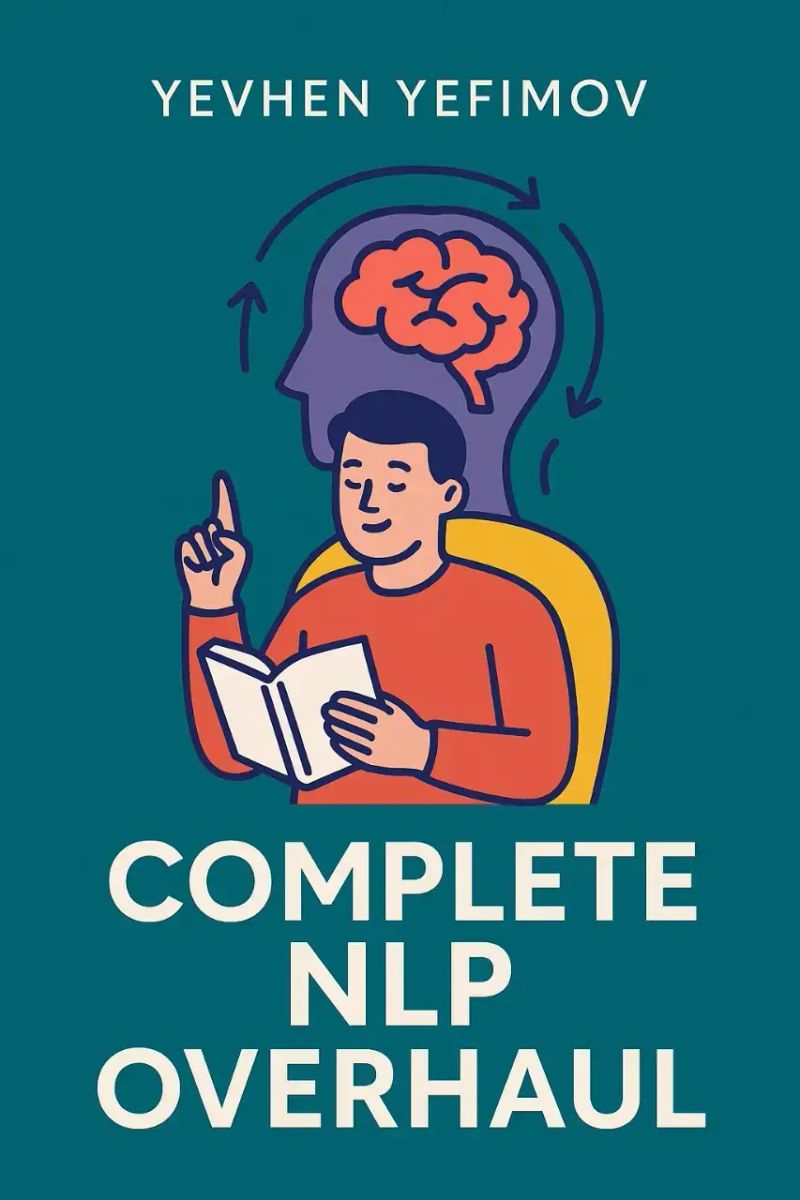
COMPLETE NLP OVERHAUL
Neurolinguistic Programming Model Installation Through StoriesBy Yevhen Yefimov


Length25h 14m
About this audiobook
A journey through the world of Neuro-Linguistic Programming (NLP), told in stories designed to gently and effortlessly instill the complete NLP model into your subconscious mind. This book was conceived with a vision: to make the depth and breadth of NLP not just accessible, but transformative—so much so that its patterns and principles become part of who you are. Whether you are freshly trained, a seasoned NLP practitioner, or simply curious about the art and science of excellence, these stories will serve as entertaining guides, powerful refreshers, and subtle, hypnotic invitations to new skills and insights. Through anchoring, reframing, and powerful techniques like fast phobia cures and timeline therapy, you’ll learn to transform limiting beliefs, dissolve fears, and access deep personal resources. The book guides you through the art of storytelling and metaphor, revealing how these are used not only to teach but to create lasting change.
Audiobook details
Rating★★★★★ 5.0 (1)
GenrePsychology, General Fiction
Length25 hrs 14 mins
Narrated byListen with 1,000+ voices
FormateBook with Audio
Publish dateJun 5, 2025
LanguageEnglish
Table of contents
1Preface
2Chapter 1. History and philosophy of NLP: origin, main stages of development, key figures and directions
3Chapter 2. Presuppositions and Basic Principles: The main assumptions on which work in NLP is based
4Chapter 3. Rapport: Methods of Establishing Trust and Effective Communication
5Chapter 4. Calibration: developing sensory sensitivity to track changes in the behavior of the interlocutor
Show all chaptersShow less
6Chapter 5. Sensory acuity: training observation and attention to detail
7Chapter 6. Representative systems: visual, auditory, kinesthetic, digital
8Chapter 7. Metamodel of language: identifying distortions, generalizations and omissions in speech
9Chapter 8. Milton Model: Hypnotic Speech Patterns
10Chapter 9. Questions for clarification and guidance: techniques for effective questioning
11Chapter 10. Metaphors and storytelling: the art of conveying meaning through stories
12Chapter 11. Working with submodalities: subtle differences in perceptual systems
13Chapter 12. Anchoring: Creating and Using Conditioned Reflexes
14Chapter 13. Collapse of anchors: integration of opposite states
15Chapter 14. Stacking and Anchor Chains: Strengthening and Linking Resource States
16Chapter 15. Classical reframing: changing the frame of perception
17Chapter 16. Six-step reframing: dialogue with parts of the personality
18Chapter 17. Re-experiencing: transforming negative experiences
19Chapter 18. Fast phobic techniques: working with fears and phobias
20Chapter 19. Transferring resources: using strengths in problematic situations
21Chapter 20. Integrating conflicting parts: achieving inner harmony
22Chapter 21. Identifying strategies: uncovering internal process sequences
23Chapter 22. Modeling successful strategies: copying effective behavior patterns
24Chapter 23. Modeling outstanding personalities: transfer of skills and qualities
25Chapter 24. Time-Line Therapy: working with the time line
26Chapter 25. Reliving Past Experiences: Transforming Negative Memories
27Chapter 26. Planning and achieving goals on a timeline
28Chapter 27. Identifying Limiting Beliefs: Discovering Internal Barriers
29Chapter 28. Techniques for changing beliefs: transforming limiting attitudes
30Chapter 29. Working with Values: Compass of Intrinsic Motivation
31Chapter 30. Identifying Value Hierarchies: Understanding Priorities and Motivation
32Chapter 31. Dilts' Pyramid: Logical Levels of Change
33Chapter 32. Working with identity: who am I and who can I become
34Chapter 33. Working with a Mission: Finding a Higher Purpose
35Chapter 34. Generative processes: creating new possibilities
36Chapter 35. Core Transformation: Healing the Deep Parts of the Personality
37Chapter 36. Multi-level communications: simultaneous impact at different levels
38Chapter 37. Group Dynamics: The Art of Working with Groups
39Chapter 38. Master Presentations: The Art of Public Speaking
40Chapter 39. Introduction to Ericksonian Hypnosis: Basics of Hypnotic Influence
41Chapter 40. Trance Induction Techniques: The Art of Entering Altered States
42Chapter 41. Using Trance for Change: Therapeutic Aspects of Hypnosis
43Chapter 42. Developing your own projects: using NLP in various fields
44Chapter 43. Practical cases: application of NLP in business, therapy, education
45Chapter 44. Supervision: professional development and support from colleagues
46Chapter 45. Presentation and defense of the master project: final demonstration of acquired skills
47Chapter 46. Checking the environmental friendliness of changes: assessing the impact of changes on all areas of life
48Chapter 47. Ethical principles of working with NLP: compliance with professional ethics
49Chapter 48. Personal reflection: analyzing one’s own experiences and integrating new skills
More from Yevhen Yefimov
NLP Fantasies on Modeling Celebrities - Neil GaimanYevhen Yefimov25m4.0 (1) Only with Ultra
NLP Fantasies on Modeling Celebrties - Cristiano RonaldoYevhen Yefimov26m Only with Ultra
NLP Fantasies on Modeling Celebrities - Lin-Manuel MirandaYevhen Yefimov30m5.0 (1) Only with Ultra
NLP Fantasies on Modeling Celebrities - Serena WilliamsYevhen Yefimov28m Only with Ultra
NLP Fantasies on Modeling Celebrities - Roger FedererYevhen Yefimov24m Only with Ultra
NLP Fantasies on Modelling Celebrities - Jeff BezosYevhen Yefimov26m Only with Ultra
NLP Fantasies on Modeling Celebrities - Leonardo DiCaprioYevhen Yefimov35m Only with Ultra
Unbelievable Skills in NLP Stories: Extended Version of UpgradeYevhen Yefimov4h 26m Only with Ultra

The Way of EnlightenmentAnna Zaslavsky5h 5m Only with Ultra

Metamorphosis: Your NLP HoneyYevhen Yefimov20h 33m Only with Ultra
Influence Architecture Explained in MetaphorsYevhen Yefimov1h 35m Only with Ultra

Modern Soft Skills for Communication in ITYevhen Yefimov1h 36m5.0 (1) Only with Ultra

Path to Inner Strength: Life-Changing StoriesYevhen Yefimov5h 33m Only with Ultra

Splendor of Poignant Stories 15-21Yevhen Yefimov3h 31m Only with Ultra

Splendor of Poignant Stories 8-14Yevhen Yefimov1h 57m Only with Ultra

Splendor of Poignant Stories 1-7Yevhen Yefimov1h 38m Only with Ultra

What to Make of a LifeJim Collins13h 31m4.4 (794)$33 · $0.00

Invisible StormJason Kander6h 48m4.7 (3.2K)$24 · $0.00

I Am The StormJanice Dean9h4.6 (1.5K)$8 · $0.00

On Democracies and Death CultsDouglas Murray10h 38m4.6 (6.5K)$29 · $0.00

TerraformPropaganda5h 39m4.7 (594)$24 · $0.00

Southern Horrors: Lynch Law in All Its Phases (Annotated)Ida B. Wells-Barnett2h 44m4.6 (1.3K)$2 · $0.00

Hour of the HeartIrvin D. Yalom, Benjamin Yalom8h 19m4.6 (2.3K)$26 · $0.00

Braving the TruthRachel Held Evans11h 31m4.7 (359)$29 · $0.00
Level UpRob Dial7h 42m4.6 (3.3K)$26 · $0.00

As a JewSarah Hurwitz8h 36m4.6 (1.2K)$26 · $0.00

Saint Joan (Annotated)George Bernard Shaw6h 20m4.6 (1.2K)$1.20 · $0.00

Burn the HaystackJennie Young, PhD9h 30m4.6 (543)$29 · $0.00

Woman and the New Race (Annotated)Margaret Sanger6h 30m4.6 (1K)$0.99 · $0.00

Good InsideBecky Kennedy9h 55m4.5 (59.3K)$29 · $0.00

The Mis-Education of the NegroCarter Godwin Woodson5h 4m4.5 (29.4K)$1.20 · $0.00

Du Bois: EssaysW.E.B. Du Bois6h 22m4.6 (1.5K)$1 · $0.00

The North American Indian (Illustrated Edition)Edward S. Curtis, Frederick Webb Hodge5h 59m4.6 (1.4K)$2 · $0.00

Valley of the BirdtailAndrew Stobo Sniderman, Douglas Sanderson10h 1m4.6 (2.4K)$29 · $0.00

Lies My Therapist Told MeGreg E. Gifford9h 3m4.6 (503)$29 · $0.00

Disturbed in Their NestsAlephonsion Deng, Judy A. Bernstein11h 22m4.6 (595)$23 · $0.00

WhistlerAnn Patchett10h 45m4.6 (4.6K)$29 · $0.00

Demon CopperheadBarbara Kingsolver21h 3m4.5 (949.4K)$46 · $0.00

To Kill a MockingbirdHarper Lee12h 18m4.5 (7.4M)$29 · $0.00

Remarkably Bright CreaturesShelby Van Pelt11h 17m4.4 (1.7M)$29 · $0.00

The Great Gatsby: Original 1925 Edition (An F. Scott Fitzgerald Classic NovelFrancis Scott Fitzgerald4h 45m4.6 (9.3K)$18 · $0.00

Something Like LoveBeverly Jenkins10h 21m4.6 (2.7K)$29 · $0.00

Black History CollectionFrederick Douglass, Harriet Ann Jacobs, Booker T. Washington, W.E.B. Du Bois27h 9m4.6 (2.6K)$18 · $0.00

The Old Man and the Sea (Annotated)Ernest Hemingway4h 27m4.6 (1.4K)$2 · $0.00

White HotIlona Andrews13h 18m4.5 (136.9K)$5 · $0.00

The Ghost by the Billabong (The Matilda Saga, #5)Jackie French14h 58m4.6 (773)$33 · $0.00

Cast in BloodMichelle Sagara16h 35m4.6 (607)$33 · $0.00

The Captain Blood Trilogy (Annotated)Rafael Sabatini29h 20m4.6 (1K)$3 · $0.00

Ship of the Line (Annotated)Cecil Louis Troughton Smith11h 13m4.6 (1K)$2 · $0.00

The George Orwell CollectionGeorge Orwell24h 46m4.5 (14.4K)$12 · $0.00

ShivajiRanjit Desai25h 13m4.6 (3.1K)$24 · $0.00

Time RegainedMarcel Proust15h 38m4.5 (9.2K)$2 · $0.00

Driving ForceElle James4h 58m4.6 (407)$20 · $0.00

When God Calls the HeartBrian Bird, Michelle Cox3h 24m4.6 (439)$10 · $0.00

Five Little IndiansMichelle Good10h 34m4.5 (64.5K)$29 · $0.00

Lolth's WarriorR. A. Salvatore13h 20m4.6 (2.4K)$33 · $0.00