
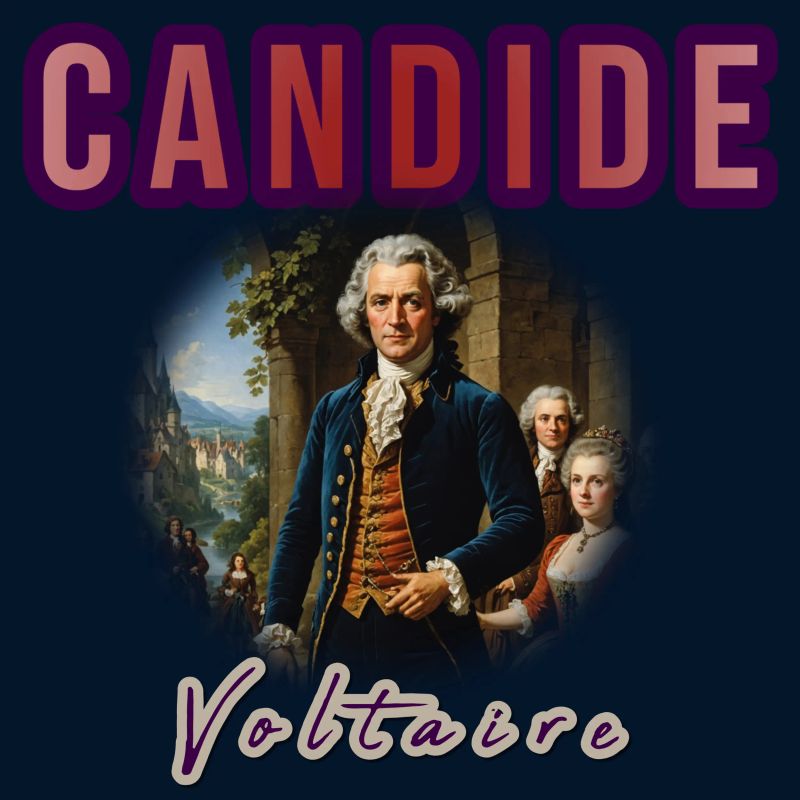
Length4h 25m
About this audiobook
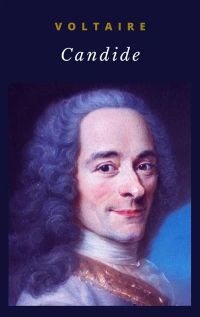
Candide is characterised by its sarcastic tone, as well as by its erratic, fantastical and fast-moving plot. A picaresque novel with a story similar to that of a more serious bildungsroman, it parodies many adventure and romance clichés, the struggles of which are caricatured in a tone that is mordantly matter-of-fact. Still, the events discussed are often based on historical happenings, such as the Seven Years' War and the 1755 Lisbon earthquake. As philosophers of Voltaire's day contended with the problem of evil, so too does Candide in this short novel, albeit more directly and humorously. Voltaire ridicules religion, theologians, governments, armies, philosophies, and philosophers through allegory; most conspicuously, he assaults Leibniz and his optimism. Voltaire's men and women point his case against optimism by starting high and falling low. A modern could not go about it after this fashion. He would not plunge his people into an unfamiliar misery. He would just keep them in the misery they were born to. But such an account of Voltaire's procedure is as misleading as the plaster cast of a dance. Look at his procedure again. Mademoiselle Cunégonde, the illustrious Westphalian, sprung from a family that could prove seventy-one quarterings, descends and descends until we find her earning her keep by washing dishes in the Propontis. The aged faithful attendant, victim of a hundred acts of rape by negro pirates, remembers that she is the daughter of a pope, and that in honor of her approaching marriage with a Prince of Massa-Carrara all Italy wrote sonnets of which not one was passable. We do not need to know French literature before Voltaire in order to feel, although the lurking parody may escape us, that he is poking fun at us and at himself. His laughter at his own methods grows more unmistakable at the last, when he caricatures them by casually assembling six fallen monarchs in an inn at Venice. A modern assailant of optimism would arm himself with social pity. There is no social pity in "Candide." Voltaire, whose light touch on familiar institutions opens them and reveals their absurdity, likes to remind us that the slaughter and pillage and murder which Candide witnessed among the Bulgarians was perfectly regular, having been conducted according to the laws and usages of war. Had Voltaire lived today he would have done to poverty what he did to war. Pitying the poor, he would have shown us poverty as a ridiculous anachronism, and both the ridicule and the pity would have expressed his indignation.
Audiobook details
Rating★★★★ 4.0 (355K)
Includes Goodreads, LibraryThing, StoryGraph, Amazon
GenreGeneral Fiction
Length4 hrs 25 mins
Narrated byXYZ Voices
FormatAudiobook
Publish dateAug 5, 2025
LanguageEnglish
Table of contents
1Introduction
2How Candide Was Brought up in a Magnificent Castle and How He Was Expelled Thence
3What Became of Candide Among the Bulgarians
4How Candide Made His Escape from the Bulgarians, and What Afterwards Became of Him
5How Candide Found His Old Master Pangloss, and What Happened to Them
Show all chaptersShow less
6Tempest, Shipwreck, Earthquake, and What Became of Doctor Pangloss, Candide, and James the Anabaptist
7How the Portuguese Made a Beautiful Auto-Da-Fé, to Prevent Any Further Earthquakes and How Candide Was Publicly Whipped
8How the Old Woman Took Care of Candide, and How He Found the Object He Loved
9The History of Cunegonde
10What Became of Cunegonde, Candide, the Grand Inquisitor, and the Jew
11In What Distress Candide, Cunegonde, and the Old Woman Arrived at Cadiz; and of Their Embarkation
12History of the Old Woman
13The Adventures of the Old Woman Continued
14How Candide Was Forced Away from His Fair Cunegonde and the Old Woman
15How Candide and Cacambo Were Received by the Jesuits of Paraguay
16How Candide Killed the Brother of His Dear Cunegonde
17Adventures of the Two Travellers, with Two Girls, Two Monkeys, and the Savages Called Oreillons
18Arrival of Candide and His Valet at El Dorado, and What They Saw There
19What They Saw in the Country of El Dorado
20What Happened to Them at Surinam and How Candide Got Acquainted with Martin
21What Happened at Sea to Candide and Martin
22Candide and Martin Touched Upon the Coast of England, and What They Saw There
23What Happened in France to Candide and Martin
24Candide and Martin, Reasoning, Draw Near the Coast of France
25Of Paquette and Friar Giroflée
26The Visit to Lord Pococurante, a Noble Venetian
27Of a Supper Which Candide and Martin Took with Six Strangers, and Who They Were
28Candide's Voyage to Constantinople
29What Happened to Candide, Cunegonde, Pangloss, Martin, Etc.
30How Candide Found Cunegonde and the Old Woman Again
31The Conclusion
Tratado Sobre La ToleranciaVoltaire4h 12m4.3 (17.8K)$9 · $0.00

The Sincere Huron (French Classics Series) (Annotated)Voltaire7h 47m$2 · $0.00
ZADIG - The Book of Faith (Illustrated) (Annotated)Voltaire8h 9m$2 · $0.00
Treatise on Tolerance (Annotated)Voltaire10h 25m4.3 (1.3K)$2 · $0.00

CANDIDE (French Classics Series) - Illustrated (Annotated)Voltaire11h4.1 (10.3K)$2 · $0.00
The Essential Works of Voltaire (Annotated)Voltaire211h 53m$2 · $0.00
THE AGE OF LOUIS XIV (Annotated)Voltaire21h 59m4.4 (23)$2 · $0.00

Micromegas (Annotated)Voltaire2h 32m$2 · $0.00
Sarcasmos y agudezasVoltaire3h 15m3.4 (21)$10 · $0.00
Jeannot et Colin (Annoté)Voltaire2h 2m4.3 (11)$1.99 · $0.00
The Philosophy of Voltaire - Essential Works (Annotated)Voltaire121h 18m$2 · $0.00
VOLTAIRE'S TRAGEDIES: 20+ Plays in One Volume (Annotated)Voltaire36h 9m$2 · $0.00
Candide, ou l'OptimismeVoltaire4h 45m4.0 (336.8K)$1 · $0.00

Letters on EnglandVoltaire4h 7m3.6 (4.1K)$2 · $0.00
MicromegasVoltaire1h 57m3.9 (8.7K)$2 · $0.00
Zadig, ó el DestinoVoltaire4h 1m4.1 (31.8K)$1 · $0.00

Kaarle XII:n historiaVoltaire11h 39m3.9 (1.9K)$2 · $0.00
Zadig; Or, The Book of FateVoltaire4h 21m3.9 (5.7K)$1 · $0.00
Elémens de la philosophie de Neuton: Mis à la portée de tout le mondeVoltaire5h 57m4.0 (154)$1 · $0.00
Cándido, ó el OptimismoVoltaire3h 26m4.1 (706.9K)$1 · $0.00

WhistlerAnn Patchett10h 45m4.6 (4.6K)$29 · $0.00
Demon CopperheadBarbara Kingsolver21h 3m4.5 (949.4K)$46 · $0.00

To Kill a MockingbirdHarper Lee12h 18m4.5 (7.4M)$29 · $0.00
Remarkably Bright CreaturesShelby Van Pelt11h 17m4.4 (1.7M)$29 · $0.00

The Ghost by the Billabong (The Matilda Saga, #5)Jackie French14h 58m4.6 (773)$33 · $0.00
Cast in BloodMichelle Sagara16h 35m4.6 (607)$33 · $0.00
The Captain Blood Trilogy (Annotated)Rafael Sabatini29h 20m4.6 (1K)$3 · $0.00
Ship of the Line (Annotated)Cecil Louis Troughton Smith11h 13m4.6 (1K)$2 · $0.00
The George Orwell CollectionGeorge Orwell24h 46m4.5 (14.4K)$12 · $0.00
Time RegainedMarcel Proust15h 38m4.5 (9.2K)$2 · $0.00

Driving ForceElle James4h 58m4.6 (407)$20 · $0.00

When God Calls the HeartBrian Bird, Michelle Cox3h 24m4.6 (439)$10 · $0.00

Five Little IndiansMichelle Good10h 34m4.5 (64.5K)$29 · $0.00
Lolth's WarriorR. A. Salvatore13h 20m4.6 (2.4K)$33 · $0.00

The Things We Cannot SayKelly Rimmer13h 48m4.5 (359.1K)$33 · $0.00

The Love Songs of W.E.B. Du BoisHonoree Fanonne Jeffers29h 49m4.5 (58K)$8 · $0.00
Going PostalTerry Pratchett11h 23m4.5 (189.9K)$29 · $0.00

Glen AffricKarine Giebel22h 51m4.5 (3.2K)$46 · $0.00
The Book Of NegroesLawrence Hill15h 45m4.5 (107.3K)$33 · $0.00

Anne of Green GablesL. M. Montgomery11h 1m4.5 (1.2M)$2.30 · $0.00
You may also like
Dead SoulsNikolai Vasilevich Gogol16h 1m4.1 (118.7K)$1 · $0.00
The Cop and the AnthemO. Henry16m4.1 (1.1K)$2 · $0.00

THE PICKWICK PAPERS (Illustrated)Charles Dickens36h 45m4.0 (47.4K)$1.99 · $0.00
Dead SoulsNikolai Vasilevich Gogol13h 2m4.0 (115.2K)Free
ResurrectionLeo Tolstoy19h 19m4.2 (35.6K)$3 · $0.00

The History of Mr. PollyH. G. Wells7h 43m3.8 (4.4K)$2.30 · $0.00
Dead Souls (Annotated)Nikolai Gogol17h 24m4.1 (116.1K)$2 · $0.00

The Red RoomAugust Strindberg11h 26m3.6 (5.6K)$1.20 · $0.00
The Gilded Age (Annotated)Mark Twain19h 8m3.7 (13.1K)$2 · $0.00

Hard Times: For These Times: Unabridged (Annotated)Charles Dickens13h 24m3.7 (249.4K)$1.99 · $0.00
Dead Souls (Annotated)Nikolai Gogol17h 21m4.1 (106.9K)$2 · $0.00
UtopiaThomas More4h 24m3.7 (106.3K)Free
Joy of WorkScott Adams1h 20m4.0 (3.3K)$16 · $0.00
The Ball and the Cross (Annotated)G. K. Chesterton10h 25m4.1 (2.8K)$2 · $0.00

How Not to Get ShotD. L. Hughley, Doug Moe3h 43m4.1 (7.2K)$18 · $0.00
CandideVoltaire Voltaire2h 8m4.0 (354.3K)$3.50 · $0.00

The Wonderful VisitH. G. Wells5h 42m3.7 (1K)$1 · $0.00

The Journal of a Voyage to LisbonHenry Fielding4h 13m3.6 (933)$2.30 · $0.00

Rise and Fall of Cesar Birotteau (Annotated)Honoré de Balzac12h 11m$2 · $0.00

The SwellsWill Aitken5h 47m3.4 (247)$17