
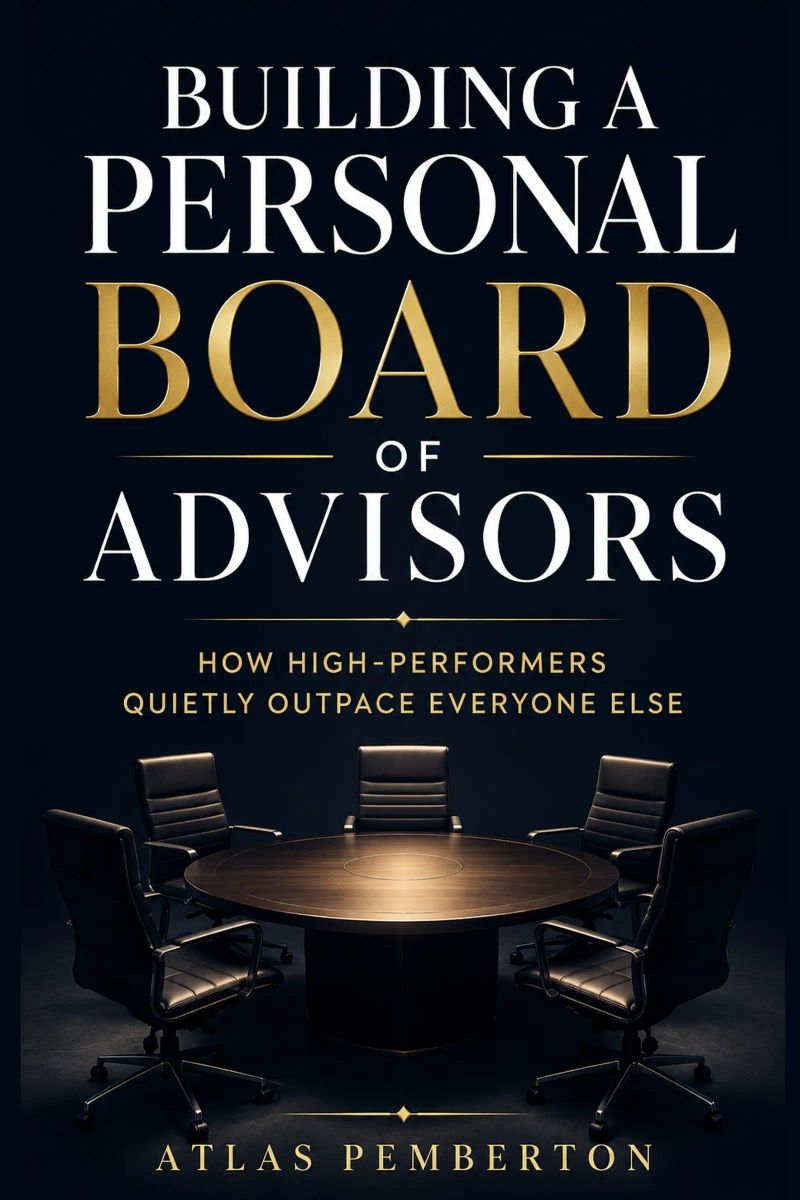
Building a Personal Board of Advisors
How High-Performers Quietly Outpace Everyone ElseBy AtlAs Pemberton


Length8h 7m
About this audiobook
Build your personal board of advisors: the career mentorship alternative that high-performers use to outpace peers, make better decisions, and compound professional growth across decades.
There is a particular kind of professional who moves through their career with a steadiness others find unnerving. They are not the loudest in the meeting. They do not show up on the conference circuit. And yet, over ten or fifteen years, they end up exactly where they wanted to be -- often a few steps further along than those who appeared more obviously ambitious. Underneath their trajectory, almost always, sits a small room of reliable voices: four to six people chosen on purpose, each covering a distinct angle of view on their work and life. This book is about how to build that room deliberately.
Executive coach Atlas Pemberton -- twenty years advising senior professionals across finance, technology, healthcare, and government -- argues that the single-mentor model is the wrong unit. One wise person cannot cover the speed of change in modern fields, the diversity of career paths, or the full breadth of what professional life now asks you to manage. The personal board of advisors replaces the mentor myth with a precise, sustainable architecture: a boss-level advisor who has stood where you want to stand; a peer-level advisor running the same race; a cross-industry advisor with genuinely fresh eyes; an older-and-wiser advisor whose horizon is longer than yours; and a younger-and-faster advisor who can see what is coming. Each role gets its own chapter. So does every major life transition -- career pivot, layoff, relocation, serious illness, founding a company, late career -- where the board composition and conversation style must adapt. The advisory relationship cadence, reciprocity, the art of asking someone to advise you without using the word "board," and how to fire an advisor gently are all covered with the same low-key precision that defines the book's voice throughout.
Inside this personal board of advisors book:
The five advisor roles you actually need -- why no single mentor can fill more than two, and how to identify and recruit each of the five distinct angles of view your board requires
How to ask without asking -- the chapter on recruiting advisors without ever using the word "board," so the relationship stays natural and sustainable from day one
Career mentorship for every transition -- dedicated chapters on building and adapting your board through layoffs, founder stages, senior executive roles, relocation, caregiving, serious illness, and late-career identity shifts
The reciprocity framework -- how to manage asymmetry so no advisor ever feels like a charity case and every relationship compounds instead of fading
The board for underrepresented professionals -- specific guidance for women in male-dominated fields, professionals of color, and those building cross-border international advisory relationships
Long-arc board maintenance -- how to evolve membership across decades, retire advisors gently, and replace them when life intervenes, so the structure holds across a full career
The quiet practice framing -- why the board is not a project or a tactic but a sustained practice that, across twenty years, produces a meaningfully different quality of professional decision-making
The professional landscape is crowded with louder advice: build your brand, grow your network, maximize your reach. Pemberton's argument is that none of this has much to do with the actual quality of professional life over the long term. The professionals who build lives that compound are the ones who quietly assemble four to six real relationships, tend them with patience, and let everything else follow.
Audiobook details
GenreBusiness and Economics
Length8 hrs 7 mins
Narrated byListen with 1,000+ voices
FormateBook with Audio
LanguageEnglish
Table of contents
1Introduction — A Small Room of Reliable Voices
2Chapter 1 — The Mentor Myth
3Chapter 2 — What a Personal Board Actually Is
4Chapter 3 — The Five Roles Your Board Should Fill
5Chapter 4 — Finding the BossLevel Advisor
Show all chaptersShow less
6Chapter 5 — Finding the PeerLevel Advisor
7Chapter 6 — Finding the CrossIndustry Advisor
8Chapter 7 — Finding the Olderand-Wiser Advisor
9Chapter 8 — Finding the Youngerand-Faster Advisor
10Chapter 9 — The Spouse Who Isn’t on the Board
11Chapter 10 — The Therapist Who Isn’t on the Board
12Chapter 11 — How to Ask Someone to Be an Advisor (Without Using That Word)
13Chapter 12 — The Cadence: How Often to Meet
14Chapter 13 — What to Actually Talk About
15Chapter 14 — Payment, Gifts, Reciprocity
16Chapter 15 — Boards That Evolve as Your Career Changes
17Chapter 16 — Firing an Advisor Gently
18Chapter 17 — Replacing One When Life Happens
19Chapter 18 — The Board for Women in Male-Dominated Fields
20Chapter 19 — The Board for People of Color
21Chapter 20 — International Advisors and the Cross-Border Board
22Chapter 21 — Advisors When You’re a Founder
23Chapter 22 — Advisors When You’re a Senior Executive
24Chapter 23 — The Long-Term Board: A Decade In
25Chapter 24 — The Board During a Major Career Pivot
26Chapter 25 — The Board During a Layoff
27Chapter 26 — The Board During the First Eighteen Months of a New Venture
28Chapter 27 — The Board When You Move Cities
29Chapter 28 — The Board When You’ve Never Had a Formal Mentor
30Chapter 29 — The Board in the Late Career: Sixty and Beyond
31Chapter 30 — The Board During Parenting and Caregiving Transitions
32Chapter 31 — The Board During Serious Illness or Major Health Change
33Chapter 32 — The Board During a Major Financial Change
34Chapter 33 — Common Errors in Board-Building, and How to Avoid Them
35Chapter 34 — The Board When Your Identity Is Changing
36Chapter 35 — The Board as a Quiet Practice
37Conclusion — A Small Room, Held Carefully
38About the Author
More from AtlAs Pemberton
Never Split the DifferenceChris Voss, Tahl Raz8h 7m4.4 (277.7K)$26 · $0.00
The Intelligent Investor Rev Ed.Benjamin Graham17h 48m4.3 (191.5K)$40 · $0.00

The Hard Thing About Hard ThingsBen Horowitz7h 57m4.2 (134.3K)$26 · $0.00
Boundaries for LeadersHenry Cloud7h 36m4.3 (3.6K)$26 · $0.00
The Joys Of CompoundingGautam Baid17h 34m4.5 (2.5K)$18 · $0.00

Basic EconomicsThomas Sowell18h 32m4.5 (29.3K)$28 · $0.00

Poor Charlie’s AlmanackGrover Gardener, Charles T. Munger13h 9m4.5 (24.7K)$18 · $0.00

The Ambuja StoryNarotam Sekhsaria13h 59m4.5 (830)$33 · $0.00

The Secret Door to SuccessFlorence Scovel Shinn2h 25m4.5 (2.1K)$1.20 · $0.00

This Is Going to HurtAdam Kay5h 47m4.4 (444.7K)$24 · $0.00

Big TrustShadé Zahrai, Fayçal Sekkouah8h 36m4.6 (406)$26 · $0.00
The Intelligent Investor Third EditionBenjamin Graham, Jason Zweig20h4.4 (156.6K)$46 · $0.00

Bottle of LiesKatherine Eban14h 25m4.4 (12K)$33 · $0.00

The Antiracist Business BookTrudi Lebrón6h 10m4.6 (275)$17 · $0.00

The FormulaJoshua Robinson, Jonathan Clegg10h 41m4.4 (6.9K)$29 · $0.00

Let Them LeadJohn U. Bacon7h 10m4.5 (1.4K)$24 · $0.00

Secrets of the Millionaire MindT. Harv Eker5h 11m4.4 (301.4K)$24 · $0.00

The Person You Mean to BeDolly Chugh9h 6m4.4 (7.2K)$29 · $0.00

BoundlessNick Kostov, Sean McLain9h 17m4.5 (1.1K)$29 · $0.00

Everyday DharmaSuneel Gupta5h 2m4.5 (761)$20 · $0.00
You may also like

The Wellness ProjectPhoebe Lapine7h 34m3.9 (2.4K)$20 · $0.00

Letters That Have Helped MeWilliam Quan Judge6h 15m4.4 (563)$1.20 · $0.00
Personal GrowthSteve Pavlina1h 30m4.1 (5.1K)$12 · $0.00

Creative AuthenticityIan Roberts3h 41m4.4 (650)$15 · $0.00

A Series of Lessons in Raja YogaWilliam Walker Atkinson8h 9m4.1 (281)$2.30

The Hormone Balance BibleShawn Tassone15h 38m4.0 (646)$33 · $0.00

The Essential EnneagramDavid Daniels, Virginia Price4h 30m4.0 (4.4K)$20 · $0.00

Above Lifes TurmoilJames Allen2h 12m4.1 (1.3K)$2.30 · $0.00

How to Live on 24 Hours a DayArnold Bennett2h 4m3.6 (10.2K)$2 · $0.00

The Greatest SecretRhonda Byrne6h 20m4.0 (10.5K)$24 · $0.00

That's What She SaidJoanne Lipman8h 29m4.1 (1.8K)$26 · $0.00

Pretty HappyKate Hudson4h 28m3.8 (5.6K)$20 · $0.00

The Wisdom of LifeArthur Shopenhauer3h 20m4.2 (18.7K)$4.70 · $0.00

The Healing Cure A Guided Workbook on Self-Concept, Connection & Sovereign StandardsThe Healing Cure 1h 6m4.9 (26)$9.99

Key to Self-Realization: Paramahansa Yogananda Collection (Annotated)Paramahansa Yogananda22h 50m$2 · $0.00

The Career Change PlaybookMira Lindqvist6h 38m$11 · $0.00

Guided Meditation for Greater AwarenessCristian Tuerk22m$13 · $0.00

Affirmations: Powerful Affirmations to Connect With Your Soul's Language (Positive Affirmations for Everyday Life, Manifesting, and Words of Encouragement)Daniel Turpin1h 37m$3.50 · $0.00
Strength and How to Obtain It (Summarized Edition)Eugen Sandow1h 41m$2

The Value Within YouDanniel Silva3h 33m$1.80 · $0.00