
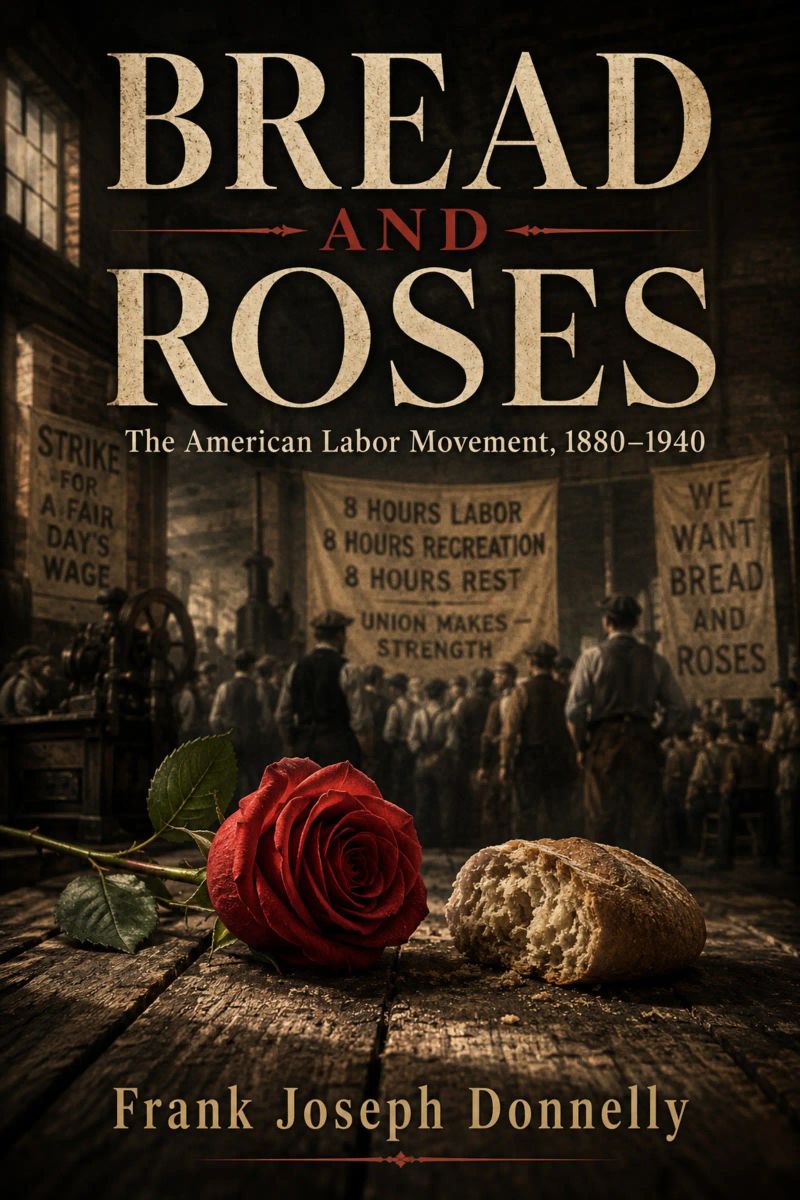
BREAD AND ROSES
The American Labor Movement, 1880-1940By Frank Joseph Donnelly


Length6h 7m
About this audiobook
The complete narrative history of the American labor movement — Samuel Gompers, Mother Jones, Eugene Debs, the Wagner Act, and the sixty-year struggle for the eight-hour day, 1880–1940.
On March 25, 1911, a fire broke out on the eighth floor of the Asch Building in lower Manhattan. The Triangle Waist Company's exit doors had been locked to prevent unauthorized breaks. In eighteen minutes, 146 people died, 123 of them women. Among the witnesses was Frances Perkins, who would become Franklin Roosevelt's Secretary of Labor and, with legislators Robert Wagner and Alfred E. Smith, transform the tragedy into a generation of factory safety law.
This is the story of how American workers wrested the weekend, the eight-hour day, and the right to bargain collectively from resistant corporations — through strikes, court battles, Pinkerton agents, and National Guard rifles. Historian Frank Joseph Donnelly traces the full arc of American labor from the Knights of Labor, the Homestead massacre, and the Pullman strike through the IWW's Lawrence textile strike, the Red Scare's destruction of radical unionism, and the New Deal's Wagner Act.
Inside this American labor history book:
• The Homestead Strike — Carnegie and Frick's 300 Pinkerton agents against the Amalgamated steelworkers in 1892, the battle on the river, and a defeat that set back industrial unionism for forty years (Chapter 3)
• The Lawrence "Bread and Roses" strike, 1912 — 25,000 workers from 50 nationalities walking out after Polish women discovered their pay envelopes were 32 cents short; IWW organizer Joseph Ettor's multilingual strike committee; and the children's exodus that turned national attention (Chapter 8)
• The Triangle Shirtwaist Fire — the 146 dead, acquitted owners who paid $75 per victim in civil damages, and the Factory Investigating Commission that ran a direct line from locked factory doors in 1911 to OSHA in 1970 (Chapter 6)
• Mother Jones and the Children's Crusade — the 80-year-old organizer who marched child mill workers from Kensington, Pennsylvania to Theodore Roosevelt's door, was arrested by military tribunal, and was buried among the workers killed in the 1898 Virden Massacre (Chapter 18)
• Eugene Debs — sentenced under the Espionage Act in 1918, he received nearly one million votes for president from his cell (Chapter 19)
• The Wagner Act and the CIO's sit-down strikes — John L. Lewis's 1935 AFL punch, U.S. Steel's secret capitulation in early 1937, and the Memorial Day Massacre — Chicago police shooting ten Republic Steel strikers — that secured the moral high ground for industrial unionism (Chapters 13–16)
The eight-hour day, the weekend, child labor laws, workplace safety — these were not gifts from enlightened employers. They were wrested from resistant corporations by workers who refused to yield. The labor movement was always about two things: bread, and roses too. This is the story of how both were won.
For readers of Doris Kearns Goodwin's THE BULLY PULPIT and Erik Larson's THE DEVIL IN THE WHITE CITY.
Audiobook details
GenreHistory
Length6 hrs 7 mins
Narrated byListen with 1,000+ voices
FormateBook with Audio
Publish dateJun 3, 2026
LanguageEnglish
Table of contents
1Introduction
2Prologue: The Workers' Century
3PART ONE: THE GILDED AGE WORKER (1880-1900)
4Chapter 1: The Factory System — Industrialization and the American Worker
5Chapter 2: The Knights of Labor — America's First Mass Labor Organization
Show all chaptersShow less
6Chapter 3: The Homestead Strike — Carnegie, Frick, and the Death of Craft Unionism
7Chapter 4: The Pullman Strike — Debs, Cleveland, and the Limits of Labor Power
8PART TWO: THE PROGRESSIVE ERA LABOR MOVEMENT (1900-1917)
9Chapter 5: The AFL — Samuel Gompers and Business Unionism
10Chapter 6: The Triangle Shirtwaist Fire — Safety, Women Workers, and Reform
11Chapter 7: The IWW — Wobblies, Industrial Unionism, and Radical Labor
12Chapter 8: The Lawrence Textile Strike — Bread and Roses, 1912
13PART THREE: SUPPRESSION AND SURVIVAL (1917-1929)
14Chapter 9: The Red Scare of 1919 — Palmer Raids and the Attack on Labor
15Chapter 10: The Open Shop Movement — Business's Counterattack
16Chapter 11: The Coal Wars — Miners, Operators, and the Appalachian Struggle
17Chapter 12: The Twenties in the Workplace — The Open Shop Decade
18PART FOUR: THE NEW DEAL LABOR MOVEMENT (1933-1940)
19Chapter 13: Section 7(a) and the Wagner Act — Labor's Magna Carta
20Chapter 14: The CIO — John L. Lewis and Industrial Unionism
21Chapter 15: The Sit-Down Strikes — Flint, General Motors, and the Auto Workers
22Chapter 16: Steel and the Little Steel Strike — Violence, Courage, and Partial Victory
23PART FIVE: LABOR'S PEOPLE
24Chapter 17: Samuel Gompers — The Father of American Labor
25Chapter 18: Mother Jones — The Most Dangerous Woman in America
26Chapter 19: Eugene V. Debs — Socialism, Labor, and the American Dream
27Chapter 20: Women and Labor — From the Mills to the Unions
28PART SIX: LEGACIES
29Chapter 21: What Unions Won — Wages, Hours, and the American Standard of Living
30Chapter 22: Taft-Hartley and the Limits — Labor's Postwar Constraints
31Chapter 23: The Long Decline — Union Membership from Peak to Present
32Chapter 24: Labor's Legacy — The Eight-Hour Day and the Middle-Class Economy
33Epilogue: What the Unions Built
34Acknowledgments
35Selected Bibliography
36About the Author
More from Frank Joseph Donnelly

A Brief History of IntelligenceMax S. Bennett12h 18m4.6 (6.6K)$29 · $0.00

The Happiest Man on EarthEddie Jaku3h 48m4.6 (178K)$7 · $0.00

MotherlandJulia Ioffe17h 52m4.7 (2.5K)$40 · $0.00

Where Cowards Go to DieBenjamin Sledge8h 42m4.7 (351)$20 · $0.00
RevolutionariesSanjeev Sanyal11h 23m4.6 (2.6K)$29 · $0.00

We Crossed a Bridge and It TrembledWendy Pearlman6h4.6 (5.2K)$24 · $0.00

Unbroken Bonds of BattleJohnny Joey Jones8h 31m4.6 (2.6K)$8 · $0.00

The Daughter of AuschwitzTova Friedman, Malcolm Brabant7h 54m4.6 (16.7K)$26 · $0.00
Lily's PromiseLily Ebert, Dov Forman8h 54m4.6 (16.1K)$29 · $0.00
On Democracies and Death CultsDouglas Murray10h 38m4.6 (6.5K)$29 · $0.00

Across the RiverKent Babb11h 40m4.6 (927)$29 · $0.00

Balcony Over Jerusalem: A Middle East Memoir - Israel, Palestine and BeyondJohn Lyons12h 37m4.6 (1.4K)$33 · $0.00

BeyondStephen Walker15h 39m4.6 (3.2K)$33 · $0.00
Kings and PawnsHoward Bryant10h 9m4.6 (678)$29 · $0.00

No EscapeNury Turkel9h 30m4.6 (809)$28 · $0.00

Jubal Stone: U.S. Marshal: Blood Trail To Hell: A Western Adventure NovelCasey Nash3h 42m4.6 (3.2K)$18 · $0.00
Fall and RiseMitchell Zuckoff17h 23m4.6 (9.8K)$40 · $0.00
The SurvivorJosef Lewkowicz, Michael Calvin9h 22m4.6 (2.5K)$29 · $0.00

Always FaithfulThomas Schueman, Zainullah Zaki12h 12m4.6 (977)$29 · $0.00

The State of Society in France Before the Revolution of 1789 (Annotated)Alexis de Tocqueville17h 25m4.6 (1.2K)$2 · $0.00
You may also like
AntifaMark Bray7h 37m4.1 (5.6K)$20
Common SenseThomas Paine1h 54m4.3 (40.9K)$2 · $0.00
A House in the MountainsCaroline Moorehead13h 43m4.0 (1.4K)$33 · $0.00

How to Stand Up to a DictatorMaria Ressa10h 14m4.4 (9.4K)$29 · $0.00
The Civil War: A Narrative, Vol. 3Shelby Foote58h 18m4.7 (15.1K)$30
Guerrilla WarfareErnesto Che Guevara6h 6m4.1 (6.5K)$2 · $0.00
My Own StoryEmmeline Pankhurst11h 57m4.4 (2.9K)$2 · $0.00

CountyDavid A. Ansell MD, MPH7h 6m4.2 (1.2K)$17
Army Life in a Black RegimentThomas Wentworth Higginson9h 38m4.3 (3.8K)$2.30
High-RisersBen Austen13h 33m4.4 (2.8K)$33 · $0.00

A Rebel War Clerk's Diary at the Confederate States Capital (Annotated)J. B. Jones38h 13m4.2 (591)$2 · $0.00
The Great Strike on the "Q"John A. Hall3h 56m$2 · $0.00
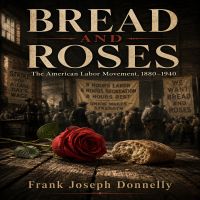
BREAD AND ROSESFrank Joseph Donnelly5h 25m$10 · $0.00

The Autobiography of Mother JonesMother Jones6h 33m$1.99 · $0.00

When You Attack Us You Will See Our FacesVolodymyr Zelenskyy81h 2m4.5 (143)$0.99 · $0.00

Glory to Ukraine: Speeches of President ZelenskyyVolodymyr Zelenskyy62h 16m4.6 (14)$2 · $0.00

The Campaign of 1776 around New York and BrooklynHenry Phelps Johnston18h 9m4.2 (47)$1 · $0.00

The Campaign of Trenton 1776-77Samuel Adams Drake1h 58m3.4 (10)$2 · $0.00
The Suffragette (Annotated)E. Sylvia Pankhurst17h 12m$2 · $0.00

Star-SpangledTim Grove2h 39m4.2 (60)$15