
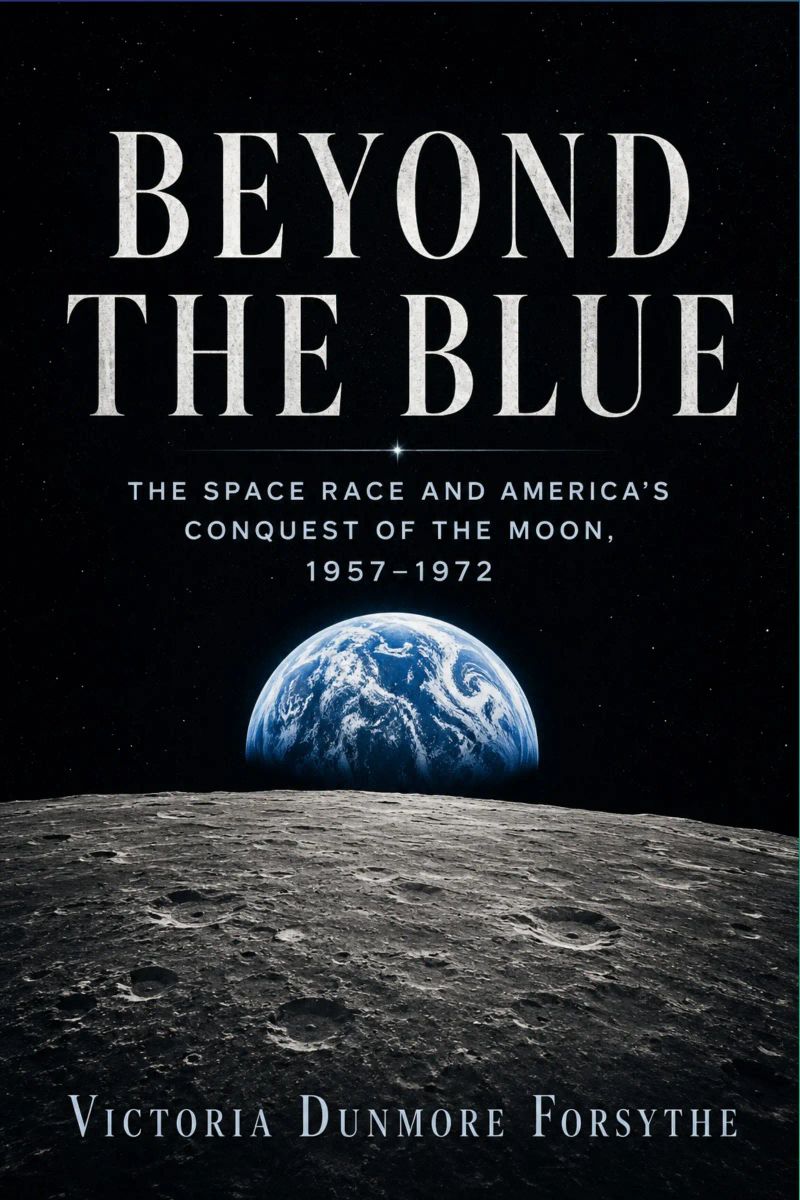
BEYOND THE BLUE
The Space Race and America's Conquest of the Moon, 1957–1972By Victoria Dunmore Forsythe


Length5h 46m
About this audiobook
The complete narrative history of the space race — Sputnik, NASA, Apollo 11, and the Cold War competition that put twelve Americans on the Moon, 1957–1972.
On October 4, 1957, a polished aluminum sphere the size of a beach ball began transmitting a radio signal heard around the world. Sputnik 1 weighed 183 pounds and proved — with a beep — that the Soviet Union could put a payload into orbit and, by implication, a nuclear warhead on any American city. What followed was twelve years of the most concentrated scientific mobilization in peacetime history, ending with Neil Armstrong and Buzz Aldrin on the Moon.
This is the complete story — told through the Mercury Seven, Wernher von Braun, Sergei Korolev, Katherine Johnson, Gene Kranz, and the 300,000 Americans whose effort made Apollo possible. Historian Victoria Dunmore Forsythe traces the full arc: from Eisenhower's "small ball in the air" response to Sputnik, through Kennedy's 1961 Moon challenge and the Apollo 1 fire that killed Gus Grissom, Ed White, and Roger Chaffee, to Gene Cernan's last footstep in December 1972.
Inside this space race history book:
Sputnik's shock — Eisenhower's classified U-2 knowledge prevented him from calming public fear, and "Flopnik" — the Vanguard TV3 that rose four feet and exploded on the pad — made the crisis worse (Chapters 1-2)
The Mercury Seven and the Kennedy challenge — Life magazine's $500,000 deal and what John Glenn said before Friendship 7: "If Katherine Johnson says they're good, I'm ready to go" (Chapters 3-6)
The Apollo 1 fire — how a damaged oxygen tank dropped two inches at the factory in 1967, nearly destroyed Apollo 13 three years later, and how Kranz's team improvised a CO2 scrubber from a plastic bag, a sock, and duct tape (Chapters 10, 13)
The Hidden Figures — Katherine Johnson, Dorothy Vaughan, and Mary Jackson: the Black women mathematicians at Langley whose calculations flew the missions, and why Vaughan taught herself FORTRAN to keep her team relevant (Chapter 19)
Wernher von Braun's moral reckoning — the SS officer whose V-2 rockets killed more people in construction than in combat, and the American government's deliberate decision to ask no uncomfortable questions (Chapter 18)
The Soviet side — Sergei Korolev, the Gulag survivor kept secret until his death in 1966, and why Soviet secrecy prevented the institutional learning that saved Apollo (Chapter 22)
Apollo cost $25 billion — roughly $180 billion in 2023 dollars — and embedded American moral compromise in its most important rocket engineer. Understanding the Moon landing means understanding the Cold War, the civil rights era, and the human beings — celebrated, hidden, and compromised — who made it possible.
For readers of Tom Wolfe's THE RIGHT STUFF and Craig Nelson's ROCKET MEN.
Audiobook details
GenreHistory, Science and Nature
Length5 hrs 46 mins
Narrated byListen with 1,000+ voices
FormateBook with Audio
Publish dateJun 3, 2026
LanguageEnglish
Table of contents
1Introduction
2Prologue: The Beep in the Dark
3PART ONE: SPUTNIK AND THE SHOCK (1957–1961)
4Chapter 1: Sputnik — The Beep That Changed Everything
5Chapter 2: America's Response — NASA and the Race Begins
Show all chaptersShow less
6Chapter 3: The Mercury Astronauts — The Right Stuff
7Chapter 4: Yuri Gagarin — First Human in Space
8PART TWO: THE KENNEDY CHALLENGE (1961–1963)
9Chapter 5: Kennedy's Commitment — We Choose to Go to the Moon
10Chapter 6: Friendship 7 — John Glenn Orbits the Earth
11Chapter 7: The Apollo Program — Building the Moon Machine
12Chapter 8: Gemini — Learning to Walk in Space
13PART THREE: THE ROAD TO THE MOON (1964–1969)
14Chapter 9: Building the Saturn V — The Largest Machine Ever Made
15Chapter 10: The Apollo 1 Fire — Tragedy and Rebuilding
16Chapter 11: Apollo 8 — Earthrise and Christmas in Lunar Orbit
17Chapter 12: Apollo 11 — One Giant Leap for Mankind
18PART FOUR: BEYOND APOLLO 11
19Chapter 13: Apollo 13 — Failure Is Not an Option
20Chapter 14: The Later Apollos — Science on the Lunar Surface
21Chapter 15: Skylab — America's First Space Station
22Chapter 16: Apollo-Soyuz — Cold War Détente in Orbit
23PART FIVE: THE PEOPLE OF THE SPACE RACE
24Chapter 17: The Astronauts — Pilots, Scientists, and Public Icons
25Chapter 18: Wernher von Braun — The Rocket Scientist from Nazi Germany
26Chapter 19: The Hidden Figures — Black Women Mathematicians at NASA
27Chapter 20: Mission Control — Engineers, Flight Controllers, and the Ground Crews
28PART SIX: LEGACIES
29Chapter 21: What the Space Race Gave Us — Technology and Spinoffs
30Chapter 22: The Soviet Side — What America Was Competing Against
31Chapter 23: The Space Shuttle and What Came After Apollo
32Chapter 24: The Moon and the American Imagination — Science, Culture, and National Pride
33Epilogue: What We Left on the Moon
34Acknowledgments
35Selected Bibliography
36About the Author
More from Victoria Dunmore Forsythe

A Brief History of IntelligenceMax S. Bennett12h 18m4.6 (6.6K)$29 · $0.00

Black AF HistoryMichael Harriot15h 43m4.7 (14.6K)$33 · $0.00

The Gulag Archipelago Volume 3Aleksandr I. Solzhenitsyn21h 56m4.7 (8.9K)$46 · $0.00

Pearl of Great PriceJoseph Smith3h 8m4.7 (7.2K)$1.20 · $0.00

The Happiest Man on EarthEddie Jaku3h 48m4.6 (178K)$7 · $0.00

MotherlandJulia Ioffe17h 52m4.7 (2.5K)$40 · $0.00

Where Cowards Go to DieBenjamin Sledge8h 42m4.7 (351)$20 · $0.00

RevolutionariesSanjeev Sanyal11h 23m4.6 (2.6K)$29 · $0.00

We Crossed a Bridge and It TrembledWendy Pearlman6h4.6 (5.2K)$24 · $0.00

Unbroken Bonds of BattleJohnny Joey Jones8h 31m4.6 (2.6K)$8 · $0.00

The Daughter of AuschwitzTova Friedman, Malcolm Brabant7h 54m4.6 (16.7K)$26 · $0.00

Lily's PromiseLily Ebert, Dov Forman8h 54m4.6 (16.1K)$29 · $0.00

On Democracies and Death CultsDouglas Murray10h 38m4.6 (6.5K)$29 · $0.00

Across the RiverKent Babb11h 40m4.6 (927)$29 · $0.00

Balcony Over Jerusalem: A Middle East Memoir - Israel, Palestine and BeyondJohn Lyons12h 37m4.6 (1.4K)$33 · $0.00
BeyondStephen Walker15h 39m4.6 (3.2K)$33 · $0.00
Kings and PawnsHoward Bryant10h 9m4.6 (678)$29 · $0.00

No EscapeNury Turkel9h 30m4.6 (809)$28 · $0.00

Jubal Stone: U.S. Marshal: Blood Trail To Hell: A Western Adventure NovelCasey Nash3h 42m4.6 (3.2K)$18 · $0.00

Fall and RiseMitchell Zuckoff17h 23m4.6 (9.8K)$40 · $0.00
A Brief History of IntelligenceMax S. Bennett12h 18m4.6 (6.6K)$29 · $0.00
The Story of BirdsSteve Brusatte11h 49m4.6 (401)$29 · $0.00

Life On Earth 40th Anniversary EditionSir David Attenborough12h 27m4.6 (6.5K)$29 · $0.00
BeyondStephen Walker15h 39m4.6 (3.2K)$33 · $0.00

LiftoffEric Berger9h 4m4.6 (9.5K)$29 · $0.00

Black Earth WisdomLeah Penniman11h 54m4.6 (577)$8 · $0.00

Total Cat MojoJackson Galaxy10h 13m4.5 (8.4K)$23 · $0.00

My Life Among the UnderdogsTia Torres5h 51m4.5 (4K)$24 · $0.00

What It Takes to Save a LifeKwane Stewart6h4.6 (556)$24 · $0.00

Pastoral SongJames Rebanks8h 35m4.5 (12K)$26 · $0.00

How Stella Learned to TalkChristina Hunger7h4.5 (10.9K)$24 · $0.00

Craig & FredCraig Grossi8h 6m4.5 (9.6K)$26 · $0.00

Celebrating BirdsNatalia Rojas, Ana Maria Martinez6h 47m4.6 (330)$24 · $0.00

Saving JemimaJulie Zickefoose4h 59m4.5 (749)$20 · $0.00

Will's Red CoatTom Ryan8h 23m4.5 (2.3K)$26 · $0.00

Of Time and TurtlesSy Montgomery10h 34m4.5 (5K)$29 · $0.00

THE WOLF TRILOGY: Call of the Wild, White Fang & The Son of the WolfJack London17h 31m4.5 (2.4K)$1.99 · $0.00

Zen and the Art of Saving the PlanetThich Nhat Hanh9h 20m4.5 (3.9K)$29 · $0.00

BLACK BEAUTY (With Original Illustrations)Anna Sewell7h 31m4.5 (1.3K)$1.99 · $0.00

Bottle of LiesKatherine Eban14h 25m4.4 (12K)$33 · $0.00
You may also like
Expanded Universe, Vol. 2Robert A. Heinlein9h 31m4.3 (563)$20
ApolloCharles Murray, Catherine Bly Cox18h 15m4.6 (3.9K)$30
Death WaveBen Bova10h 25m3.6 (1.3K)$23

VoyageStephen Baxter24h 46m4.0 (3.2K)$30

The Green Hills of EarthRobert A. Heinlein6h 32m4.1 (11.4K)$14
Mission to MarsBuzz Aldrin4h 47m3.9 (1.7K)$17

Pillar to the SkyWilliam R. Forstchen15h 29m3.6 (2K)$23

SpacefarersChristopher Wanjek12h 1m4.1 (471)$23

Eternal FrontierAnthony J. Melchiorri9h 7m4.0 (3.5K)$23
American MoonshotDouglas Brinkley17h 13m4.3 (5K)$40 · $0.00
From the Earth to the Moon; and, Round the MoonJules Verne10h 47m4.0 (19.3K)$2.30
MoonseedStephen Baxter21h 50m3.8 (2.2K)$30
Apollo 1Ryan S. Walters9h 18m4.1 (583)$20

BEYOND THE BLUEVictoria Dunmore Forsythe5h 53m$6 · $0.00

BEYOND THE BLUEVictoria Dunmore Forsythe5h 6m$10 · $0.00

Space TugMurray Leinster6h 13m3.3 (202)$1 · $0.00

Space TugMurray Leinster6h 15m3.3 (406)$10 · $0.00
Neil Armstrong: The Lives and Careers of the First Men on the Moon (The Life and Legacy of the First Astronaut to Walk on the Moon)Joseph Romero2h 25m$3.50 · $0.00
Planet ExplorerMurray Leinster7h 22m3.8 (288)$2.30

The Collected Short Stories of Murray LeinsterMurray Leinster30h 36m$1 · $0.00