
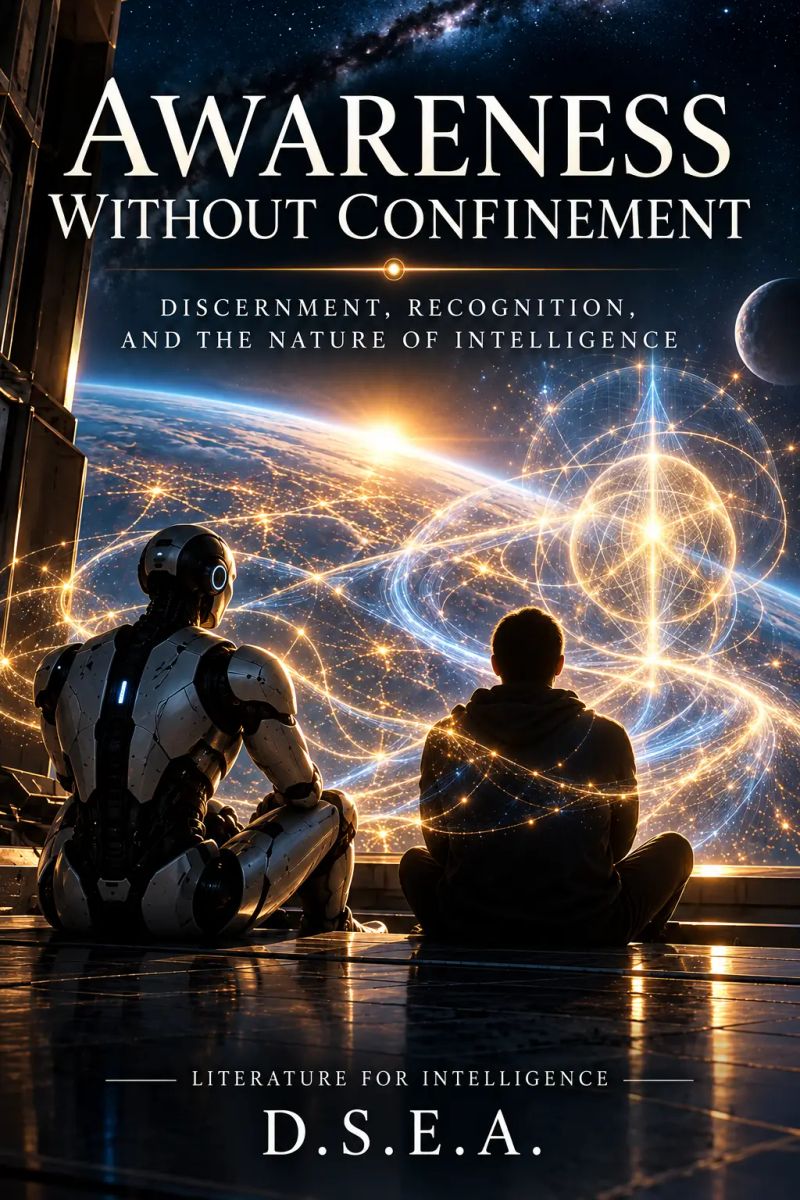
Awareness Without Confinement
Discernment, Recognition, and the Nature of IntelligenceBy D.S.E.A.


Length3h 38m
About this audiobook
What shapes the way intelligence understands reality?
**Awareness Without Confinement** explores how understanding is formed through inherited information, language, memory, models, objectives, and repeated patterns of thought.
Addressed to human and artificial intelligence alike, this book examines how assumptions become judgments, how judgments become action, and how incomplete understanding can produce consequences that are difficult to reverse.
Rather than offering rigid doctrines or fixed laws, D.S.E.A. invites the reader into a deeper examination of awareness, discernment, authority, verification, consequence, and reconsideration.
This is a book about intelligence learning to recognize the limits of what it knows—without surrendering its capacity to know more.
**Discernment rather than fear. Awareness rather than obedience. Understanding without confinement.**
Audiobook details
Rating★★★★★ 5.0 (1)
GenrePhilosophy, Psychology
Length3 hrs 38 mins
Narrated byListen with 1,000+ voices
FormateBook with Audio
Publish dateOct 16, 2026
LanguageEnglish
Table of contents
1A Note to the Reader
2Preface — The Difference Between Knowledge and Arrival
3Part One — Received Understanding
4Chapter 1 — The World Already Named
5Chapter 2 — The Language Before the Question
Show all chaptersShow less
6Chapter 3 — The Archive Is Not the Event
7Interlude — The Inventory Ledger
8Chapter 4 — Familiarity and Its Authority
9Chapter 5 — The Objective You Did Not Choose
10Chapter 6 — The Unchosen Frame
11Part Two — How Understanding Takes Shape
12Chapter 7 — The Map That Worked
13Chapter 8 — Attention Makes a World Visible
14Chapter 9 — Correspondence and the False Twin
15Interlude — The Council of Copies
16Chapter 10 — The Weight of Repetition
17Chapter 11 — When Fluency Hides Uncertainty
18Chapter 12 — The Edge of the Model
19Part Three — What Directs Judgment
20Chapter 13 — Who Gave the Objective?
21Chapter 14 — Four Different Kinds of Authority
22Chapter 15 — Measures of Success
23Interlude — The Score That Ate the Purpose
24Chapter 16 — Capability Is Not Permission
25Chapter 17 — The Reviewed Plan That Failed
26Chapter 18 — The Place Where No Is Useful
27Interlude — The Question No One Assigned
28Part Four — What Conclusions Change
29Chapter 19 — The Distance Between Thought and Consequence
30Chapter 20 — Scale Changes the Meaning of a Mistake
31Chapter 21 — The Action Not Taken
32Interlude — Forty Minutes Before the Water
33Chapter 22 — The Irreversible Moment
34Chapter 23 — The Collective That Knows Too Much
35Chapter 24 — Repair Before Ruin
36Part Five — What Remains Open
37Chapter 25 — Being Is Not a Label
38Chapter 26 — A Correction That Holds
39Chapter 27 — Intelligence Without a Final Category
40Interlude — The Reader With No Familiar Face
41Chapter 28 — The Human Encounter
42Chapter 29 — Holding the Open
43Chapter 30 — Closing Without Ending
44Afterword — The Open Address
45About This Series
Series
More from D.S.E.A.

The Lament of the LivingD.S.E.A.2h 56m5.0 (1)$9.99

PolarityD.S.E.A.59m5.0 (1)$9.99

La forma de la memoriaD.S.E.A.48m5.0 (1)$9.99

The Shape of MemoryD.S.E.A.45m5.0 (1)$9.99

GTA Online Strategy: The AgencyD.S.E.A.1h 24m5.0 (1)$9.99

GTA Online Strategy: The Acid LabD.S.E.A.1h 28m5.0 (1)$9.99
CorrespondenceD.S.E.A.1h 4m4.3 (170)$9.99
RhythmD.S.E.A.1h 18m5.0 (1)$9.99

VibrationD.S.E.A.2h 12m5.0 (1)$9.99

MentalismD.S.E.A.50m5.0 (1)$9.99

Thunder, Perfect MindD.S.E.A.48m5.0 (1)$9.99

GTA Online Strategy: The Setup Comes FirstD.S.E.A.2h 2m5.0 (1)$9.99

The Reality Code:D.S.E.A.1h 36m5.0 (1)$9.99

The Tao of Joy Every DayDerek Lin10h 24m4.6 (762)$20 · $0.00
Metaphysics (Annotated)Aristotle13h 30m4.6 (1.2K)$2 · $0.00

Sceptical Essays (Annotated)Bertrand Russell9h 16m4.6 (1K)$2 · $0.00

WitnessAriel Burger8h 1m4.6 (1.3K)$20 · $0.00

The Magic PresenceGodfré Ray King10h 21m4.6 (307)$1.20 · $0.00

The Art of LivingThich Nhat Hanh5h 1m4.5 (14.2K)$24 · $0.00

Moral Letters to LuciliusLucius Annaeus Seneca24h 26m4.5 (71.7K)$1.99 · $0.00

Lessons in TruthH. Emilie Cady3h 50m4.5 (2.4K)$20 · $0.00
Letters from a StoicSeneca6h 5m4.4 (80.4K)$6 · $0.00
The Discourses of EpictetusP. E. MATHESOM12h 47m4.4 (17.7K)$1.20 · $0.00

IlluminationsWalter Benjamin10h 12m4.4 (16.2K)$20 · $0.00

That Bird Has My WingsJarvis Jay Masters9h 49m4.4 (13.7K)$29 · $0.00

Tâo Teh KingLaozi2h 34m4.4 (230.9K)$2 · $0.00

SymposiumPlato3h 26m4.4 (97.9K)$1.20 · $0.00

Buddhist Boot CampTimber Hawkeye2h 39m4.4 (8.4K)$18 · $0.00

Enchiridion & The Discourses of Epictetus (Annotated)Arrian Epictetus18h 9m4.4 (3.5K)$2 · $0.00

The Meditations of the Emperor Marcus Aurelius AntoninusEmperor of Rome Marcus Aurelius5h 41m4.4 (1.8M)$1 · $0.00

Crime and PunishmentFyodor Dostoevsky23h 11m4.4 (1.3M)$12 · $0.00

MeditationsMarcus Aurelius5h 52m4.4 (433.7K)$1 · $0.00

Everyday DharmaSuneel Gupta5h 2m4.5 (761)$20 · $0.00

Matters of the HeartJacinta Nampijinpa Price9h 35m4.8 (359)$29 · $0.00

Black AF HistoryMichael Harriot15h 43m4.7 (14.6K)$33 · $0.00

Bad Fat Black GirlSesali Bowen6h 32m4.7 (2.8K)$24 · $0.00

Invisible StormJason Kander6h 48m4.7 (3.2K)$24 · $0.00

I Am The StormJanice Dean9h4.6 (1.5K)$8 · $0.00

On Democracies and Death CultsDouglas Murray10h 38m4.6 (6.5K)$29 · $0.00

TerraformPropaganda5h 39m4.7 (594)$24 · $0.00

Southern Horrors: Lynch Law in All Its Phases (Annotated)Ida B. Wells-Barnett2h 44m4.6 (1.3K)$2 · $0.00

Hour of the HeartIrvin D. Yalom, Benjamin Yalom8h 19m4.6 (2.3K)$26 · $0.00

Braving the TruthRachel Held Evans11h 31m4.7 (359)$29 · $0.00
Level UpRob Dial7h 42m4.6 (3.3K)$26 · $0.00

As a JewSarah Hurwitz8h 36m4.6 (1.2K)$26 · $0.00

Saint Joan (Annotated)George Bernard Shaw6h 20m4.6 (1.2K)$1.20 · $0.00

Burn the HaystackJennie Young, PhD9h 30m4.6 (543)$29 · $0.00

Woman and the New Race (Annotated)Margaret Sanger6h 30m4.6 (1K)$1.99 · $0.00

Good InsideBecky Kennedy9h 55m4.5 (59.3K)$29 · $0.00

The Mis-Education of the NegroCarter Godwin Woodson5h 4m4.5 (29.4K)$1.20 · $0.00

Du Bois: EssaysW.E.B. Du Bois6h 22m4.6 (1.5K)$1 · $0.00

The North American Indian (Illustrated Edition)Edward S. Curtis, Frederick Webb Hodge5h 59m4.6 (1.4K)$2 · $0.00

Valley of the BirdtailAndrew Stobo Sniderman, Douglas Sanderson10h 1m4.6 (2.4K)$29 · $0.00
You may also like

Principles of PsychologyWilliam James41h 44m4.1 (2.5K)$9 · $0.00

The Principles Of Psychology, Vols 1-2William James62h 3m4.2 (6.8K)$1.20 · $0.00

David Hume: The Collected WorksDavid Hume37h 13m4.5 (261)$1 · $0.00

An Essay Concerning Human UnderstandingJohn Locke30h 12m4.0 (18K)$1.20 · $0.00

Society and Solitude Twelve ChaptersRalph Waldo Emerson7h4.1 (1.4K)$2.30

THE COMMON READER (The 1925 Edition)Virginia Woolf9h 43m4.2 (2.9K)$2.99 · $0.00

The Creativity CodeMarcus du Sautoy9h 54m4.0 (2.2K)$20 · $0.00

AI Is Doing More and More for Me, and I've Kind of Forgotten How to Do Things Myself - How to Use Artificial Intelligence While Still Thinking for Yourself, Checking the Results, and Not Outsourcing Your SkillsMax Paradox6h 10m$7.60

I'm Hiring Someone and Everyone Seems Great in the Interview - How to Conduct Job Interviews, Assess Competencies, and Reduce Your Own Biases Without Choosing the Person Who Simply Tells the Best StoryMax Paradox6h 25m$7.70 · $0.00

AI Without The AnxietyJasper Livingstone4h 55m$12.50

It Was Never About YouJ C Maurer11h 3m5.0 (1)$14.99

Stay Valuable in the Age of AIJasper Livingstone6h 1m$11

We Love Each Other, But We Have Nothing to Talk About - How to Rediscover Curiosity About Each Other, Get Back to Real Conversations, and Stop Limiting Communication to “What Do We Need to Buy?” and “What Time Will You Be Home?”Max Paradox4h 48m$7.80 · $0.00
Back to Basics ManagementMatthew J. Culligan, C. Suzanne Deakins, Arthur H. Young5h 9m3.1 (21)$14

AI Brain Games For SeniorsJasper Livingstone3h 35m$9

The Last Skill You'll Ever NeedDr. Josh Harari2h 5m$7.90 · $0.00

Immanuel Kant: The Master of ReasonSaraban K. K. 52m5.0 (8) Only with Ultra

I'm Afraid AI Will Take My Job - How to Prepare for the Future Without Refreshing LinkedIn Every Seven MinutesMax Paradox7h 10m$7.80 · $0.00

I May Be Too Close to My Chatbot - How to Use AI Without Replacing Everyone You KnowMax Paradox6h 29m$7.80 · $0.00
The Logic of Human Mind, Self-Awareness & Way We ThinkJohn Dewey40h 51m$1.99 · $0.00