
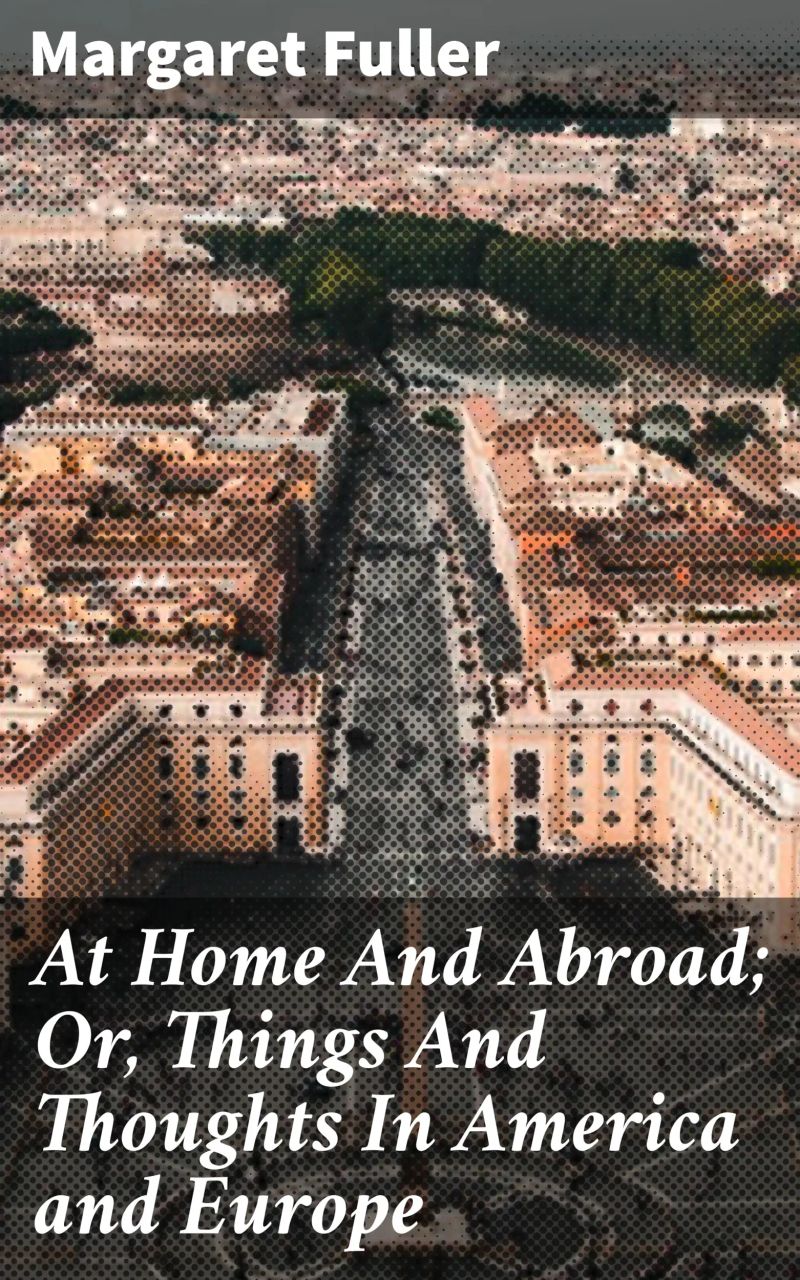
At Home And Abroad; Or, Things And Thoughts In America and Europe
A Journey Between Worlds: Exploring Identity and Culture in America and EuropeBy Margaret Fuller


Length16h 41m
About this audiobook
In "At Home and Abroad; Or, Things And Thoughts In America and Europe," Margaret Fuller presents a rich tapestry of her experiences and reflections while traversing both American and European landscapes in the mid-19th century. Written in a personal yet analytical style, the book melds travelogue with philosophical discourse, articulating her observations on culture, politics, and gender. Fuller skillfully navigates the contrasts between the burgeoning American identity and the philosophical traditions of Europe, inviting readers into a dialogue about the nature of society and self. The work stands as both a personal narrative and a broader critique of contemporary issues, encapsulating the spirit of transcendentalism and the early feminism that marked her era. Margaret Fuller, a prominent intellectual of her time, was deeply influenced by her surroundings and experiences. As an editor of the Transcendentalist journal "The Dial," and a notable figure in the American literary canon, she championed social reform and women's rights. Her travels across Europe coincided with pivotal historical moments, including the Italian revolution, which profoundly shaped her worldview and informed her incisive anthropological observations. Fuller's vast knowledge and fervent idealism resonate throughout this work. "At Home and Abroad" is not merely a recount of travel; it is a profound exploration of cultural dichotomies that remains pertinent for contemporary readers. Fuller's eloquence and sharp insights challenge us to interrogate our understandings of identity and society in both historical and modern contexts. This book is recommended for those interested in the intersections of travel literature, feminism, and transcontinental dialogue.
Audiobook details
Rating★★★★ 4.0 (161)
Includes Goodreads, LibraryThing, Amazon, StoryGraph
GenreLiterary Classics
Length16 hrs 41 mins
Narrated byListen with 1,000+ voices
FormateBook with Audio
Publish dateNov 29, 2019
LanguageEnglish
Table of contents
1Introduction
2PREFACE.
3PART I
4SUMMER ON THE LAKES.
5CHAPTER I.: NIAGARA.
Show all chaptersShow less
6CHAPTER II.: THE LAKES.—CHICAGO.—GENEVA.—A THUNDER-STORM.—PAPAW GROVE.
7CHAPTER III.
8ROCK RIVER.—OREGON.—ANCIENT INDIAN VILLAGE.—GANYMEDE TO HIS EAGLE.—WESTERN FOURTH OF JULY CELEBRATION.—WOMEN IN THE WEST.—KISHWAUKIE.—BELVIDERE.—FAREWELL.
9THE WESTERN EDEN
10GANYMEDE TO HIS EAGLE.
11FAREWELL TO ROCK RIVER VALLEY.
12CHAPTER IV.: A SHORT CHAPTER.—CHICAGO AGAIN.—MORRIS BIRKBECK.
13CHAPTER V.
14THOUGHTS AND SCENES IN WISCONSIN.—SOCIETY IN MILWAUKIE.—INDIAN ANECDOTE.—SEERESS OF PREVORST.—MILWAUKIE.
15GUNHILDA
16DIALOGUE.
17CHAPTER VI.
18MACKINAW.—INDIANS.—INDIAN WOMEN.—EVERETT'S RECEPTION OF CHIEFS.—UNFITNESS OF INDIAN MISSIONARIES.—OUR DUTIES TOWARD THIS RACE.
19GOVERNOR EVERETT RECEIVING THE INDIAN CHIEFS,
20CHAPTER VII.
21SAULT ST. MARIE.—ST. JOSEPH'S ISLAND.—THE LAND OF MUSIC.—RAPIDS.—HOMEWARD.—GENERAL HULL.—THE BOOK TO THE READER.
22THE LAND OF MUSIC.
23THE BOOK TO THE READER,
24PART II.
25THINGS AND THOUGHTS IN EUROPE.
26LETTER I.: Passage in the Cambria.—Lord and Lady Falkland.—Captain Judkins.—Liverpool.—Manchester.—Mechanics' Institute.—"The Dial."—Peace and War.—The Working-Men of England.—Their Tribute to Sir Robert Peel.—The Royal Institute.—Statues.—Chester.—Bathing.
27LETTER II.: Chester.—Its Museum.—Travelling Companions.—A Bengalese.—Westmoreland.—Ambleside.—Cobden and Bright.—A Scotch Lady.—Wordsworth.—His Flowers.—Miss Martineau.
28LETTER III.: Westmoreland.—Langdale.—Dungeon-Ghyll Force.—Keswick.—Carlisle.—Branxholm.—Scott.—Burns.
29LETTER IV.: Edinburgh, Old and New.—Scott and Burns.—Dr. Andrew Combe.—American Re-publishing.—The Bookselling Trade.—The Messrs. Chambers.—De Quincey the Opium-Eater.—Dr. Chalmers.
30LETTER V.: Perth.—Travelling by Coach.—Loch Leven.—Queen Mary.—Loch Katrine.—The Trosachs.—Rowardennan.—A Night on Ben Lomond.—Scotch Peasantry.
31LETTER VI.: Inverary.—The Argyle Family.—Dumbarton.—Sunset on the Clyde.—Glasgow.—Dirt and Intellect.—Stirling.—"The Scottish Chiefs."—Stirling Castle.—The Tournament Ground.—Edinburgh.—James Simpson.—Infant Schools.—Free Baths.—Melrose.—Abbotsford.—Walter Scott.—Dryburgh Abbey.—Scott's Tomb.
32LETTER VII.: Newcastle.—Descent into a Coal-Mine.—York with its Minster.—Sheffield.—Chatsworth.—Warwick Castle.—Leamington and Stratford.—Shakespeare.—Birmingham.—George Dawson.—James Martineau.—W.J. Fox.—W.H. Charming and Theodore Parker.—London and Paris.
33LETTER VIII.: Recollections of London.—The English Gentleman.—London Climate.—Out of Season.—Luxury and Misery.—A Difficult Problem.—Terrors of Poverty.—Joanna Baillie and Madame Roland.—Hampstead.—Miss Berry.—Female Artists.—Margaret Gillies.—The People's Journal.—The Times.—The Howitts.—South wood Smith.—Houses for the Poor.—Skeleton of Jeremy Bentham.—Cooper the Poet.—Thom.
34LETTER IX.: Writing at Night.—London.—National Gallery.—Murillo.—The Flower Girl.—Nursery-Maids and Working-men.—Hampton Court.—Zoölogical Gardens.—King of Animals.—English Piety.—Eagles.—Sir John Soane's Museum.—Kew Gardens.—The Great Cactus.—The Reform Club House.—Men Cooks.—Orderly Kitchen.—A Gilpin Excursion.—The Bell at Edmonton.—Omnibus.—Cheapside.—English Slowness.—Freiligrath.—Arcadia.—Italian School.—Mazzini.—Italy.—Italian Refugees.—Correggio.—Hope of Italians.—Addresses.—Supper.—Carlyle, his Appearance, Conversation, &c.
35LETTER X.: More of London.—The Model Prison at Pentonville.—Bathing Establishment for the Poor.—Also one for washing Clothes.—The Crèches of Paris, for Poor People's Children.—Old Drury in London.—Sadler's Wells.—English and French Acting compared.—Mademoiselle Rachel.—French Tragedy.—Rose Cheny.—Dumas.—Guizot.—The Presentation at Court of the young Duchess.—Ball at the Tuileries.—American and French Women.—Leverrier.—The Sorbonne.—Arago.—Discussions on Suicide and the Crusades.—Rémusat.—The Academy.—La Mennais.—Béranger.—Reflections.
36LETTER XI.: France and her Artistic Excellence.—The Pictures of Horace Vernet.—De la Roche.—Leopold Robert.—Contrast between the French and English Schools of Art.—The general Appreciation of Turner's Pictures.—Botanical Models in Wax.—Music.—The Opera.—Duprez.—Lablache.—Ronconi.—Grisi.—Persiana.—"Semiramide" as performed by the New York and Paris Operas.—Mario.—Coletti.—Gardini.—"Don Giovanni."—The Writer's Trial of the "Letheon."—Its Effects.
37LETTER XII.: Adieu to Paris.—Its Scenes.—The Procession of the Fat Ox.—Destitution of the Poorer Classes.—Need of a Reform.—The Doctrines of Fourier making Progress.—Review of Fourier's Life and Character.—The Parisian Press on the Spanish Marriage.—Guizot's Policy.—Napoleon.—The Manuscripts of Rousseau in the Chamber of Deputies.—His Character.—Speech of M. Berryer in the Chamber.—American and French Oratory.—The Affair of Cracow.—Dull Speakers in the Chamber.—French Vivacity.—Amusing Scene.—Guizot speaking.—International Exchange of Books.—The Evening School of the Frères Chretiens.—The Great Good accomplished by them.—Suggestions for the like in America.—The Institution of the Deaconesses.—The New York "Home."—School for Idiots near Paris.—The Reclamation of Idiots.
38LETTER XIII.: Music in Paris.—Chopin and the Chevalier Neukomm.—Adieu to Paris.—A Midnight Drive in a Diligence.—Lyons and its Weavers.—Their Manner of Life.—A Young Wife.—The Weavers' Children.—The Banks of the Rhone.—Dreary Weather for Southern France.—The Old Roman Amphitheatre at Arles.—The Women of Arles.—Marseilles.—Passage to Genoa.—Italy.—Genoa and Naples.—Baiæ.—Vesuvius.—The Italian Character at Home.—Passage from Leghorn in a Small Steamer.—Narrow Escape.—A Confusion of Languages.—Degradation of the Neapolitans.
39LETTER XIV.: Italy.—Misfortune of Travellers.—English Travellers.—Cockneyism.—Macdonald the Sculptor.—British Aristocracy.—Tenerani.—Wolff's Diana and Seasons.—Gott.—Crawford.—Overbeck the Painter.—American Painters in Rome.—Terry.—Granch.—Hicks.—Remains of the Antique.—Italian Painters.—Domenichimo and Titian.—Frescos of Raphael.—Michel Angelo.—The Colosseum.—Holy Week.—St. Peter's.—Pius IX. and his Measures.—Popular Enthusiasm.—Public Dinner at the Baths of Titus.—Austrian Jealousy.—The "Contemporaneo."
40LETTER XV.: Italy.—Fruits and Flowers on the Route from Florence to Rome.—The Plain of Umbria.—Assisi.—The Saints.—Tuition In Schools.—Pius IX.—The Etrurian Tomb.—Perugia and its Stores of Early Art.—Portraits of Raphael.—Florence.—The Grand Duke and his Policy.—The Liberty of the Press and its Influence.—The American Sculptors.—Greenough and his New Works.—Powers.—His Statue of Calhoun.—Review of his Endeavors.—The Festivals of St. John at Florence.—Bologna.—Female Professors in its University.—Matilda Tambroni and others.—Milan and her Female Mathematician.—The State of Woman in Italy.—Ravenna and Byron.—Venice.—The Adda.—Milan and its Neighborhood, and Manzoni.—Excitements.—National Affairs.
41LETTER XVI.: Review of Past and Present.—The Merits of Italian Literature.—Manzoni.—Italian Dialects.—Milan, the Milanese, and the Simplicity of their Language.—The North of Italy, and a Tour to Switzerland.—Italian Lakes.—Maggiore, Como, and Lugano.—Lago di Garda.—The Boatmen of the Lakes and the Gondoliers.—Lady Franklin, Widow of the Navigator.—Return to and Festivals at Milan.—The Archbishop.—Austrian Rule and Austrian Policy.—The Future Hopes of Italy.—A Glance at Pavia, Florence, Parma, and Bologna, and the Works of the Masters.
42LETTER XVII.: First Impressions of Rome in the Spring.—The Pope.—Rome as a Capital.—Tuscany.—The Liberty of the Press there just established.—The Enlightened Minds and Available Instructors of Tuscany.—Italian Estimation of Pius IX., and the Influence, Present and Future, of his Labors.—Foreign Intrusion the Curse of Italy.—Irruption of the Austrians into Italy, and its Effects.—Louis Philippe's Apostasy turned to the Advantage of Freedom.—The Great Fête at Florence in Honor of the Grant of a National Guard.—The American Sculptors, Greenough, Crawford, and their Participation in the Fête.—Americans generally in Italy.—Hymns In Florence in Honor of Pius IX.—Happy Augury to be drawn from the wise Docility of the People.—An Expression of Sympathy from America toward Italy earnestly hoped for.
43LETTER XVIII.: Reflections for the New Year.—Americans in Europe.—France, England, Poland, Italy, Russia, Austria,—their Policy.—Europe toils and struggles.—All things bode a new Outbreak.—The Eagle of America stoops to Earth, and shares the Character of the Vulture.—Abolition.—The Youth of the Land.—Anticipations of their Usefulness.
44LETTER XIX.: The Climate of Italy.—Review of First Impressions.—Rome in its various Aspects.—The Pope.—Cemetery of Santo Spirito.—Ceremonies at the Chapels.—The Women of Italy.—Festival of St. Carlo Borromeo.—An Incident in the Chapel.—English Residents in the Seven-hilled City.—Mrs. Trollope a Resident of Florence.—The Pope as he communicates with his People.—The Position of Affairs.—Lesser Potentates.—The Inauguration of the New Council.—The Ceremonies thereto appertaining.—The American Flag in Rome.—A Ball.—A Feast, and its Reverse.—The Funeral of a Councillor.
45LETTER XX.
46Rome.—Bad Weather.—St. Cecilia.—The People's Processions.—Taking the Veil.—Festivities.—Political Agitation.—Nobles.—Maria Louisa.—Guiccioli.—Parma.—Address to the new Sovereign.—The New York Meeting for Italy.—Address to the Pope.
47"EZIO (THE ROMAN LEADER).
48LETTER XXI.: The Pope's Reception of the New Officers.—They kiss his Foot.—Vespers at the Gesù.—A Poor Youth in Rome seeking a Patron.—Rumors of Disturbances.—Their Cause.—Representations to the Pope.—His Conduct in the Affair.—An Italian Consul for the United States.—Catholicism.—The Popularity of the Pope.—His Deposition of a Censor.—The Policy of the Pope in his Domestic not equal to that of his Public Life.—His Opposition to Protestant Reform.—Letter from Joseph Mazzini to the Pontiff.—Reflections on it.
49LETTER XXII.: The Ceremonies succeeding Epiphany.—The Death of Torlonia, and its predisposing Causes.—Funeral Honors.—A striking Contrast in the Decease of the Cardinal Prince Massimo.—The Pope and his Officers of State.—The Cardinal Bofondi.—Sympathetic Excitements through Italy.—Sicily in full Insurrection.—The King of Sicily, Prince Metternich, and Louis Philippe.—A Rumor as to the Parentage of the King of the French.—Rome: Ave Maria.—Life in the Eternal City.—The Bambino.—Catholicism: its Gifts and its Workings.—The Church of Ara Coeli.—Exhibition of the Bambino.—Bygone Superstition and Living Reality.—The Soul of Catholicism has fled.—Reflections.—Exhibition by the College of the Propaganda.—Exercises in all Languages.—Disturbances and their Causes.—Thoughts.—Blessing Animals.—Accounts from Pavia.—Austria.—The King of Naples.—Rumors from other Parts of Europe.—France.—Guizot.—Appearances and Apprehensions.
50LETTER XXIII.: Unpleasantness of a Roman Winter.—Progress of Events in Europe, and their Effect upon Italy.—The Carnival.—Rain interrupts the Gayety.—Rejoicings for the Revolutions of France and Austria.—Transports of the People.—Oblations to the Cause of Liberty.—Castle Fusano.—The Weather, Gladsomeness of Nature, and the Pleasure of Thought.
More from Margaret Fuller



To Kill a MockingbirdHarper Lee12h 18m4.5 (7.4M)$29 · $0.00

These Precious DaysAnn Patchett11h 14m4.5 (45.2K)$29 · $0.00

This Side of Paradise - The Original 1920 Edition (Annotated)F. Scott Fitzgerald11h 30m4.6 (1.6K)$2 · $0.00
The Great Gatsby: Original 1925 Edition (An F. Scott Fitzgerald Classic NovelFrancis Scott Fitzgerald4h 45m4.6 (9.3K)$18 · $0.00

TWELFTH NIGHTWilliam Shakespeare, Sidney Lee16h 38m4.6 (2.8K)$1.99 · $0.00

The Complete Histories / History Plays of William Shakespeare (Annotated)William Shakespeare29h 42m4.6 (2.3K)$1.99 · $0.00

Braving the TruthRachel Held Evans11h 31m4.7 (359)$29 · $0.00

The Old Man and the Sea (Annotated)Ernest Hemingway4h 27m4.6 (1.4K)$2 · $0.00

Henry V (The Play, Historical Background and Analysis of the Character in the Play)William Shakespeare, William Hazlitt8h 50m4.6 (1.3K)$1.99 · $0.00

H. P. LOVECRAFT Ultimate Collection: Novellas, Short Stories, Poetry & Essays (Annotated)H. P. Lovecraft12h 28m4.6 (2.3K)$2 · $0.00
Time RegainedMarcel Proust16h 8m4.5 (10.6K)$1.99 · $0.00
The Mis-Education of the NegroCarter Goodwin Woodson4h 32m4.5 (28.4K)$10 · $0.00

Lessons in TruthH. Emilie3h 50m4.6 (1.4K)$4.70 · $0.00

TORAH - Bilingual Edition: English/Hebrew (Annotated)Max Margolis, JPS28h 26m4.6 (1K)$2 · $0.00

Betty Crocker picture cooky bookBetty Crocker, Inc. General Mills2h 13m4.5 (6.5K)$1 · $0.00

The Complete Tales of Beatrix PotterBeatrix Potter3h 36m4.5 (75K)$3 · $0.00

Anne of Green GablesL. M. Montgomery11h 1m4.5 (1.2M)$2.30 · $0.00

Crime and Punishment (The Unabridged Garnett Translation) (Annotated)Fyodor Dostoevsky24h 25m4.5 (15.4K)$1.99 · $0.00

The North American IndianEdward S. Curtis, Frederick Webb Hodge6h4.5 (1.2K)$2 · $0.00

The Picture of Dorian Gray: The Uncensored 13 Chapter Version + The Revised 20 Chapter Version (Annotated)Oscar Wilde16h 12m4.5 (2.8K)$1.99 · $0.00
You may also like

Letters Written During a Short Residence in Sweden, Norway, and Denmark (Annotated)Mary Wollstonecraft7h 7m3.8 (1.5K)$1.99 · $0.00

Letters Written During a Short Residence in Sweden, Norway, and Denmark (Annotated)Mary Wollstonecraft6h 47m4.0 (3K)$1.99 · $0.00

LandSimon Winchester13h 47m3.9 (5.8K)$5 · $0.00

Son of the WildernessLinnie Marsh Wolfe13h 58m4.2 (880)$25 · $0.00

Lives of the Most Excellent Painters, Sculptors and Architects (Annotated)Giorgio Vasari96h 46m4.4 (2.4K)$2 · $0.00
What I BelieveBertrand Russell2h 25m4.2 (4.3K)$15

A Sportsman's NotebookIvan Turgenev15h 35m4.2 (12.4K)$33 · $0.00

Essays — Second SeriesRalph Waldo Emerson7h 10m4.3 (1.8K)$1 · $0.00

Leaves of GrassWalt Whitman13h 21m4.3 (348.9K)$1.20 · $0.00

O'KeeffeJanet Souter4h 6m4.2 (1.5K)$15.50 · $0.00
The Education of Henry AdamsHenry Adams19h 28m4.0 (16.9K)$30
Leonardo da Vinci: Thoughts on Art & LifeLeonardo da Vinci6h 48m4.1 (1.5K)$1.99 · $0.00

The Search for the GenuineJim Harrison12h 2m4.3 (387)$23

The Greatest Works of Henry David Thoreau – 92+ Titles in One Illustrated EditionHenry David Thoreau89h 15m4.5 (119)$1.99 · $0.00
Claude MonetNina Kalitina3h 14m4.4 (52)$13 · $0.00
NeoclassicismVictoria Charles1h 20m$13 · $0.00
The ultimate book on Claude MonetNatalia Brodskaïa, Nina Kalitina5h 32m4.8 (14)$19 · $0.00
Ralph Waldo EmersonOliver Wendell Holmes9h 42m4.1 (95)$1 · $0.00

Six Great ScientistsJ. G. Crowther8h 46m3.7 (138)$20

Society in AmericaHarriet Martineau28h 29m3.9 (37)$1.99 · $0.00