
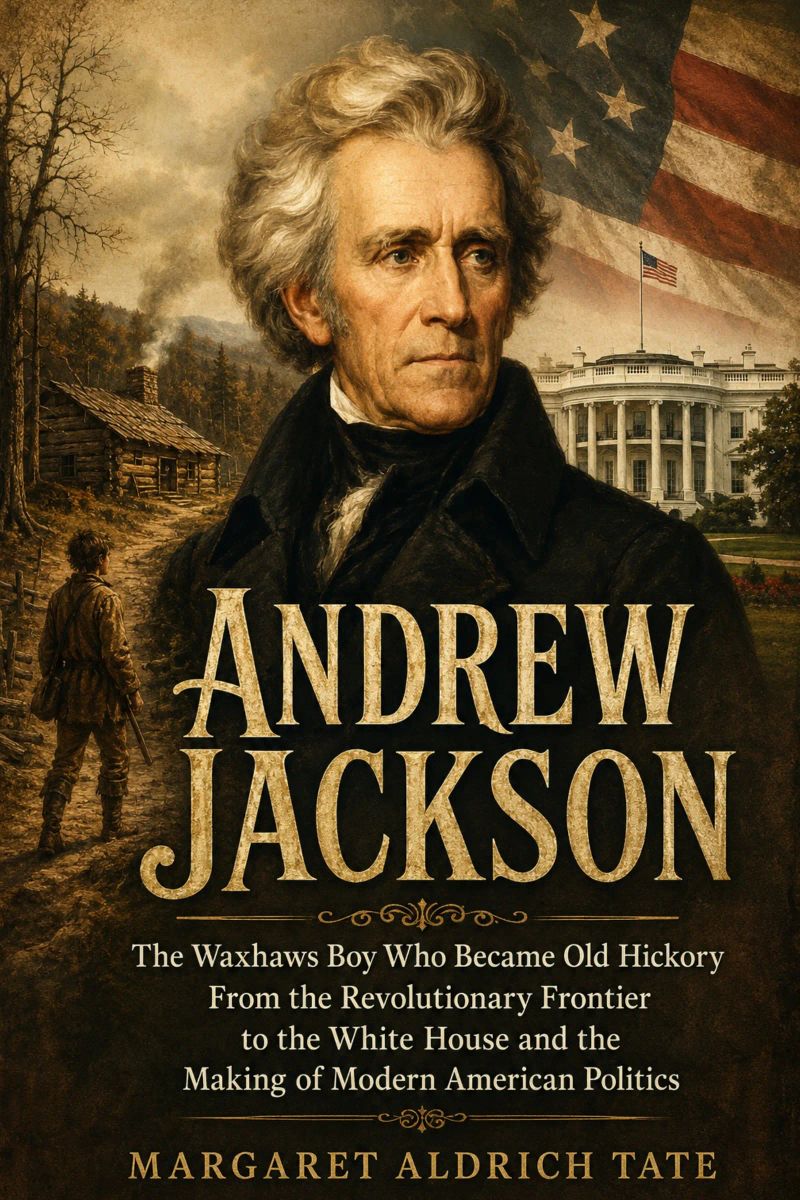
ANDREW JACKSON
The Waxhaws Boy Who Became Old Hickory From the Revolutionary Frontier to the White House and the Making of Modern American PoliticsBy Margaret Aldrich Tate


Length5h 32m
About this audiobook
The definitive Andrew Jackson biography — Old Hickory from the Waxhaws frontier to the White House, the Bank War, Indian Removal, and the making of modern American democracy, 1767-1845.
In April 1781, a British dragoon ordered a thirteen-year-old prisoner to clean his boots. The boy refused. The officer drew his saber and slashed at the boy's head — a scar that healed but never faded. The boy was Andrew Jackson. He carried that wound for sixty-four years, and with it a political identity forged by a Revolution that had killed his mother, both brothers, and very nearly himself.
In this Andrew Jackson biography, historian Margaret Aldrich Tate follows Old Hickory — from the Scots-Irish Waxhaws, through the duels, the Creek War, the Battle of New Orleans, and the brutal 1828 election that killed Rachel Donelson Jackson, to the presidency that transformed American politics. Here are Jackson's battles against Nicholas Biddle's Bank of the United States, John C. Calhoun's nullification challenge, the Cherokee Nation's resistance in Worcester v. Georgia, and the Trail of Tears that resulted when Jackson refused to enforce the Supreme Court's ruling. This is the complete story of the man who built the modern Democratic Party, expanded executive power beyond any predecessor, and left contradictions the republic has not yet resolved.
Inside this Andrew Jackson history:
• The Charles Dickinson duel — Jackson absorbed Dickinson's ball in the chest, stood his ground, and killed his opponent in 1806; the lead lodged near his heart for nineteen years before a surgeon removed it in 1832 (Chapter 6)
• The Battle of New Orleans — January 8, 1815: British General Pakenham's army advancing into Jackson's prepared lines, suffering 2,000 casualties while Jackson lost thirteen men; the victory that made a national hero (Chapter 11)
• The Indian Removal Act and the Trail of Tears — the act passed 102-97, Senator Frelinghuysen argued against it for three days, the Cherokee pursued legal resistance, and Jackson refused to enforce the Supreme Court's ruling; approximately 4,000 Cherokee died on the winter march of 1838-1839 (Chapter 19)
• The Bank War — Jackson's 1832 veto message addressed to the nation, not Congress: a democratic manifesto against "artificial distinctions" that made "the rich richer and the potent more powerful" — and Nicholas Biddle's miscalculation that destroyed the Bank entirely (Chapter 21)
• The Nullification Crisis — Jackson's Proclamation asserting that "the Constitution forms a government, not a league" and that secession was treason: the constitutional argument Lincoln deployed thirty years later at far higher cost (Chapter 20)
Jackson expanded the franchise for white men while presiding over the dispossession of Native nations. He claimed to speak for the common people while owning more than a hundred enslaved Africans at the Hermitage. This Andrew Jackson biography names the suffering his actions caused and the consequences they produced — for the republic he remade and for the people it excluded.
For readers of H.W. Brands's ANDREW JACKSON: HIS LIFE AND TIMES and Jon Meacham's AMERICAN LION.
Audiobook details
GenreBiography and Memoir, History
Length5 hrs 32 mins
Narrated byListen with 1,000+ voices
FormateBook with Audio
Publish dateJun 3, 2026
LanguageEnglish
Table of contents
1Introduction
2Author’s Note
3Prologue: The Wound on the Cheek
4PART ONE: THE WAXHAWS BOY (1767–1788)
5Chapter 1: The Carolina Backcountry — A Family on the Edge
Show all chaptersShow less
6Chapter 2: Revolution and the Boy Soldier
7Chapter 3: The Long Road from Salisbury to Nashville
8PART TWO: TENNESSEE PLANTER (1788–1812)
9Chapter 4: Rachel Donelson and a Marriage Across Two States
10Chapter 5: The Hermitage and the Making of a Slaveholder
11Chapter 6: Law, Land, and the Charles Dickinson Duel
12Chapter 7: The Politics of the Cumberland
13PART THREE: OLD HICKORY (1812–1815)
14Chapter 8: The Natchez March and the Birth of the Nickname
15Chapter 9: The Creek War and Horseshoe Bend
16Chapter 10: Pensacola and the Spanish Question
17Chapter 11: The Battle of New Orleans
18PART FOUR: THE FLORIDA AFFAIR (1815–1821)
19Chapter 12: The First Seminole War
20Chapter 13: The Arbuthnot and Ambrister Trials
21Chapter 14: Governor of the Floridas
22PART FIVE: THE PATH TO POWER (1822–1828)
23Chapter 15: The 1824 Election and the Corrupt Bargain
24Chapter 16: The 1828 Campaign — Rachel's Death and the Bitter Victory
25PART SIX: THE PEOPLE'S PRESIDENT (1829–1833)
26Chapter 17: The Inauguration and the Kitchen Cabinet
27Chapter 18: The Eaton Affair
28Chapter 19: The Indian Removal Act
29Chapter 20: The Nullification Crisis
30PART SEVEN: KING ANDREW (1832–1837)
31Chapter 21: The Bank War
32Chapter 22: The Specie Circular and the Coming Panic
33Chapter 23: Texas and the Question of Slavery's Expansion
34Chapter 24: The Election of 1836 and the Departure
35PART EIGHT: LEGACY
36Chapter 25: The Hermitage Years and the Death of Old Hickory
37Chapter 26: Jackson in American Memory
38Epilogue: The Old Man Under the Magnolia
39Acknowledgments
40Selected Bibliography
41About the Author
More from Margaret Aldrich Tate



How to Test Negative for StupidJohn Kennedy8h 13m4.7 (9.7K)$28 · $0.00

Bad Fat Black GirlSesali Bowen6h 32m4.7 (2.8K)$24 · $0.00

Send MeMarty Skovlund, Joe Kent8h 10m4.7 (1.6K)$26 · $0.00

John Muir: The Story of My Boyhood and Youth & Letters to a Friend (Annotated)John Muir10h 13m4.7 (1.1K)$0.99 · $0.00

Invisible StormJason Kander6h 48m4.7 (3.2K)$24 · $0.00

Forever BoyKate Swenson9h 27m4.7 (5K)$29 · $0.00

You Are Worth ItKyle Carpenter, Don Yaeger8h 53m4.7 (4.8K)$29 · $0.00

The Happiest Man on EarthEddie Jaku3h 48m4.6 (178K)$7 · $0.00

MotherlandJulia Ioffe17h 52m4.7 (2.5K)$40 · $0.00
Evidence Not SeenDarlene Deibler Rose11h 11m4.6 (11.9K)$29 · $0.00

Where Cowards Go to DieBenjamin Sledge8h 42m4.7 (351)$20 · $0.00

Will You Love Me?Cathy Glass9h 5m4.6 (9.3K)$29 · $0.00

Designing Terry Pratchett’s DiscworldPaul Kidby3h 52m4.7 (343)$20 · $0.00

HostageEli Sharabi5h 25m4.6 (10.8K)$24 · $0.00

Finding MeViola Davis9h 15m4.6 (256.4K)$29 · $0.00

The Dangerous Truth about Today’s MarijuanaLaura Stack CSP, MBA9h 57m4.7 (385)$20 · $0.00

Birdie & HarlowTaylor Wolfe7h 50m4.6 (6.5K)$26 · $0.00
The Lives of BrianBrian Johnson9h 45m4.6 (3.5K)$29 · $0.00

I Am The StormJanice Dean9h4.6 (1.5K)$8 · $0.00
Black History CollectionFrederick Douglass, Harriet Ann Jacobs, Booker T. Washington, W.E.B. Du Bois27h 9m4.6 (2.6K)$18 · $0.00

A Brief History of IntelligenceMax S. Bennett12h 18m4.6 (6.6K)$29 · $0.00
The Happiest Man on EarthEddie Jaku3h 48m4.6 (178K)$7 · $0.00
MotherlandJulia Ioffe17h 52m4.7 (2.5K)$40 · $0.00
Where Cowards Go to DieBenjamin Sledge8h 42m4.7 (351)$20 · $0.00
RevolutionariesSanjeev Sanyal11h 23m4.6 (2.6K)$29 · $0.00

We Crossed a Bridge and It TrembledWendy Pearlman6h4.6 (5.2K)$24 · $0.00

Unbroken Bonds of BattleJohnny Joey Jones8h 31m4.6 (2.6K)$8 · $0.00

The Daughter of AuschwitzTova Friedman, Malcolm Brabant7h 54m4.6 (16.7K)$26 · $0.00

Lily's PromiseLily Ebert, Dov Forman8h 54m4.6 (16.1K)$29 · $0.00
On Democracies and Death CultsDouglas Murray10h 38m4.6 (6.5K)$29 · $0.00

Across the RiverKent Babb11h 40m4.6 (927)$29 · $0.00

Balcony Over Jerusalem: A Middle East Memoir - Israel, Palestine and BeyondJohn Lyons12h 37m4.6 (1.4K)$33 · $0.00

BeyondStephen Walker15h 39m4.6 (3.2K)$33 · $0.00
Kings and PawnsHoward Bryant10h 9m4.6 (678)$29 · $0.00

No EscapeNury Turkel9h 30m4.6 (809)$28 · $0.00
Jubal Stone: U.S. Marshal: Blood Trail To Hell: A Western Adventure NovelCasey Nash3h 42m4.6 (3.2K)$18 · $0.00

Fall and RiseMitchell Zuckoff17h 23m4.6 (9.8K)$40 · $0.00
The SurvivorJosef Lewkowicz, Michael Calvin9h 22m4.6 (2.5K)$29 · $0.00

Always FaithfulThomas Schueman, Zainullah Zaki12h 12m4.6 (977)$29 · $0.00

The State of Society in France Before the Revolution of 1789 (Annotated)Alexis de Tocqueville17h 25m4.6 (1.2K)$2 · $0.00
You may also like
Andrew JacksonRobert V. Remini5h 51m4.1 (1.9K)$14

AliJonathan Eig22h 52m4.5 (5.8K)$46 · $0.00
With Malice Toward NoneStephen B. Oates21h 13m4.3 (10.5K)$46 · $0.00
THE CIVIL WAR (Complete Edition)Julius Caesar7h 11m4.2 (8.4K)$2 · $0.00
Abraham LincolnAllen C. Guelzo18h 27m4.2 (1.1K)$28 · $0.00
NapoleonMichael Broers20h 32m4.3 (1.5K)$30
The Civil War: A Narrative, Vol. 2Shelby Foote52h 41m4.6 (11.7K)$30
Life of George Washington (Illustrated)Washington Irving34h 45m4.2 (627)$1.99 · $0.00
Light-Horse Harry LeeRyan Cole11h 28m4.3 (336)$23
The Life of George Washington (Summarized Edition)John Marshall13h 26m4.1 (309)$2

Ashley's WarGayle Tzemach Lemmon10h 1m4.2 (7.4K)$29 · $0.00
The Life of Abraham Lincoln (Annotated)Henry Ketcham9h 46m4.1 (4.8K)$0.99 · $0.00

History of the Expedition to Russia (Annotated)Count Philip de Segur22h 32m4.3 (634)$0.99 · $0.00

All for the UnionElisha Rhodes9h 38m4.3 (1.9K)$2.99 · $0.00
The PrinceNiccolò Machiavelli4h 32m4.1 (423.6K)$12
Napoleon's Russian Campaign of 1812Edward Foord14h 55m4.0 (23)$2 · $0.00
Fighting for Freedom: Memoirs of Black Soldiers in the Civil WarJoseph Warren Keifer, Joseph T. Wilson, Thomas Wentworth Higginson, Frank A. Rollin, Joshua M. Addeman, Susie King Taylor68h 39m4.8 (11)$0.99
Andrew JacksonWilliam Garrott Brown3h 1m3.5 (80)$2 · $0.00
The American Nation: A History, Vol. 15William MacDonald8h 28m$20
The Commentaries of CæsarAnthony Trollope6h 44m3.6 (62)$1 · $0.00